Semi-supervised Multitask Learning for Sequence Labeling
Marek Rei
University of Cambridge
Sequence Labeling
The task:
Given a sequence of tokens, predict a label for every token.
Named Entity Recognition:
PER _ _ _ _ ORG ORG _ TIME _
Jim bought 300 shares of Acme Corp. in 2006 .
POS-tagging:
DT NN VBD NNS IN DT NN .
The pound extended losses against the dollar .
Error Detection:
+ + + - + + + + - +
I like to playing the guitar and sing louder .
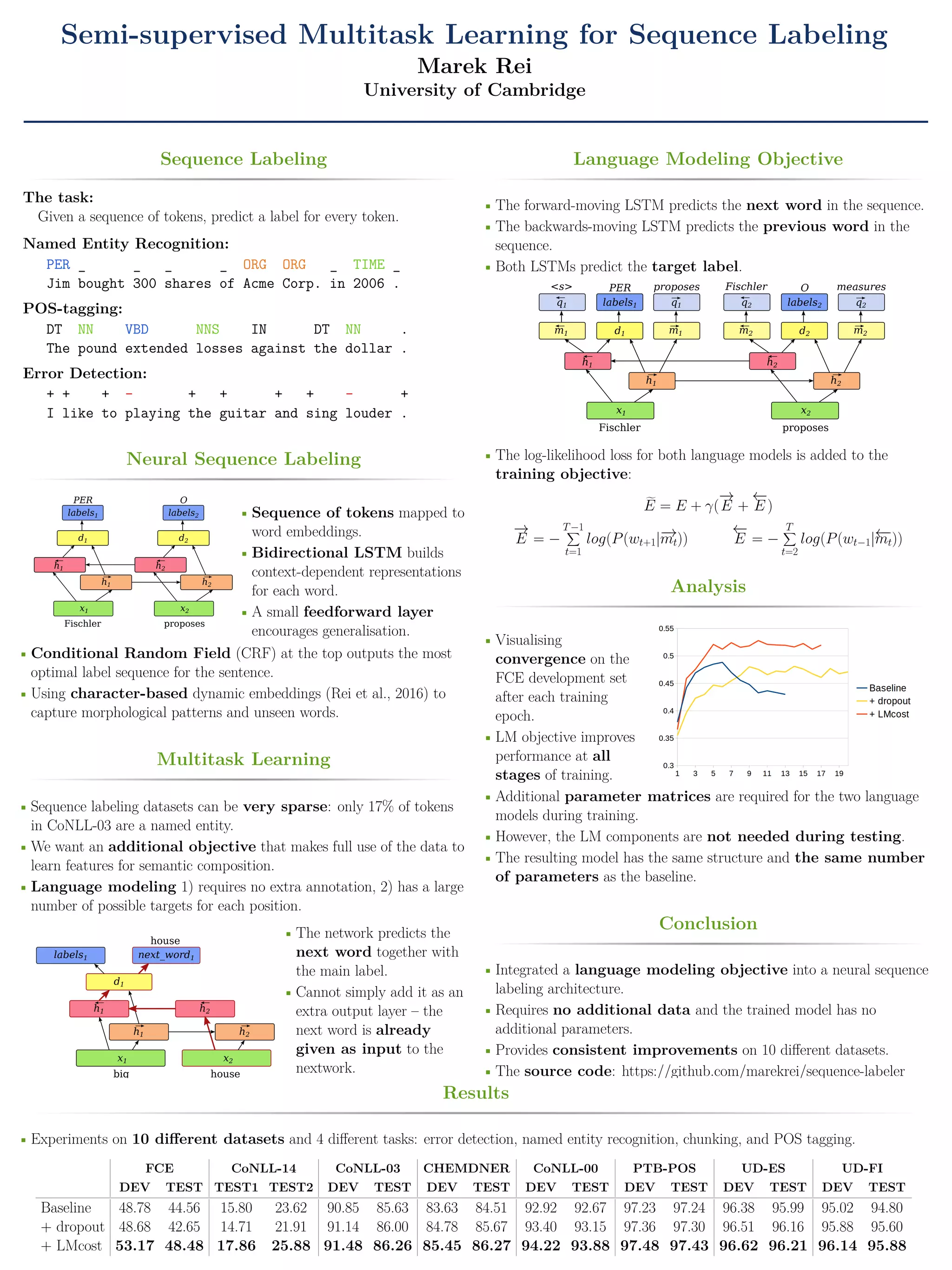
Neural Sequence Labeling
h2
x2
d2
labels2
h2
proposes
O
h1
x1
d1
labels1
h1
Fischler
PER
• Sequence of tokens mapped to
word embeddings.
• Bidirectional LSTM builds
context-dependent representations
for each word.
• A small feedforward layer
encourages generalisation.
• Conditional Random Field (CRF) at the top outputs the most
optimal label sequence for the sentence.
• Using character-based dynamic embeddings (Rei et al., 2016) to
capture morphological patterns and unseen words.
Multitask Learning
• Sequence labeling datasets can be very sparse: only 17% of tokens
in CoNLL-03 are a named entity.
• We want an additional objective that makes full use of the data to
learn features for semantic composition.
• Language modeling 1) requires no extra annotation, 2) has a large
number of possible targets for each position.
h1
x1
d1
labels1
h1
h2
x2
h2
big house
next_word1
house
• The network predicts the
next word together with
the main label.
• Cannot simply add it as an
extra output layer – the
next word is already
given as input to the
nextwork.
Language Modeling Objective
• The forward-moving LSTM predicts the next word in the sequence.
• The backwards-moving LSTM predicts the previous word in the
sequence.
• Both LSTMs predict the target label.
h2
x2
d2
labels2
h2
proposes
m2
q2
m2
q2
OFischler measures
h1
x1
d1
labels1
h1
Fischler
m1
q1
m1
q1
PER<s> proposes
• The log-likelihood loss for both language models is added to the
training objective:
E = E + γ(
−→
E +
←−
E )
−→
E = −
T−1
t=1
log(P(wt+1|−→mt))
←−
E = −
T
t=2
log(P(wt−1|←−mt))
Analysis
• Visualising
convergence on the
FCE development set
after each training
epoch.
• LM objective improves
performance at all
stages of training.
• Additional parameter matrices are required for the two language
models during training.
• However, the LM components are not needed during testing.
• The resulting model has the same structure and the same number
of parameters as the baseline.
Conclusion
• Integrated a language modeling objective into a neural sequence
labeling architecture.
• Requires no additional data and the trained model has no
additional parameters.
• Provides consistent improvements on 10 different datasets.
• The source code: https://github.com/marekrei/sequence-labeler
Results
• Experiments on 10 different datasets and 4 different tasks: error detection, named entity recognition, chunking, and POS tagging.
FCE CoNLL-14 CoNLL-03 CHEMDNER CoNLL-00 PTB-POS UD-ES UD-FI
DEV TEST TEST1 TEST2 DEV TEST DEV TEST DEV TEST DEV TEST DEV TEST DEV TEST
Baseline 48.78 44.56 15.80 23.62 90.85 85.63 83.63 84.51 92.92 92.67 97.23 97.24 96.38 95.99 95.02 94.80
+ dropout 48.68 42.65 14.71 21.91 91.14 86.00 84.78 85.67 93.40 93.15 97.36 97.30 96.51 96.16 95.88 95.60
+ LMcost 53.17 48.48 17.86 25.88 91.48 86.26 85.45 86.27 94.22 93.88 97.48 97.43 96.62 96.21 96.14 95.88

Marek Rei - 2017 - Semi-supervised Multitask Learning for Sequence Labeling

  • 1.
    Semi-supervised Multitask Learningfor Sequence Labeling Marek Rei University of Cambridge Sequence Labeling The task: Given a sequence of tokens, predict a label for every token. Named Entity Recognition: PER _ _ _ _ ORG ORG _ TIME _ Jim bought 300 shares of Acme Corp. in 2006 . POS-tagging: DT NN VBD NNS IN DT NN . The pound extended losses against the dollar . Error Detection: + + + - + + + + - + I like to playing the guitar and sing louder . Neural Sequence Labeling h2 x2 d2 labels2 h2 proposes O h1 x1 d1 labels1 h1 Fischler PER • Sequence of tokens mapped to word embeddings. • Bidirectional LSTM builds context-dependent representations for each word. • A small feedforward layer encourages generalisation. • Conditional Random Field (CRF) at the top outputs the most optimal label sequence for the sentence. • Using character-based dynamic embeddings (Rei et al., 2016) to capture morphological patterns and unseen words. Multitask Learning • Sequence labeling datasets can be very sparse: only 17% of tokens in CoNLL-03 are a named entity. • We want an additional objective that makes full use of the data to learn features for semantic composition. • Language modeling 1) requires no extra annotation, 2) has a large number of possible targets for each position. h1 x1 d1 labels1 h1 h2 x2 h2 big house next_word1 house • The network predicts the next word together with the main label. • Cannot simply add it as an extra output layer – the next word is already given as input to the nextwork. Language Modeling Objective • The forward-moving LSTM predicts the next word in the sequence. • The backwards-moving LSTM predicts the previous word in the sequence. • Both LSTMs predict the target label. h2 x2 d2 labels2 h2 proposes m2 q2 m2 q2 OFischler measures h1 x1 d1 labels1 h1 Fischler m1 q1 m1 q1 PER<s> proposes • The log-likelihood loss for both language models is added to the training objective: E = E + γ( −→ E + ←− E ) −→ E = − T−1 t=1 log(P(wt+1|−→mt)) ←− E = − T t=2 log(P(wt−1|←−mt)) Analysis • Visualising convergence on the FCE development set after each training epoch. • LM objective improves performance at all stages of training. • Additional parameter matrices are required for the two language models during training. • However, the LM components are not needed during testing. • The resulting model has the same structure and the same number of parameters as the baseline. Conclusion • Integrated a language modeling objective into a neural sequence labeling architecture. • Requires no additional data and the trained model has no additional parameters. • Provides consistent improvements on 10 different datasets. • The source code: https://github.com/marekrei/sequence-labeler Results • Experiments on 10 different datasets and 4 different tasks: error detection, named entity recognition, chunking, and POS tagging. FCE CoNLL-14 CoNLL-03 CHEMDNER CoNLL-00 PTB-POS UD-ES UD-FI DEV TEST TEST1 TEST2 DEV TEST DEV TEST DEV TEST DEV TEST DEV TEST DEV TEST Baseline 48.78 44.56 15.80 23.62 90.85 85.63 83.63 84.51 92.92 92.67 97.23 97.24 96.38 95.99 95.02 94.80 + dropout 48.68 42.65 14.71 21.91 91.14 86.00 84.78 85.67 93.40 93.15 97.36 97.30 96.51 96.16 95.88 95.60 + LMcost 53.17 48.48 17.86 25.88 91.48 86.26 85.45 86.27 94.22 93.88 97.48 97.43 96.62 96.21 96.14 95.88