MARBURY V. MADISON (1803)
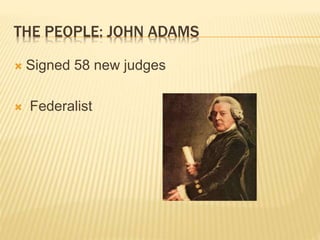
THE PEOPLE: JOHN ADAMS
 Signed 58 new judges
 Federalist
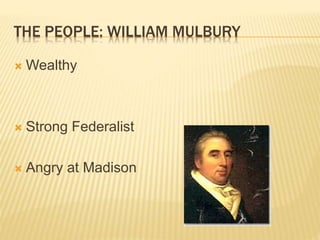
THE PEOPLE: WILLIAM MULBURY
 Wealthy
 Strong Federalist
 Angry at Madison
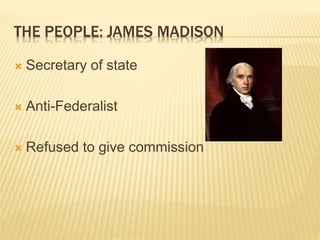
THE PEOPLE: JAMES MADISON
 Secretary of state
 Anti-Federalist
 Refused to give commission
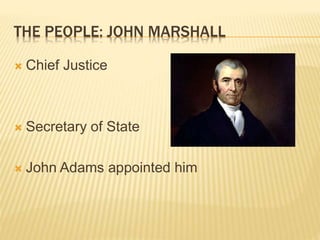
THE PEOPLE: JOHN MARSHALL
 Chief Justice
 Secretary of State
 John Adams appointed him
THE SIDES
 Federalists- strong government
 Anti- Federalists- limited government
THE JUSTICES
 58 Peace justices made in last 15 days
 42 Judges accepted
 Federalists attempt branch take over
MANDAMUS
 Court order saying an official should
perform/not perform a duty.
 Marbury thought Madison was wrong
POINTS TO CONSIDER
 Does Marbury have right to commission?
 Can Congress expand power of Supreme
Court?
THE DECISION
 Marshall said that not paying commission
was unconstitutional.
 Judiciary Act of 1789
THE DECISION
 Section 13 of 1789 Judiciary Act
unconstitutional
 Congress’ law is void
WHY?
 Marshall wanted the supreme court to have
more power.
 He wanted to avoid a confrontation with the
anti-federalists
THE IMPACT
 let the supreme court decide whether
something was constitutional or not. (judicial
review)
 Gave the court more power than before.
UNCONSTITUTIONAL CASES
 Tinker v. Des Moines
 Brown v. Board of Education

Marbury v madison