Tinker vs. Des Moines School DistrictBy Samuel Liggett and Jack Groskreutz
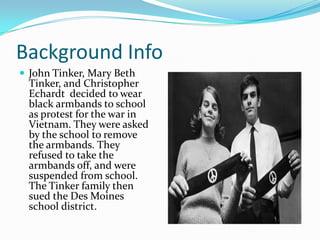
Background InfoJohn Tinker, Mary Beth Tinker, and Christopher Echardt  decided to wear black armbands to school as protest for the war in Vietnam. They were asked by the school to remove the armbands. They refused to take the armbands off, and were suspended from school. The Tinker family then sued the Des Moines school district.
Constitutional IssuesViolates the 1st Amendment (freedom of speech)Issue about whether or not the 1st Amendment is still allowed in school.
Decision The Supreme Court voted 7-2, in favor of the Tinkers.Justice Stewart’s concurring opinion states that while he agrees with much of what is said, and that he agrees with the decision, he believes children’s first amendment rights are not the same as an adult’s rights.Justice Harlan’s dissenting opinion states that “school officials should be accorded the widest authority in maintaining discipline and good order in their institutions.”
Jack and Liggett’s opinion on the lasting impact of this case.It sets the model for most cases involving a dress code (not including uniforms)After this case, Courts are most likely to be in favor of the people who feel that their rights have been restricted.
What is the cartoon saying about the dress code?Do you agree with the artist’s message?
Sourceshttp://www.oyez.org/cases/1960-1969/1968/1968_21http://www.law.cornell.edu/supct/html/historics/USSC_CR_0393_0503_ZD1.html

Tinker Vs. Des Moines

  • 1.
    Tinker vs. DesMoines School DistrictBy Samuel Liggett and Jack Groskreutz
  • 2.
    Background InfoJohn Tinker,Mary Beth Tinker, and Christopher Echardt decided to wear black armbands to school as protest for the war in Vietnam. They were asked by the school to remove the armbands. They refused to take the armbands off, and were suspended from school. The Tinker family then sued the Des Moines school district.
  • 3.
    Constitutional IssuesViolates the1st Amendment (freedom of speech)Issue about whether or not the 1st Amendment is still allowed in school.
  • 4.
    Decision The SupremeCourt voted 7-2, in favor of the Tinkers.Justice Stewart’s concurring opinion states that while he agrees with much of what is said, and that he agrees with the decision, he believes children’s first amendment rights are not the same as an adult’s rights.Justice Harlan’s dissenting opinion states that “school officials should be accorded the widest authority in maintaining discipline and good order in their institutions.”
  • 5.
    Jack and Liggett’sopinion on the lasting impact of this case.It sets the model for most cases involving a dress code (not including uniforms)After this case, Courts are most likely to be in favor of the people who feel that their rights have been restricted.
  • 6.
    What is thecartoon saying about the dress code?Do you agree with the artist’s message?
  • 7.