Marbury vs. Madison
1803
Key Characters
 John Adams: President leaving office (2nd)
 Thomas Jefferson: Newly elected President (3rd)
 William Marbury: Appointed Justice of Peace by Adams
 John Marshall: Chief Justice of the Supreme Court
 James Madison: Secretary of State
Key Terminology
 Writ of mandamus: an edict commanding a government
official to preform a particular action
 Judicial review: doctrine under
which legislative and executive actions are subject to review
by a specific court, this court has the power to annul the acts
of the state when it finds them incompatible with a higher
authority
Background
 The situation
 John Adams (President at the time) lost the presidential election
to Thomas Jefferson
 During last days of his Presidency Adams appointed William Marbury
as the justice of the peace and others to positions in government

 Judiciary Act of 1798
 Established new courts, gave president the power to appoint Federal judges
and justices of peace
 Gave the Supreme the right to issue writs of mandamus

 Commissions for the appointed positions did not go through
before Adams left office

 Question: If you were Thomas Jefferson would you recognize
Adams appointees?
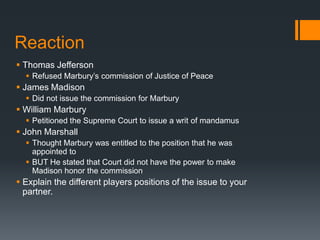
Reaction
 Thomas Jefferson
 Refused Marbury’s commission of Justice of Peace

 James Madison
 Did not issue the commission for Marbury

 William Marbury
 Petitioned the Supreme Court to issue a writ of mandamus

 John Marshall
 Thought Marbury was entitled to the position that he was
appointed to
 BUT He stated that Court did not have the power to make
Madison honor the commission

 Explain the different players positions of the issue to your
partner.
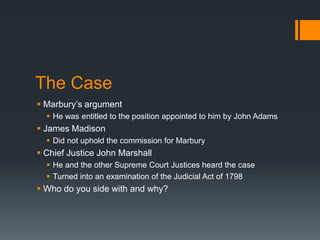
The Case
 Marbury’s argument
 He was entitled to the position appointed to him by John Adams

 James Madison
 Did not uphold the commission for Marbury

 Chief Justice John Marshall
 He and the other Supreme Court Justices heard the case
 Turned into an examination of the Judicial Act of 1798

 Who do you side with and why?
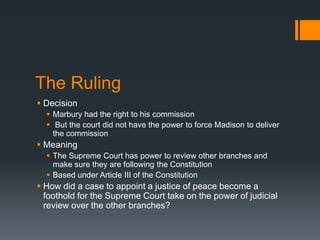
The Ruling
 Decision
 Marbury had the right to his commission
 But the court did not have the power to force Madison to deliver
the commission

 Meaning
 The Supreme Court has power to review other branches and
make sure they are following the Constitution
 Based under Article III of the Constitution

 How did a case to appoint a justice of peace become a
foothold for the Supreme Court take on the power of judicial
review over the other branches?

Marbury v madison

  • 1.
  • 2.
    Key Characters  JohnAdams: President leaving office (2nd)  Thomas Jefferson: Newly elected President (3rd)  William Marbury: Appointed Justice of Peace by Adams  John Marshall: Chief Justice of the Supreme Court  James Madison: Secretary of State
  • 3.
    Key Terminology  Writof mandamus: an edict commanding a government official to preform a particular action  Judicial review: doctrine under which legislative and executive actions are subject to review by a specific court, this court has the power to annul the acts of the state when it finds them incompatible with a higher authority
  • 4.
    Background  The situation John Adams (President at the time) lost the presidential election to Thomas Jefferson  During last days of his Presidency Adams appointed William Marbury as the justice of the peace and others to positions in government  Judiciary Act of 1798  Established new courts, gave president the power to appoint Federal judges and justices of peace  Gave the Supreme the right to issue writs of mandamus  Commissions for the appointed positions did not go through before Adams left office  Question: If you were Thomas Jefferson would you recognize Adams appointees?
  • 5.
    Reaction  Thomas Jefferson Refused Marbury’s commission of Justice of Peace  James Madison  Did not issue the commission for Marbury  William Marbury  Petitioned the Supreme Court to issue a writ of mandamus  John Marshall  Thought Marbury was entitled to the position that he was appointed to  BUT He stated that Court did not have the power to make Madison honor the commission  Explain the different players positions of the issue to your partner.
  • 6.
    The Case  Marbury’sargument  He was entitled to the position appointed to him by John Adams  James Madison  Did not uphold the commission for Marbury  Chief Justice John Marshall  He and the other Supreme Court Justices heard the case  Turned into an examination of the Judicial Act of 1798  Who do you side with and why?
  • 7.
    The Ruling  Decision Marbury had the right to his commission  But the court did not have the power to force Madison to deliver the commission  Meaning  The Supreme Court has power to review other branches and make sure they are following the Constitution  Based under Article III of the Constitution  How did a case to appoint a justice of peace become a foothold for the Supreme Court take on the power of judicial review over the other branches?