is a term used to
describe art that is made
or presented using
digital technology.
is a term used to
describe art that is made
or presented using
digital technology.
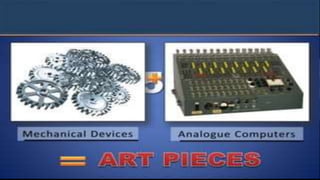
During
artists use mechanical devices and
analogue computers to create their art pieces.
In
Ben Laposky used an oscilloscope to
manipulate electronic waves from a fluorescent.
In
Ben Laposky used an oscilloscope to
manipulate electronic waves from a fluorescent.
In Early
And
most of the first digital artists has a background in computer science or
math. Moving forward, other artists started teaching themselves how to
program rather than relying on computer programs.
Digital age started growing in the
computers were affordable and easily available to most. The
evolution of digital art started.
In
digital art was being used on a day-to-day basis by artists. They
used software tools such as Photoshop which took digital art to a
different level.
Art has clearly evolved and come a long
way from mechanical devices and
analogue computers. It is a lot easier to be
an artist or learn the skills. YouTube
tutorials, art classes, digital art software’s
etc. make it something everyone
passionate about it can try.
Photoshop
Illustrator
3ds Max
Flash Professional
And many more
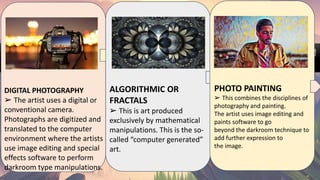
DIGITAL PHOTOGRAPHY
➢ The artist uses a digital or
conventional camera.
Photographs are digitized and
translated to the computer
environment where the artists
use image editing and special
effects software to perform
darkroom type manipulations.
ALGORITHMIC OR
FRACTALS
➢ This is art produced
exclusively by mathematical
manipulations. This is the so-
called “computer generated”
art.
PHOTO PAINTING
➢ This combines the disciplines of
photography and painting.
The artist uses image editing and
paints software to go
beyond the darkroom technique to
add further expression to
the image.
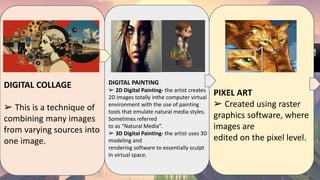
DIGITAL COLLAGE
➢ This is a technique of
combining many images
from varying sources into
one image.
DIGITAL PAINTING
➢ 2D Digital Painting- the artist creates
2D images totally inthe computer virtual
environment with the use of painting
tools that emulate natural media styles.
Sometimes referred
to as “Natural Media”.
➢ 3D Digital Painting- the artist uses 3D
modeling and
rendering software to essentially sculpt
in virtual space.
PIXEL ART
➢ Created using raster
graphics software, where
images are
edited on the pixel level.
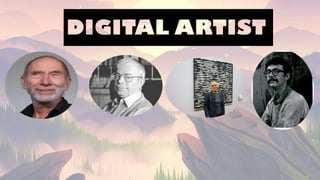
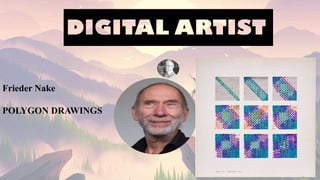
Frieder Nake. Born on Dec. 16, 1938, is a
mathematician, computer scientist, and pioneer
of computer art. He is best known internationally
for his contributions to the earliest
manifestations of computer art, a field of
computing that made its first public appearances
with three small exhibitions in 1965.
Frieder Nake
POLYGON DRAWINGS
George Nees (June 23, 1926-January 03, 2016)
was a German academic who was a pioneer of
computer art and generative graphics. He studied
mathematics, physics and philosophy in Erlangen
and Stuttgart and was scientific advisor at the
SEMIOSIS, International Journal of semiotics and
aesthetics.
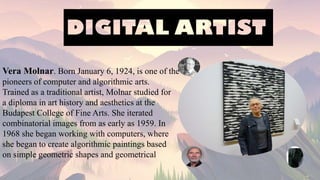
Vera Molnar. Born January 6, 1924, is one of the
pioneers of computer and algorithmic arts.
Trained as a traditional artist, Molnar studied for
a diploma in art history and aesthetics at the
Budapest College of Fine Arts. She iterated
combinatorial images from as early as 1959. In
1968 she began working with computers, where
she began to create algorithmic paintings based
on simple geometric shapes and geometrical
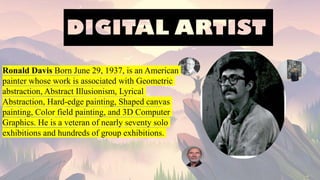
Ronald Davis Born June 29, 1937, is an American
painter whose work is associated with Geometric
abstraction, Abstract Illusionism, Lyrical
Abstraction, Hard-edge painting, Shaped canvas
painting, Color field painting, and 3D Computer
Graphics. He is a veteran of nearly seventy solo
exhibitions and hundreds of group exhibitions.
The impact of digital technology has transformed activities
such as painting, drawing, sculpture, and music/sound art,
while new forms, such as net art, digital installation art, and
virtual reality, have become recognized artistic practices.
More generally the term digital artist is used to describe an
artist who makes use of digital technologies in the
production of art. In an expanded sense, “digital art” is a
term applied to contemporary art that uses the methods of
mass production or digital media.

MAPEH10 2nd Quarter Art Module 1

  • 1.
    is a termused to describe art that is made or presented using digital technology.
  • 2.
    is a termused to describe art that is made or presented using digital technology.
  • 3.
    During artists use mechanicaldevices and analogue computers to create their art pieces.
  • 4.
    In Ben Laposky usedan oscilloscope to manipulate electronic waves from a fluorescent.
  • 5.
    In Ben Laposky usedan oscilloscope to manipulate electronic waves from a fluorescent.
  • 6.
  • 7.
    most of thefirst digital artists has a background in computer science or math. Moving forward, other artists started teaching themselves how to program rather than relying on computer programs.
  • 8.
    Digital age startedgrowing in the computers were affordable and easily available to most. The evolution of digital art started.
  • 9.
    In digital art wasbeing used on a day-to-day basis by artists. They used software tools such as Photoshop which took digital art to a different level.
  • 10.
    Art has clearlyevolved and come a long way from mechanical devices and analogue computers. It is a lot easier to be an artist or learn the skills. YouTube tutorials, art classes, digital art software’s etc. make it something everyone passionate about it can try.
  • 12.
  • 14.
    DIGITAL PHOTOGRAPHY ➢ Theartist uses a digital or conventional camera. Photographs are digitized and translated to the computer environment where the artists use image editing and special effects software to perform darkroom type manipulations. ALGORITHMIC OR FRACTALS ➢ This is art produced exclusively by mathematical manipulations. This is the so- called “computer generated” art. PHOTO PAINTING ➢ This combines the disciplines of photography and painting. The artist uses image editing and paints software to go beyond the darkroom technique to add further expression to the image.
  • 15.
    DIGITAL COLLAGE ➢ Thisis a technique of combining many images from varying sources into one image. DIGITAL PAINTING ➢ 2D Digital Painting- the artist creates 2D images totally inthe computer virtual environment with the use of painting tools that emulate natural media styles. Sometimes referred to as “Natural Media”. ➢ 3D Digital Painting- the artist uses 3D modeling and rendering software to essentially sculpt in virtual space. PIXEL ART ➢ Created using raster graphics software, where images are edited on the pixel level.
  • 17.
    Frieder Nake. Bornon Dec. 16, 1938, is a mathematician, computer scientist, and pioneer of computer art. He is best known internationally for his contributions to the earliest manifestations of computer art, a field of computing that made its first public appearances with three small exhibitions in 1965.
  • 18.
  • 19.
    George Nees (June23, 1926-January 03, 2016) was a German academic who was a pioneer of computer art and generative graphics. He studied mathematics, physics and philosophy in Erlangen and Stuttgart and was scientific advisor at the SEMIOSIS, International Journal of semiotics and aesthetics.
  • 20.
    Vera Molnar. BornJanuary 6, 1924, is one of the pioneers of computer and algorithmic arts. Trained as a traditional artist, Molnar studied for a diploma in art history and aesthetics at the Budapest College of Fine Arts. She iterated combinatorial images from as early as 1959. In 1968 she began working with computers, where she began to create algorithmic paintings based on simple geometric shapes and geometrical
  • 21.
    Ronald Davis BornJune 29, 1937, is an American painter whose work is associated with Geometric abstraction, Abstract Illusionism, Lyrical Abstraction, Hard-edge painting, Shaped canvas painting, Color field painting, and 3D Computer Graphics. He is a veteran of nearly seventy solo exhibitions and hundreds of group exhibitions.
  • 22.
    The impact ofdigital technology has transformed activities such as painting, drawing, sculpture, and music/sound art, while new forms, such as net art, digital installation art, and virtual reality, have become recognized artistic practices. More generally the term digital artist is used to describe an artist who makes use of digital technologies in the production of art. In an expanded sense, “digital art” is a term applied to contemporary art that uses the methods of mass production or digital media.