1950
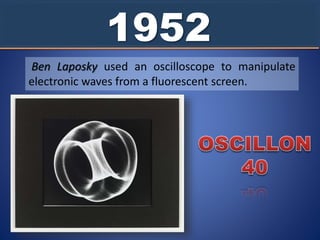
1952
Ben Laposky used an oscilloscope to manipulate
electronic waves from a fluorescent screen.
1960
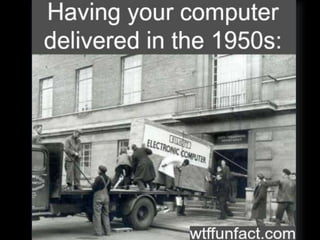
Computers were very expensive in the 1960’s.
Only research laboratories, universities and
large corporations could afford them.
Regardless of these constraints, when the
computer came into existence that’s when
digital art started emerging.
1970
1970’s, other than artists with mathematic
and scientific backgrounds joined the scene.
They begun to teach themselves to program
rather than simply relying on computer
programmers.
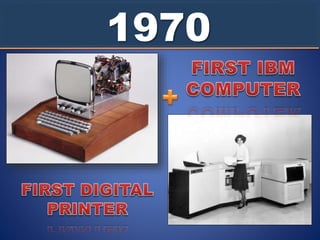
1970
1970
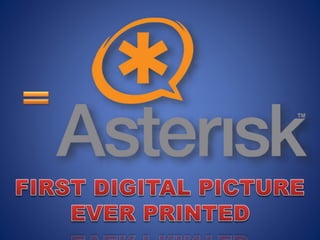
Various names have been used to describe
the process :
1980
The growth of the digital age started in the
1980’s. Computers were affordable and easily
available to most.
This is most commonly achieved by the use
of layering techniques in image editing and
paint software.
PRESENT…
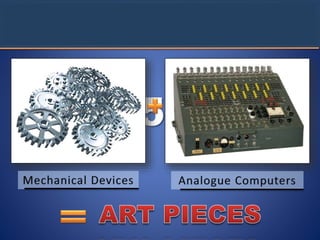
Art has clearly evolved and come a long way
from mechanical devices and analogue
computers. It is a lot easier to be an artist or
learn the skills.
It only gets better and easier from here on!
DIGITAL ART
“Digital art is using new technologies for the digital,
computer-based composition, display, and reproduction of
images and sounds” – Katherine Thomson-Jones, Professor
“Digital art is a general term for a range of artistic works
and practices that use digital technology as an essential
part of the creative and/or presentation process”
– Christiane Paul, Curator
“Digital art is anything involving computers and art such as
using a computer to create art or digitized art displays”
– EB Boyd, Writer
DIGITAL ART
It is an overarching term
that refers to all mechanized
or computer-based art i.e.,
art generated with the aid
of digital technology.
DIGITAL ART
Any form of artwork that is
produced or manipulated
through digital medium
(Softwares, graphics and
renderers)
DIGITAL ART
Complex Interactions:
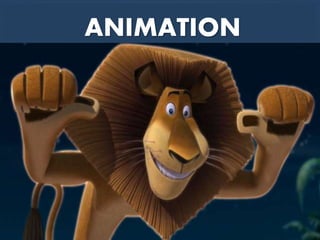
ANIMATION
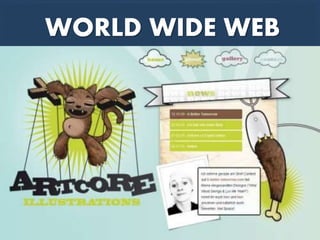
WORLD WIDE WEB
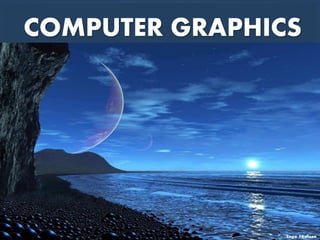
COMPUTER GRAPHICS
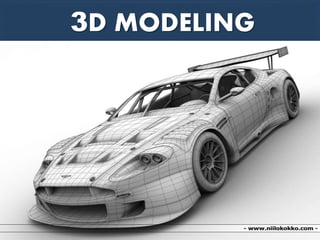
3D MODELING
PHOTOGRAPHY
ARCHITECTURE
ARCHITECTURE
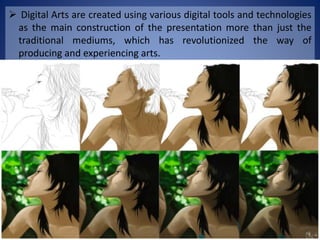
 Digital Arts are created using various digital tools and technologies
as the main construction of the presentation more than just the
traditional mediums, which has revolutionized the way of
producing and experiencing arts.
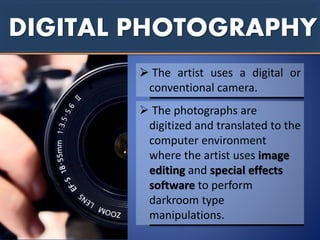
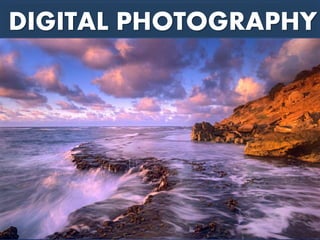
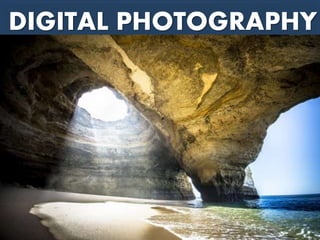
DIGITAL PHOTOGRAPHY
 The artist uses a digital or
conventional camera.
 The photographs are
digitized and translated to the
computer environment
where the artist uses image
editing and special effects
software to perform
darkroom type
manipulations.
DIGITAL PHOTOGRAPHY
DIGITAL PHOTOGRAPHY
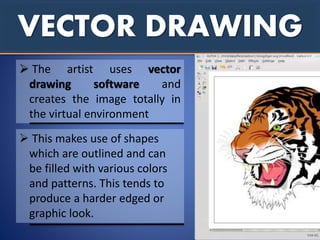
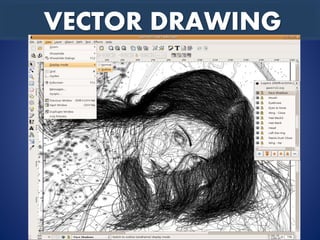
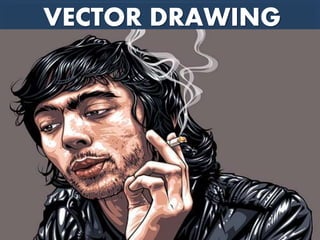
VECTOR DRAWING
 This makes use of shapes
which are outlined and can
be filled with various colors
and patterns. This tends to
produce a harder edged or
graphic look.
 The artist uses vector
drawing software and
creates the image totally in
the virtual environment
VECTOR DRAWING
VECTOR DRAWING
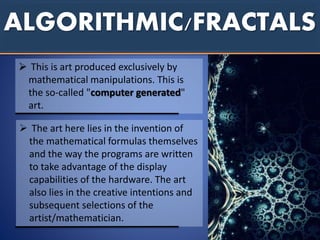
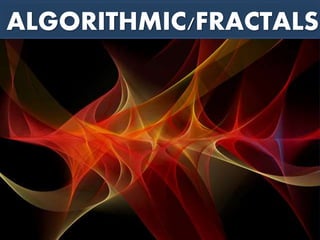
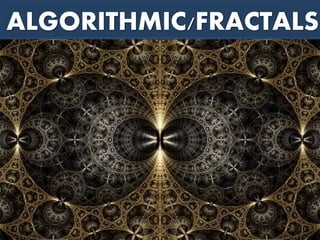
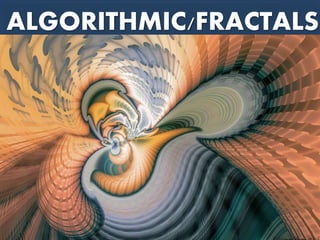
ALGORITHMIC/FRACTALS
 The art here lies in the invention of
the mathematical formulas themselves
and the way the programs are written
to take advantage of the display
capabilities of the hardware. The art
also lies in the creative intentions and
subsequent selections of the
artist/mathematician.
 This is art produced exclusively by
mathematical manipulations. This is
the so-called "computer generated"
art.
ALGORITHMIC/FRACTALS
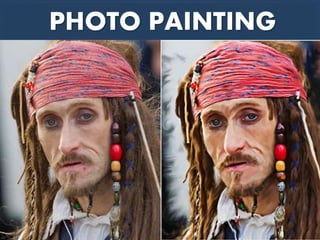
PHOTO PAINTING
 This combines the disciplines of photography and
painting .
 The artist uses image editing and paint software
to go beyond dark room technique to add further
expression to the image.
PHOTO PAINTING
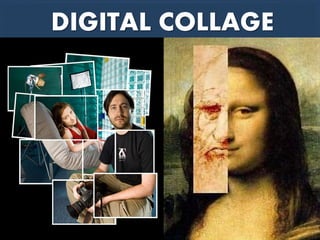
DIGITAL COLLAGE
 This is a technique of combining many images
from varying sources into one image.
This is most commonly achieved by the use of
layering techniques in image editing and paint
software.
DIGITAL COLLAGE
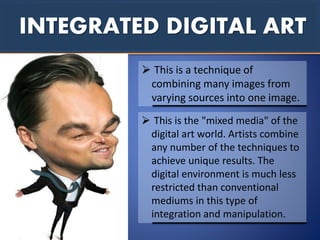
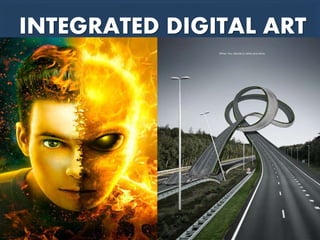
INTEGRATED DIGITAL ART
 This is a technique of
combining many images from
varying sources into one image.
 This is the "mixed media" of the
digital art world. Artists combine
any number of the techniques to
achieve unique results. The
digital environment is much less
restricted than conventional
mediums in this type of
integration and manipulation.
INTEGRATED DIGITAL ART
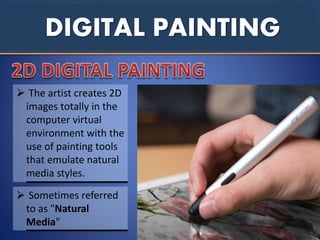
DIGITAL PAINTING
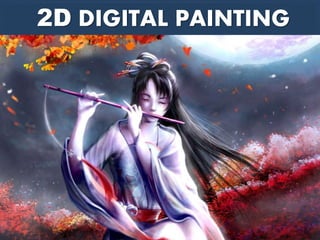
 The artist creates 2D
images totally in the
computer virtual
environment with the
use of painting tools
that emulate natural
media styles.
 Sometimes referred
to as "Natural
Media"
2D DIGITAL PAINTING
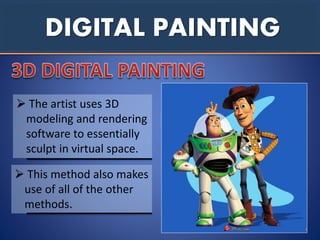
DIGITAL PAINTING
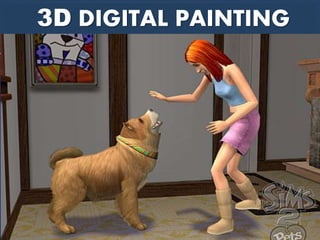
 The artist uses 3D
modeling and rendering
software to essentially
sculpt in virtual space.
 This method also makes
use of all of the other
methods.
3D DIGITAL PAINTING
3D MODELING
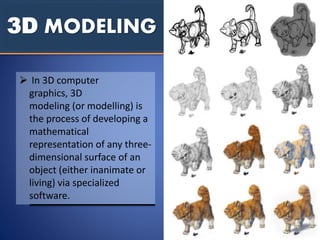
 In 3D computer
graphics, 3D
modeling (or modelling) is
the process of developing a
mathematical
representation of any three-
dimensional surface of an
object (either inanimate or
living) via specialized
software.
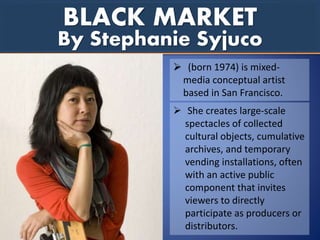
BLACK MARKET
 (born 1974) is mixed-
media conceptual artist
based in San Francisco.
 She creates large-scale
spectacles of collected
cultural objects, cumulative
archives, and temporary
vending installations, often
with an active public
component that invites
viewers to directly
participate as producers or
distributors.
By Stephanie Syjuco
BLACK MARKET
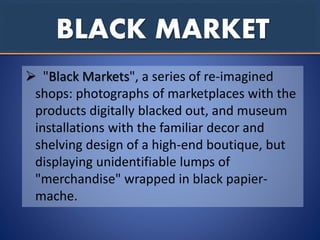
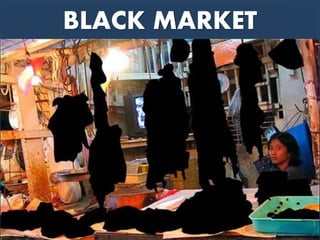
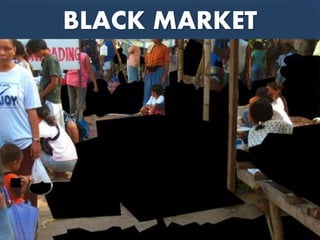
 "Black Markets", a series of re-imagined
shops: photographs of marketplaces with the
products digitally blacked out, and museum
installations with the familiar decor and
shelving design of a high-end boutique, but
displaying unidentifiable lumps of
"merchandise" wrapped in black papier-
mache.
BLACK MARKET
BLACK MARKET
BLACK MARKET
 Showed how shapes, even when blotted out
in black, can still be the main figure in an
image.
BLACK MARKET

Digital Art

  • 2.
  • 4.
    1952 Ben Laposky usedan oscilloscope to manipulate electronic waves from a fluorescent screen.
  • 5.
    1960 Computers were veryexpensive in the 1960’s. Only research laboratories, universities and large corporations could afford them. Regardless of these constraints, when the computer came into existence that’s when digital art started emerging.
  • 6.
    1970 1970’s, other thanartists with mathematic and scientific backgrounds joined the scene. They begun to teach themselves to program rather than simply relying on computer programmers.
  • 7.
  • 9.
    1970 Various names havebeen used to describe the process :
  • 10.
    1980 The growth ofthe digital age started in the 1980’s. Computers were affordable and easily available to most. This is most commonly achieved by the use of layering techniques in image editing and paint software.
  • 11.
    PRESENT… Art has clearlyevolved and come a long way from mechanical devices and analogue computers. It is a lot easier to be an artist or learn the skills. It only gets better and easier from here on!
  • 13.
    DIGITAL ART “Digital artis using new technologies for the digital, computer-based composition, display, and reproduction of images and sounds” – Katherine Thomson-Jones, Professor “Digital art is a general term for a range of artistic works and practices that use digital technology as an essential part of the creative and/or presentation process” – Christiane Paul, Curator “Digital art is anything involving computers and art such as using a computer to create art or digitized art displays” – EB Boyd, Writer
  • 14.
    DIGITAL ART It isan overarching term that refers to all mechanized or computer-based art i.e., art generated with the aid of digital technology.
  • 15.
    DIGITAL ART Any formof artwork that is produced or manipulated through digital medium (Softwares, graphics and renderers)
  • 16.
  • 17.
  • 18.
  • 19.
  • 20.
  • 21.
  • 22.
  • 23.
  • 26.
     Digital Artsare created using various digital tools and technologies as the main construction of the presentation more than just the traditional mediums, which has revolutionized the way of producing and experiencing arts.
  • 28.
    DIGITAL PHOTOGRAPHY  Theartist uses a digital or conventional camera.  The photographs are digitized and translated to the computer environment where the artist uses image editing and special effects software to perform darkroom type manipulations.
  • 29.
  • 30.
  • 31.
    VECTOR DRAWING  Thismakes use of shapes which are outlined and can be filled with various colors and patterns. This tends to produce a harder edged or graphic look.  The artist uses vector drawing software and creates the image totally in the virtual environment
  • 32.
  • 33.
  • 34.
    ALGORITHMIC/FRACTALS  The arthere lies in the invention of the mathematical formulas themselves and the way the programs are written to take advantage of the display capabilities of the hardware. The art also lies in the creative intentions and subsequent selections of the artist/mathematician.  This is art produced exclusively by mathematical manipulations. This is the so-called "computer generated" art.
  • 35.
  • 36.
  • 37.
  • 38.
    PHOTO PAINTING  Thiscombines the disciplines of photography and painting .  The artist uses image editing and paint software to go beyond dark room technique to add further expression to the image.
  • 39.
  • 40.
    DIGITAL COLLAGE  Thisis a technique of combining many images from varying sources into one image. This is most commonly achieved by the use of layering techniques in image editing and paint software.
  • 41.
  • 42.
    INTEGRATED DIGITAL ART This is a technique of combining many images from varying sources into one image.  This is the "mixed media" of the digital art world. Artists combine any number of the techniques to achieve unique results. The digital environment is much less restricted than conventional mediums in this type of integration and manipulation.
  • 43.
  • 44.
    DIGITAL PAINTING  Theartist creates 2D images totally in the computer virtual environment with the use of painting tools that emulate natural media styles.  Sometimes referred to as "Natural Media"
  • 45.
  • 46.
    DIGITAL PAINTING  Theartist uses 3D modeling and rendering software to essentially sculpt in virtual space.  This method also makes use of all of the other methods.
  • 47.
  • 48.
    3D MODELING  In3D computer graphics, 3D modeling (or modelling) is the process of developing a mathematical representation of any three- dimensional surface of an object (either inanimate or living) via specialized software.
  • 50.
    BLACK MARKET  (born1974) is mixed- media conceptual artist based in San Francisco.  She creates large-scale spectacles of collected cultural objects, cumulative archives, and temporary vending installations, often with an active public component that invites viewers to directly participate as producers or distributors. By Stephanie Syjuco
  • 51.
    BLACK MARKET  "BlackMarkets", a series of re-imagined shops: photographs of marketplaces with the products digitally blacked out, and museum installations with the familiar decor and shelving design of a high-end boutique, but displaying unidentifiable lumps of "merchandise" wrapped in black papier- mache.
  • 52.
  • 53.
  • 54.
    BLACK MARKET  Showedhow shapes, even when blotted out in black, can still be the main figure in an image.
  • 55.