EMERGING ISSUES AND CONSIDERATIONS IN MANUFACTURING QUALITY CONTROL AND ASSURANCE OF DRUG PRODUCTS Yi Tsong, Ph.D., Acting Deputy Director Quantitative Methods and Research Staff  OB, OPaSS, CDER, FDA This presentation does not necessarily represent  the official position of FDA
Three Dimensions of the Critical Path Assessment of Safety – how to predict if a potential product will be harmful? Proof of Efficacy  -- how to determine if a potential product will have medical benefit? Industrialization – how to manufacture a product at commercial scale with consistently high quality?
Working in Three Dimensions on the Critical Path
Statistical Chemical Manufacturing Control and Assurance Programs Shelf  Life Determination  & Stability Acceptance  Tests of  Finished  Product PAT (Process  Analytical  Technology) In Vitro  Equivalence  Tests
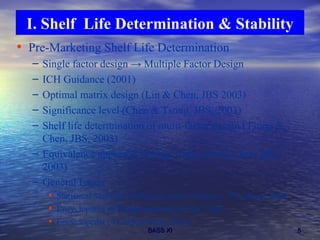
Pre-Marketing Shelf Life Determination Single factor design  -> Multiple Factor Design ICH Guidance (2001) Optimal matrix design (Lin & Chen, JBS 2003) Significance level (Chen & Tsong, JBS, 2003) Shelf life determination of multi-factor design (Tsong & Chen, JBS, 2003) Equivalence approach (Tsong, Chen, Lin & Chen, JBS, 2003) General Issues  Statistical Methods in Pharmaceutical Industry, 3 rd  edition, 2004; Encyclopedia of Biopharmaceutical Stat. 2004;  Encyclopedia of Clinical trials, 2005) I. Shelf  Life Determination & Stability
Postmarketing stability Scale up Mixed effect design (batch is random)  Nested factor design (specific levels of factors within a batch) Compliance of stability batches Web tool User friendly stability analysis tool for FDA reviewers Shelf  Life Determination & Stability (2)
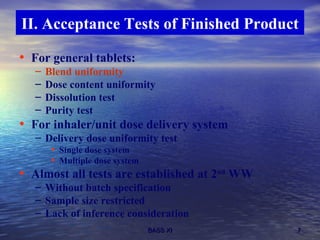
II. Acceptance Tests of Finished Product For general tablets: Blend uniformity Dose content uniformity Dissolution test Purity test For inhaler/unit dose delivery system Delivery dose uniformity test Single dose system Multiple dose system Almost all tests are established at 2 nd  WW Without batch specification Sample size restricted  Lack of inference consideration
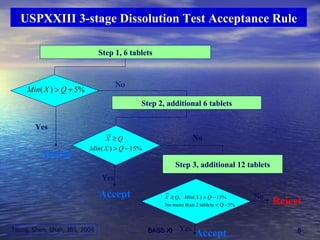
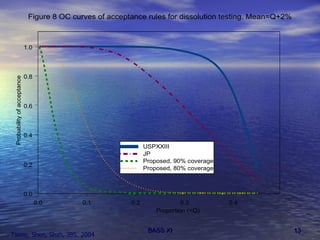
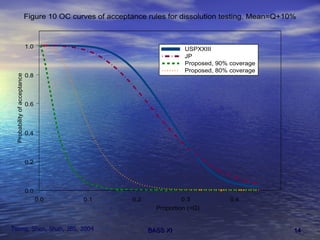
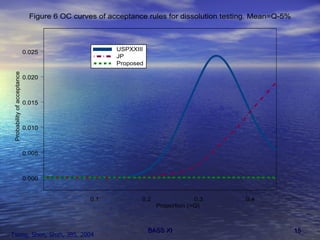
USPXXIII 3-stage Dissolution Test Acceptance Rule Step 1, 6 tablets No Accept Yes Step 2, additional 6 tablets Yes No Step 3, additional 12 tablets Yes No Reject Accept Accept Tsong, Shen, Shah, JBS, 2004
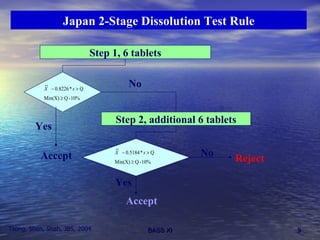
Japan 2-Stage Dissolution Test Rule Step 1, 6 tablets No Accept Yes Step 2, additional 6 tablets Yes Accept No Reject Tsong, Shen, Shah, JBS, 2004
Tsong, Shen, Shah, JBS, 2004
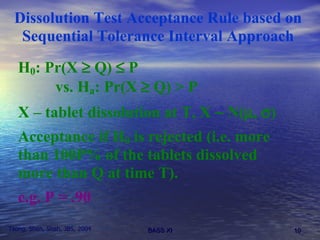
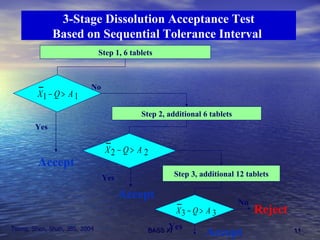
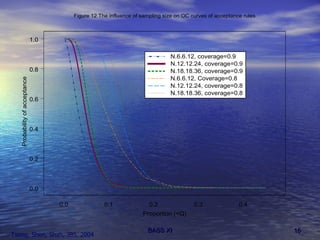
3-Stage Dissolution Acceptance Test Based on Sequential Tolerance Interval  Step 1, 6 tablets No Accept Yes Step 2, additional 6 tablets Yes Accept Step 3, additional 12 tablets Yes No Reject Accept Tsong, Shen, Shah, JBS, 2004
Tsong, Shen, Shah, JBS, 2004
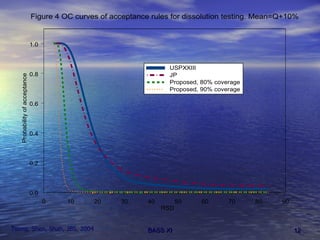
Tsong, Shen, Shah, JBS,   2004
Tsong, Shen, Shah, JBS, 2004
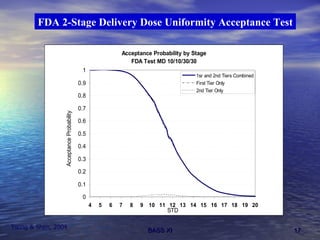
FDA 2-Stage Delivery Dose Uniformity Acceptance Test Tsong & Shen, 2004
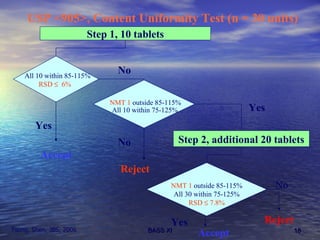
Step 1, 10 tablets No Accept Yes NMT 1  outside 85-115% All 10 within 75-125% Yes Reject No Step 2, additional 20 tablets NMT 1  outside 85-115% All 30 within 75-125% RSD    7.8% Yes Reject Accept All 10 within 85-115% RSD     6% No USP <905>, Content Uniformity Test (n = 30 units) Tsong, Shen, JBS, 2006
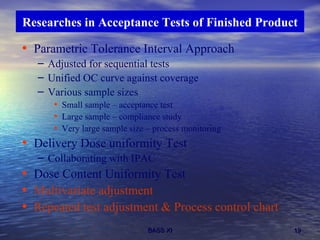
Parametric Tolerance Interval Approach Adjusted for sequential tests Unified OC curve against coverage Various sample sizes Small sample – acceptance test Large sample – compliance study Very large sample size – process monitoring Delivery Dose uniformity Test Collaborating with IPAC Dose Content Uniformity Test Multivariate adjustment Repeated test adjustment & Process control chart Researches in Acceptance Tests of Finished Product
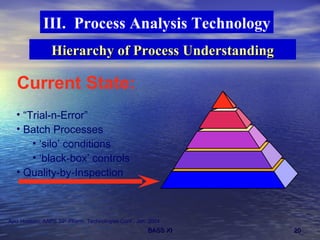
Hierarchy of Process Understanding Ajaz Hussain, AAPS 39 th  Pharm. Technologies Conf., Jan. 2004 Current State: “ Trial-n-Error” Batch Processes ‘ silo’ conditions ‘ black-box’ controls Quality-by-Inspection III.  Process Analysis Technology
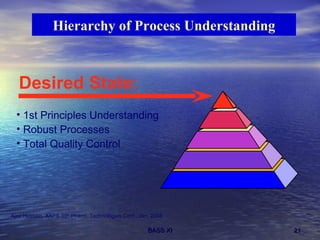
Hierarchy of Process Understanding Ajaz Hussain, AAPS 39 th  Pharm. Technologies Conf., Jan. 2004 Desired State: 1st Principles Understanding  Robust Processes Total Quality Control
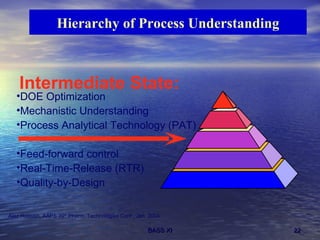
Hierarchy of Process Understanding Ajaz Hussain, AAPS 39 th  Pharm. Technologies Conf., Jan. 2004 DOE Optimization Mechanistic Understanding Process Analytical Technology (PAT) Feed-forward control Real-Time-Release (RTR) Quality-by-Design Intermediate State:
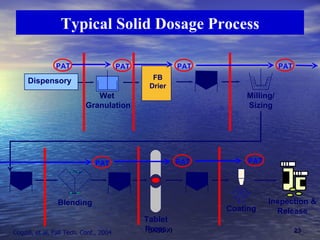
Typical Solid Dosage Process Wet  Granulation Milling/ Sizing Blending Tablet Press Coating Inspection & Release Cogdill, et al, Fall Tech. Conf., 2004 FB Drier Dispensory PAT PAT PAT PAT PAT PAT PAT
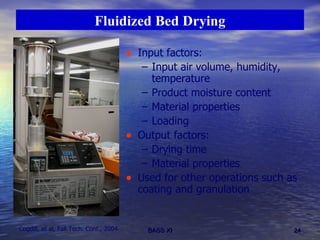
Fluidized Bed Drying Input factors: Input air volume, humidity, temperature Product moisture content Material properties Loading Output factors: Drying time Material properties Used for other operations such as coating and granulation Cogdill, et al, Fall Tech. Conf., 2004
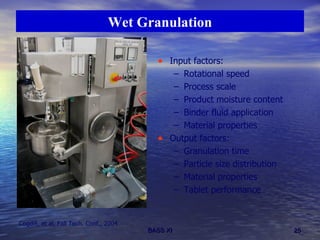
Wet Granulation Input factors: Rotational speed Process scale Product moisture content Binder fluid application Material properties Output factors: Granulation time Particle size distribution Material properties Tablet performance Cogdill, et al, Fall Tech. Conf., 2004
Factors varied: Drug concentration Rotational speed Humidity Factors held constant Material properties Temperature Fill level Loading scheme Powder Blending Cogdill, et al, Fall Tech. Conf., 2004
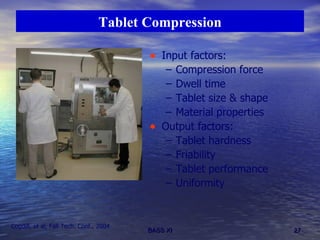
Tablet Compression Input factors: Compression force Dwell time Tablet size & shape Material properties Output factors: Tablet hardness Friability Tablet performance Uniformity Cogdill, et al, Fall Tech. Conf., 2004
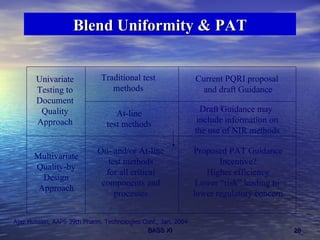
Blend Uniformity & PAT Univariate Testing to Document Quality Approach Multivariate Quality-by Design Approach Traditional test methods At-line test methods On- and/or At-line test methods for all critical components and processes Current PQRI proposal  and draft Guidance Draft Guidance may  include information on the use of NIR methods Proposed PAT Guidance Incentive? Higher efficiency Lower “risk” leading to  lower regulatory concern Ajaz Hussain, AAPS 39th Pharm. Technologies Conf., Jan. 2004
8-qt plastic V-blender (Patterson-Kelly) Blend composition Salicyclic acid (SA), 30.5 mm particle size Lactose, 115.5 mm particle size Input factor levels Relative humidity: 20%, 60% SA concentration: 3%, 7%, 11% Rotation speed: 12.8, 20.3 rpm Powder Blending Cogdill, et al, Fall Tech. Conf., 2004
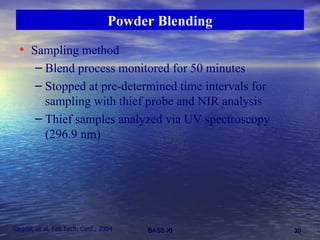
Sampling method Blend process monitored for 50 minutes Stopped at pre-determined time intervals for sampling with thief probe and NIR analysis Thief samples analyzed via UV spectroscopy (296.9 nm) Powder Blending Cogdill, et al, Fall Tech. Conf., 2004
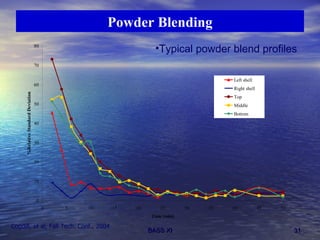
Powder Blending Typical powder blend profiles Cogdill, et al, Fall Tech. Conf., 2004
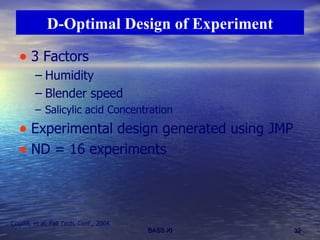
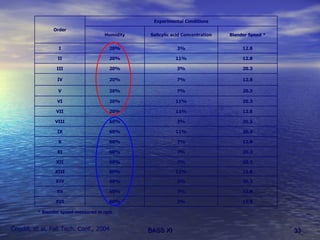
3 Factors Humidity Blender speed Salicylic acid Concentration Experimental design generated using JMP ND = 16 experiments   D-Optimal Design of Experiment Cogdill, et al, Fall Tech. Conf., 2004
Cogdill, et al, Fall Tech. Conf., 2004 * Blender speed measured in rpm 12.8 3% 60% XVI 12.8 7% 60% XV 20.3 3% 60% XIV 12.8 11% 60% XIII 20.3 7% 60% XII 20.3 7% 60% XI 12.8 7% 60% X 20.3 11% 60% IX 20.3 3% 60% VIII 12.8 11% 20% VII 20.3 11% 20% VI 20.3 7% 20% V 12.8 7% 20% IV 20.3 3% 20% III 12.8 11% 20% II 12.8 3% 20% I Blender Speed * Salicylic acid Concentration Humidity Experimental Conditions Order
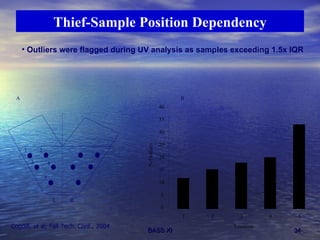
Thief-Sample Position Dependency Outliers were flagged during UV analysis as samples exceeding 1.5x IQR Cogdill, et al, Fall Tech. Conf., 2004 R L 1 2 3 4 5 0 5 10 15 20 25 30 35 40 1 2 3 4 5 Location % Outliers B A
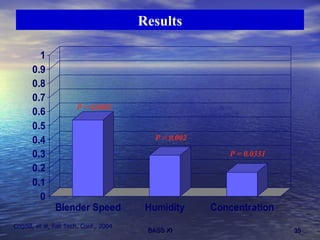
Results P = 0.0002 P = 0.002 P = 0.0331 Cogdill, et al, Fall Tech. Conf., 2004
Optimal Design of Experiment Collect Data to Establish Control Chart Univariate Multivariate  PCA Profile Application of Multi-level Control Specification Trend Statistical Monitoring and Feedback System Similar concepts are applicable also to batch-to-batch control of finished products PAT (Process Analytical Technology)
Generic Product Requirement SUPAC (Scale-up and Post Approval Changes) Requirement Biowaiver Comparability of new suppliers Formulation change Manufacturer site Change IV.  In Vitro Equivalence Tests
Dissolution Profile Similarity Test Particle Size Distribution Profile Equivalence Pharmaceutical Equivalence In Vitro Equivalence Tests
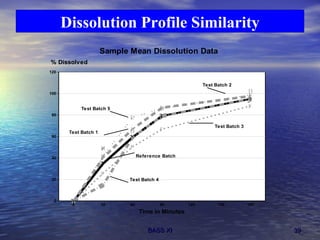
Dissolution Profile Similarity
Dissolution Profile Similarity The U.S. FDA Guidance, (SUPAC – IR), 1997 The U.S. FDA Guidance, (SUPAC – MR), 1997 The U.S. FDA Guidance, (SUPAC – ER), 1997 Sathe, Tsong, Shah, In Vitro-In Vivo Correlation, ed. Young D., Devane J.D., and  Butler J., Plenum Publishing Corp., 1996. Tsong, Hammerstrom, Sathe, Shah. Proceedings of the Biopharmaceutical Section of ASA, pp. 129-134, 1996. Tsong, Hammerstrom, Sathe, Shah. DIJ, 30: 1105-1112, 1996. Shah, Tsong, Sathe, Liu. Pharmaceutical Research, 15: 889-896, 1998. Ma, Wang, Liu, Tsong. JBS, 10(2):229-249, 2000.
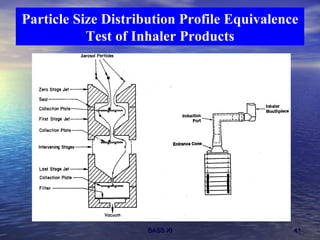
Particle Size Distribution Profile Equivalence Test of Inhaler Products
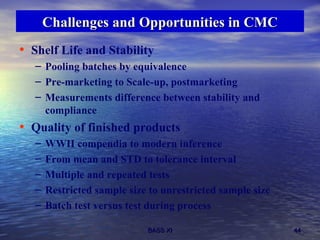
Challenges and Opportunities in CMC Shelf Life and Stability Pooling batches by equivalence Pre-marketing to Scale-up, postmarketing Measurements difference between stability and compliance Quality of finished products WWII compendia to modern inference From mean and STD to tolerance interval Multiple and repeated tests Restricted sample size to unrestricted sample size Batch test versus test during process
PAT From acceptance test to quality by design To identify, manage, monitor, and control critical variables of the manufacturing process   Statistical expertise in process control In-vitro equivalence  Variation between laboratories, technicians, and environmental conditions No conventional statistics and critical values Challenges and Opportunities in CMC
Thank You For Your Interest!!!

Manufacturing QC and QA

  • 1.
    EMERGING ISSUES ANDCONSIDERATIONS IN MANUFACTURING QUALITY CONTROL AND ASSURANCE OF DRUG PRODUCTS Yi Tsong, Ph.D., Acting Deputy Director Quantitative Methods and Research Staff OB, OPaSS, CDER, FDA This presentation does not necessarily represent the official position of FDA
  • 2.
    Three Dimensions ofthe Critical Path Assessment of Safety – how to predict if a potential product will be harmful? Proof of Efficacy -- how to determine if a potential product will have medical benefit? Industrialization – how to manufacture a product at commercial scale with consistently high quality?
  • 3.
    Working in ThreeDimensions on the Critical Path
  • 4.
    Statistical Chemical ManufacturingControl and Assurance Programs Shelf Life Determination & Stability Acceptance Tests of Finished Product PAT (Process Analytical Technology) In Vitro Equivalence Tests
  • 5.
    Pre-Marketing Shelf LifeDetermination Single factor design -> Multiple Factor Design ICH Guidance (2001) Optimal matrix design (Lin & Chen, JBS 2003) Significance level (Chen & Tsong, JBS, 2003) Shelf life determination of multi-factor design (Tsong & Chen, JBS, 2003) Equivalence approach (Tsong, Chen, Lin & Chen, JBS, 2003) General Issues Statistical Methods in Pharmaceutical Industry, 3 rd edition, 2004; Encyclopedia of Biopharmaceutical Stat. 2004; Encyclopedia of Clinical trials, 2005) I. Shelf Life Determination & Stability
  • 6.
    Postmarketing stability Scaleup Mixed effect design (batch is random) Nested factor design (specific levels of factors within a batch) Compliance of stability batches Web tool User friendly stability analysis tool for FDA reviewers Shelf Life Determination & Stability (2)
  • 7.
    II. Acceptance Testsof Finished Product For general tablets: Blend uniformity Dose content uniformity Dissolution test Purity test For inhaler/unit dose delivery system Delivery dose uniformity test Single dose system Multiple dose system Almost all tests are established at 2 nd WW Without batch specification Sample size restricted Lack of inference consideration
  • 8.
    USPXXIII 3-stage DissolutionTest Acceptance Rule Step 1, 6 tablets No Accept Yes Step 2, additional 6 tablets Yes No Step 3, additional 12 tablets Yes No Reject Accept Accept Tsong, Shen, Shah, JBS, 2004
  • 9.
    Japan 2-Stage DissolutionTest Rule Step 1, 6 tablets No Accept Yes Step 2, additional 6 tablets Yes Accept No Reject Tsong, Shen, Shah, JBS, 2004
  • 10.
  • 11.
    3-Stage Dissolution AcceptanceTest Based on Sequential Tolerance Interval Step 1, 6 tablets No Accept Yes Step 2, additional 6 tablets Yes Accept Step 3, additional 12 tablets Yes No Reject Accept Tsong, Shen, Shah, JBS, 2004
  • 12.
  • 13.
  • 14.
  • 15.
  • 16.
  • 17.
    FDA 2-Stage DeliveryDose Uniformity Acceptance Test Tsong & Shen, 2004
  • 18.
    Step 1, 10tablets No Accept Yes NMT 1 outside 85-115% All 10 within 75-125% Yes Reject No Step 2, additional 20 tablets NMT 1 outside 85-115% All 30 within 75-125% RSD  7.8% Yes Reject Accept All 10 within 85-115% RSD  6% No USP <905>, Content Uniformity Test (n = 30 units) Tsong, Shen, JBS, 2006
  • 19.
    Parametric Tolerance IntervalApproach Adjusted for sequential tests Unified OC curve against coverage Various sample sizes Small sample – acceptance test Large sample – compliance study Very large sample size – process monitoring Delivery Dose uniformity Test Collaborating with IPAC Dose Content Uniformity Test Multivariate adjustment Repeated test adjustment & Process control chart Researches in Acceptance Tests of Finished Product
  • 20.
    Hierarchy of ProcessUnderstanding Ajaz Hussain, AAPS 39 th Pharm. Technologies Conf., Jan. 2004 Current State: “ Trial-n-Error” Batch Processes ‘ silo’ conditions ‘ black-box’ controls Quality-by-Inspection III. Process Analysis Technology
  • 21.
    Hierarchy of ProcessUnderstanding Ajaz Hussain, AAPS 39 th Pharm. Technologies Conf., Jan. 2004 Desired State: 1st Principles Understanding Robust Processes Total Quality Control
  • 22.
    Hierarchy of ProcessUnderstanding Ajaz Hussain, AAPS 39 th Pharm. Technologies Conf., Jan. 2004 DOE Optimization Mechanistic Understanding Process Analytical Technology (PAT) Feed-forward control Real-Time-Release (RTR) Quality-by-Design Intermediate State:
  • 23.
    Typical Solid DosageProcess Wet Granulation Milling/ Sizing Blending Tablet Press Coating Inspection & Release Cogdill, et al, Fall Tech. Conf., 2004 FB Drier Dispensory PAT PAT PAT PAT PAT PAT PAT
  • 24.
    Fluidized Bed DryingInput factors: Input air volume, humidity, temperature Product moisture content Material properties Loading Output factors: Drying time Material properties Used for other operations such as coating and granulation Cogdill, et al, Fall Tech. Conf., 2004
  • 25.
    Wet Granulation Inputfactors: Rotational speed Process scale Product moisture content Binder fluid application Material properties Output factors: Granulation time Particle size distribution Material properties Tablet performance Cogdill, et al, Fall Tech. Conf., 2004
  • 26.
    Factors varied: Drugconcentration Rotational speed Humidity Factors held constant Material properties Temperature Fill level Loading scheme Powder Blending Cogdill, et al, Fall Tech. Conf., 2004
  • 27.
    Tablet Compression Inputfactors: Compression force Dwell time Tablet size & shape Material properties Output factors: Tablet hardness Friability Tablet performance Uniformity Cogdill, et al, Fall Tech. Conf., 2004
  • 28.
    Blend Uniformity &PAT Univariate Testing to Document Quality Approach Multivariate Quality-by Design Approach Traditional test methods At-line test methods On- and/or At-line test methods for all critical components and processes Current PQRI proposal and draft Guidance Draft Guidance may include information on the use of NIR methods Proposed PAT Guidance Incentive? Higher efficiency Lower “risk” leading to lower regulatory concern Ajaz Hussain, AAPS 39th Pharm. Technologies Conf., Jan. 2004
  • 29.
    8-qt plastic V-blender(Patterson-Kelly) Blend composition Salicyclic acid (SA), 30.5 mm particle size Lactose, 115.5 mm particle size Input factor levels Relative humidity: 20%, 60% SA concentration: 3%, 7%, 11% Rotation speed: 12.8, 20.3 rpm Powder Blending Cogdill, et al, Fall Tech. Conf., 2004
  • 30.
    Sampling method Blendprocess monitored for 50 minutes Stopped at pre-determined time intervals for sampling with thief probe and NIR analysis Thief samples analyzed via UV spectroscopy (296.9 nm) Powder Blending Cogdill, et al, Fall Tech. Conf., 2004
  • 31.
    Powder Blending Typicalpowder blend profiles Cogdill, et al, Fall Tech. Conf., 2004
  • 32.
    3 Factors HumidityBlender speed Salicylic acid Concentration Experimental design generated using JMP ND = 16 experiments D-Optimal Design of Experiment Cogdill, et al, Fall Tech. Conf., 2004
  • 33.
    Cogdill, et al,Fall Tech. Conf., 2004 * Blender speed measured in rpm 12.8 3% 60% XVI 12.8 7% 60% XV 20.3 3% 60% XIV 12.8 11% 60% XIII 20.3 7% 60% XII 20.3 7% 60% XI 12.8 7% 60% X 20.3 11% 60% IX 20.3 3% 60% VIII 12.8 11% 20% VII 20.3 11% 20% VI 20.3 7% 20% V 12.8 7% 20% IV 20.3 3% 20% III 12.8 11% 20% II 12.8 3% 20% I Blender Speed * Salicylic acid Concentration Humidity Experimental Conditions Order
  • 34.
    Thief-Sample Position DependencyOutliers were flagged during UV analysis as samples exceeding 1.5x IQR Cogdill, et al, Fall Tech. Conf., 2004 R L 1 2 3 4 5 0 5 10 15 20 25 30 35 40 1 2 3 4 5 Location % Outliers B A
  • 35.
    Results P =0.0002 P = 0.002 P = 0.0331 Cogdill, et al, Fall Tech. Conf., 2004
  • 36.
    Optimal Design ofExperiment Collect Data to Establish Control Chart Univariate Multivariate PCA Profile Application of Multi-level Control Specification Trend Statistical Monitoring and Feedback System Similar concepts are applicable also to batch-to-batch control of finished products PAT (Process Analytical Technology)
  • 37.
    Generic Product RequirementSUPAC (Scale-up and Post Approval Changes) Requirement Biowaiver Comparability of new suppliers Formulation change Manufacturer site Change IV. In Vitro Equivalence Tests
  • 38.
    Dissolution Profile SimilarityTest Particle Size Distribution Profile Equivalence Pharmaceutical Equivalence In Vitro Equivalence Tests
  • 39.
  • 40.
    Dissolution Profile SimilarityThe U.S. FDA Guidance, (SUPAC – IR), 1997 The U.S. FDA Guidance, (SUPAC – MR), 1997 The U.S. FDA Guidance, (SUPAC – ER), 1997 Sathe, Tsong, Shah, In Vitro-In Vivo Correlation, ed. Young D., Devane J.D., and Butler J., Plenum Publishing Corp., 1996. Tsong, Hammerstrom, Sathe, Shah. Proceedings of the Biopharmaceutical Section of ASA, pp. 129-134, 1996. Tsong, Hammerstrom, Sathe, Shah. DIJ, 30: 1105-1112, 1996. Shah, Tsong, Sathe, Liu. Pharmaceutical Research, 15: 889-896, 1998. Ma, Wang, Liu, Tsong. JBS, 10(2):229-249, 2000.
  • 41.
    Particle Size DistributionProfile Equivalence Test of Inhaler Products
  • 42.
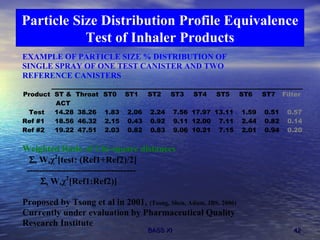
    Particle Size DistributionProfile Equivalence Test of Inhaler Products
  • 43.
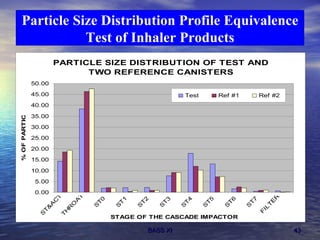
    Particle Size DistributionProfile Equivalence Test of Inhaler Products
  • 44.
    Challenges and Opportunitiesin CMC Shelf Life and Stability Pooling batches by equivalence Pre-marketing to Scale-up, postmarketing Measurements difference between stability and compliance Quality of finished products WWII compendia to modern inference From mean and STD to tolerance interval Multiple and repeated tests Restricted sample size to unrestricted sample size Batch test versus test during process
  • 45.
    PAT From acceptancetest to quality by design To identify, manage, monitor, and control critical variables of the manufacturing process Statistical expertise in process control In-vitro equivalence Variation between laboratories, technicians, and environmental conditions No conventional statistics and critical values Challenges and Opportunities in CMC
  • 46.
    Thank You ForYour Interest!!!