MANUFACTURING
EXCELLENCE FOR
FUTURE PRODUCTION
PERSPECTIVE
Importance and Dilemma of
  Today‟s Manufacturing
Vital Importance
• Basic means of human
  existence
• Major contributor to the creation
  of the wealth of a nation
• Contributes to human happiness
  and to world peace
Manufacturing Dilemma
Today
1) Maturity and saturation of
   industrial products
2) De-industrialization or industrial
   hollowness
3) Unattractiveness of
   employment in manufacturing
4) Environmental effect
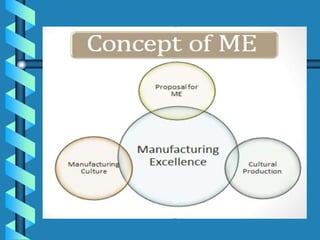
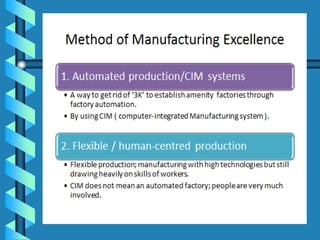
1) Proposal for Manufacturing
         Excellence

 Expressing the enhancement
  condition of goods production

 Eliminate:
  Hollowing production
  3k => kitanai (dirty), kitsui (hard
    work) and kiken (dangerous)
  Environmental problem
2) Manufacturing Culture

 Combination of conceptual ,intellectual activities
  and ideas with human relationship.

 Also called restructuring of goods production
  (relate with human working condition)

 Difference between:
    Manufacturing Excellence => Describe
     enhancement and elegance of goods production
    Manufacturing Culture => Throw away Culture
     (mass production, mass disposal, mass
     consumption)
3) Cultural/Civilised Production


Mode of human activity
 applicable to all over the world
 (Kimura, 1992)

Now, Cultural Production can
 mean manufacturing based upon
 modern science and technology
What Is Green
Manufacturing?
• Green manufacturing is a
  method for manufacturing that
  minimizes waste and pollution.
  These goals are often achieved
  through product and process
  design.
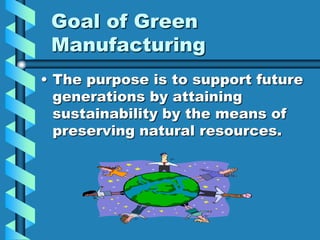
Goal of Green
 Manufacturing
• The purpose is to support future
  generations by attaining
  sustainability by the means of
  preserving natural resources.
Obstacles
• Businesses have a responsibility
  of influence
• Prices of raw material and
  subsidized energy are essential
• Lack of availability and
  information
Obstacles (2 of 2)
• High-profile leadership
• Training programs need more
  support
• Accessibility to loans from the
  government
• National cleaner production
  centers need to be established
How It Works
1) Rethink product and process
   technology
2) Explore the market potential
3) Supply goods and services
4) Extend producer responsibility
How It Works (2 of 2)
1)   Reduce energy consumption
2)   Integrate promotion
3)   Incorporate goals
4)   Promote development
5)   Integrate environmental costs (
Real World Example

• The need for fossil fuels has
 lead to discoveries of different
 methods of manufacturing that
 replace renewable resources.
Real World Example

 Petroleum.
     • Fossil fuel base for plastic.
     • Can be replaced by plants.
           »Corn can be fermented into
             polyhydroxyalkanoates (PHA).
           »Final product is synthesized
             biologically and completely
             biodegradable.
     • Fast food and packaging industry use
       polystyrene which has similar
       characteristics as PHA.
Real World Example –
How It Works

 Corn is grown and harvested

 Transported to manufacturing plant

 Glucose extracted and fermented

 Cells are washed and spun in
 centrifuge twice

 Concentrated and dried into powder
Summary
• “Green production is a preventive
  strategy that aims at promoting the
  use and the development of cleaner,
  processes, products, and services”.

• “A key to more sustainable
  development is long-term structural
  changes in the way our economies
  work”.
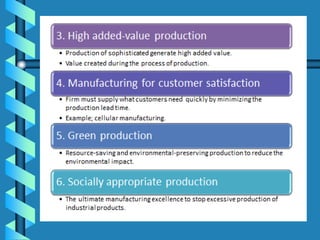
Socially Appropriate
Production as Ultimate
    Manufacturing
     Excellence
Collapse of Production-
          Firstism
• Manufacturing activities commonly expect
  to consume huge amounts of natural
  resources.

• Manufacturing brought about mass
  production, mass consumption, and mass
  disposal.

• Resulting in great fear of complete
  exhaustion of natural resources and
  energy and destruction of Earth.
Socially Appropriate Manufacturing
       Through the Satisfaction-
       consciousness Principle

 Human are now largely responsible for
  environmental issues of sustaining our
  Earth.

 Excessive production has to stop and
  profits must contribute to public welfare
  or humankind will no longer able to live.

 Chinese said that „the man who realizes
  that he is satisfied is spiritually wealthy‟
Satisfaction-consciousness
     Production/Consumption and
          Minimum Disposal


• Traditional mass production must be
  replace with this satisfaction-conscious
  production.

• Only durable products are produces in
  amounts as small as society requires.

• Ultimate „manufacturing excellence‟ should
  be vision of future management strategy of
  each individual manufacturing firm.
Manufacturing Ethics

• Satisfaction-conscious production is not
  easy, it will be attained by recognition of
  „manufacturing ethics‟

      Spirit of capitalism based upon the
       ethics of Protestantism in the West
      Spirit of Buddhism/Confucianism in the
       Orient

• Latter idea has contributed to the economics
  and industrial developments of Asian
  countries but rate of adopting the ethical
  codes in the West is higher

Manufacturing excellence for future production perspective

  • 1.
  • 2.
    Importance and Dilemmaof Today‟s Manufacturing
  • 3.
    Vital Importance • Basicmeans of human existence • Major contributor to the creation of the wealth of a nation • Contributes to human happiness and to world peace
  • 4.
    Manufacturing Dilemma Today 1) Maturityand saturation of industrial products 2) De-industrialization or industrial hollowness 3) Unattractiveness of employment in manufacturing 4) Environmental effect
  • 6.
    1) Proposal forManufacturing Excellence  Expressing the enhancement condition of goods production  Eliminate: Hollowing production 3k => kitanai (dirty), kitsui (hard work) and kiken (dangerous) Environmental problem
  • 7.
    2) Manufacturing Culture Combination of conceptual ,intellectual activities and ideas with human relationship.  Also called restructuring of goods production (relate with human working condition)  Difference between:  Manufacturing Excellence => Describe enhancement and elegance of goods production  Manufacturing Culture => Throw away Culture (mass production, mass disposal, mass consumption)
  • 8.
    3) Cultural/Civilised Production Modeof human activity applicable to all over the world (Kimura, 1992) Now, Cultural Production can mean manufacturing based upon modern science and technology
  • 11.
    What Is Green Manufacturing? •Green manufacturing is a method for manufacturing that minimizes waste and pollution. These goals are often achieved through product and process design.
  • 12.
    Goal of Green Manufacturing • The purpose is to support future generations by attaining sustainability by the means of preserving natural resources.
  • 13.
    Obstacles • Businesses havea responsibility of influence • Prices of raw material and subsidized energy are essential • Lack of availability and information
  • 14.
    Obstacles (2 of2) • High-profile leadership • Training programs need more support • Accessibility to loans from the government • National cleaner production centers need to be established
  • 15.
    How It Works 1)Rethink product and process technology 2) Explore the market potential 3) Supply goods and services 4) Extend producer responsibility
  • 16.
    How It Works(2 of 2) 1) Reduce energy consumption 2) Integrate promotion 3) Incorporate goals 4) Promote development 5) Integrate environmental costs (
  • 17.
    Real World Example •The need for fossil fuels has lead to discoveries of different methods of manufacturing that replace renewable resources.
  • 18.
    Real World Example Petroleum. • Fossil fuel base for plastic. • Can be replaced by plants. »Corn can be fermented into polyhydroxyalkanoates (PHA). »Final product is synthesized biologically and completely biodegradable. • Fast food and packaging industry use polystyrene which has similar characteristics as PHA.
  • 19.
    Real World Example– How It Works  Corn is grown and harvested  Transported to manufacturing plant  Glucose extracted and fermented  Cells are washed and spun in centrifuge twice  Concentrated and dried into powder
  • 20.
    Summary • “Green productionis a preventive strategy that aims at promoting the use and the development of cleaner, processes, products, and services”. • “A key to more sustainable development is long-term structural changes in the way our economies work”.
  • 21.
    Socially Appropriate Production asUltimate Manufacturing Excellence
  • 22.
    Collapse of Production- Firstism • Manufacturing activities commonly expect to consume huge amounts of natural resources. • Manufacturing brought about mass production, mass consumption, and mass disposal. • Resulting in great fear of complete exhaustion of natural resources and energy and destruction of Earth.
  • 23.
    Socially Appropriate Manufacturing Through the Satisfaction- consciousness Principle  Human are now largely responsible for environmental issues of sustaining our Earth.  Excessive production has to stop and profits must contribute to public welfare or humankind will no longer able to live.  Chinese said that „the man who realizes that he is satisfied is spiritually wealthy‟
  • 24.
    Satisfaction-consciousness Production/Consumption and Minimum Disposal • Traditional mass production must be replace with this satisfaction-conscious production. • Only durable products are produces in amounts as small as society requires. • Ultimate „manufacturing excellence‟ should be vision of future management strategy of each individual manufacturing firm.
  • 25.
    Manufacturing Ethics • Satisfaction-consciousproduction is not easy, it will be attained by recognition of „manufacturing ethics‟ Spirit of capitalism based upon the ethics of Protestantism in the West Spirit of Buddhism/Confucianism in the Orient • Latter idea has contributed to the economics and industrial developments of Asian countries but rate of adopting the ethical codes in the West is higher