Mobile Operating System
(Symbian OS)
Presented By:-
Manish Solanki
0105IT121047
Information Technology
Submitted to:-
Prateek Sir
Contents
 Introduction
 Types of Operating System
 Symbian OS
 Architecture
 Symbian Mobile Operating System Version
 Future Mobile OS’s
 Applications
 Technologies in Symbian
 Conclusion
2
Introduction
 An operating system (OS) is an interface between
hardware and user. It manages hardware and
software resources of the system.
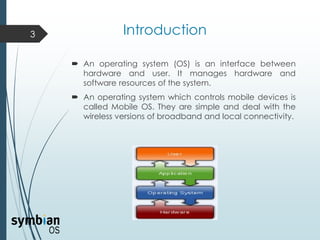
 An operating system which controls mobile devices is
called Mobile OS. They are simple and deal with the
wireless versions of broadband and local connectivity.
3
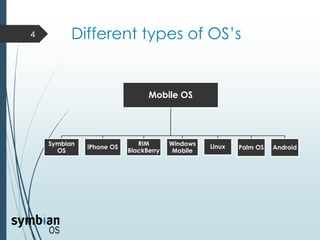
Different types of OS’s
Mobile OS
Symbian
OS
iPhone OS
RIM
BlackBerry
Windows
Mobile
Linux Palm OS Android
4
SYMBIAN OS
 Symbian OS is a mobile operating system, developed
by Symbian Ltd, in 1997.
 It is a mobile operating system (OS) and designed for
Smartphone’s and currently maintained by
Accenture.
 It runs exclusively on ARM processors.
 In June 2008, Nokia announced the acquisition of
Symbian Ltd.
5
8/5/2014
6
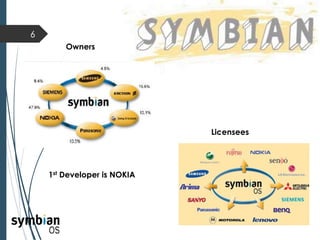
Licensees
Owners
1st Developer is NOKIA
 It was the most popular smartphone OS across the
world till the end of 2010,untill it was overtaken by
Android, although in some developing nations,
Symbian is still the biggest.
 The current form of Symbian is an open-source
platform developed by Symbian Foundation in 2009.
 Symbian OS is programmed in C++.
7
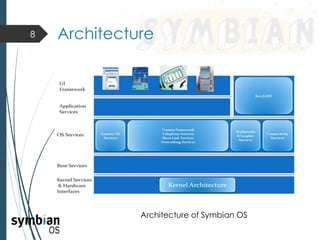
Architecture8
Architecture of Symbian OS
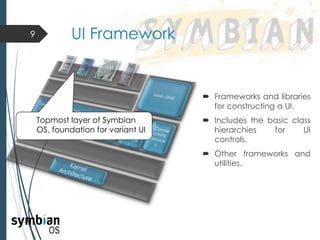
 Frameworks and libraries
for constructing a UI.
 Includes the basic class
hierarchies for UI
controls.
 Other frameworks and
utilities.
9 UI Framework
Topmost layer of Symbian
OS, foundation for variant UI
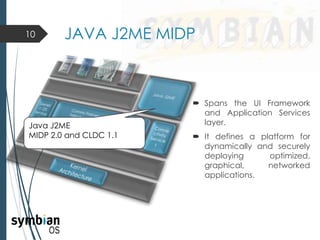
 Spans the UI Framework
and Application Services
layer.
 It defines a platform for
dynamically and securely
deploying optimized,
graphical, networked
applications.
10 JAVA J2ME MIDP
Java J2ME
MIDP 2.0 and CLDC 1.1
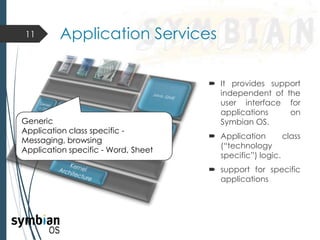
 It provides support
independent of the
user interface for
applications on
Symbian OS.
 Application class
(“technology
specific”) logic.
 support for specific
applications
11 Application Services
Generic
Application class specific -
Messaging, browsing
Application specific - Word, Sheet
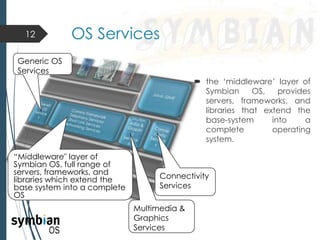
 the ‘middleware’ layer of
Symbian OS, provides
servers, frameworks, and
libraries that extend the
base-system into a
complete operating
system.
12 OS Services
Generic OS
Services
“Middleware" layer of
Symbian OS, full range of
servers, frameworks, and
libraries which extend the
base system into a complete
OS
Multimedia &
Graphics
Services
Connectivity
Services
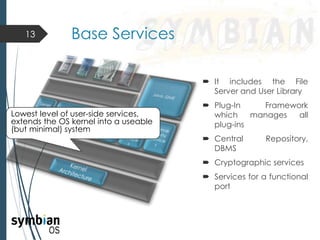
 It includes the File
Server and User Library
 Plug-In Framework
which manages all
plug-ins
 Central Repository,
DBMS
 Cryptographic services
 Services for a functional
port
13 Base Services
Lowest level of user-side services,
extends the OS kernel into a useable
(but minimal) system
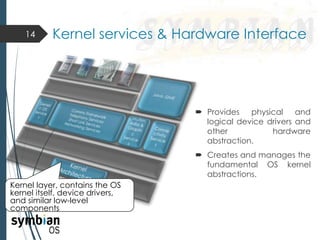
 Provides physical and
logical device drivers and
other hardware
abstraction.
 Creates and manages the
fundamental OS kernel
abstractions.
14 Kernel services & Hardware Interface
Kernel layer, contains the OS
kernel itself, device drivers,
and similar low-level
components
SYMBIAN MOBILE OS VERSION15
 Series 60 3rd edition Feature Pack 2
 Released on 12 July 2006.
 Support for Wi-Fi 802.11, HSDPA.
 Symbian^1 (Series 60 5th edition):-
 Applications should launch up to 75% faster.
 Additionally, SQL support is provided by SQLite.
 Symbian^3:-
 Released in the year 2010.
 Symbian^3 is an improvement over previous S60
5th Edition and features single touch menus in the
user interface, as well as new Symbian OS kernel
with hardware-accelerated graphics.
Contd..
 Symbian Anna and Symbian Belle:-
 Released in the year 2011.
 Free-form, differently-sized, live widgets
 More home screens
 Improved status bar
 Modernised navigation
 New apps
 Informative lock screen
 NFC devices
16
Features
 Processes and Threads:
 Symbian OS is a multitasking and multithreaded
operating system.
 Many processes can run concurrently, can
communicate with each other, and can utilize multiple
threads that run internal to each process.
 Common File System support:
 Symbian OS organizes access to system storage using a
file system model, just like larger Operating systems.
 It has a default file system compatible with windows (by
default it uses FAT-32 file system).
 It supports several different file systems , like FAT 16 & FAT
32, NTFS etc.
17
Contd..
 Networking:
Symbian OS supports TCP/IP networking as well
as several other communication interfaces such as serial,
infrared and Bluetooth.
 Memory Management:
Although Symbian OS does not use or have the
facilities for mapped virtual memory , it organizes
memory access in pages and allows for the replacement
of the pages, that is , bringing pages in, but not
swapping them out.
18
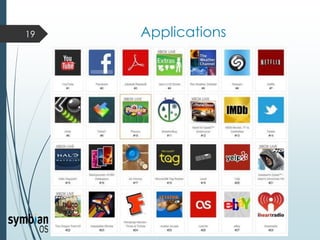
Applications
GVPCE(A)
19
Technologies in Symbian
 Symbian SDK
 Carbide.c++
20
Conclusion
 Symbian OS is a multi-tasking operating system which
addressing the mass-market and designed for simplifying the
work load.
 It’s a open platform allows the installation of third party software
to enhance the platform.
21
Thank you all..!
22

Manish solanki

  • 1.
    Mobile Operating System (SymbianOS) Presented By:- Manish Solanki 0105IT121047 Information Technology Submitted to:- Prateek Sir
  • 2.
    Contents  Introduction  Typesof Operating System  Symbian OS  Architecture  Symbian Mobile Operating System Version  Future Mobile OS’s  Applications  Technologies in Symbian  Conclusion 2
  • 3.
    Introduction  An operatingsystem (OS) is an interface between hardware and user. It manages hardware and software resources of the system.  An operating system which controls mobile devices is called Mobile OS. They are simple and deal with the wireless versions of broadband and local connectivity. 3
  • 4.
    Different types ofOS’s Mobile OS Symbian OS iPhone OS RIM BlackBerry Windows Mobile Linux Palm OS Android 4
  • 5.
    SYMBIAN OS  SymbianOS is a mobile operating system, developed by Symbian Ltd, in 1997.  It is a mobile operating system (OS) and designed for Smartphone’s and currently maintained by Accenture.  It runs exclusively on ARM processors.  In June 2008, Nokia announced the acquisition of Symbian Ltd. 5
  • 6.
  • 7.
     It wasthe most popular smartphone OS across the world till the end of 2010,untill it was overtaken by Android, although in some developing nations, Symbian is still the biggest.  The current form of Symbian is an open-source platform developed by Symbian Foundation in 2009.  Symbian OS is programmed in C++. 7
  • 8.
  • 9.
     Frameworks andlibraries for constructing a UI.  Includes the basic class hierarchies for UI controls.  Other frameworks and utilities. 9 UI Framework Topmost layer of Symbian OS, foundation for variant UI
  • 10.
     Spans theUI Framework and Application Services layer.  It defines a platform for dynamically and securely deploying optimized, graphical, networked applications. 10 JAVA J2ME MIDP Java J2ME MIDP 2.0 and CLDC 1.1
  • 11.
     It providessupport independent of the user interface for applications on Symbian OS.  Application class (“technology specific”) logic.  support for specific applications 11 Application Services Generic Application class specific - Messaging, browsing Application specific - Word, Sheet
  • 12.
     the ‘middleware’layer of Symbian OS, provides servers, frameworks, and libraries that extend the base-system into a complete operating system. 12 OS Services Generic OS Services “Middleware" layer of Symbian OS, full range of servers, frameworks, and libraries which extend the base system into a complete OS Multimedia & Graphics Services Connectivity Services
  • 13.
     It includesthe File Server and User Library  Plug-In Framework which manages all plug-ins  Central Repository, DBMS  Cryptographic services  Services for a functional port 13 Base Services Lowest level of user-side services, extends the OS kernel into a useable (but minimal) system
  • 14.
     Provides physicaland logical device drivers and other hardware abstraction.  Creates and manages the fundamental OS kernel abstractions. 14 Kernel services & Hardware Interface Kernel layer, contains the OS kernel itself, device drivers, and similar low-level components
  • 15.
    SYMBIAN MOBILE OSVERSION15  Series 60 3rd edition Feature Pack 2  Released on 12 July 2006.  Support for Wi-Fi 802.11, HSDPA.  Symbian^1 (Series 60 5th edition):-  Applications should launch up to 75% faster.  Additionally, SQL support is provided by SQLite.  Symbian^3:-  Released in the year 2010.  Symbian^3 is an improvement over previous S60 5th Edition and features single touch menus in the user interface, as well as new Symbian OS kernel with hardware-accelerated graphics.
  • 16.
    Contd..  Symbian Annaand Symbian Belle:-  Released in the year 2011.  Free-form, differently-sized, live widgets  More home screens  Improved status bar  Modernised navigation  New apps  Informative lock screen  NFC devices 16
  • 17.
    Features  Processes andThreads:  Symbian OS is a multitasking and multithreaded operating system.  Many processes can run concurrently, can communicate with each other, and can utilize multiple threads that run internal to each process.  Common File System support:  Symbian OS organizes access to system storage using a file system model, just like larger Operating systems.  It has a default file system compatible with windows (by default it uses FAT-32 file system).  It supports several different file systems , like FAT 16 & FAT 32, NTFS etc. 17
  • 18.
    Contd..  Networking: Symbian OSsupports TCP/IP networking as well as several other communication interfaces such as serial, infrared and Bluetooth.  Memory Management: Although Symbian OS does not use or have the facilities for mapped virtual memory , it organizes memory access in pages and allows for the replacement of the pages, that is , bringing pages in, but not swapping them out. 18
  • 19.
  • 20.
    Technologies in Symbian Symbian SDK  Carbide.c++ 20
  • 21.
    Conclusion  Symbian OSis a multi-tasking operating system which addressing the mass-market and designed for simplifying the work load.  It’s a open platform allows the installation of third party software to enhance the platform. 21
  • 22.