IOS OPERATING SYSTEM
iOS (previously iPhone OS ) is a mobile operating system
developed and distributed by Apple Inc. Originally released in
2007 for the iPhone and iPod Touch , it has been extended to
support other Apple devices such as the iPad and Apple TV.

The user interface of iOS is based on the concept of direct
manipulation , using multi-touch gestures.
History
The operating system was unveiled with the iPhone at the
Macworld Conference & Expo, January 9, 2007, and released
in June of that year. At first, Apple marketing literature did
not specify a separate name for the operating system, stating
simply that the "iPhone runs OS X". Initially, third-party
applications were not supported.

In June 2010, Apple rebranded iPhone OS as "iOS".
The trademark "IOS" had been used by Cisco for over a
decade for its operating system, IOS, used on its routers
With its easy-to-use interface, amazing features, and rock-solid
stability, iOS is the foundation of iPhone, iPad, and iPod touch.
And even as others try to catch up, the technologies and features
built into iOS keep your Apple devices years ahead.
No company in the world can match Cisco Systems when it
comes to maximizing an internetwork's applications
availability and minimizing its total cost of ownership.
Over the last decade, our proven technology and wide
range of scalable solutions have enabled us to set the pace
in the internetworking industry.

Multiplatform IOS: Cisco's IOS enables an enterprise to
build an integrated, cost-effective infrastructure using
platforms from both Cisco and its partners.
The Internetwork Foundation

Today's multifaceted enterprise internetworks typically consist of
four distinct sectors, each with its own specific mission:

The core of the internetwork provides broad, reliable wide-area
connections among all worldwide locations. Its focus is on cost-
effective and efficient use of expensive WAN resources.

The workgroup sector provides groups of end users with scalable
bandwidth capable of meeting increasing application demands.

The remote access sector serves remote locations, telecommuters, and
mobile users with cost-effective, easily managed connectivity
solutions.

The IBM internetworking sector lowers costs and provides a safe and
secure migration path for IBM SNA network applications.
The IOS: Cisco's Advantage

The IOS cost-effectively manages resources by controlling and
unifying complex, distributed network intelligence. Also, it functions
as a flexible vehicle that can add new services, features, and
applications to the internetwork.

In the applications support arena, the Cisco IOS provides
interoperability with more standards-based physical and logical
protocol interfaces than any other internetwork supplier in the
industry. From twisted pair to optical fiber, LAN to campus to WAN
media, UNIX to Novell NetWare to IBM SNA, no other internetwork
architecture can match the wide-ranging protocol support of the IOS.
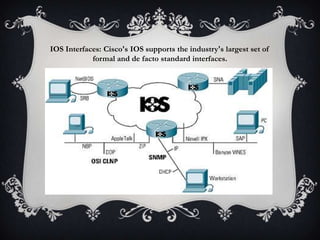
IOS Interfaces: Cisco's IOS supports the industry's largest set of
            formal and de facto standard interfaces.
Four Cornerstones of the IOS
The value-added intelligence of the IOS is embodied in four
types of internetwork services:

Reliable adaptive routing services

WAN optimization services

Management and security services

Scalability services

Four IOS Cornerstones: The value-added intelligence of the
IOS is embodied in four types of services: reliable adaptive
routing, WAN optimization, management and security, and
scalability services.
Cisco's IOS: A Strategic Investment

The IOS supports the broadest range of applications by virtue of a
full portfolio of standards-based interfaces. Thus, users with very
diverse needs and applications (from finance, to sales, to
engineering) can be served by a single, integrated network
infrastructure.

Wherever a user needs to be (in a workgroup, in the data center, in
a remote office, or telecommuting across a distance) the IOS
provides the network resources to increase that user's
productivity.
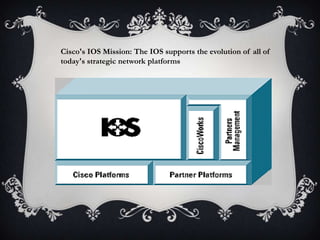
Cisco's IOS Mission: The IOS supports the evolution of all of
today's strategic network platforms
http://www.youtube.com/watch?v=R1X4m-
RuFJU

http://www.youtube.com/watch?v=a7PGL2O_
4MA

Operating system

  • 1.
  • 2.
    iOS (previously iPhoneOS ) is a mobile operating system developed and distributed by Apple Inc. Originally released in 2007 for the iPhone and iPod Touch , it has been extended to support other Apple devices such as the iPad and Apple TV. The user interface of iOS is based on the concept of direct manipulation , using multi-touch gestures.
  • 3.
    History The operating systemwas unveiled with the iPhone at the Macworld Conference & Expo, January 9, 2007, and released in June of that year. At first, Apple marketing literature did not specify a separate name for the operating system, stating simply that the "iPhone runs OS X". Initially, third-party applications were not supported. In June 2010, Apple rebranded iPhone OS as "iOS". The trademark "IOS" had been used by Cisco for over a decade for its operating system, IOS, used on its routers
  • 4.
    With its easy-to-useinterface, amazing features, and rock-solid stability, iOS is the foundation of iPhone, iPad, and iPod touch. And even as others try to catch up, the technologies and features built into iOS keep your Apple devices years ahead.
  • 5.
    No company inthe world can match Cisco Systems when it comes to maximizing an internetwork's applications availability and minimizing its total cost of ownership. Over the last decade, our proven technology and wide range of scalable solutions have enabled us to set the pace in the internetworking industry. Multiplatform IOS: Cisco's IOS enables an enterprise to build an integrated, cost-effective infrastructure using platforms from both Cisco and its partners.
  • 8.
    The Internetwork Foundation Today'smultifaceted enterprise internetworks typically consist of four distinct sectors, each with its own specific mission: The core of the internetwork provides broad, reliable wide-area connections among all worldwide locations. Its focus is on cost- effective and efficient use of expensive WAN resources. The workgroup sector provides groups of end users with scalable bandwidth capable of meeting increasing application demands. The remote access sector serves remote locations, telecommuters, and mobile users with cost-effective, easily managed connectivity solutions. The IBM internetworking sector lowers costs and provides a safe and secure migration path for IBM SNA network applications.
  • 9.
    The IOS: Cisco'sAdvantage The IOS cost-effectively manages resources by controlling and unifying complex, distributed network intelligence. Also, it functions as a flexible vehicle that can add new services, features, and applications to the internetwork. In the applications support arena, the Cisco IOS provides interoperability with more standards-based physical and logical protocol interfaces than any other internetwork supplier in the industry. From twisted pair to optical fiber, LAN to campus to WAN media, UNIX to Novell NetWare to IBM SNA, no other internetwork architecture can match the wide-ranging protocol support of the IOS.
  • 10.
    IOS Interfaces: Cisco'sIOS supports the industry's largest set of formal and de facto standard interfaces.
  • 11.
    Four Cornerstones ofthe IOS The value-added intelligence of the IOS is embodied in four types of internetwork services: Reliable adaptive routing services WAN optimization services Management and security services Scalability services Four IOS Cornerstones: The value-added intelligence of the IOS is embodied in four types of services: reliable adaptive routing, WAN optimization, management and security, and scalability services.
  • 13.
    Cisco's IOS: AStrategic Investment The IOS supports the broadest range of applications by virtue of a full portfolio of standards-based interfaces. Thus, users with very diverse needs and applications (from finance, to sales, to engineering) can be served by a single, integrated network infrastructure. Wherever a user needs to be (in a workgroup, in the data center, in a remote office, or telecommuting across a distance) the IOS provides the network resources to increase that user's productivity.
  • 14.
    Cisco's IOS Mission:The IOS supports the evolution of all of today's strategic network platforms
  • 15.