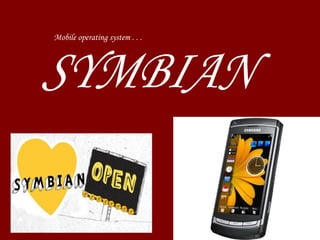
SYMBIAN Mobile operating system . . .
Smart phones Typical difference to feature phones. --traditionally more features, more software installed --install own native application. --more advanced computing ability and connectivity  --Smart phones run complete  operating system  software providing a platform for application developers.
 
Symbian was founded in 1998, initially from Psion, Nokia and Ericsson. Since then, Siemens, Samsung, Sony Ericsson Panasonic and Motorola have all become partners. Symbian is a software licensing company - its core business is to supply the advanced, open operating system, Symbian OS, for data-enabled mobile phones. •  More details of when the companies above became partners is as follows: •  Ericsson - founder member June 1998 •  Nokia - founder member June 1998 •  Panasonic - joined May 1999 •  Psion -was a founder member June 1998, but has since sold its shares •  Samsung - joined 2002 •  Siemens - joined April 2002 •  Sony Ericsson - 2001 •  Motorola joined later in 1998 but no longer has a shareholding, it remains a Symbian OS licensee In 2008, the former  Symbian Software Limited  was acquired by  Nokia  and a new independent non-profit organization called the  Symbian Foundation  was established.
Time line.... Symbian foundation   announced Acquisition of Symbian ltd. by Nokia First unified Symbian foundation released Symbian available as open source 2008 2009 2010
Basic principles to design Symbian 3 basic rules… •  User data is sacred. •  User time is precious. •  All resources are scarce. More…. •  rigorous separation of user interfaces from services •  rigorous separation of application user interfaces from engines •  pervasive support for instant availability and instant switching of applications •  always-on systems, capable of running forever: robust management and reclaiming of system resources .
The key design patterns of Symbian OS include the following: The microkernel pattern: kernel responsibilities are reduced to an essential minimum •  Runs on battery powered devices •  has low power consumption •  Designed for devices with limited memory •  Open Operating System (3rd party developers can write  applications)
•  Reliable and stable (Applications can run for years without being closed or losing user data) •  Object Orientated from the “ground up” •  Provides a C++ API •  Component based •  Can run on multiple platforms pre emptive-multi tasking
Layered view of Symbian
The breakdown of the GT( generic technology) is as follows: •  Symbian application engines (20%) - these allow access to built in functionality such as contacts and calendar information. Engines concern themselves only with the data and not how it is presented. •  Symbian System layer (55%) - this contains the bulk of the OS APIs and provides functionality  from string handling to event scheduling within an application. •  Kernel (5%) - not directly accessible from user programs. The remaining 20% of the Symbian OS is concerned with the UI design .
user interface platforms Symbian and its   Three UI Platforms S60 MOAP 3) UIQ User Interface Framework Symbian has separated the user interface layer from the operating system to let phone manufacturer provides the right UI for their phone.
Series 60 UI Design •  Leading in the market owned by nokia. •  Designed for one-hand operation of advanced consumer-friendly data services •  176x208 colour screen •  Uses standard 12 key number keypad •  2 soft keys and 4-way navigation •  No file system visible to the us
3 rd  Edition
A typical application window is divided into the following areas: •  Status pane - displays status information of the current application and state, as well as general information about the device status (signal strength, battery charging); consists the following subpanes: title pane, context pane, navi pane, signal pane battery pane •  Main pane - the principal area of the screen where an application can display its data •  Control pane - displays the labels associated with the two softkeys
UIQ This includes UIQ, which was originally produced by Symbian, by now. Owned by Ericsson and Motorola. used in Sony Ericsson P800 model. •  Pen-based GUI •  Large touch sensitive colour display •  208 x 320 pixel resolution •  The user does not launch or quit applications but switches between them •  Data is saved automatically •  No file system is visible to the user.
 
The UIQ screen layout includes the following areas (from top to bottom of the screen): •  Application picker - contains icons that allow the user to switch applications. Tapping on any icon brings the application it represents to the foreground.  When an application is opened, its icon is selected in the application picker. •  Menu bar - usually, contains two menus on the left and a folder menu on the right •  Application space - the central area of the screen where the applications' view is displayed •  Button bar - optionally, an application view displays a button bar at the bottom of the application space. Not all application views require a button bar. The most common use is in the detail view. The 'Go back button' in the lower right corner is the most important detail in the button bar. •  Status bar - displays status information such as battery charge, signal strength and notification for incoming messages etc.
UI Platform FOMA -> NTT Docomo -Largest operator in Japan -FOMA 3G network (“freedom of mobile access”) -UI internally named MOAP ( “mobile oriented application platform”) -Supported by two platforms Symbian and linux ->Phones  -Manufacturers Fujitsu, Sharp, Mitsubishi, Sony Ericsson  -closed platform ( user cant install platform)
•  Clamshell phone •  QVGA main display •  Camera •  Fingerprint access to personal data (some phones) Largely aimed Japanese market
Application service layer The Application Services layer provides user-interface-independent support for applications on Symbian OS As the system has evolved, there has been an increasing distinction between engines and services. There are good reasons for this evolution. Compared with its beginnings, Symbian OS now supports a wider range of devices in diverse markets and geographies. Increasingly, the APIs provided by the generic engines have been perceived by licensees as being too broad (providing too much functionality), while not delivering functionality required in specific markets
The OS Services layer In terms of the number of components, it is by some margin the largest single layer of the system. To bring clear structure to it, the System Model organizes the layer into four major blocks by broad technology type •  Generic OS Services •  Comms Services •  Multimedia and Graphics Services •  Connectivity Services These blocks are relatively self-contained
8.2 Purpose Symbian OS is a microkernel operating system. The kernel is restricted to providing the minimum of essential services, specifically those required to implement process execution and memory access models.  These are extended by the remaining (non-kernel) components of the base layers of the system, to support bringing up a bare system on hardware, providing access to peripherals and a file system, and to support a program execution model. Higher-level system services are built on top of this foundation. In Symbian OS, the higher-level system services are located in the OS Services layer. These services provide the specialized system-level support required by other system components and by higher layers of the system, as well as by applications. Thus, for example, graphics support, communications support including networking and telephony, and the connectivity infrastructure are all provided as OS services.
Symbian Licensee
 
Competition In the number of "smart mobile device" sales, Symbian devices are the market leaders. Statistics published for the second quarter of 2010 showed that Symbian devices comprised a 41.2% share of smart mobile devices sold, with  RIM  having 18.2%,  Android  having 17.2%, and Apple having 15.1% (through  iPhone  OS )  [7] Previous reports on device shipments as published in February 2010 showed that the Symbian devices comprised a 47.2% share of the smart mobile devices shipped in 2009, with  RIM having 20.8%, Apple having 15.1% (through  iPhone  OS ), Microsoft having 8.8% (through  Windows CE  and  Windows Mobile ) and  Android  having 4.7%. [8]  Other competitors include webOS ,  Qualcomm 's  BREW ,  SavaJe ,  Linux  and  MontaVista  Software . Although the share of the global smartphone market dropped from 52.4% in 2008 to 47.2% in 2009, the shipment volume of Symbian devices grew 4.8%, from 74.9 million units to 78.5 million units. [8]  From Q2 2009 to Q2 2010, the shipment volume of Symbian devices grew 41.5%, by 8.0 million units, from 19,178,910 units to 27,129,340; compared with an increase of 9.6 million units for Android, but 3.3 million units for RIM and 3.2 million units for Apple. [9
Other operating system
 
 
Disadvantages of Symbian. 1)Problematic syncing with desktop computers, particularly if you’re a new user with a Mac. 2)Menus often have  too many key presses before you reach your desired option. 3)No native multitouch. These disadvantages show the operating system’s age more than anything else.
References The Symbian Os architecture sourcebook Smartphone Operating System Concepts with Symbian OS Symbian Os Basics (Developer Training) Wikipedia www.symbian.org www.symbiandevelopers.org
“… the  mobile phone …is most likely to carry the dream of the ‘personal computer’ to its conclusion’’ THANK YOU

Symbain5

  • 1.
  • 2.
    Smart phones Typicaldifference to feature phones. --traditionally more features, more software installed --install own native application. --more advanced computing ability and connectivity --Smart phones run complete  operating system  software providing a platform for application developers.
  • 3.
  • 4.
    Symbian was foundedin 1998, initially from Psion, Nokia and Ericsson. Since then, Siemens, Samsung, Sony Ericsson Panasonic and Motorola have all become partners. Symbian is a software licensing company - its core business is to supply the advanced, open operating system, Symbian OS, for data-enabled mobile phones. • More details of when the companies above became partners is as follows: • Ericsson - founder member June 1998 • Nokia - founder member June 1998 • Panasonic - joined May 1999 • Psion -was a founder member June 1998, but has since sold its shares • Samsung - joined 2002 • Siemens - joined April 2002 • Sony Ericsson - 2001 • Motorola joined later in 1998 but no longer has a shareholding, it remains a Symbian OS licensee In 2008, the former  Symbian Software Limited  was acquired by  Nokia  and a new independent non-profit organization called the  Symbian Foundation  was established.
  • 5.
    Time line.... Symbianfoundation announced Acquisition of Symbian ltd. by Nokia First unified Symbian foundation released Symbian available as open source 2008 2009 2010
  • 6.
    Basic principles todesign Symbian 3 basic rules… • User data is sacred. • User time is precious. • All resources are scarce. More…. • rigorous separation of user interfaces from services • rigorous separation of application user interfaces from engines • pervasive support for instant availability and instant switching of applications • always-on systems, capable of running forever: robust management and reclaiming of system resources .
  • 7.
    The key designpatterns of Symbian OS include the following: The microkernel pattern: kernel responsibilities are reduced to an essential minimum • Runs on battery powered devices • has low power consumption • Designed for devices with limited memory • Open Operating System (3rd party developers can write applications)
  • 8.
    • Reliableand stable (Applications can run for years without being closed or losing user data) • Object Orientated from the “ground up” • Provides a C++ API • Component based • Can run on multiple platforms pre emptive-multi tasking
  • 9.
  • 10.
    The breakdown ofthe GT( generic technology) is as follows: • Symbian application engines (20%) - these allow access to built in functionality such as contacts and calendar information. Engines concern themselves only with the data and not how it is presented. • Symbian System layer (55%) - this contains the bulk of the OS APIs and provides functionality from string handling to event scheduling within an application. • Kernel (5%) - not directly accessible from user programs. The remaining 20% of the Symbian OS is concerned with the UI design .
  • 11.
    user interface platformsSymbian and its Three UI Platforms S60 MOAP 3) UIQ User Interface Framework Symbian has separated the user interface layer from the operating system to let phone manufacturer provides the right UI for their phone.
  • 12.
    Series 60 UIDesign • Leading in the market owned by nokia. • Designed for one-hand operation of advanced consumer-friendly data services • 176x208 colour screen • Uses standard 12 key number keypad • 2 soft keys and 4-way navigation • No file system visible to the us
  • 13.
    3 rd Edition
  • 14.
    A typical applicationwindow is divided into the following areas: • Status pane - displays status information of the current application and state, as well as general information about the device status (signal strength, battery charging); consists the following subpanes: title pane, context pane, navi pane, signal pane battery pane • Main pane - the principal area of the screen where an application can display its data • Control pane - displays the labels associated with the two softkeys
  • 15.
    UIQ This includesUIQ, which was originally produced by Symbian, by now. Owned by Ericsson and Motorola. used in Sony Ericsson P800 model. • Pen-based GUI • Large touch sensitive colour display • 208 x 320 pixel resolution • The user does not launch or quit applications but switches between them • Data is saved automatically • No file system is visible to the user.
  • 16.
  • 17.
    The UIQ screenlayout includes the following areas (from top to bottom of the screen): • Application picker - contains icons that allow the user to switch applications. Tapping on any icon brings the application it represents to the foreground. When an application is opened, its icon is selected in the application picker. • Menu bar - usually, contains two menus on the left and a folder menu on the right • Application space - the central area of the screen where the applications' view is displayed • Button bar - optionally, an application view displays a button bar at the bottom of the application space. Not all application views require a button bar. The most common use is in the detail view. The 'Go back button' in the lower right corner is the most important detail in the button bar. • Status bar - displays status information such as battery charge, signal strength and notification for incoming messages etc.
  • 18.
    UI Platform FOMA-> NTT Docomo -Largest operator in Japan -FOMA 3G network (“freedom of mobile access”) -UI internally named MOAP ( “mobile oriented application platform”) -Supported by two platforms Symbian and linux ->Phones -Manufacturers Fujitsu, Sharp, Mitsubishi, Sony Ericsson -closed platform ( user cant install platform)
  • 19.
    • Clamshellphone • QVGA main display • Camera • Fingerprint access to personal data (some phones) Largely aimed Japanese market
  • 20.
    Application service layerThe Application Services layer provides user-interface-independent support for applications on Symbian OS As the system has evolved, there has been an increasing distinction between engines and services. There are good reasons for this evolution. Compared with its beginnings, Symbian OS now supports a wider range of devices in diverse markets and geographies. Increasingly, the APIs provided by the generic engines have been perceived by licensees as being too broad (providing too much functionality), while not delivering functionality required in specific markets
  • 21.
    The OS Serviceslayer In terms of the number of components, it is by some margin the largest single layer of the system. To bring clear structure to it, the System Model organizes the layer into four major blocks by broad technology type • Generic OS Services • Comms Services • Multimedia and Graphics Services • Connectivity Services These blocks are relatively self-contained
  • 22.
    8.2 Purpose SymbianOS is a microkernel operating system. The kernel is restricted to providing the minimum of essential services, specifically those required to implement process execution and memory access models. These are extended by the remaining (non-kernel) components of the base layers of the system, to support bringing up a bare system on hardware, providing access to peripherals and a file system, and to support a program execution model. Higher-level system services are built on top of this foundation. In Symbian OS, the higher-level system services are located in the OS Services layer. These services provide the specialized system-level support required by other system components and by higher layers of the system, as well as by applications. Thus, for example, graphics support, communications support including networking and telephony, and the connectivity infrastructure are all provided as OS services.
  • 23.
  • 24.
  • 25.
    Competition In thenumber of "smart mobile device" sales, Symbian devices are the market leaders. Statistics published for the second quarter of 2010 showed that Symbian devices comprised a 41.2% share of smart mobile devices sold, with  RIM  having 18.2%,  Android  having 17.2%, and Apple having 15.1% (through  iPhone OS )  [7] Previous reports on device shipments as published in February 2010 showed that the Symbian devices comprised a 47.2% share of the smart mobile devices shipped in 2009, with  RIM having 20.8%, Apple having 15.1% (through  iPhone OS ), Microsoft having 8.8% (through  Windows CE  and  Windows Mobile ) and  Android  having 4.7%. [8]  Other competitors include webOS ,  Qualcomm 's  BREW ,  SavaJe ,  Linux  and  MontaVista Software . Although the share of the global smartphone market dropped from 52.4% in 2008 to 47.2% in 2009, the shipment volume of Symbian devices grew 4.8%, from 74.9 million units to 78.5 million units. [8]  From Q2 2009 to Q2 2010, the shipment volume of Symbian devices grew 41.5%, by 8.0 million units, from 19,178,910 units to 27,129,340; compared with an increase of 9.6 million units for Android, but 3.3 million units for RIM and 3.2 million units for Apple. [9
  • 26.
  • 27.
  • 28.
  • 29.
    Disadvantages of Symbian.1)Problematic syncing with desktop computers, particularly if you’re a new user with a Mac. 2)Menus often have too many key presses before you reach your desired option. 3)No native multitouch. These disadvantages show the operating system’s age more than anything else.
  • 30.
    References The SymbianOs architecture sourcebook Smartphone Operating System Concepts with Symbian OS Symbian Os Basics (Developer Training) Wikipedia www.symbian.org www.symbiandevelopers.org
  • 31.
    “… the mobile phone …is most likely to carry the dream of the ‘personal computer’ to its conclusion’’ THANK YOU