May 2018
Slips, Trips & Falls
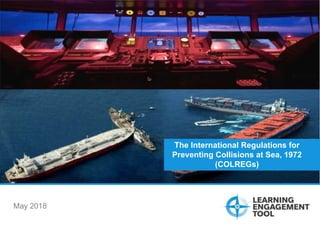
The International Regulations for
Preventing Collisions at Sea, 1972
(COLREGs)
Health, Safety, Security and Environment
COLREGS – May 2018
Notes for Guidance
This Engagement Pack IS NOT to be used for skills
training or a task requiring a licensed operator. This IS
NOT a tool box talk. This is an opportunity for staff on
board to talk about safety without feeling rushed to
commence their work. The rate of learning is more
important than completing the pack so allow two or more
sessions if necessary.
What the Engagement Pack includes
• Key points the supervisor should cover in their discussion
• Questions the supervisor can ask the group
Purpose of the Engagement Pack
To help supervisors provide their staff with a platform to have a
meaningful safety discussion and encourage sharing of
experiences and discussions around their learning outcomes.
Using the Engagement Pack
This pack has been designed for use by a supervisor in front of a
group of no more than 10 people. The pack should be placed on a
table with the pictures facing the group and the notes facing the
supervisor. Use practical demonstration where possible. The notes
are memory joggers to highlight key points but should not be read
word for word.
Preparing for an Engagement Session
Before beginning the session the supervisor should familiarise
themselves with the content and it’s purpose. Make sure there is
enough space and time for the staff to interact with each other.
Who is to be Engaged?
For the use of vessel crews and all those who are involved in
marine operations.
Where?
Engagement should be carried out in a quiet room/area where they
will not be disturbed. The vessel’s office, mess room, or quiet area
in a workshop would be suitable.
When to hold the Engagement
Choose a time that is suitable for all staff. This should be when
they are alert and most likely to contribute to the discussion. This
will help in absorbing and retaining the information for much longer.
COLREGs- May 2018
Health, Safety, Security and Environment
COLREGS – May 2018
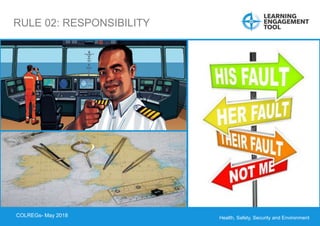
RULE 02: RESPONSIBILITY
Incorrect
footwear
COLREGs- May 2018
Health, Safety, Security and Environment
COLREGS – May 2018
RULE 02: RESPONSIBILITY
Discussion points:
1. Are your responsibilities limited to compliance with COLREGs?
2. What does Rule 2 require you to do?
3. When are you supposed to call the Master?
4. What will keep you out of danger?
Key message: It is always your responsibility
to comply with COLREGs and avoid collisions.
The main issues:
(a) Nothing in these Rules shall exonerate any vessel, or the owner, master or crew thereof, from
the consequences of any neglect to comply with these Rules or of the neglect of any precaution
which may be required by the ordinary practice of seamen, or by the special circumstances of the
case.
(b) In construing and complying with these Rules due regard shall be had to all dangers of
navigation and collision and to any special circumstances, including the limitations of the vessels
involved, which may make a departure from these Rules necessary to avoid immediate danger.
Processes:
Always
It does not tell you what to do or when to do it, but highlights the fact that you are responsible for
your own actions. You are the one who has to make the immediate decision on what to do in order
to comply with the rules.
Rule 2 makes you responsible to your fellow crew and to the ships around you.
Your responsibility is not only to follow the COLREGs – you are also responsible for doing
everything necessary to avoid the risk of collision and the dangers of navigation.
Ensure
Rule 2(a) requires you to follow both the rules and ‘the ordinary practice of seamen’. This means
that you must always use common sense.
Rule 2(b) is often misunderstood so read it carefully. It only allows you to depart from the rules if
that is the only way to avoid an immediate danger. But, in almost every situation, it is the proper
application of the rules that will keep you out of that danger.
Rule 2(b) is never a justification for not following the rules properly.
Always ask yourself:
• How does Rule 2 apply to this situation?
• What does Rule 2 require me to do?
COLREGs- May 2018
Health, Safety, Security and Environment
COLREGS – May 2018
RULE 05: LOOK-OUT
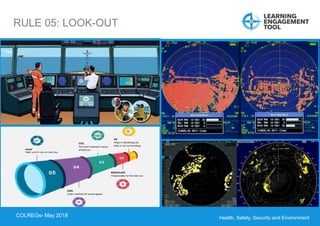
RADAR
Highly used for look out these days
EYES
The most important source
of look out
AIS
Helps in identifying the
ships in our surroundings
BINOCULARS
Irreplaceable for the look out
EARS
Listen carefully for sound signals
COLREGs- May 2018
Health, Safety, Security and Environment
COLREGS – May 2018
RULE 05: LOOK-OUT
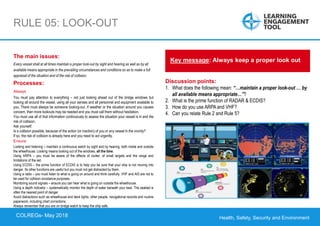
Discussion points:
1. What does the following mean: “…maintain a proper look-out … by
all available means appropriate…”?
2. What is the prime function of RADAR & ECDIS?
3. How do you use ARPA and VHF?
4. Can you relate Rule 2 and Rule 5?
Key message: Always keep a proper look out
The main issues:
Every vessel shall at all times maintain a proper look-out by sight and hearing as well as by all
available means appropriate in the prevailing circumstances and conditions so as to make a full
appraisal of the situation and of the risk of collision.
Processes:
Always
You must pay attention to everything – not just looking ahead out of the bridge windows but
looking all around the vessel, using all your senses and all personnel and equipment available to
you. There must always be someone looking-out. If weather or the situation around you causes
concern, then more lookouts may be needed and you must call them without hesitation.
You must use all of that information continuously to assess the situation your vessel is in and the
risk of collision.
Ask yourself:
Is a collision possible, because of the action (or inaction) of you or any vessel in the vicinity?
If so, the risk of collision is already here and you need to act urgently.
Ensure
Looking and listening – maintain a continuous watch by sight and by hearing, both inside and outside
the wheelhouse. Looking means looking out of the windows, all the time.
Using ARPA – you must be aware of the effects of clutter, of small targets and the range and
limitations of the set.
Using ECDIS – the prime function of ECDIS is to help you be sure that your ship is not moving into
danger. Its other functions are useful but you must not get distracted by them.
Using a radio – you must listen to what is going on around and think carefully. VHF and AIS are not to
be used for collision avoidance purposes.
Monitoring sound signals – ensure you can hear what is going on outside the wheelhouse.
Using a depth indicator – systematically monitor the depth of water beneath your keel. The seabed is
often the nearest point of danger.
Avoid distractions such as wheelhouse and deck lights, other people, navigational records and routine
paperwork, including chart corrections.
Always remember that you are on bridge watch to keep the ship safe.
COLREGs- May 2018
Health, Safety, Security and Environment
COLREGS – May 2018
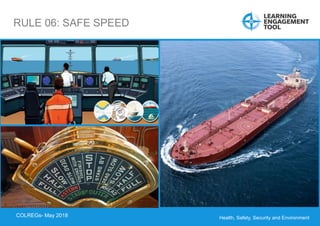
RULE 06: SAFE SPEED
COLREGs- May 2018
Health, Safety, Security and Environment
COLREGS – May 2018
RULE 06: SAFE SPEED
Discussion points:
1. In most cases, what happens with the CPA if you reduce speed?
2. What initial action will help you stop easier at a later stage?
3. Who is responsible for proceeding at a safe speed?
4. Define and elaborate “safe speed”?
5. Can you relate Rule 5 and Rule 6?
Key message: Always travel at a safe speed.
The main issues:
Every vessel shall at all times proceed at a safe speed so that she can take proper and effective
action to avoid collision and be stopped within a distance appropriate to the prevailing circumstances
and conditions.
The following factors shall be among those taken into account: visibility, traffic density and nature,
manoeuvrability of the vessel (stopping and turning ability in the prevailing conditions), presence of
background light at night, the state of wind, sea and current, and the proximity of navigational hazards,
the draught in relation to the available depth of water.
When radar in operation: the characteristics, any constraints imposed by the range scale in use, the
effect on radar detection of the sea state and weather, the possibility that small objects (ice, boats)
may not be detected by radar at an adequate range, the location and movement of vessels detected
by radar, the more exact assessment of the visibility.
Processes:
Always
Make your own judgement on the appropriate speed for your vessel. Excessive speed contributes to
many collisions.
In most cases, if either ship reduces speed, their closest point of approach (CPA) will increase.
Too much speed and too little time can fatally impair your risk assessment processes. It allows you to
stop more effectively.
Ensure
If an alteration of speed is necessary, then you do not have to ask permission.
Constantly monitor your speed – the situation at sea is always changing and a safe speed in one
situation can be too fast in another. Situations can change suddenly.
Maintaining a high speed for commercial reasons is no excuse and no defence for proceeding at an
unsafe speed.
Navigational aids such as RADAR, ECDIS and GPS are not always correct. Never rely on one
instrument or on one technique – always cross-check.
COLREGs- May 2018
Health, Safety, Security and Environment
COLREGS – May 2018
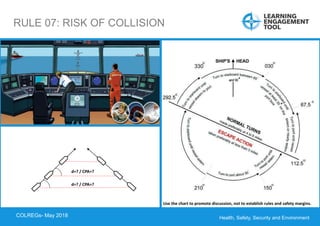
RULE 07: RISK OF COLLISION
Handrails
d=? / CPA=?
Use the chart to promote discussion, not to establish rules and safety margins.
d=? / CPA=?
COLREGs- May 2018
Health, Safety, Security and Environment
COLREGS – May 2018
RULE 07: RISK OF COLLISION
Discussion points:
1. Is there a risk of collision if the bearing to a target is changing
considerably? If yes, When?
2. Describe the difference between: true and relative vector, water and
ground speed?
3. Explain why not to use VHF for collision avoidance?
4. Can you relate Rule 5 and Rule 7?
Key message: Keep monitoring the situation until the
target ship is passed and clear. Always assess the risk of
collision.
The main issues:
(a) Every vessel shall use all available means appropriate to the prevailing circumstances and
conditions to determine if risk of collision exists. If there is any doubt such risk shall be deemed to
exist.
(b) Proper use shall be made of radar equipment if fitted and operational, including long-range
scanning to obtain early warning of risk of collision …
(c) Assumptions shall not be made on the basis of scanty information…
(d) In determining if risk of collision exists …:
(i) …deemed to exist if the compass bearing of an approaching vessel does not appreciably change;
(ii) such risk may sometimes exist even when an appreciable bearing change is evident, particularly
when approaching a very large vessel or a tow or when approaching a vessel at close range.
Processes:
Always
You must use all available means to collect information on the situation around you – Rule 5.
You must use that information continuously to assess the risk of collision – Rule 7.
Ask yourself:
Is a collision possible, because of the action/inaction of any vessel in the vicinity – including our own?
Is a collision probable? If so, the risk of collision is already here and you need to act urgently.
Do not just rely on a change of bearing as an indicator of clearance. As a target ship approaches, its
change of bearing should accelerate significantly. If the change of bearing does not accelerate then
there is a risk of collision.
Ensure
Risk-assessment techniques include:
Look and listen –you must use all the information and equipment available to determine the risk.
Use the compass regularly to check the bearing of approaching vessels. A steady bearing indicates
the risk of collision but a risk of collision may exist even with a bearing change, particularly at close
range and with large vessels.
 Is the target passing ahead or astern or are you going to collide?
 With ARPA, periodically use relative vectors to determine the risk of collision.
 At open sea: Bear in mind that the calculated CPA might be affected by the size of the
target (VLCC, very large container carriers). For accurate CPA take appropriate safe
margin.
COLREGs- May 2018
Health, Safety, Security and Environment
COLREGS – May 2018
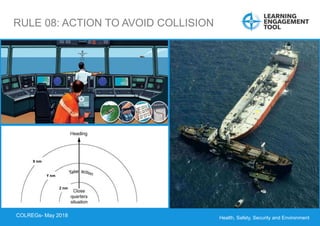
RULE 08: ACTION TO AVOID COLLISION
Handrails
X nm
Y nm
Z nm
COLREGs- May 2018
Health, Safety, Security and Environment
COLREGS – May 2018
RULE 08: ACTION TO AVOID COLLISION
Discussion points:
1. Explain actions that will help you to avoid collision?
2. Explain “bold and timely action”?
3. What can you do if your ability to alter course is constrained?
4. You are the stand-on vessel. Are you required to give way at any
time? Clarify? (Rules 2 and 17)
5. Do you remember sound and light signals of actions to avoid collision?
Key message: Take a bold and timely action to
avoid collision.
The main issues:
Action to avoid collision should always be:
• Positive – make a big alteration of course and/or speed.
• Made in good time – which means early.
• Seamanlike – do not make the situation worse for any other ship in the vicinity, assess what they
may have to do.
• Easily seen by the other ship(s) – avoid a series of small alterations of course and/or speed.
Processes:
Always
As soon as you identify a risk of collision, you must identify the correct action to avoid collision
to ensure the vessels will pass at ‘a safe distance’. You should then take that action to avoid
collision as soon as it is appropriate to do so.
Remember, a substantial alteration made early is better than a very large alteration made late.
The closer you are to the other vessel the greater the risk of collision and the more you will have
to do, to pass at a safe distance. Small alterations of course and speed are dangerous; they do
not often solve the problem and they do not give the other vessel a clear indication of what you
are doing.
Remember to make appropriate sound and light signals.
You should confirm your action to avoid collision by monitoring the change in CPA. Keep taking
bearings and checking the situation until the risk of collision is over. And remember your engine –
if your ability to alter course is constrained then slow down or stop.
Ensure
Giving way and not impeding
If the COLREGs require you ‘not to impede’ or ‘give way to’ another vessel, then you must take
very early action to make sure risk of collision does not develop.
If you are the ‘not to be impeded’ or stand-on vessel, then you must always be prepared for the
give-way vessel not to take the correct action. If a risk of collision develops, you will have to act –
remember the caution in Rule 2 on responsibilities and your continuing responsibilities in Rule 17
on action by the stand-on vessel.
COLREGs- May 2018
Health, Safety, Security and Environment
COLREGS – May 2018
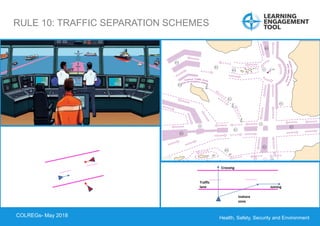
RULE 10: TRAFFIC SEPARATION SCHEMES
Inshore
zone
Traffic
lane
Crossing
Joining
COLREGs- May 2018
Health, Safety, Security and Environment
COLREGS – May 2018
RULE 10: TRAFFIC SEPARATION SCHEMES
Discussion points:
1. What are the rules for crossing or joining a TSS?
2. Does the TSS give you the right of way?
3. Do you have to pay particular attention at certain parts of a TSS?
4. What do you think on the use of VHF?
Key message: You have no additional rights of
way in a traffic separation scheme.
The main issues:
This Rule applies to traffic separation schemes adopted by the Organisation and does not
relieve any vessel of her obligation under any other Rule.
Rule 10 is one of the longest rules and one of the hardest to understand. Please take your time and
use the COLREGs to review it.
Processes:
Always
Always remember the following:
There is no right of way – a traffic separation scheme does not give you right of way over any
other vessels.
All of the other rules continue to apply within a traffic separation scheme.
The actions of vessels navigating in and near a traffic separation scheme can be unpredictable.
Traffic separation schemes are established in busy areas of difficult navigation. You can expect
above-average density of traffic, crossing vessels, fishing vessels and high-speed craft. Study the
passage before your watch, be prepared and, if you need assistance, ask for it well in advance.
Ensure
Tips for navigating in traffic separation schemes are:
• Keep in your lane.
• Particular caution is required at the ends of the scheme.
• Avoid VHF calls to other ships – it will only distract them.
• Beware of fishing vessels – they are allowed to fish in traffic separation lanes.
• Look out for crossing vessels – they should cross the scheme at right angles but they may
navigate parallel to the scheme for a while to find an opportunity to cross.
• Look out for high-speed craft – especially wide on your beam.
• If you are not happy, slow down or stop.
• Stay vigilant at all times.
COLREGs- May 2018
Health, Safety, Security and Environment
COLREGS – May 2018
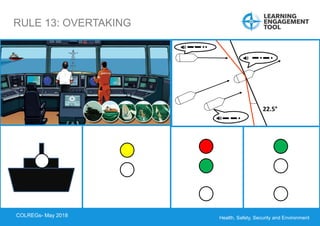
RULE 13: OVERTAKING
22.5°
COLREGs- May 2018
Health, Safety, Security and Environment
COLREGS – May 2018
RULE 13: OVERTAKING
Discussion points:
1. What are your obligations when overtaking or being overtaken?
2. What sound signals or lights can explain/support your actions?
3. Think of scenarios and development of an overtaking situation?
4. Which are the visible lights of a ship being overtaken?
Key message: Keep clear of a ship you are
overtaking.
The main issues:
(a) Notwithstanding anything contained in the Rules of Part B, Sections I and II, any vessel overtaking
any other shall keep out of the way of the vessel being overtaken.
(b) A vessel shall be deemed to be overtaking when coming up with another vessel from a direction
more than 22.5 degrees abaft her beam, that is, in such a position with reference to the vessel she is
overtaking, that at night she would be able to see only the stern light of that vessel but neither of her
sidelights.
(c) When a vessel is in any doubt as to whether she is overtaking another, she shall assume that this
is the case and act accordingly.
(d) Any subsequent alteration of the bearing between the two vessels shall not make the overtaking
vessel a crossing vessel within the meaning of these Rules or relieve her of the duty of keeping clear
of the overtaken vessel until she is finally past and clear.
Processes:
Always
Rule 13 has no exceptions; the overtaking vessel always keeps out of the way.
If you are not sure whether you are overtaking another vessel, then Rule 13 says that you
are.
Always presume the other ship does not know you are there.
Once you are an overtaking vessel, you are an overtaking vessel until you are finally past and
clear.
Ensure
Avoid crossing ahead – it is always safer to cross astern.
Do not pass close – overtaking always takes time, so make sure both ships have plenty of room
to manoeuvre. Never assume that the other ship will maintain its course and speed.
Beware of interaction – if you are forced to pass close, be very careful of interaction between the
two vessels.
Remain vigilant – remember; you remain an overtaking vessel until you are finally passed and
clear.
COLREGs- May 2018
Health, Safety, Security and Environment
COLREGS – May 2018
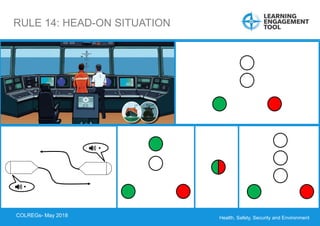
RULE 14: HEAD-ON SITUATION
COLREGs- May 2018
Health, Safety, Security and Environment
COLREGS – May 2018
RULE 14: HEAD-ON SITUATION
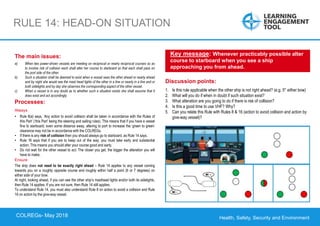
Discussion points:
1. Is this rule applicable when the other ship is not right ahead? (e.g. 5° either bow)
2. What will you do if when in doubt if such situation exist?
3. What alteration are you going to do if there is risk of collision?
4. Is this a good time to use VHF? Why?
5. Can you relate this Rule with Rules 8 & 16 (action to avoid collision and action by
give-way vessel)?
Key message: Whenever practicably possible alter
course to starboard when you see a ship
approaching you from ahead.
The main issues:
a) When two power-driven vessels are meeting on reciprocal or nearly reciprocal courses so as
to involve risk of collision each shall alter her course to starboard so that each shall pass on
the port side of the other.
b) Such a situation shall be deemed to exist when a vessel sees the other ahead or nearly ahead
and by night she would see the mast head lights of the other in a line or nearly in a line and or
both sidelights and by day she observes the corresponding aspect of the other vessel.
c) When a vessel is in any doubt as to whether such a situation exists she shall assume that it
does exist and act accordingly.
Processes:
Always
• Rule 8(a) says, ‘Any action to avoid collision shall be taken in accordance with the Rules of
this Part’ (‘this Part’ being the steering and sailing rules). This means that if you have a vessel
fine to starboard, even some distance away, altering to port to increase the ‘green to green’
clearance may not be in accordance with the COLREGs.
• If there is any risk of collision then you should always go to starboard, as Rule 14 says.
• Rule 16 says that if you are to keep out of the way, you must take early and substantial
action. This means you should alter your course good and early.
• Do not wait for the other vessel to act. The closer you get, the bigger the alteration you will
have to make.
Ensure
The ship does not need to be exactly right ahead – Rule 14 applies to any vessel coming
towards you on a roughly opposite course and roughly within half a point (6 or 7 degrees) on
either side of your bow.
At night, looking ahead, if you can see the other ship’s masthead lights and/or both its sidelights,
then Rule 14 applies. If you are not sure, then Rule 14 still applies.
To understand Rule 14, you must also understand Rule 8 on action to avoid a collision and Rule
16 on action by the give-way vessel.
COLREGs- May 2018
Health, Safety, Security and Environment
COLREGS – May 2018
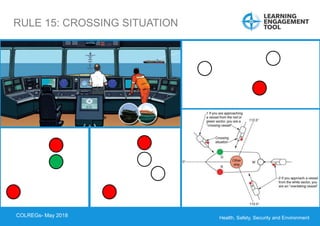
RULE 15: CROSSING SITUATION
COLREGs- May 2018
Health, Safety, Security and Environment
COLREGS – May 2018
RULE 15: CROSSING SITUATION
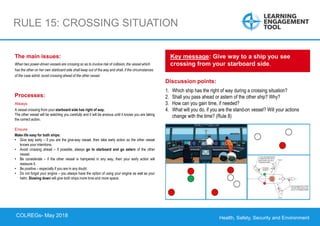
Discussion points:
1. Which ship has the right of way during a crossing situation?
2. Shall you pass ahead or astern of the other ship? Why?
3. How can you gain time, if needed?
4. What will you do, if you are the stand-on vessel? Will your actions
change with the time? (Rule 8)
Key message: Give way to a ship you see
crossing from your starboard side.
The main issues:
When two power-driven vessels are crossing so as to involve risk of collision, the vessel which
has the other on her own starboard side shall keep out of the way and shall, if the circumstances
of the case admit, avoid crossing ahead of the other vessel.
Processes:
Always
A vessel crossing from your starboard side has right of way.
The other vessel will be watching you carefully and it will be anxious until it knows you are taking
the correct action.
Ensure
Make life easy for both ships:
• Give way early – if you are the give-way vessel, then take early action so the other vessel
knows your intentions.
• Avoid crossing ahead – if possible, always go to starboard and go astern of the other
vessel.
• Be considerate – if the other vessel is hampered in any way, then your early action will
reassure it.
• Be positive – especially if you are in any doubt.
• Do not forget your engine – you always have the option of using your engine as well as your
helm. Slowing down will give both ships more time and more space.
COLREGs- May 2018
Health, Safety, Security and Environment
COLREGS – May 2018
RULE 16: ACTION BY GIVE-WAY VESSEL
COLREGs- May 2018
Health, Safety, Security and Environment
COLREGS – May 2018
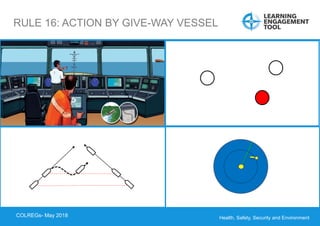
RULE 16: ACTION BY GIVE-WAY VESSEL
Discussion points:
1. What is the best time to take action?
2. When changing course, how much will you alter?
3. How can you make sure that the other vessel will not do something
unexpected?
4. Can you rely on one equipment solely? Which is the best way to
determine if the other ship is altering?
Key message: Give way to a stand-on ship
early, clearly and courteously.
The main issues:
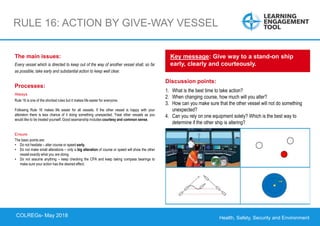
Every vessel which is directed to keep out of the way of another vessel shall, so far
as possible, take early and substantial action to keep well clear.
Processes:
Always
Rule 16 is one of the shortest rules but it makes life easier for everyone.
Following Rule 16 makes life easier for all vessels. If the other vessel is happy with your
alteration there is less chance of it doing something unexpected. Treat other vessels as you
would like to be treated yourself. Good seamanship includes courtesy and common sense.
Ensure
The basic points are:
• Do not hesitate – alter course or speed early.
• Do not make small alterations – only a big alteration of course or speed will show the other
vessel exactly what you are doing.
• Do not assume anything – keep checking the CPA and keep taking compass bearings to
make sure your action has the desired effect.
COLREGs- May 2018
Health, Safety, Security and Environment
COLREGS – May 2018
RULE 17: ACTION BY STAND-ON VESSEL
COLREGs- May 2018
Health, Safety, Security and Environment
COLREGS – May 2018
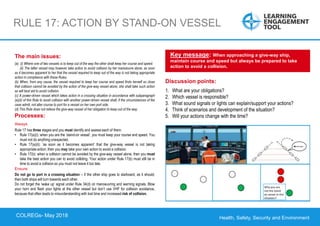
RULE 17: ACTION BY STAND-ON VESSEL
Discussion points:
1. What are your obligations?
2. Which vessel is responsible?
3. What sound signals or lights can explain/support your actions?
4. Think of scenarios and development of the situation?
5. Will your actions change with the time?
Key message: When approaching a give-way ship,
maintain course and speed but always be prepared to take
action to avoid a collision.
The main issues:
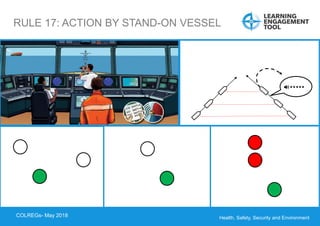
(a) (i) Where one of two vessels is to keep out of the way the other shall keep her course and speed.
(ii) The latter vessel may however take action to avoid collision by her manoeuvre alone, as soon
as it becomes apparent to her that the vessel required to keep out of the way is not taking appropriate
action in compliance with these Rules.
(b) When, from any cause, the vessel required to keep her course and speed finds herself so close
that collision cannot be avoided by the action of the give-way vessel alone, she shall take such action
as will best aid to avoid collision.
(c) A power-driven vessel which takes action in a crossing situation in accordance with subparagraph
(a)(ii) of this Rule to avoid collision with another power-driven vessel shall, if the circumstances of the
case admit, not alter course to port for a vessel on her own port side.
(d) This Rule does not relieve the give-way vessel of her obligation to keep out of the way.
Processes:
Always
Rule 17 has three stages and you must identify and assess each of them:
• Rule 17(a)(i): when you are the ‘stand-on vessel’, you must keep your course and speed. You
must not do anything unexpected.
• Rule 17(a)(ii): ‘as soon as it becomes apparent’ that the give-way vessel is not taking
appropriate action, then you may take your own action to avoid a collision.
• Rule 17(b): when a collision cannot be avoided by the give-way vessel alone, then you must
take the best action you can to avoid colliding. Your action under Rule 17(b) must still be in
time to avoid a collision so you must not leave it too late.
Ensure
Do not go to port in a crossing situation – if the other ship goes to starboard, as it should,
then both ships will turn towards each other.
Do not forget the ‘wake up’ signal under Rule 34(d) on manoeuvring and warning signals. Blow
your horn and flash your lights at the other vessel but don’t use VHF for collision avoidance,
because that often leads to misunderstanding with lost time and increased risk of collision.
Why you are
not the stand
on vessel in this
situation?
COLREGs- May 2018
Health, Safety, Security and Environment
COLREGS – May 2018
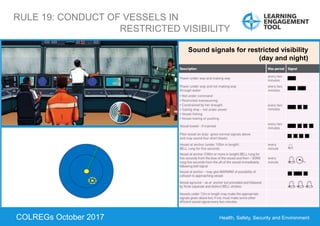
RULE 19: CONDUCT OF VESSELS IN
RESTRICTED VISIBILITY
Sound signals for restricted visibility
(day and night)
COLREGs October 2017
Health, Safety, Security and Environment
COLREGS – May 2018
Discussion points:
1. How will you determine if you are entering area of restricted visibility
and what actions will you take?
2. Give examples on sound signals in restricted visibility?
3. What will you do if the other ship is detected aft of your beam?
4. Give example of bridge manning in prolonged restricted visibility?
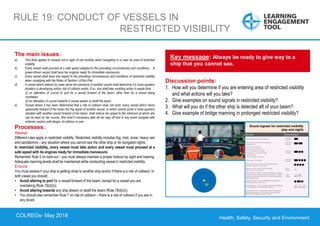
Key message: Always be ready to give way to a
ship that you cannot see.
The main issues:
a) This Rule applies to vessels not in sight of one another when navigating in or near an area of restricted
visibility.
b) Every vessel shall proceed at a safe speed adapted to the prevailing circumstances and conditions… A
power-driven vessel shall have her engines ready for immediate manoeuvre.
c) Every vessel shall have due regard to the prevailing circumstances and conditions of restricted visibility
when complying with the Rules of Section I of this Part.
d) A vessel which detects by radar alone the presence of another vessel shall determine if a close quarters
situation is developing and/or risk of collision exists. If so, she shall take avoiding action in ample time…:
(i) an alteration of course to port for a vessel forward of the beam, other than for a vessel being
overtaken;
(ii) an alteration of course towards a vessel abeam or abaft the beam.
e) Except where it has been determined that a risk of collision does not exist, every vessel which hears
apparently forward of her beam the fog signal of another vessel, or which cannot avoid a close-quarters
situation with another vessel forward of her beam, shall reduce her speed to the minimum at which she
can be kept on her course. She shall if necessary take all her way off and in any event navigate with
extreme caution until danger of collision is over.
Processes:
Always
Different rules apply in restricted visibility. Restricted visibility includes fog, mist, snow, heavy rain
and sandstorms – any situation where you cannot see the other ship or its navigation lights.
In restricted visibility, every vessel must take action and every vessel must proceed at a
safe speed with its engines ready for immediate manoeuvre.
Remember Rule 5 on look-out – you must always maintain a proper lookout by sight and hearing.
Adequate manning levels shall be maintained while conducting vessel in restricted visibility.
Ensure
You must assess if your ship is getting close to another ship and/or if there is a risk of collision. In
both cases you should:
• Avoid altering to port for a vessel forward of the beam, except for a vessel you are
overtaking (Rule 19(d)(i)).
• Avoid altering towards any ship abeam or abaft the beam (Rule 19(d)(ii)).
• You should also remember Rule 7 on risk of collision – there is a risk of collision if you are in
any doubt.
RULE 19: CONDUCT OF VESSELS IN
RESTRICTED VISIBILITY
COLREGs- May 2018
Health, Safety, Security and Environment
COLREGS – May 2018
REFERENCE SECTION
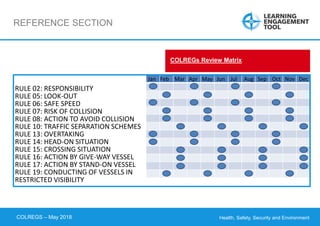
RULE 02: RESPONSIBILITY
RULE 05: LOOK-OUT
RULE 06: SAFE SPEED
RULE 07: RISK OF COLLISION
RULE 08: ACTION TO AVOID COLLISION
RULE 10: TRAFFIC SEPARATION SCHEMES
RULE 13: OVERTAKING
RULE 14: HEAD-ON SITUATION
RULE 15: CROSSING SITUATION
RULE 16: ACTION BY GIVE-WAY VESSEL
RULE 17: ACTION BY STAND-ON VESSEL
RULE 19: CONDUCTING OF VESSELS IN
RESTRICTED VISIBILITY
Jan Feb Mar Apr May Jun Jul Aug Sep Oct Nov Dec
COLREGs Review Matrix
Health, Safety, Security and Environment
COLREGS – May 2018
REFERENCE SECTION
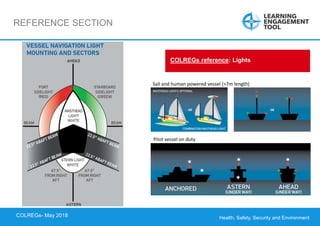
COLREGs reference: Lights
Sail and human powered vessel (>7m length)
Pilot vessel on duty
COLREGs- May 2018
Health, Safety, Security and Environment
COLREGS – May 2018
REFERENCE SECTION
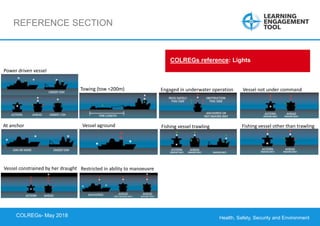
COLREGs reference: Lights
Power driven vessel
Towing (tow <200m)
At anchor Vessel aground
Vessel constrained by her draught Restricted in ability to manoeuvre
Engaged in underwater operation Vessel not under command
Fishing vessel trawling Fishing vessel other than trawling
COLREGs- May 2018
Health, Safety, Security and Environment
COLREGS – May 2018
REFERENCE SECTION
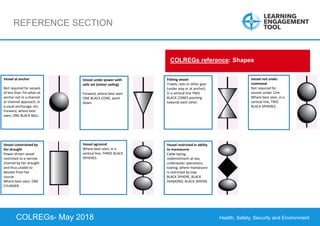
COLREGs reference: Shapes
Vessel not under
command
Not required for
vessels under 12m.
Where best seen, in a
vertical line, TWO
BLACK SPHERES.
Fishing vessel
Trawls, nets or other gear
(under way or at anchor).
In a vertical line TWO
BLACK CONES pointing
towards each other.
Vessel at anchor
Not required for vessels
of less than 7m when at
anchor not in a channel
or channel approach, or
a usual anchorage, etc.
Forward, where best
seen, ONE BLACK BALL.
Vessel under power with
sails set (motor sailing)
Forward, where best seen
ONE BLACK CONE, point
down.
Vessel constrained by
her draught
Power-driven vessel
restricted to a narrow
channel by her draught
and thus unable to
deviate from her
course.
Where best seen, ONE
CYLINDER.
Vessel aground
Where best seen, in a
vertical line, THREE BLACK
SPHERES.
Vessel restricted in ability
to manoeuvre
Cable laying,
replenishment at sea,
underwater operations,
towing, where manoeuvre
is restricted by tow.
BLACK SPHERE, BLACK
DIAMOND, BLACK SPHERE.
COLREGs- May 2018
Health, Safety, Security and Environment
COLREGS – May 2018
REFERENCE SECTION
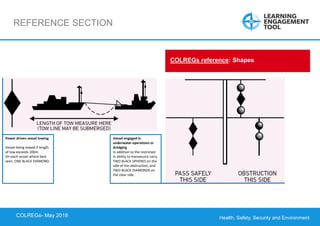
COLREGs reference: Shapes
Power driven vessel towing
Vessel being towed if length
of tow exceeds 200m.
On each vessel where best
seen, ONE BLACK DIAMOND.
Vessel engaged in
underwater operations or
dredging
In addition to the restricted
in ability to manoeuvre carry
TWO BLACK SPHERES on the
side of the obstruction, and
TWO BLACK DIAMONDS on
the clear side.
COLREGs- May 2018
Health, Safety, Security and Environment
COLREGS – May 2018
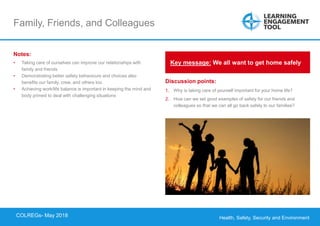
Family, Friends, and Colleagues
YOUR FAMILY NEEDS YOU
Remember
COLREGs- May 2018
Health, Safety, Security and Environment
COLREGS – May 2018
Family, Friends, and Colleagues
Discussion points:
1. Why is taking care of yourself important for your home life?
2. How can we set good examples of safety for our friends and
colleagues so that we can all go back safely to our families?
Key message: We all want to get home safely
Notes:
• Taking care of ourselves can improve our relationships with
family and friends
• Demonstrating better safety behaviours and choices also
benefits our family, crew, and others too
• Achieving work/life balance is important in keeping the mind and
body primed to deal with challenging situations
COLREGs- May 2018

Collision Avoidance Regulations for Maritime

  • 1.
    May 2018 Slips, Trips& Falls The International Regulations for Preventing Collisions at Sea, 1972 (COLREGs)
  • 2.
    Health, Safety, Securityand Environment COLREGS – May 2018 Notes for Guidance This Engagement Pack IS NOT to be used for skills training or a task requiring a licensed operator. This IS NOT a tool box talk. This is an opportunity for staff on board to talk about safety without feeling rushed to commence their work. The rate of learning is more important than completing the pack so allow two or more sessions if necessary. What the Engagement Pack includes • Key points the supervisor should cover in their discussion • Questions the supervisor can ask the group Purpose of the Engagement Pack To help supervisors provide their staff with a platform to have a meaningful safety discussion and encourage sharing of experiences and discussions around their learning outcomes. Using the Engagement Pack This pack has been designed for use by a supervisor in front of a group of no more than 10 people. The pack should be placed on a table with the pictures facing the group and the notes facing the supervisor. Use practical demonstration where possible. The notes are memory joggers to highlight key points but should not be read word for word. Preparing for an Engagement Session Before beginning the session the supervisor should familiarise themselves with the content and it’s purpose. Make sure there is enough space and time for the staff to interact with each other. Who is to be Engaged? For the use of vessel crews and all those who are involved in marine operations. Where? Engagement should be carried out in a quiet room/area where they will not be disturbed. The vessel’s office, mess room, or quiet area in a workshop would be suitable. When to hold the Engagement Choose a time that is suitable for all staff. This should be when they are alert and most likely to contribute to the discussion. This will help in absorbing and retaining the information for much longer. COLREGs- May 2018
  • 3.
    Health, Safety, Securityand Environment COLREGS – May 2018 RULE 02: RESPONSIBILITY Incorrect footwear COLREGs- May 2018
  • 4.
    Health, Safety, Securityand Environment COLREGS – May 2018 RULE 02: RESPONSIBILITY Discussion points: 1. Are your responsibilities limited to compliance with COLREGs? 2. What does Rule 2 require you to do? 3. When are you supposed to call the Master? 4. What will keep you out of danger? Key message: It is always your responsibility to comply with COLREGs and avoid collisions. The main issues: (a) Nothing in these Rules shall exonerate any vessel, or the owner, master or crew thereof, from the consequences of any neglect to comply with these Rules or of the neglect of any precaution which may be required by the ordinary practice of seamen, or by the special circumstances of the case. (b) In construing and complying with these Rules due regard shall be had to all dangers of navigation and collision and to any special circumstances, including the limitations of the vessels involved, which may make a departure from these Rules necessary to avoid immediate danger. Processes: Always It does not tell you what to do or when to do it, but highlights the fact that you are responsible for your own actions. You are the one who has to make the immediate decision on what to do in order to comply with the rules. Rule 2 makes you responsible to your fellow crew and to the ships around you. Your responsibility is not only to follow the COLREGs – you are also responsible for doing everything necessary to avoid the risk of collision and the dangers of navigation. Ensure Rule 2(a) requires you to follow both the rules and ‘the ordinary practice of seamen’. This means that you must always use common sense. Rule 2(b) is often misunderstood so read it carefully. It only allows you to depart from the rules if that is the only way to avoid an immediate danger. But, in almost every situation, it is the proper application of the rules that will keep you out of that danger. Rule 2(b) is never a justification for not following the rules properly. Always ask yourself: • How does Rule 2 apply to this situation? • What does Rule 2 require me to do? COLREGs- May 2018
  • 5.
    Health, Safety, Securityand Environment COLREGS – May 2018 RULE 05: LOOK-OUT RADAR Highly used for look out these days EYES The most important source of look out AIS Helps in identifying the ships in our surroundings BINOCULARS Irreplaceable for the look out EARS Listen carefully for sound signals COLREGs- May 2018
  • 6.
    Health, Safety, Securityand Environment COLREGS – May 2018 RULE 05: LOOK-OUT Discussion points: 1. What does the following mean: “…maintain a proper look-out … by all available means appropriate…”? 2. What is the prime function of RADAR & ECDIS? 3. How do you use ARPA and VHF? 4. Can you relate Rule 2 and Rule 5? Key message: Always keep a proper look out The main issues: Every vessel shall at all times maintain a proper look-out by sight and hearing as well as by all available means appropriate in the prevailing circumstances and conditions so as to make a full appraisal of the situation and of the risk of collision. Processes: Always You must pay attention to everything – not just looking ahead out of the bridge windows but looking all around the vessel, using all your senses and all personnel and equipment available to you. There must always be someone looking-out. If weather or the situation around you causes concern, then more lookouts may be needed and you must call them without hesitation. You must use all of that information continuously to assess the situation your vessel is in and the risk of collision. Ask yourself: Is a collision possible, because of the action (or inaction) of you or any vessel in the vicinity? If so, the risk of collision is already here and you need to act urgently. Ensure Looking and listening – maintain a continuous watch by sight and by hearing, both inside and outside the wheelhouse. Looking means looking out of the windows, all the time. Using ARPA – you must be aware of the effects of clutter, of small targets and the range and limitations of the set. Using ECDIS – the prime function of ECDIS is to help you be sure that your ship is not moving into danger. Its other functions are useful but you must not get distracted by them. Using a radio – you must listen to what is going on around and think carefully. VHF and AIS are not to be used for collision avoidance purposes. Monitoring sound signals – ensure you can hear what is going on outside the wheelhouse. Using a depth indicator – systematically monitor the depth of water beneath your keel. The seabed is often the nearest point of danger. Avoid distractions such as wheelhouse and deck lights, other people, navigational records and routine paperwork, including chart corrections. Always remember that you are on bridge watch to keep the ship safe. COLREGs- May 2018
  • 7.
    Health, Safety, Securityand Environment COLREGS – May 2018 RULE 06: SAFE SPEED COLREGs- May 2018
  • 8.
    Health, Safety, Securityand Environment COLREGS – May 2018 RULE 06: SAFE SPEED Discussion points: 1. In most cases, what happens with the CPA if you reduce speed? 2. What initial action will help you stop easier at a later stage? 3. Who is responsible for proceeding at a safe speed? 4. Define and elaborate “safe speed”? 5. Can you relate Rule 5 and Rule 6? Key message: Always travel at a safe speed. The main issues: Every vessel shall at all times proceed at a safe speed so that she can take proper and effective action to avoid collision and be stopped within a distance appropriate to the prevailing circumstances and conditions. The following factors shall be among those taken into account: visibility, traffic density and nature, manoeuvrability of the vessel (stopping and turning ability in the prevailing conditions), presence of background light at night, the state of wind, sea and current, and the proximity of navigational hazards, the draught in relation to the available depth of water. When radar in operation: the characteristics, any constraints imposed by the range scale in use, the effect on radar detection of the sea state and weather, the possibility that small objects (ice, boats) may not be detected by radar at an adequate range, the location and movement of vessels detected by radar, the more exact assessment of the visibility. Processes: Always Make your own judgement on the appropriate speed for your vessel. Excessive speed contributes to many collisions. In most cases, if either ship reduces speed, their closest point of approach (CPA) will increase. Too much speed and too little time can fatally impair your risk assessment processes. It allows you to stop more effectively. Ensure If an alteration of speed is necessary, then you do not have to ask permission. Constantly monitor your speed – the situation at sea is always changing and a safe speed in one situation can be too fast in another. Situations can change suddenly. Maintaining a high speed for commercial reasons is no excuse and no defence for proceeding at an unsafe speed. Navigational aids such as RADAR, ECDIS and GPS are not always correct. Never rely on one instrument or on one technique – always cross-check. COLREGs- May 2018
  • 9.
    Health, Safety, Securityand Environment COLREGS – May 2018 RULE 07: RISK OF COLLISION Handrails d=? / CPA=? Use the chart to promote discussion, not to establish rules and safety margins. d=? / CPA=? COLREGs- May 2018
  • 10.
    Health, Safety, Securityand Environment COLREGS – May 2018 RULE 07: RISK OF COLLISION Discussion points: 1. Is there a risk of collision if the bearing to a target is changing considerably? If yes, When? 2. Describe the difference between: true and relative vector, water and ground speed? 3. Explain why not to use VHF for collision avoidance? 4. Can you relate Rule 5 and Rule 7? Key message: Keep monitoring the situation until the target ship is passed and clear. Always assess the risk of collision. The main issues: (a) Every vessel shall use all available means appropriate to the prevailing circumstances and conditions to determine if risk of collision exists. If there is any doubt such risk shall be deemed to exist. (b) Proper use shall be made of radar equipment if fitted and operational, including long-range scanning to obtain early warning of risk of collision … (c) Assumptions shall not be made on the basis of scanty information… (d) In determining if risk of collision exists …: (i) …deemed to exist if the compass bearing of an approaching vessel does not appreciably change; (ii) such risk may sometimes exist even when an appreciable bearing change is evident, particularly when approaching a very large vessel or a tow or when approaching a vessel at close range. Processes: Always You must use all available means to collect information on the situation around you – Rule 5. You must use that information continuously to assess the risk of collision – Rule 7. Ask yourself: Is a collision possible, because of the action/inaction of any vessel in the vicinity – including our own? Is a collision probable? If so, the risk of collision is already here and you need to act urgently. Do not just rely on a change of bearing as an indicator of clearance. As a target ship approaches, its change of bearing should accelerate significantly. If the change of bearing does not accelerate then there is a risk of collision. Ensure Risk-assessment techniques include: Look and listen –you must use all the information and equipment available to determine the risk. Use the compass regularly to check the bearing of approaching vessels. A steady bearing indicates the risk of collision but a risk of collision may exist even with a bearing change, particularly at close range and with large vessels.  Is the target passing ahead or astern or are you going to collide?  With ARPA, periodically use relative vectors to determine the risk of collision.  At open sea: Bear in mind that the calculated CPA might be affected by the size of the target (VLCC, very large container carriers). For accurate CPA take appropriate safe margin. COLREGs- May 2018
  • 11.
    Health, Safety, Securityand Environment COLREGS – May 2018 RULE 08: ACTION TO AVOID COLLISION Handrails X nm Y nm Z nm COLREGs- May 2018
  • 12.
    Health, Safety, Securityand Environment COLREGS – May 2018 RULE 08: ACTION TO AVOID COLLISION Discussion points: 1. Explain actions that will help you to avoid collision? 2. Explain “bold and timely action”? 3. What can you do if your ability to alter course is constrained? 4. You are the stand-on vessel. Are you required to give way at any time? Clarify? (Rules 2 and 17) 5. Do you remember sound and light signals of actions to avoid collision? Key message: Take a bold and timely action to avoid collision. The main issues: Action to avoid collision should always be: • Positive – make a big alteration of course and/or speed. • Made in good time – which means early. • Seamanlike – do not make the situation worse for any other ship in the vicinity, assess what they may have to do. • Easily seen by the other ship(s) – avoid a series of small alterations of course and/or speed. Processes: Always As soon as you identify a risk of collision, you must identify the correct action to avoid collision to ensure the vessels will pass at ‘a safe distance’. You should then take that action to avoid collision as soon as it is appropriate to do so. Remember, a substantial alteration made early is better than a very large alteration made late. The closer you are to the other vessel the greater the risk of collision and the more you will have to do, to pass at a safe distance. Small alterations of course and speed are dangerous; they do not often solve the problem and they do not give the other vessel a clear indication of what you are doing. Remember to make appropriate sound and light signals. You should confirm your action to avoid collision by monitoring the change in CPA. Keep taking bearings and checking the situation until the risk of collision is over. And remember your engine – if your ability to alter course is constrained then slow down or stop. Ensure Giving way and not impeding If the COLREGs require you ‘not to impede’ or ‘give way to’ another vessel, then you must take very early action to make sure risk of collision does not develop. If you are the ‘not to be impeded’ or stand-on vessel, then you must always be prepared for the give-way vessel not to take the correct action. If a risk of collision develops, you will have to act – remember the caution in Rule 2 on responsibilities and your continuing responsibilities in Rule 17 on action by the stand-on vessel. COLREGs- May 2018
  • 13.
    Health, Safety, Securityand Environment COLREGS – May 2018 RULE 10: TRAFFIC SEPARATION SCHEMES Inshore zone Traffic lane Crossing Joining COLREGs- May 2018
  • 14.
    Health, Safety, Securityand Environment COLREGS – May 2018 RULE 10: TRAFFIC SEPARATION SCHEMES Discussion points: 1. What are the rules for crossing or joining a TSS? 2. Does the TSS give you the right of way? 3. Do you have to pay particular attention at certain parts of a TSS? 4. What do you think on the use of VHF? Key message: You have no additional rights of way in a traffic separation scheme. The main issues: This Rule applies to traffic separation schemes adopted by the Organisation and does not relieve any vessel of her obligation under any other Rule. Rule 10 is one of the longest rules and one of the hardest to understand. Please take your time and use the COLREGs to review it. Processes: Always Always remember the following: There is no right of way – a traffic separation scheme does not give you right of way over any other vessels. All of the other rules continue to apply within a traffic separation scheme. The actions of vessels navigating in and near a traffic separation scheme can be unpredictable. Traffic separation schemes are established in busy areas of difficult navigation. You can expect above-average density of traffic, crossing vessels, fishing vessels and high-speed craft. Study the passage before your watch, be prepared and, if you need assistance, ask for it well in advance. Ensure Tips for navigating in traffic separation schemes are: • Keep in your lane. • Particular caution is required at the ends of the scheme. • Avoid VHF calls to other ships – it will only distract them. • Beware of fishing vessels – they are allowed to fish in traffic separation lanes. • Look out for crossing vessels – they should cross the scheme at right angles but they may navigate parallel to the scheme for a while to find an opportunity to cross. • Look out for high-speed craft – especially wide on your beam. • If you are not happy, slow down or stop. • Stay vigilant at all times. COLREGs- May 2018
  • 15.
    Health, Safety, Securityand Environment COLREGS – May 2018 RULE 13: OVERTAKING 22.5° COLREGs- May 2018
  • 16.
    Health, Safety, Securityand Environment COLREGS – May 2018 RULE 13: OVERTAKING Discussion points: 1. What are your obligations when overtaking or being overtaken? 2. What sound signals or lights can explain/support your actions? 3. Think of scenarios and development of an overtaking situation? 4. Which are the visible lights of a ship being overtaken? Key message: Keep clear of a ship you are overtaking. The main issues: (a) Notwithstanding anything contained in the Rules of Part B, Sections I and II, any vessel overtaking any other shall keep out of the way of the vessel being overtaken. (b) A vessel shall be deemed to be overtaking when coming up with another vessel from a direction more than 22.5 degrees abaft her beam, that is, in such a position with reference to the vessel she is overtaking, that at night she would be able to see only the stern light of that vessel but neither of her sidelights. (c) When a vessel is in any doubt as to whether she is overtaking another, she shall assume that this is the case and act accordingly. (d) Any subsequent alteration of the bearing between the two vessels shall not make the overtaking vessel a crossing vessel within the meaning of these Rules or relieve her of the duty of keeping clear of the overtaken vessel until she is finally past and clear. Processes: Always Rule 13 has no exceptions; the overtaking vessel always keeps out of the way. If you are not sure whether you are overtaking another vessel, then Rule 13 says that you are. Always presume the other ship does not know you are there. Once you are an overtaking vessel, you are an overtaking vessel until you are finally past and clear. Ensure Avoid crossing ahead – it is always safer to cross astern. Do not pass close – overtaking always takes time, so make sure both ships have plenty of room to manoeuvre. Never assume that the other ship will maintain its course and speed. Beware of interaction – if you are forced to pass close, be very careful of interaction between the two vessels. Remain vigilant – remember; you remain an overtaking vessel until you are finally passed and clear. COLREGs- May 2018
  • 17.
    Health, Safety, Securityand Environment COLREGS – May 2018 RULE 14: HEAD-ON SITUATION COLREGs- May 2018
  • 18.
    Health, Safety, Securityand Environment COLREGS – May 2018 RULE 14: HEAD-ON SITUATION Discussion points: 1. Is this rule applicable when the other ship is not right ahead? (e.g. 5° either bow) 2. What will you do if when in doubt if such situation exist? 3. What alteration are you going to do if there is risk of collision? 4. Is this a good time to use VHF? Why? 5. Can you relate this Rule with Rules 8 & 16 (action to avoid collision and action by give-way vessel)? Key message: Whenever practicably possible alter course to starboard when you see a ship approaching you from ahead. The main issues: a) When two power-driven vessels are meeting on reciprocal or nearly reciprocal courses so as to involve risk of collision each shall alter her course to starboard so that each shall pass on the port side of the other. b) Such a situation shall be deemed to exist when a vessel sees the other ahead or nearly ahead and by night she would see the mast head lights of the other in a line or nearly in a line and or both sidelights and by day she observes the corresponding aspect of the other vessel. c) When a vessel is in any doubt as to whether such a situation exists she shall assume that it does exist and act accordingly. Processes: Always • Rule 8(a) says, ‘Any action to avoid collision shall be taken in accordance with the Rules of this Part’ (‘this Part’ being the steering and sailing rules). This means that if you have a vessel fine to starboard, even some distance away, altering to port to increase the ‘green to green’ clearance may not be in accordance with the COLREGs. • If there is any risk of collision then you should always go to starboard, as Rule 14 says. • Rule 16 says that if you are to keep out of the way, you must take early and substantial action. This means you should alter your course good and early. • Do not wait for the other vessel to act. The closer you get, the bigger the alteration you will have to make. Ensure The ship does not need to be exactly right ahead – Rule 14 applies to any vessel coming towards you on a roughly opposite course and roughly within half a point (6 or 7 degrees) on either side of your bow. At night, looking ahead, if you can see the other ship’s masthead lights and/or both its sidelights, then Rule 14 applies. If you are not sure, then Rule 14 still applies. To understand Rule 14, you must also understand Rule 8 on action to avoid a collision and Rule 16 on action by the give-way vessel. COLREGs- May 2018
  • 19.
    Health, Safety, Securityand Environment COLREGS – May 2018 RULE 15: CROSSING SITUATION COLREGs- May 2018
  • 20.
    Health, Safety, Securityand Environment COLREGS – May 2018 RULE 15: CROSSING SITUATION Discussion points: 1. Which ship has the right of way during a crossing situation? 2. Shall you pass ahead or astern of the other ship? Why? 3. How can you gain time, if needed? 4. What will you do, if you are the stand-on vessel? Will your actions change with the time? (Rule 8) Key message: Give way to a ship you see crossing from your starboard side. The main issues: When two power-driven vessels are crossing so as to involve risk of collision, the vessel which has the other on her own starboard side shall keep out of the way and shall, if the circumstances of the case admit, avoid crossing ahead of the other vessel. Processes: Always A vessel crossing from your starboard side has right of way. The other vessel will be watching you carefully and it will be anxious until it knows you are taking the correct action. Ensure Make life easy for both ships: • Give way early – if you are the give-way vessel, then take early action so the other vessel knows your intentions. • Avoid crossing ahead – if possible, always go to starboard and go astern of the other vessel. • Be considerate – if the other vessel is hampered in any way, then your early action will reassure it. • Be positive – especially if you are in any doubt. • Do not forget your engine – you always have the option of using your engine as well as your helm. Slowing down will give both ships more time and more space. COLREGs- May 2018
  • 21.
    Health, Safety, Securityand Environment COLREGS – May 2018 RULE 16: ACTION BY GIVE-WAY VESSEL COLREGs- May 2018
  • 22.
    Health, Safety, Securityand Environment COLREGS – May 2018 RULE 16: ACTION BY GIVE-WAY VESSEL Discussion points: 1. What is the best time to take action? 2. When changing course, how much will you alter? 3. How can you make sure that the other vessel will not do something unexpected? 4. Can you rely on one equipment solely? Which is the best way to determine if the other ship is altering? Key message: Give way to a stand-on ship early, clearly and courteously. The main issues: Every vessel which is directed to keep out of the way of another vessel shall, so far as possible, take early and substantial action to keep well clear. Processes: Always Rule 16 is one of the shortest rules but it makes life easier for everyone. Following Rule 16 makes life easier for all vessels. If the other vessel is happy with your alteration there is less chance of it doing something unexpected. Treat other vessels as you would like to be treated yourself. Good seamanship includes courtesy and common sense. Ensure The basic points are: • Do not hesitate – alter course or speed early. • Do not make small alterations – only a big alteration of course or speed will show the other vessel exactly what you are doing. • Do not assume anything – keep checking the CPA and keep taking compass bearings to make sure your action has the desired effect. COLREGs- May 2018
  • 23.
    Health, Safety, Securityand Environment COLREGS – May 2018 RULE 17: ACTION BY STAND-ON VESSEL COLREGs- May 2018
  • 24.
    Health, Safety, Securityand Environment COLREGS – May 2018 RULE 17: ACTION BY STAND-ON VESSEL Discussion points: 1. What are your obligations? 2. Which vessel is responsible? 3. What sound signals or lights can explain/support your actions? 4. Think of scenarios and development of the situation? 5. Will your actions change with the time? Key message: When approaching a give-way ship, maintain course and speed but always be prepared to take action to avoid a collision. The main issues: (a) (i) Where one of two vessels is to keep out of the way the other shall keep her course and speed. (ii) The latter vessel may however take action to avoid collision by her manoeuvre alone, as soon as it becomes apparent to her that the vessel required to keep out of the way is not taking appropriate action in compliance with these Rules. (b) When, from any cause, the vessel required to keep her course and speed finds herself so close that collision cannot be avoided by the action of the give-way vessel alone, she shall take such action as will best aid to avoid collision. (c) A power-driven vessel which takes action in a crossing situation in accordance with subparagraph (a)(ii) of this Rule to avoid collision with another power-driven vessel shall, if the circumstances of the case admit, not alter course to port for a vessel on her own port side. (d) This Rule does not relieve the give-way vessel of her obligation to keep out of the way. Processes: Always Rule 17 has three stages and you must identify and assess each of them: • Rule 17(a)(i): when you are the ‘stand-on vessel’, you must keep your course and speed. You must not do anything unexpected. • Rule 17(a)(ii): ‘as soon as it becomes apparent’ that the give-way vessel is not taking appropriate action, then you may take your own action to avoid a collision. • Rule 17(b): when a collision cannot be avoided by the give-way vessel alone, then you must take the best action you can to avoid colliding. Your action under Rule 17(b) must still be in time to avoid a collision so you must not leave it too late. Ensure Do not go to port in a crossing situation – if the other ship goes to starboard, as it should, then both ships will turn towards each other. Do not forget the ‘wake up’ signal under Rule 34(d) on manoeuvring and warning signals. Blow your horn and flash your lights at the other vessel but don’t use VHF for collision avoidance, because that often leads to misunderstanding with lost time and increased risk of collision. Why you are not the stand on vessel in this situation? COLREGs- May 2018
  • 25.
    Health, Safety, Securityand Environment COLREGS – May 2018 RULE 19: CONDUCT OF VESSELS IN RESTRICTED VISIBILITY Sound signals for restricted visibility (day and night) COLREGs October 2017
  • 26.
    Health, Safety, Securityand Environment COLREGS – May 2018 Discussion points: 1. How will you determine if you are entering area of restricted visibility and what actions will you take? 2. Give examples on sound signals in restricted visibility? 3. What will you do if the other ship is detected aft of your beam? 4. Give example of bridge manning in prolonged restricted visibility? Key message: Always be ready to give way to a ship that you cannot see. The main issues: a) This Rule applies to vessels not in sight of one another when navigating in or near an area of restricted visibility. b) Every vessel shall proceed at a safe speed adapted to the prevailing circumstances and conditions… A power-driven vessel shall have her engines ready for immediate manoeuvre. c) Every vessel shall have due regard to the prevailing circumstances and conditions of restricted visibility when complying with the Rules of Section I of this Part. d) A vessel which detects by radar alone the presence of another vessel shall determine if a close quarters situation is developing and/or risk of collision exists. If so, she shall take avoiding action in ample time…: (i) an alteration of course to port for a vessel forward of the beam, other than for a vessel being overtaken; (ii) an alteration of course towards a vessel abeam or abaft the beam. e) Except where it has been determined that a risk of collision does not exist, every vessel which hears apparently forward of her beam the fog signal of another vessel, or which cannot avoid a close-quarters situation with another vessel forward of her beam, shall reduce her speed to the minimum at which she can be kept on her course. She shall if necessary take all her way off and in any event navigate with extreme caution until danger of collision is over. Processes: Always Different rules apply in restricted visibility. Restricted visibility includes fog, mist, snow, heavy rain and sandstorms – any situation where you cannot see the other ship or its navigation lights. In restricted visibility, every vessel must take action and every vessel must proceed at a safe speed with its engines ready for immediate manoeuvre. Remember Rule 5 on look-out – you must always maintain a proper lookout by sight and hearing. Adequate manning levels shall be maintained while conducting vessel in restricted visibility. Ensure You must assess if your ship is getting close to another ship and/or if there is a risk of collision. In both cases you should: • Avoid altering to port for a vessel forward of the beam, except for a vessel you are overtaking (Rule 19(d)(i)). • Avoid altering towards any ship abeam or abaft the beam (Rule 19(d)(ii)). • You should also remember Rule 7 on risk of collision – there is a risk of collision if you are in any doubt. RULE 19: CONDUCT OF VESSELS IN RESTRICTED VISIBILITY COLREGs- May 2018
  • 27.
    Health, Safety, Securityand Environment COLREGS – May 2018 REFERENCE SECTION RULE 02: RESPONSIBILITY RULE 05: LOOK-OUT RULE 06: SAFE SPEED RULE 07: RISK OF COLLISION RULE 08: ACTION TO AVOID COLLISION RULE 10: TRAFFIC SEPARATION SCHEMES RULE 13: OVERTAKING RULE 14: HEAD-ON SITUATION RULE 15: CROSSING SITUATION RULE 16: ACTION BY GIVE-WAY VESSEL RULE 17: ACTION BY STAND-ON VESSEL RULE 19: CONDUCTING OF VESSELS IN RESTRICTED VISIBILITY Jan Feb Mar Apr May Jun Jul Aug Sep Oct Nov Dec COLREGs Review Matrix
  • 28.
    Health, Safety, Securityand Environment COLREGS – May 2018 REFERENCE SECTION COLREGs reference: Lights Sail and human powered vessel (>7m length) Pilot vessel on duty COLREGs- May 2018
  • 29.
    Health, Safety, Securityand Environment COLREGS – May 2018 REFERENCE SECTION COLREGs reference: Lights Power driven vessel Towing (tow <200m) At anchor Vessel aground Vessel constrained by her draught Restricted in ability to manoeuvre Engaged in underwater operation Vessel not under command Fishing vessel trawling Fishing vessel other than trawling COLREGs- May 2018
  • 30.
    Health, Safety, Securityand Environment COLREGS – May 2018 REFERENCE SECTION COLREGs reference: Shapes Vessel not under command Not required for vessels under 12m. Where best seen, in a vertical line, TWO BLACK SPHERES. Fishing vessel Trawls, nets or other gear (under way or at anchor). In a vertical line TWO BLACK CONES pointing towards each other. Vessel at anchor Not required for vessels of less than 7m when at anchor not in a channel or channel approach, or a usual anchorage, etc. Forward, where best seen, ONE BLACK BALL. Vessel under power with sails set (motor sailing) Forward, where best seen ONE BLACK CONE, point down. Vessel constrained by her draught Power-driven vessel restricted to a narrow channel by her draught and thus unable to deviate from her course. Where best seen, ONE CYLINDER. Vessel aground Where best seen, in a vertical line, THREE BLACK SPHERES. Vessel restricted in ability to manoeuvre Cable laying, replenishment at sea, underwater operations, towing, where manoeuvre is restricted by tow. BLACK SPHERE, BLACK DIAMOND, BLACK SPHERE. COLREGs- May 2018
  • 31.
    Health, Safety, Securityand Environment COLREGS – May 2018 REFERENCE SECTION COLREGs reference: Shapes Power driven vessel towing Vessel being towed if length of tow exceeds 200m. On each vessel where best seen, ONE BLACK DIAMOND. Vessel engaged in underwater operations or dredging In addition to the restricted in ability to manoeuvre carry TWO BLACK SPHERES on the side of the obstruction, and TWO BLACK DIAMONDS on the clear side. COLREGs- May 2018
  • 32.
    Health, Safety, Securityand Environment COLREGS – May 2018 Family, Friends, and Colleagues YOUR FAMILY NEEDS YOU Remember COLREGs- May 2018
  • 33.
    Health, Safety, Securityand Environment COLREGS – May 2018 Family, Friends, and Colleagues Discussion points: 1. Why is taking care of yourself important for your home life? 2. How can we set good examples of safety for our friends and colleagues so that we can all go back safely to our families? Key message: We all want to get home safely Notes: • Taking care of ourselves can improve our relationships with family and friends • Demonstrating better safety behaviours and choices also benefits our family, crew, and others too • Achieving work/life balance is important in keeping the mind and body primed to deal with challenging situations COLREGs- May 2018