Managing Project Issues & Their
Commencement
Dr. Parmeshwar Biradar
MBA (Finance, HR, Operations Management), SET, PhD (
Commerce and Management)
Content
• 4.1 Identifying Project Costs
• 4.2 Calculating Return on Investment (ROI)
• 4.3 Calculating the Payback Period
• 4.4 Determining Net Present Value (NPV)
• 4.5 Identifying the life cycle of a Project
• 4.6 Handling over a Project
• 4.7 Closing a Project
• 4.8 Reviewing a Project
Identifying Project Cost
Expert Judgement Method
• Expertise should be considered from
individuals or groups with specialized
knowledge or training in team and physical
resource planning and estimating.
• Expert judgment can also be used to
determine whether to combine different
methods of estimation and how to reconcile
differences between them.
Three-Point Estimating Method
• Most likely (M): The cost of the activity, based
on realistic effort assessment for the required
work and any predicted expenses.
• Optimistic (O): The activity cost based on
analysis of the best-case scenario for the
activity.
• Pessimistic (P): The activity cost based on
analysis of the worst-case scenario for the
activity.
Three-Point Estimating Method
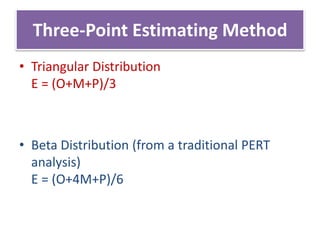
• Triangular Distribution
E = (O+M+P)/3
• Beta Distribution (from a traditional PERT
analysis)
E = (O+4M+P)/6
Comparative Estimate
• When estimating costs, this technique relies
on the actual cost of previous, similar projects
as the basis for estimating the cost of the
current project.
• It is most reliable when the previous projects
are similar in fact and not just in appearance,
and the project team members preparing the
estimates have the needed expertise.
Parametric Estimating Method
• Parametric estimating uses an algorithm or a
statistical relationship between historical data
and other variables (e.g., square footage in
construction)
• For example, if an activity needs 4,000 hours
of coding
Bottom-up Estimating Method
• Bottom-up estimating is a method of
estimating a component of work. The cost of
individual work packages or activities is
estimated to the greatest level of specified
detail. The detailed cost is then summarized
or rolled up to higher levels for subsequent
reporting and tracking purposes.
4.2 Calculating Return on Investment
(ROI)
4.3 Calculating the Payback Period
• The payback period is the number of years
required to recover initial investment
• Benefits
• It is simple to understand and to compute.
• It dose not involve any cost for computation of the payback
period
• It can be computed on the basis of accounting information
available from the books.
4.3 Calculating the Payback Period
• Demerits
This method fails to take into account the cash
flows received by the company after the pay
back period. .
It doesn’t take into account the interest factor
involved in an investment outlay.
It is not consistent with the objective of
maximizing the market value of the company’s
share.
4.3 Calculating the Payback Period
•
Year A B C D E F
0 -4000 -6000 -1000 -1000 -1000 -1000
1 1000 1000 4000 500 400 500
2 5000 2000 300 500 400 500
3 4000 200 500 400 10000
4 4000 100 400
5 500 500 400
Payback
Period
4.4 Determining Net Present Value
(NPV)
• The NPV takes into consideration the time
value of money.
• The cash flows of different years and valued
differently and made comparable in terms of
present values for this the net cash inflows of
various period are
• Discounted using required rate of return
which is predetermined.
4.4 Determining Net Present Value
(NPV)
• NPV= Total Present value of cash
inflows – investment
• Present Value = Actual Cash
Inflow / Discounting Factor
4.4 Determining Net Present Value
(NPV)
• Discounting Factor = ( 1+R)^N
• Where R is Rate of Return or Cost of capital or
Inflation Rate
• N is Number of year
NPV Decision Rule
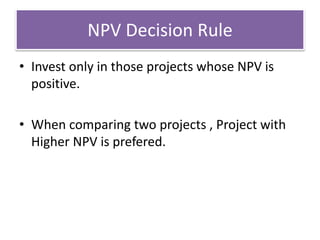
• Invest only in those projects whose NPV is
positive.
• When comparing two projects , Project with
Higher NPV is prefered.
NPV Merits
1. It recognizes the time value of money.
2. It is based on the entire cash flows generated
during the useful life of the asset
3. It is consistent with the objective of
maximization of wealth of the owners.
NPV Merits
1. It is difficult to understand and use.
2. The NPV is calculated by using the cost of capital
as a discount rate. But the concept of cost of
capital. If self is difficult to understood and
determine.
3. It does not give solutions when the comparable
projects are involved in different amounts of
investment.
Calculate NPV for following data if
Initial investment of project is Rs 50 Cr.
Year Cash Inflow ( Amount in
Cr Rs )
Discounting Factor Present Value ( Amount in
Cr Rs )
1 16 1.10 14.54
2 16 1.21 13.22
3 16 1.331 12.03
4 16 1.464 10.93
5 20 1.61 12.42
Total 63.13
NPV = Total Discounted cash
inflow- Initial Investment
63.13-50 = 13.13 Cr

Managing Project Issues and.pptx

  • 1.
    Managing Project Issues& Their Commencement Dr. Parmeshwar Biradar MBA (Finance, HR, Operations Management), SET, PhD ( Commerce and Management)
  • 2.
    Content • 4.1 IdentifyingProject Costs • 4.2 Calculating Return on Investment (ROI) • 4.3 Calculating the Payback Period • 4.4 Determining Net Present Value (NPV) • 4.5 Identifying the life cycle of a Project • 4.6 Handling over a Project • 4.7 Closing a Project • 4.8 Reviewing a Project
  • 3.
  • 4.
    Expert Judgement Method •Expertise should be considered from individuals or groups with specialized knowledge or training in team and physical resource planning and estimating. • Expert judgment can also be used to determine whether to combine different methods of estimation and how to reconcile differences between them.
  • 5.
    Three-Point Estimating Method •Most likely (M): The cost of the activity, based on realistic effort assessment for the required work and any predicted expenses. • Optimistic (O): The activity cost based on analysis of the best-case scenario for the activity. • Pessimistic (P): The activity cost based on analysis of the worst-case scenario for the activity.
  • 6.
    Three-Point Estimating Method •Triangular Distribution E = (O+M+P)/3 • Beta Distribution (from a traditional PERT analysis) E = (O+4M+P)/6
  • 7.
    Comparative Estimate • Whenestimating costs, this technique relies on the actual cost of previous, similar projects as the basis for estimating the cost of the current project. • It is most reliable when the previous projects are similar in fact and not just in appearance, and the project team members preparing the estimates have the needed expertise.
  • 8.
    Parametric Estimating Method •Parametric estimating uses an algorithm or a statistical relationship between historical data and other variables (e.g., square footage in construction) • For example, if an activity needs 4,000 hours of coding
  • 9.
    Bottom-up Estimating Method •Bottom-up estimating is a method of estimating a component of work. The cost of individual work packages or activities is estimated to the greatest level of specified detail. The detailed cost is then summarized or rolled up to higher levels for subsequent reporting and tracking purposes.
  • 10.
    4.2 Calculating Returnon Investment (ROI)
  • 11.
    4.3 Calculating thePayback Period • The payback period is the number of years required to recover initial investment • Benefits • It is simple to understand and to compute. • It dose not involve any cost for computation of the payback period • It can be computed on the basis of accounting information available from the books.
  • 12.
    4.3 Calculating thePayback Period • Demerits This method fails to take into account the cash flows received by the company after the pay back period. . It doesn’t take into account the interest factor involved in an investment outlay. It is not consistent with the objective of maximizing the market value of the company’s share.
  • 13.
    4.3 Calculating thePayback Period • Year A B C D E F 0 -4000 -6000 -1000 -1000 -1000 -1000 1 1000 1000 4000 500 400 500 2 5000 2000 300 500 400 500 3 4000 200 500 400 10000 4 4000 100 400 5 500 500 400 Payback Period
  • 14.
    4.4 Determining NetPresent Value (NPV) • The NPV takes into consideration the time value of money. • The cash flows of different years and valued differently and made comparable in terms of present values for this the net cash inflows of various period are • Discounted using required rate of return which is predetermined.
  • 15.
    4.4 Determining NetPresent Value (NPV) • NPV= Total Present value of cash inflows – investment • Present Value = Actual Cash Inflow / Discounting Factor
  • 16.
    4.4 Determining NetPresent Value (NPV) • Discounting Factor = ( 1+R)^N • Where R is Rate of Return or Cost of capital or Inflation Rate • N is Number of year
  • 17.
    NPV Decision Rule •Invest only in those projects whose NPV is positive. • When comparing two projects , Project with Higher NPV is prefered.
  • 18.
    NPV Merits 1. Itrecognizes the time value of money. 2. It is based on the entire cash flows generated during the useful life of the asset 3. It is consistent with the objective of maximization of wealth of the owners.
  • 19.
    NPV Merits 1. Itis difficult to understand and use. 2. The NPV is calculated by using the cost of capital as a discount rate. But the concept of cost of capital. If self is difficult to understood and determine. 3. It does not give solutions when the comparable projects are involved in different amounts of investment.
  • 20.
    Calculate NPV forfollowing data if Initial investment of project is Rs 50 Cr. Year Cash Inflow ( Amount in Cr Rs ) Discounting Factor Present Value ( Amount in Cr Rs ) 1 16 1.10 14.54 2 16 1.21 13.22 3 16 1.331 12.03 4 16 1.464 10.93 5 20 1.61 12.42 Total 63.13 NPV = Total Discounted cash inflow- Initial Investment 63.13-50 = 13.13 Cr