Training in Oil & Gas Based
Industry (OGBI): Employees
        Perspective


     Dr. Hend Al Muftah
         March 2005
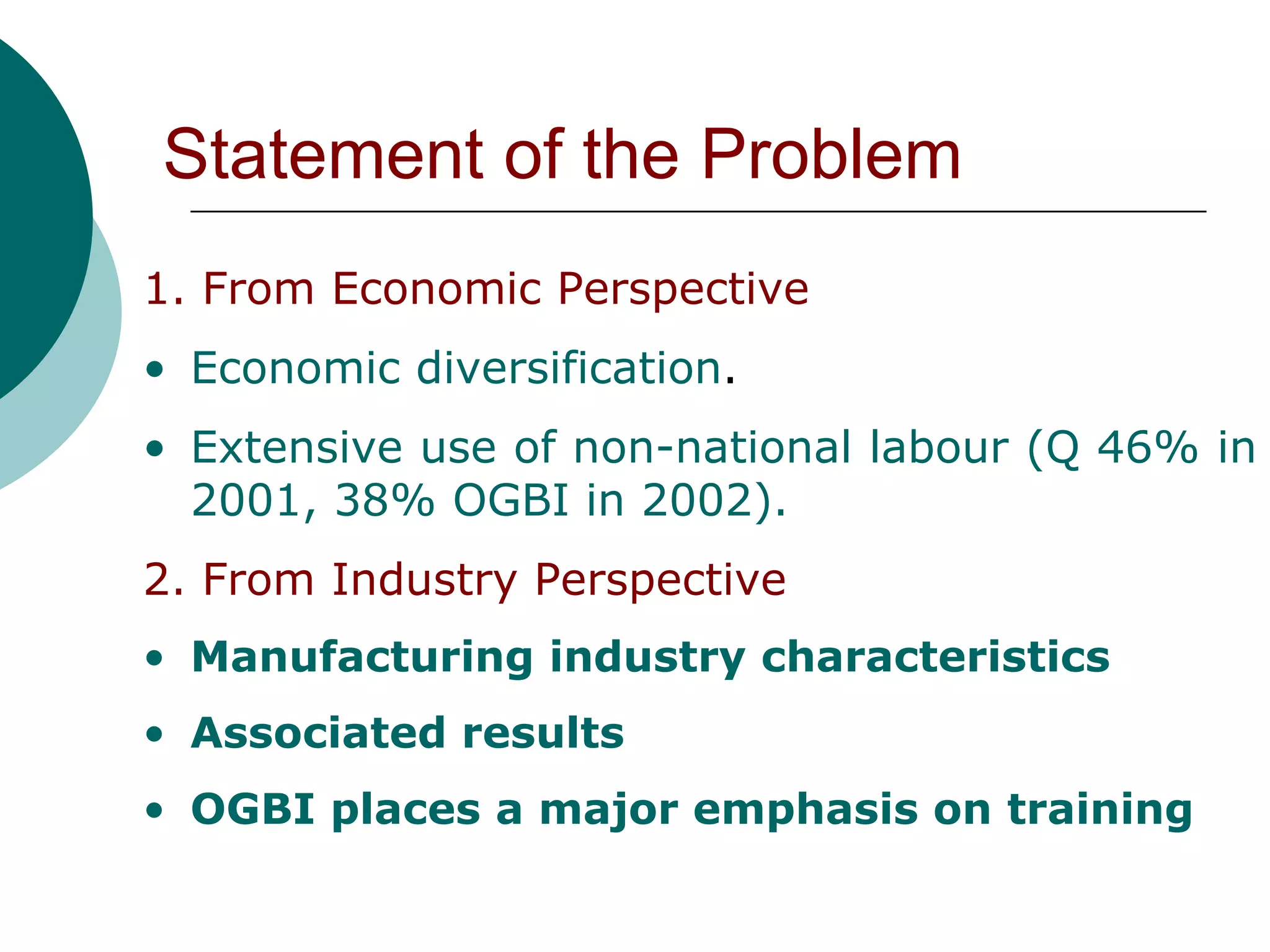
Statement of the Problem
1. From Economic Perspective
• Economic diversification.
• Extensive use of non-national labour (Q 46% in
  2001, 38% OGBI in 2002).
2. From Industry Perspective
• Manufacturing industry characteristics
• Associated results
• OGBI places a major emphasis on training
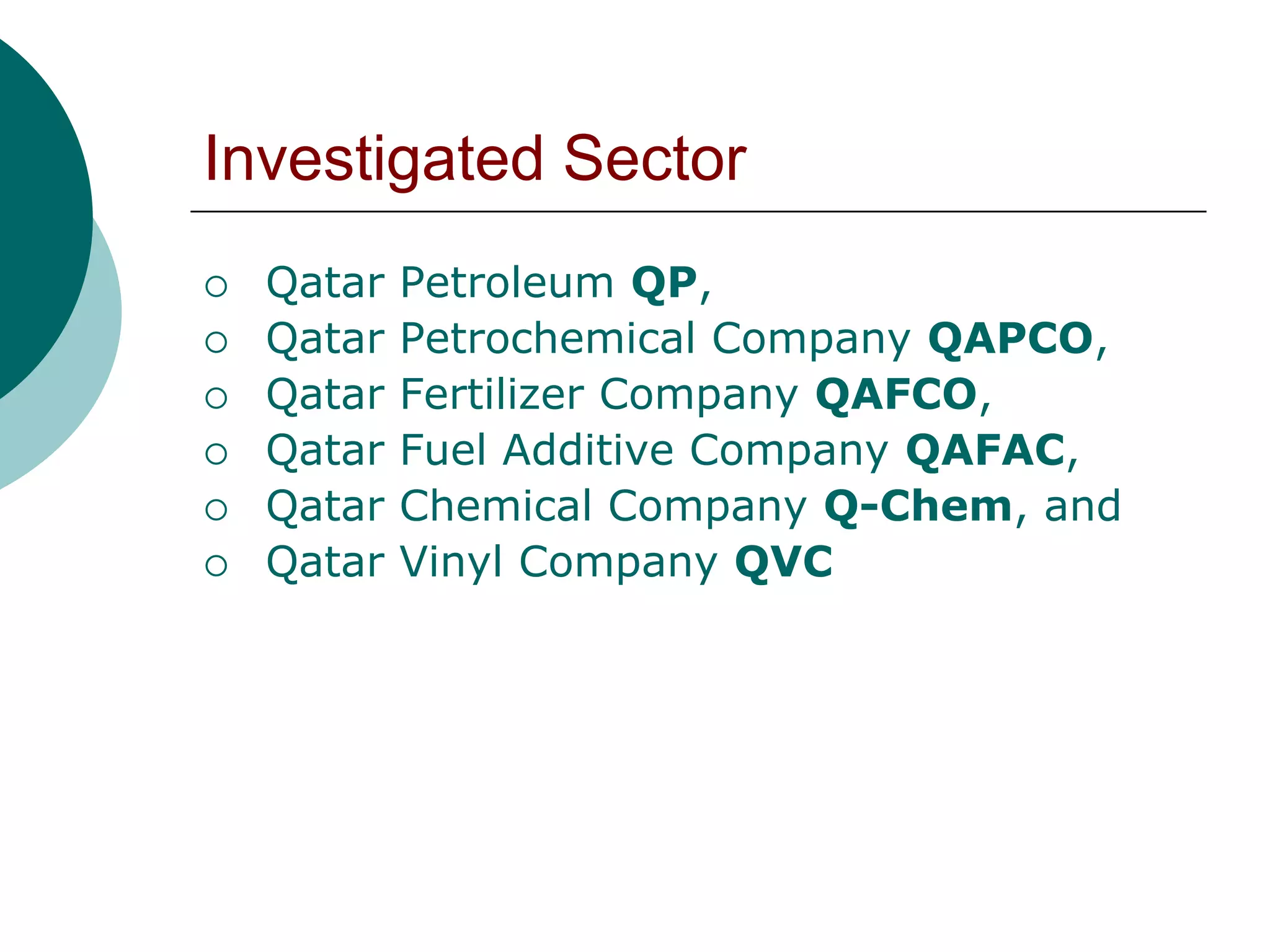
Investigated Sector
   Qatar   Petroleum QP,
   Qatar   Petrochemical Company QAPCO,
   Qatar   Fertilizer Company QAFCO,
   Qatar   Fuel Additive Company QAFAC,
   Qatar   Chemical Company Q-Chem, and
   Qatar   Vinyl Company QVC
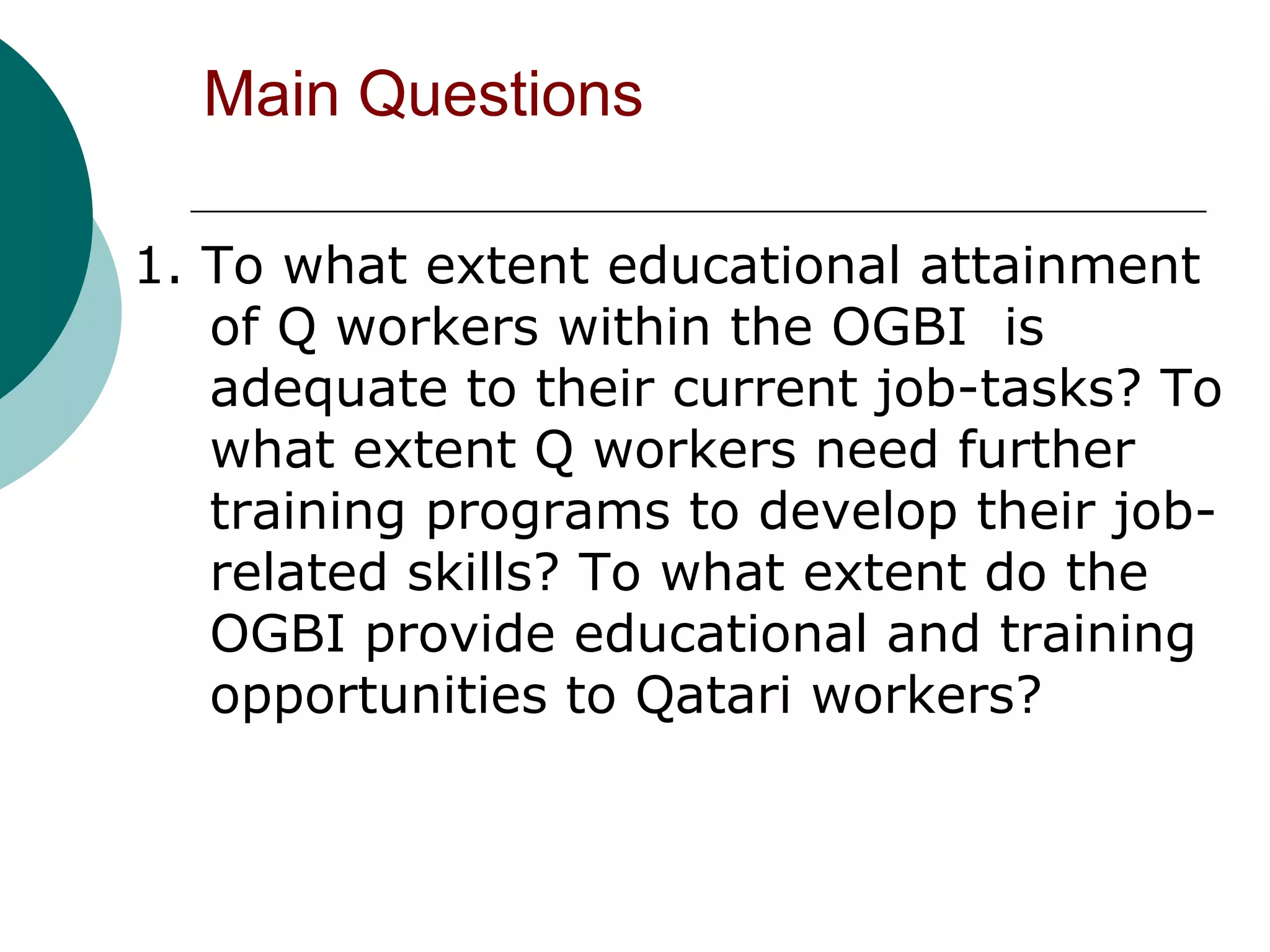
Main Questions

1. To what extent educational attainment
   of Q workers within the OGBI is
   adequate to their current job-tasks? To
   what extent Q workers need further
   training programs to develop their job-
   related skills? To what extent do the
   OGBI provide educational and training
   opportunities to Qatari workers?
Main Questions
2. To what extent do Q workers'
   educational attainments affect the
   effectiveness of their training
   programmes, related practices and
   their attitudes towards technical
   and production jobs and labour
   turnover?
Main Questions

3. To what extent do other practices
  such as promotion, performance
  appraisal schemes, and training
  difficulties influence the
  effectiveness of training of Q
  workers within the OGBI?
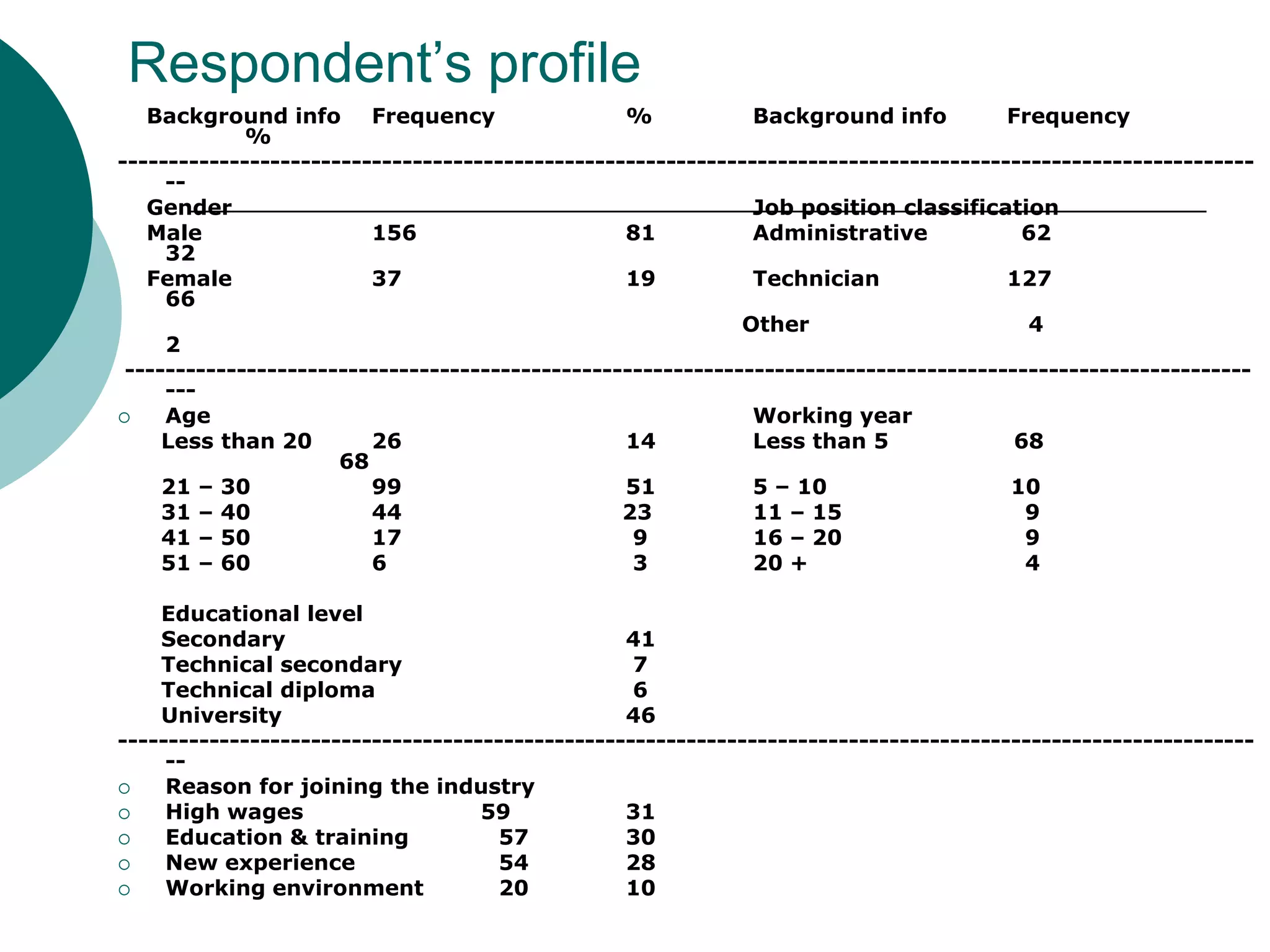
Respondent’s profile
   Background info Frequency                      %            Background info          Frequency
             %
----------------------------------------------------------------------------------------------------------------
     --
   Gender                                                      Job position classification
   Male                  156                      81           Administrative            62
     32
   Female                37                       19           Technician               127
     66
                                                              Other                       4
     2
 ---------------------------------------------------------------------------------------------------------------
     ---
    Age                                                       Working year
     Less than 20        26                       14           Less than 5               68
                      68
     21 – 30             99                       51           5 – 10                   10
     31 – 40             44                       23           11 – 15                    9
     41 – 50             17                        9           16 – 20                    9
     51 – 60             6                         3           20 +                       4

    Educational level
    Secondary                                     41
    Technical secondary                            7
    Technical diploma                              6
    University                                    46
----------------------------------------------------------------------------------------------------------------
     --
    Reason for joining the industry
    High wages                     59            31
    Education & training             57          30
    New experience                   54          28
    Working environment              20          10
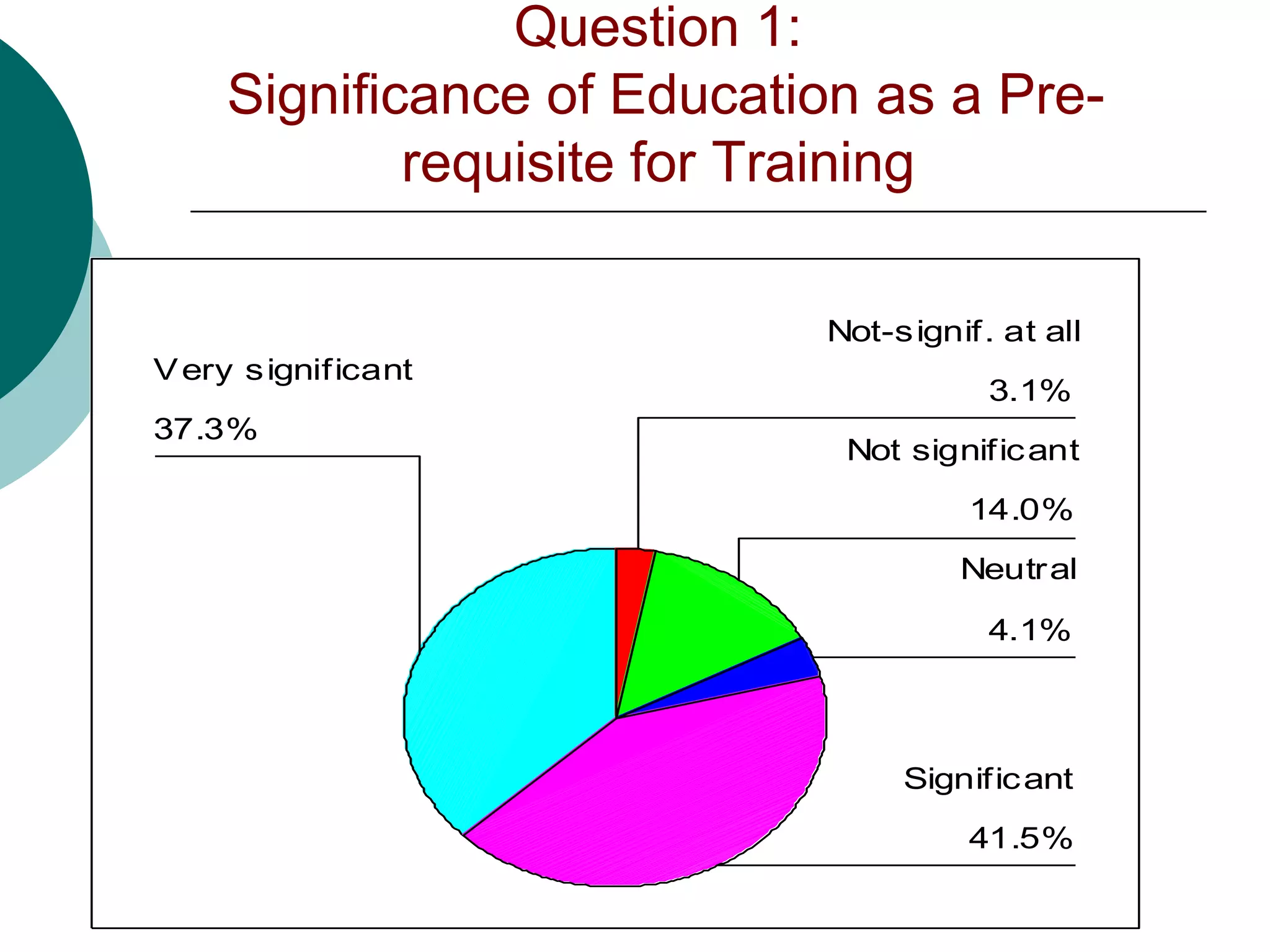
Question 1:
     Significance of Education as a Pre-
             requisite for Training

                            Not-s ignif. at all
V ery s ignificant
                                        3.1%
37.3%
                             Not signific ant
                                      14.0%
                                     Neutral

                                        4.1%


                                 Signific ant
                                      41.5%
Significance of Education as a Pre-
    requisite for Training
   The HCT prediction that the general-
    skills level is significant in the
    development of specific skills, which are
    formed through training, does not apply
    to the current study findings.
   It may be argued that within the
    industrial sector, a higher level of
    education is not necessary to absorb and
    acquire specific skills, but technical
    secondary may seem to be a better
    minimum level for acquiring such skills
    within any industry.
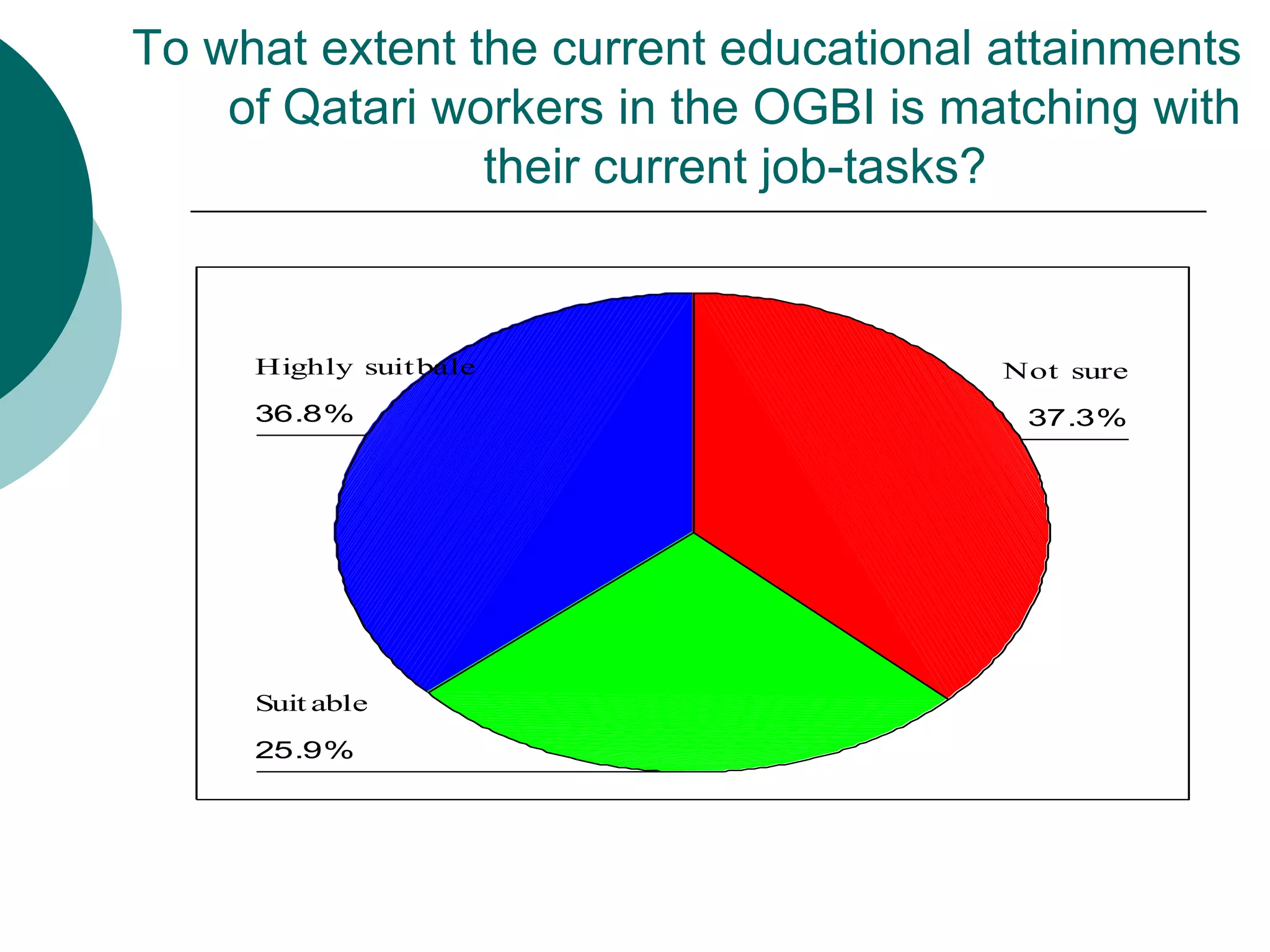
To what extent the current educational attainments
    of Qatari workers in the OGBI is matching with
                their current job-tasks?


     Highly suit bale                  Not sure
     36.8%                              37.3%


     Suit able
     25.9%
To what extent the current educational attainments of Qatari
    workers in the OGBI is matching with their current job-tasks?


   68% are satisfied with their current educational
    attainments in managing their current job's
   tasks (insignificant statistical relationship between
    education/job suitability and respondents' educational
    attainment).
   82% indicated their need for further training in order to
    enhance their job-skills.
   Conclusion: though formal education may create basic
    skills that may be relevant to industry, such skills may
    only serve the needs of small-scale industries. For a
    higher level of industrialization as OGBI, both technical
    education and OJT are essential to meet the
    requirements for new skills needs.
   within OGBI, training is of greater importance when
    compared to education
1.3 To what extent they need further specific-training
programs in order to develop their skills required by their
current jobs?

   82% indicated their need for further training program as
    follows: 41% technical PT, 34% non-technical PT,18%
    technical IT, 6% non-technical IT, and 1.6% are
    interested in the four types of training
   Statistically, there was no association between the need
    for further training programmes and respondents'
    educational attainment.
   It is concluded that:
   Education in Qatar plays a significant role in generating
    and enhancing specific skills among Q.
   Education is significant in providing workers with
    general-skills but not specific-ones, which in turn points
    to the significance of continuous training in developing
    workers' specific-skills and its great value in filling gaps
    between formal education and workplace skills.
4 To what extent do the OGBI provide
educational and training opportunities to Qatari
                   workers?

     67% of Q participants indicated that
      their education was not upgraded
      (31% secondary, 29% university).
      33% had upgrades their education
      (20% secondary).
     Conclusion: training (short-term)
      remains a higher priority in
      comparison to education (long-
      term) since it is more effective in
      developing and enhancing workers'
      general and specific skills.
1.5 Education/Training Links significance in Forming
                       QHC
   42% indicated the significance of
    education/training close linkages in forming
    their general & specific HC
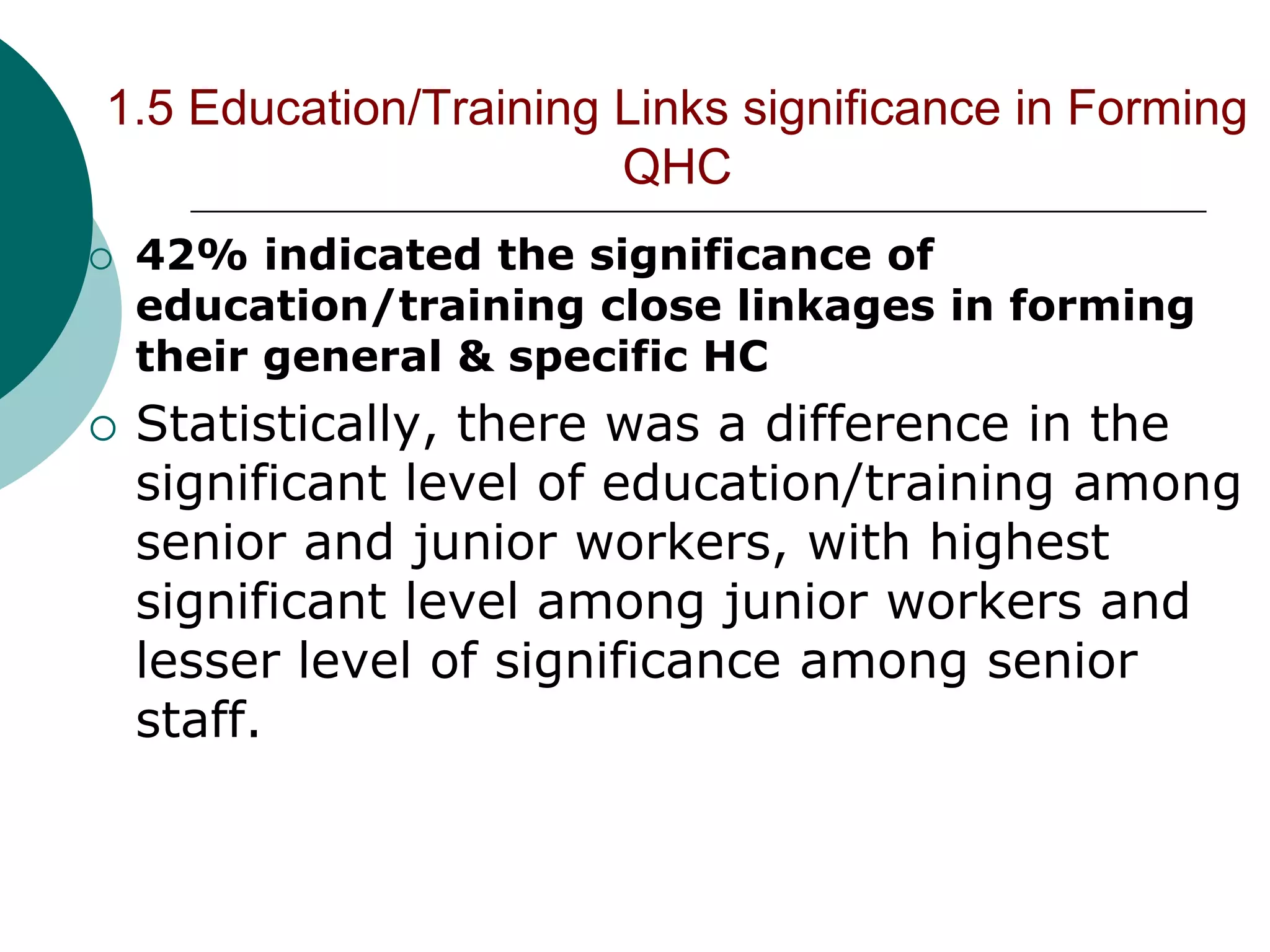
   Statistically, there was a difference in the
    significant level of education/training among
    senior and junior workers, with highest
    significant level among junior workers and
    lesser level of significance among senior
    staff.
Question 2:
To what extent do Q workers' educational attainments affect the
effectiveness of their training programmes, related practices and their
attitudes towards technical and production jobs and labour turnover?

      2.1 Training Objectives and Achievement
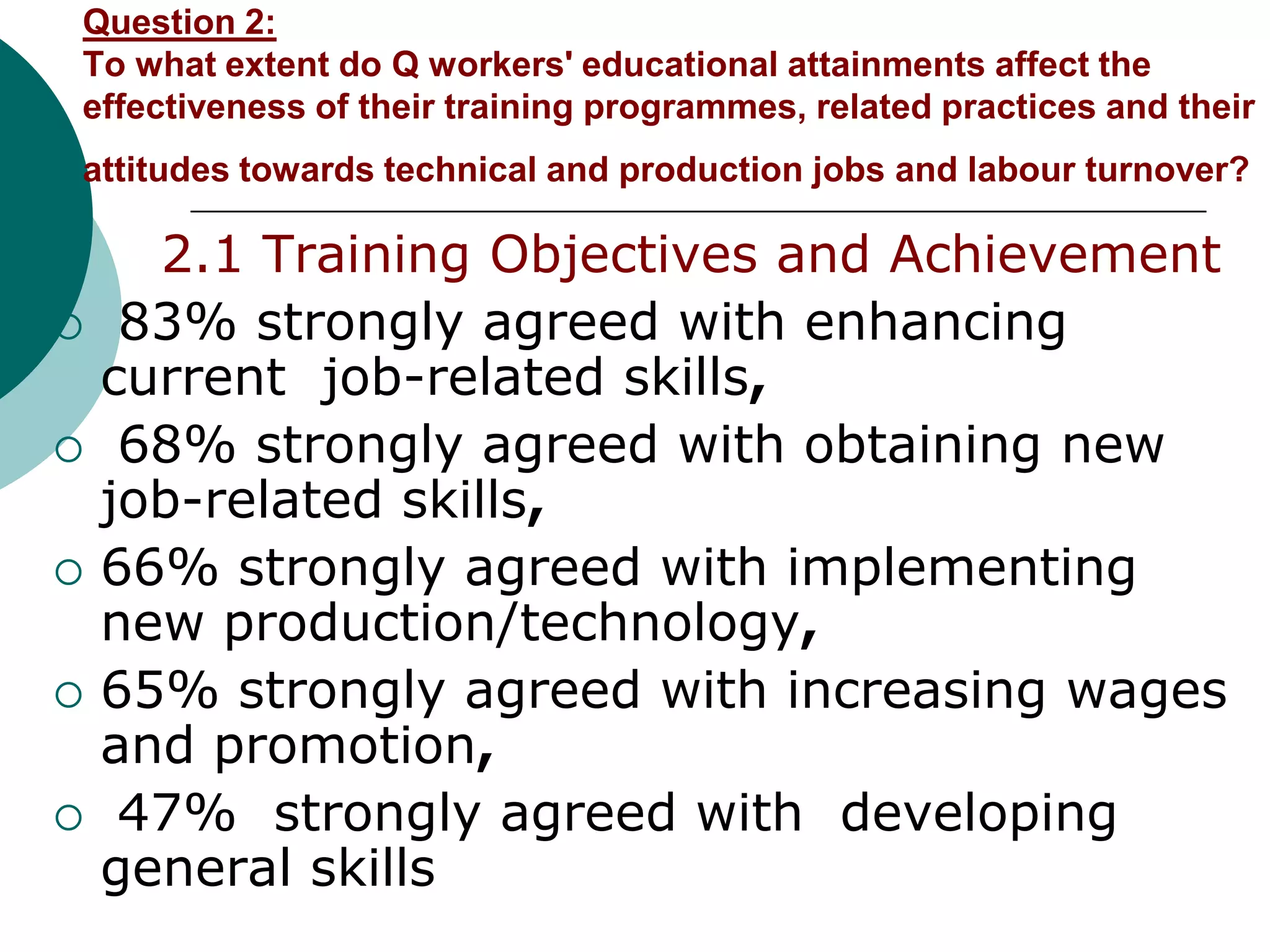
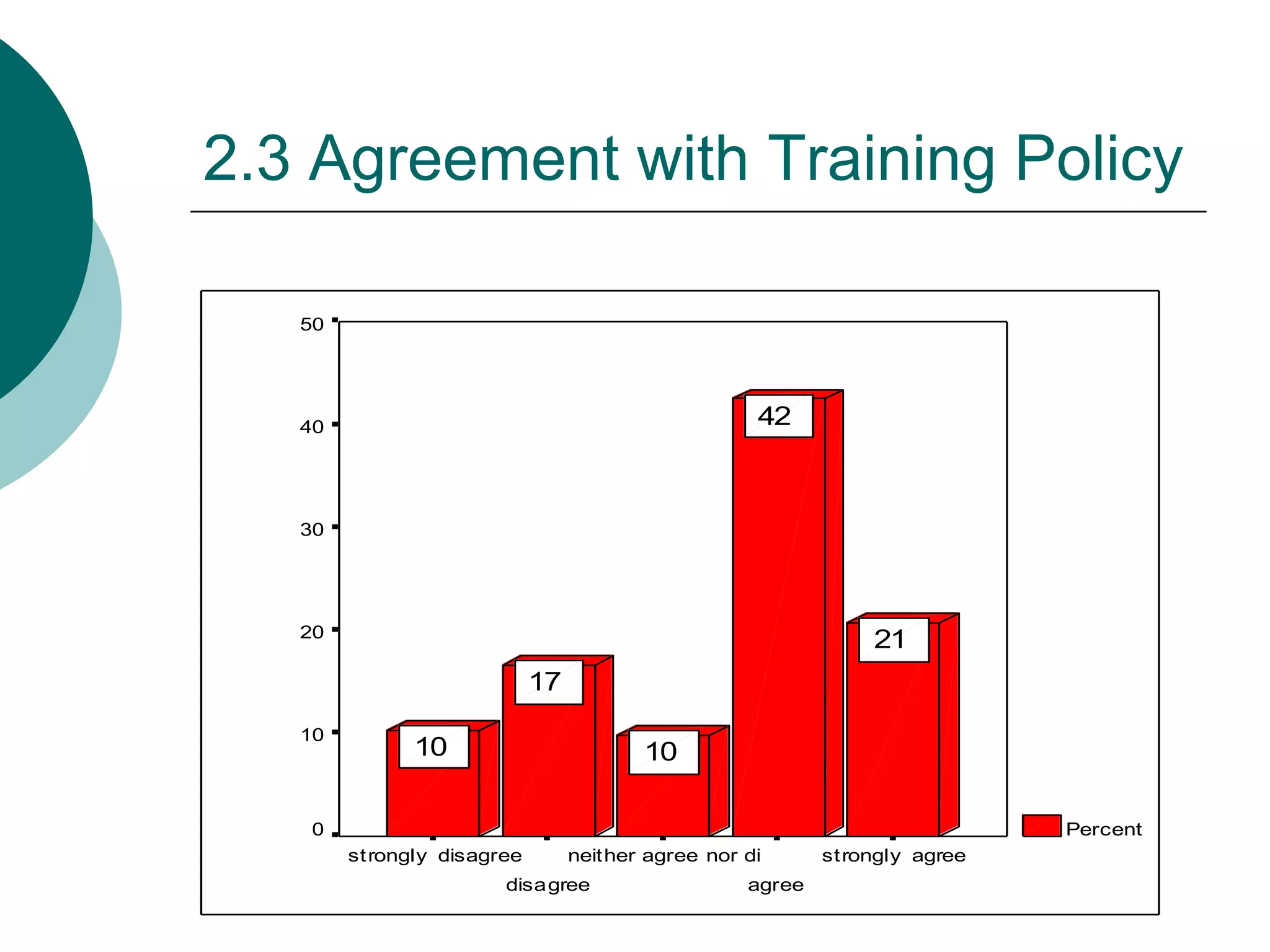
    83% strongly agreed with enhancing
    current job-related skills,
    68% strongly agreed with obtaining new
    job-related skills,
   66% strongly agreed with implementing
    new production/technology,
   65% strongly agreed with increasing wages
    and promotion,
    47% strongly agreed with developing
    general skills
To what extent do Q workers' educational attainments affect
the effectiveness of their training programmes, related
practices and their attitudes towards technical and production
jobs and labour turnover?


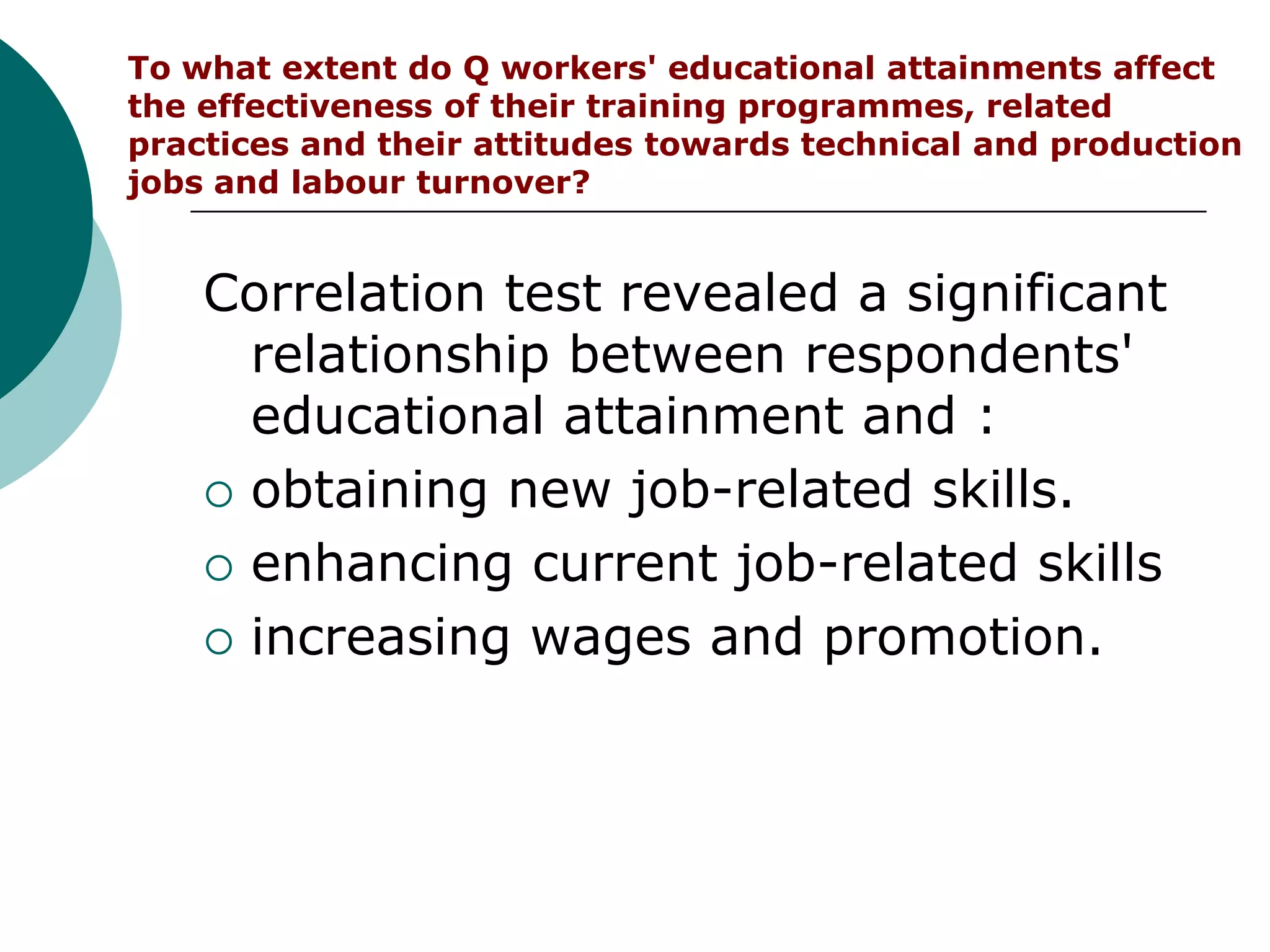
    Correlation test revealed a significant
      relationship between respondents'
      educational attainment and :
     obtaining new job-related skills.

     enhancing current job-related skills

     increasing wages and promotion.
These findings:

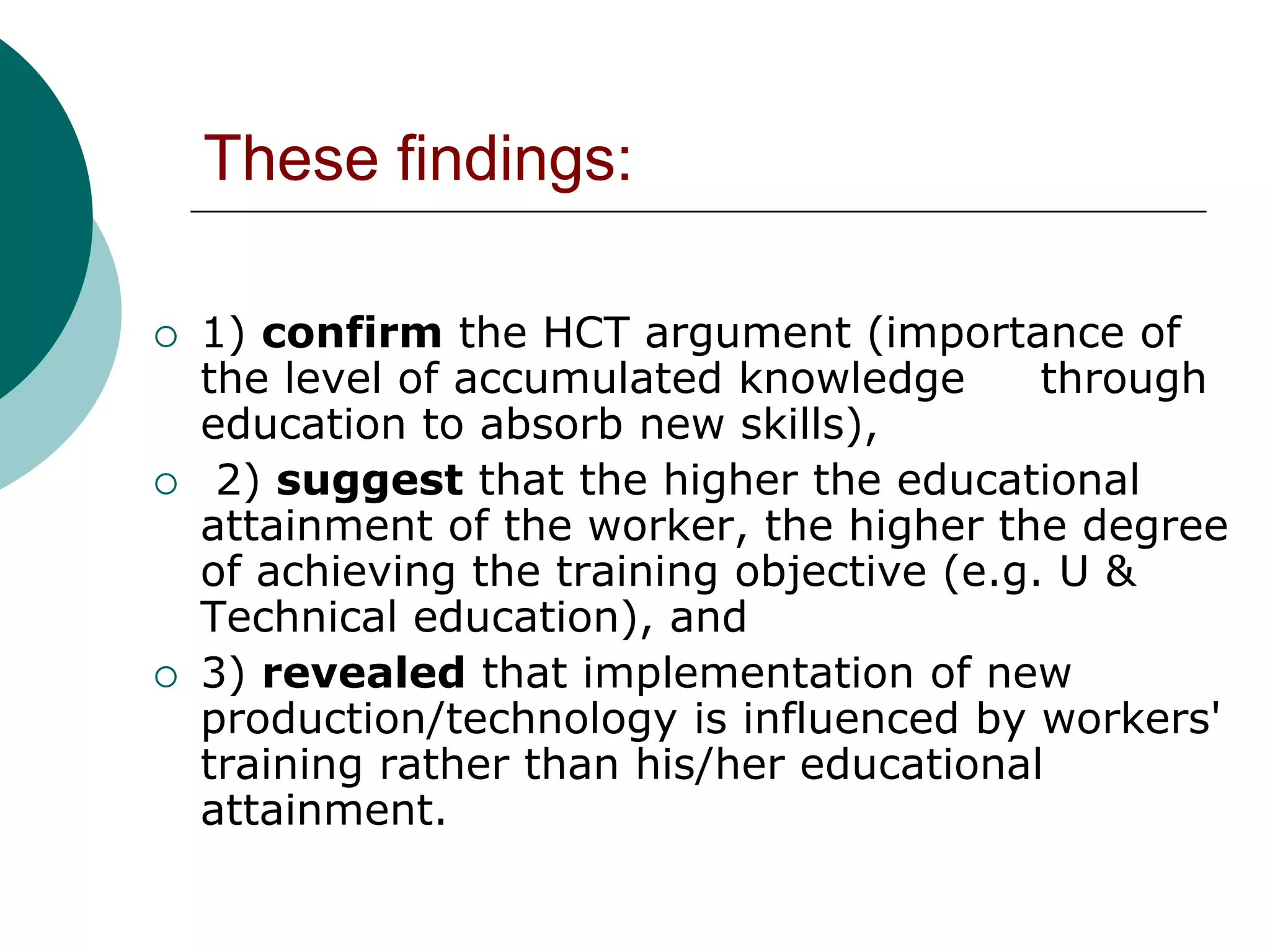
   1) confirm the HCT argument (importance of
    the level of accumulated knowledge       through
    education to absorb new skills),
    2) suggest that the higher the educational
    attainment of the worker, the higher the degree
    of achieving the training objective (e.g. U &
    Technical education), and
   3) revealed that implementation of new
    production/technology is influenced by workers'
    training rather than his/her educational
    attainment.
Training Effectiveness
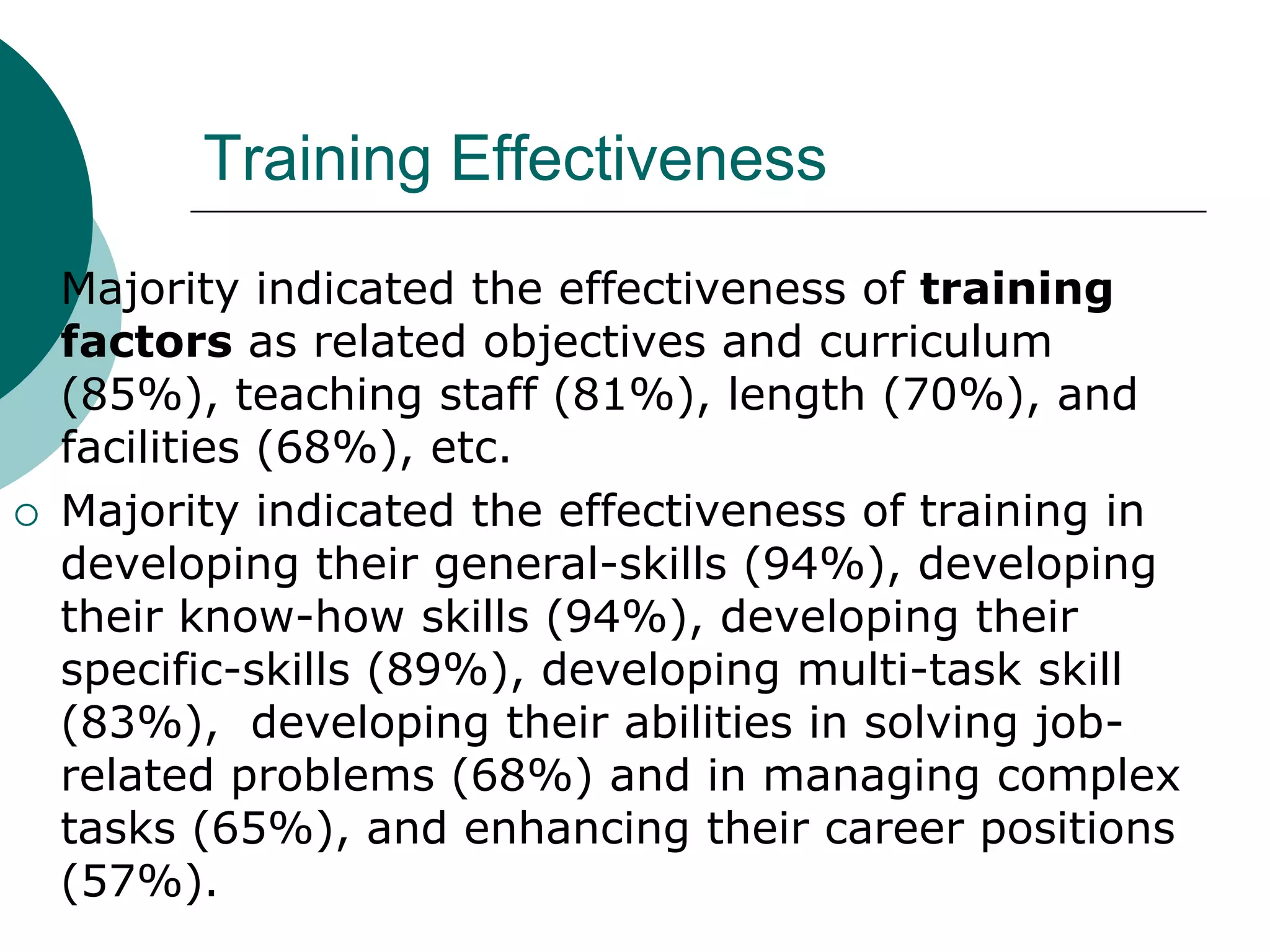
   Majority indicated the effectiveness of training
    factors as related objectives and curriculum
    (85%), teaching staff (81%), length (70%), and
    facilities (68%), etc.
   Majority indicated the effectiveness of training in
    developing their general-skills (94%), developing
    their know-how skills (94%), developing their
    specific-skills (89%), developing multi-task skill
    (83%), developing their abilities in solving job-
    related problems (68%) and in managing complex
    tasks (65%), and enhancing their career positions
    (57%).
Training Effectiveness

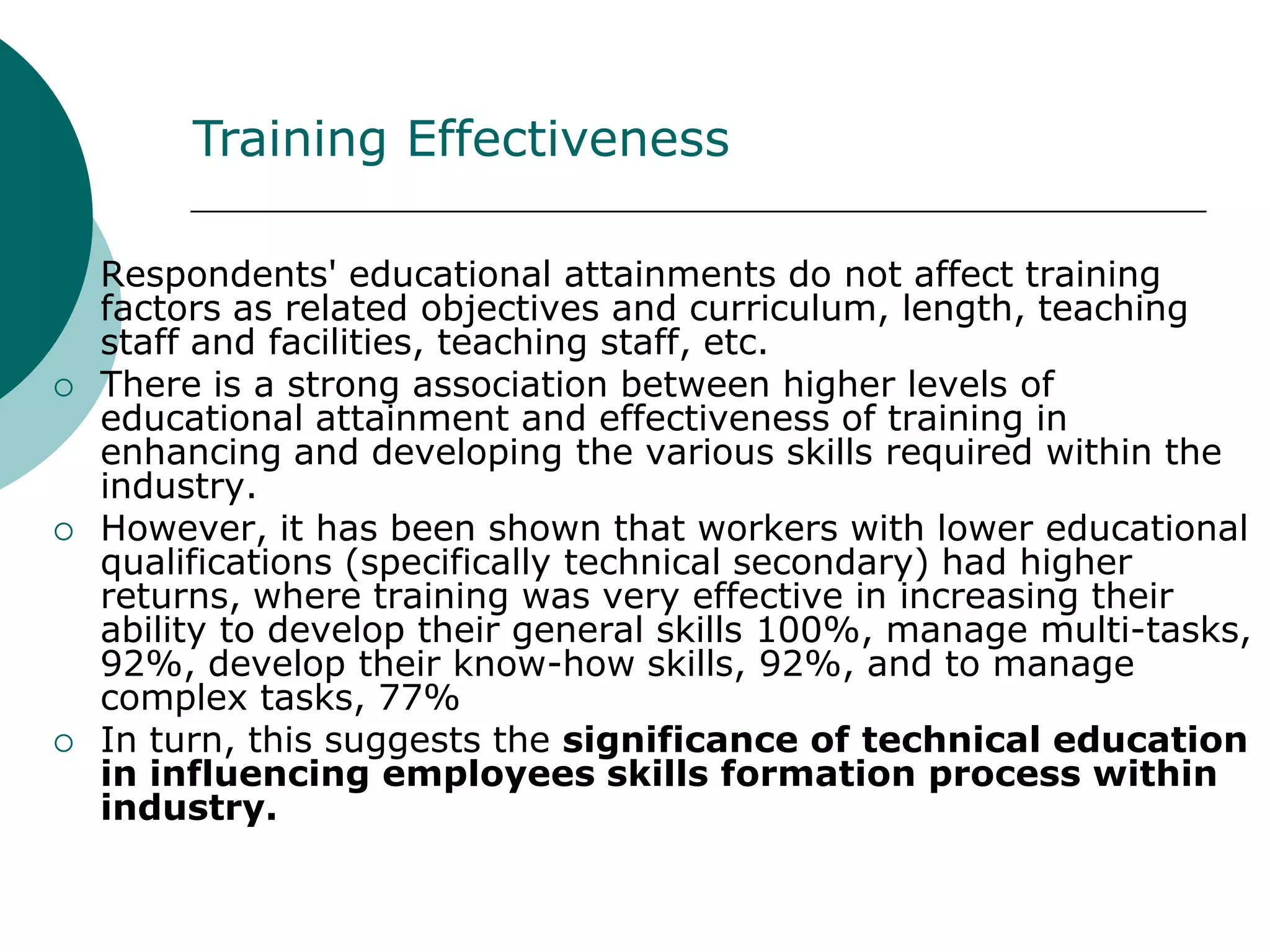
   Respondents' educational attainments do not affect training
    factors as related objectives and curriculum, length, teaching
    staff and facilities, teaching staff, etc.
   There is a strong association between higher levels of
    educational attainment and effectiveness of training in
    enhancing and developing the various skills required within the
    industry.
   However, it has been shown that workers with lower educational
    qualifications (specifically technical secondary) had higher
    returns, where training was very effective in increasing their
    ability to develop their general skills 100%, manage multi-tasks,
    92%, develop their know-how skills, 92%, and to manage
    complex tasks, 77%
   In turn, this suggests the significance of technical education
    in influencing employees skills formation process within
    industry.
2.3 Agreement with Training Policy

             50


             40                                                 42


             30


             20
                                                                            21
                                       17
             10
                        10                          10
Percent


             0                                                                           Percent
                  st rongly disagree        neit her agree nor di      st rongly agree
                                  disagree                     agree
2.4 Qatari Workers' Attitudes towards
          On-Site Jobs
           300


           200
                                                           64


                                                           55
                                                                     Curren t e ducatio na l
           100
                                                           62            Univ ersit y
                                                  17
                                                  18                     Technical diploma
                                                  23
Percent


                     18                                                  Technical Secondary
                                                  30       38
            0        19                                                  Secondary
                 Not high at all        Neutral          Very high
                             Not high             High
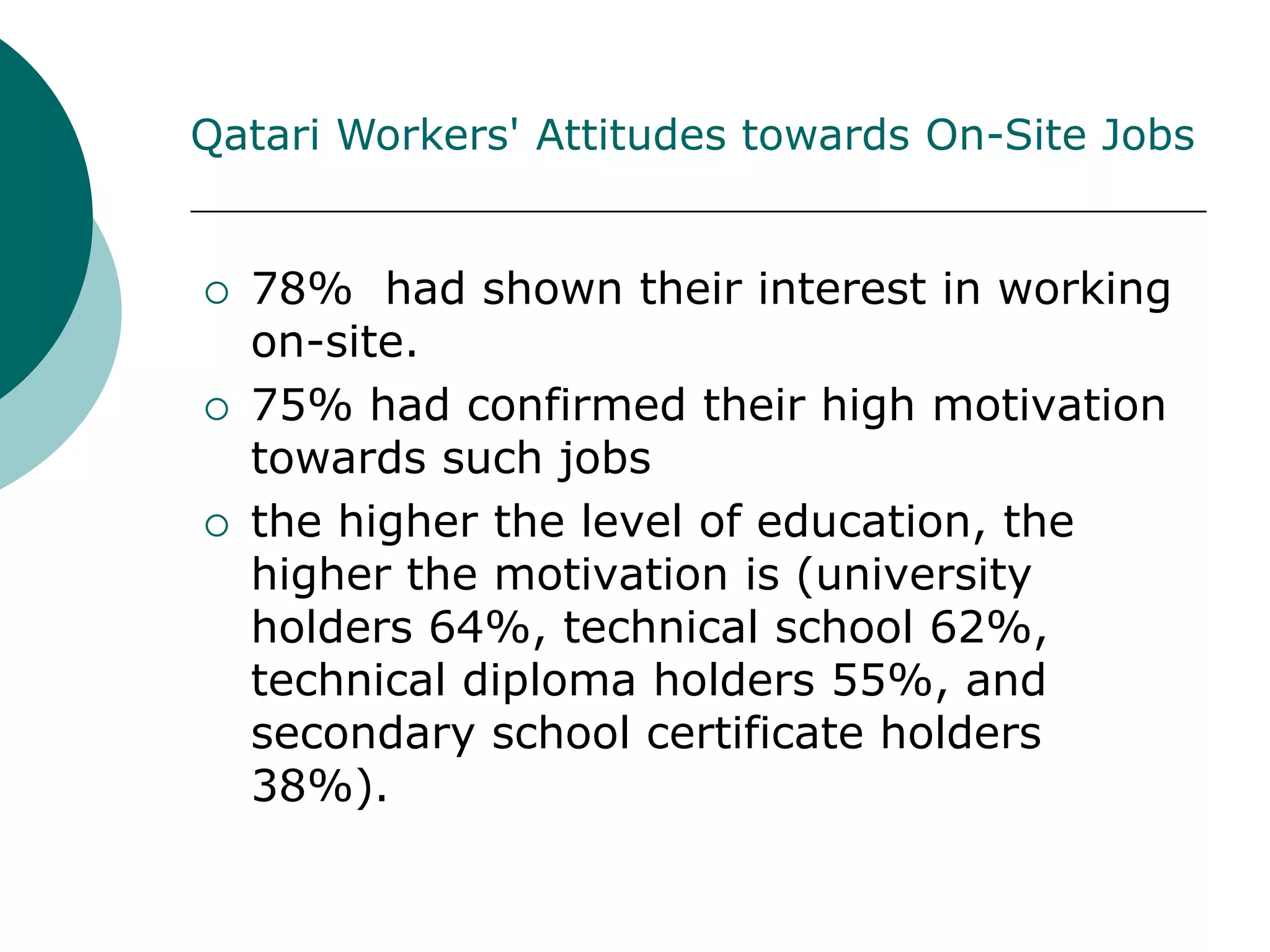
Qatari Workers' Attitudes towards On-Site Jobs


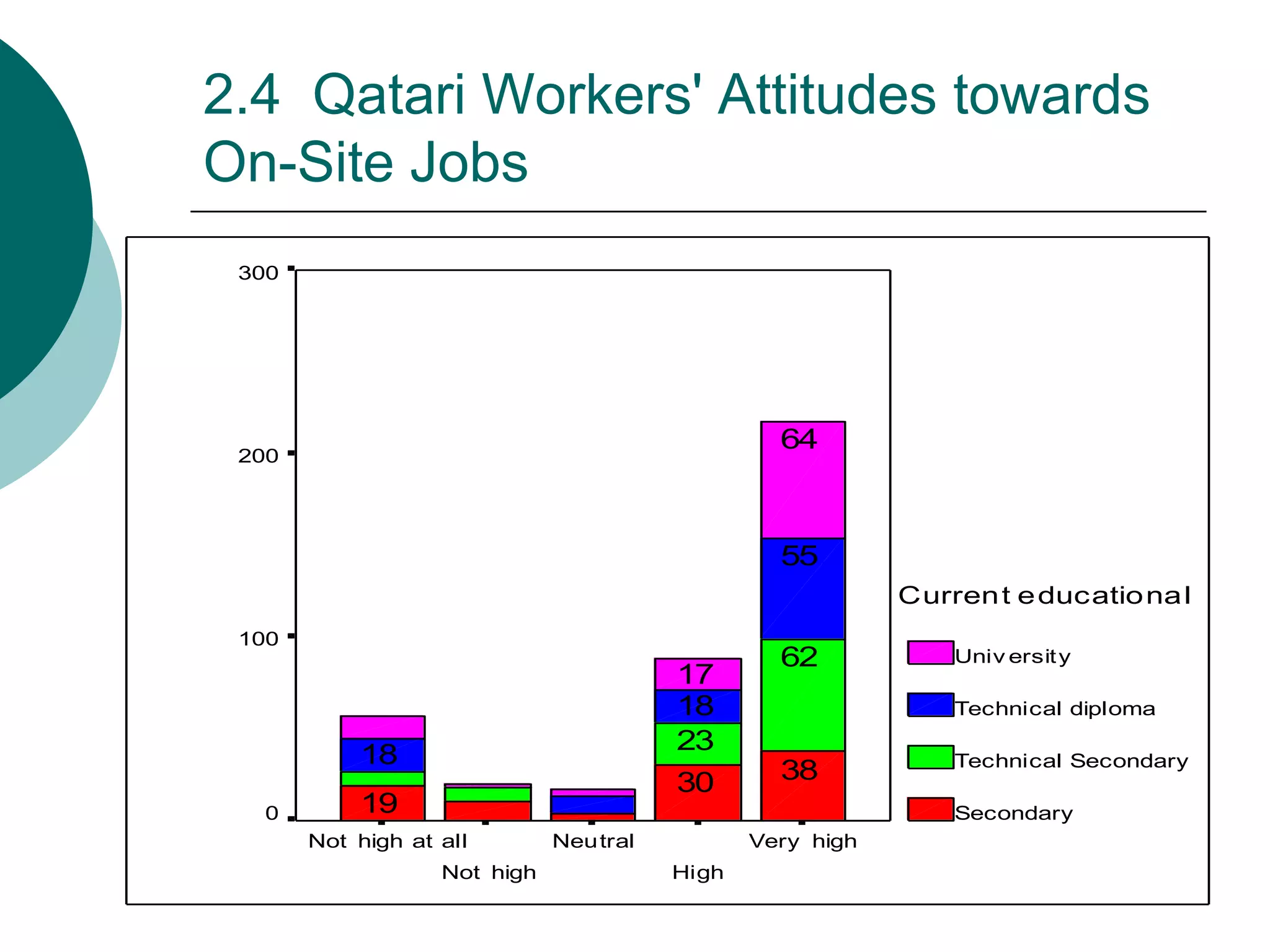
   78% had shown their interest in working
    on-site.
   75% had confirmed their high motivation
    towards such jobs
   the higher the level of education, the
    higher the motivation is (university
    holders 64%, technical school 62%,
    technical diploma holders 55%, and
    secondary school certificate holders
    38%).
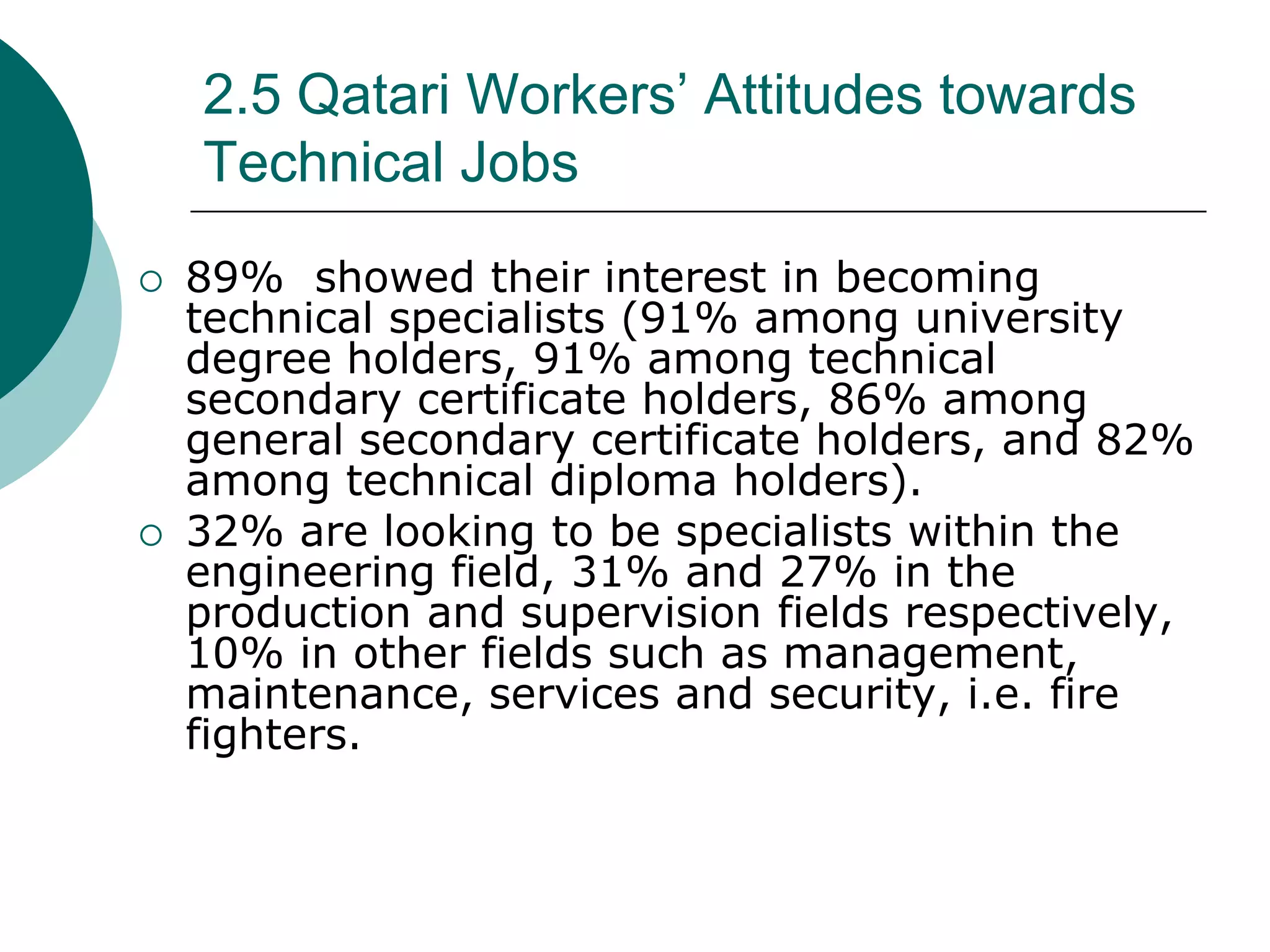
2.5 Qatari Workers’ Attitudes towards
    Technical Jobs
   89% showed their interest in becoming
    technical specialists (91% among university
    degree holders, 91% among technical
    secondary certificate holders, 86% among
    general secondary certificate holders, and 82%
    among technical diploma holders).
   32% are looking to be specialists within the
    engineering field, 31% and 27% in the
    production and supervision fields respectively,
    10% in other fields such as management,
    maintenance, services and security, i.e. fire
    fighters.
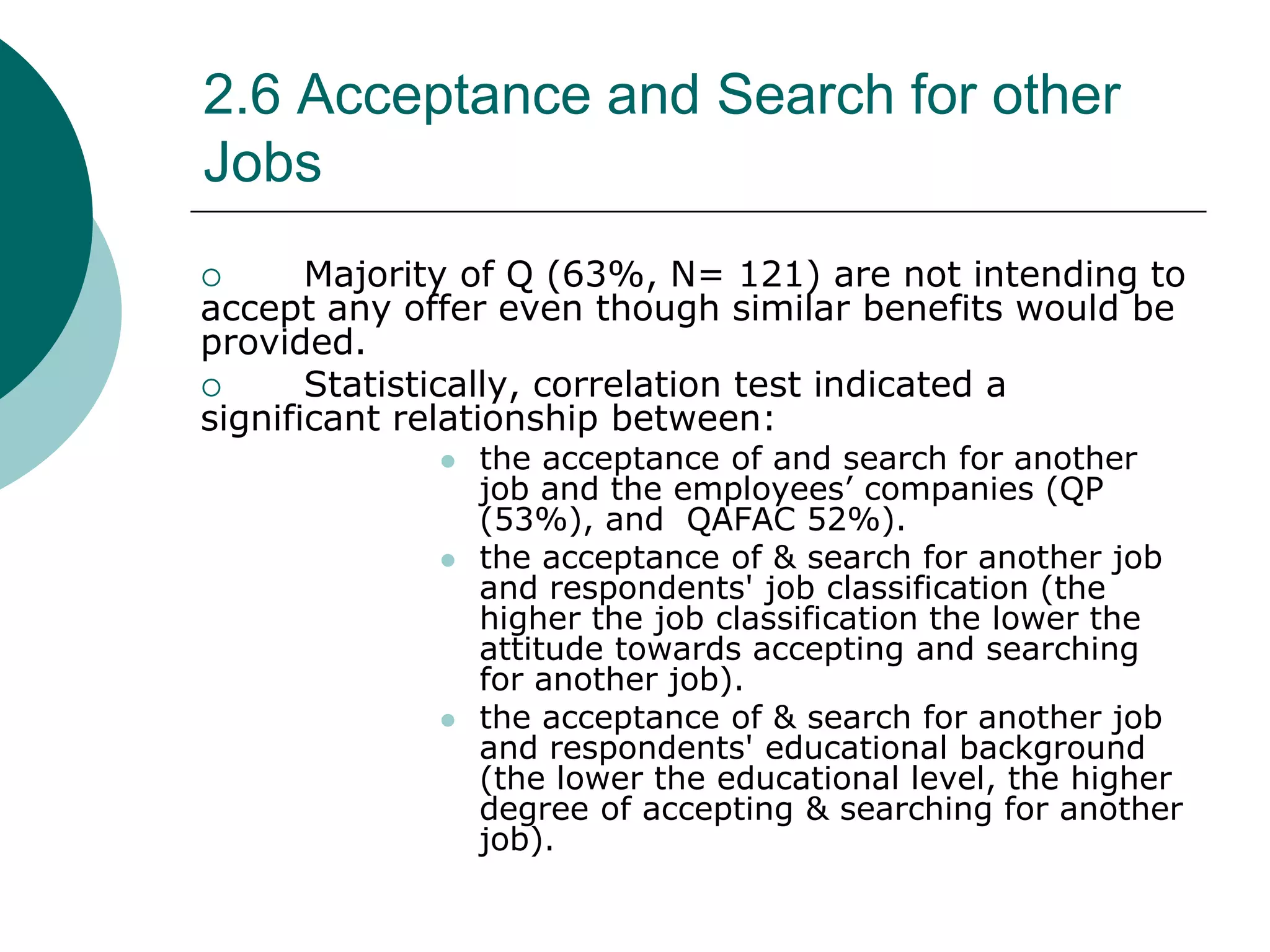
2.6 Acceptance and Search for other
Jobs
      Majority of Q (63%, N= 121) are not intending to
accept any offer even though similar benefits would be
provided.
      Statistically, correlation test indicated a
significant relationship between:
                the acceptance of and search for another
                 job and the employees’ companies (QP
                 (53%), and QAFAC 52%).
                the acceptance of & search for another job
                 and respondents' job classification (the
                 higher the job classification the lower the
                 attitude towards accepting and searching
                 for another job).
                the acceptance of & search for another job
                 and respondents' educational background
                 (the lower the educational level, the higher
                 degree of accepting & searching for another
                 job).
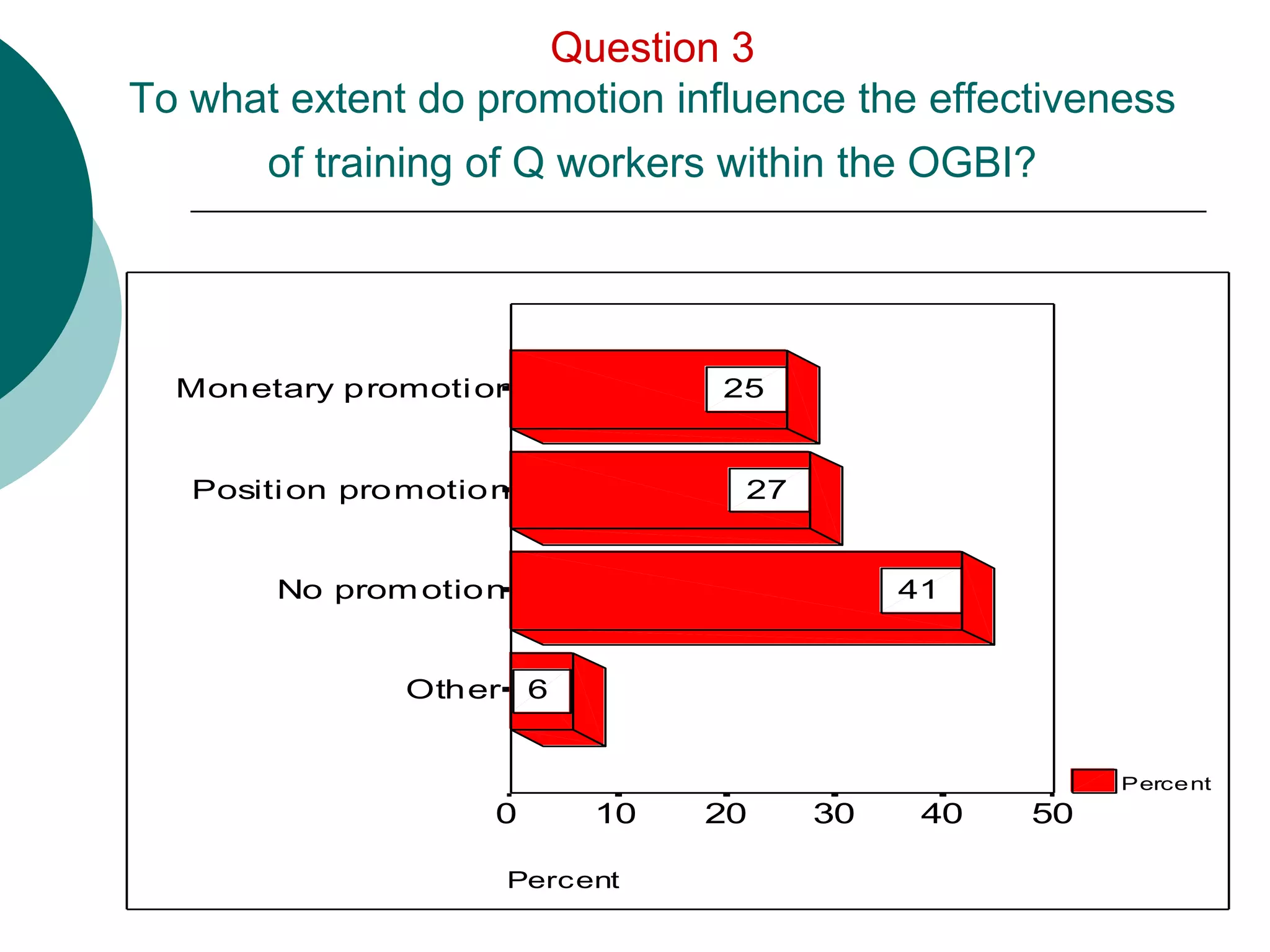
Question 3
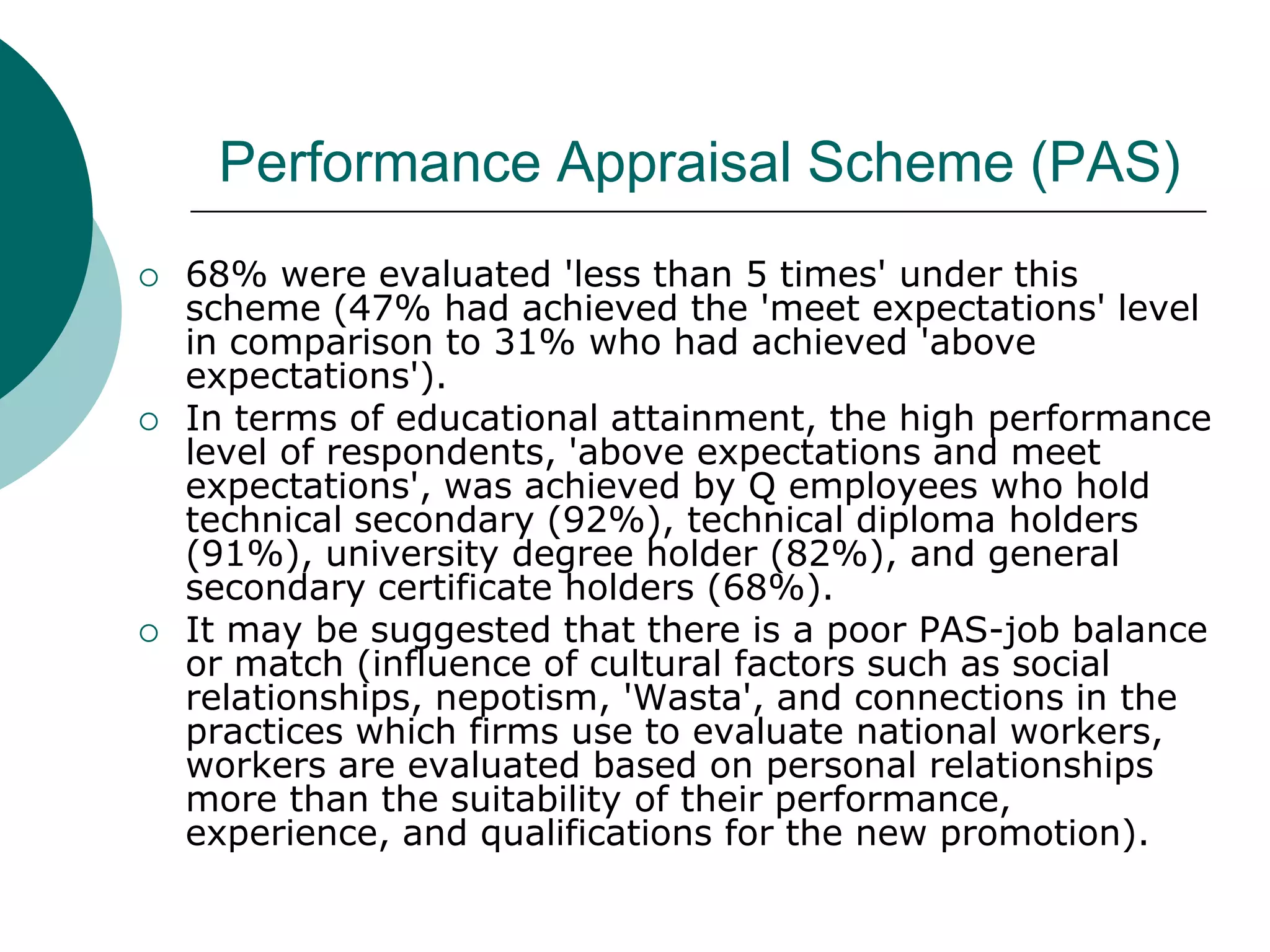
To what extent do promotion influence the effectiveness
       of training of Q workers within the OGBI?


  Monetary promoti on             25


   Positi on promotion             27


        No prom otion                        41


               Other     6


                                                        Perce nt
                     0       10   20    30    40   50

                        Percent
To what extent do promotion influence the
effectiveness of training of Q workers within the
                      OGBI?

      Completion of any training
       programme does not necessarily
       coincide with any promotion or
       reward although its proven positive
       effect on work motivation and
       organizational commitment.
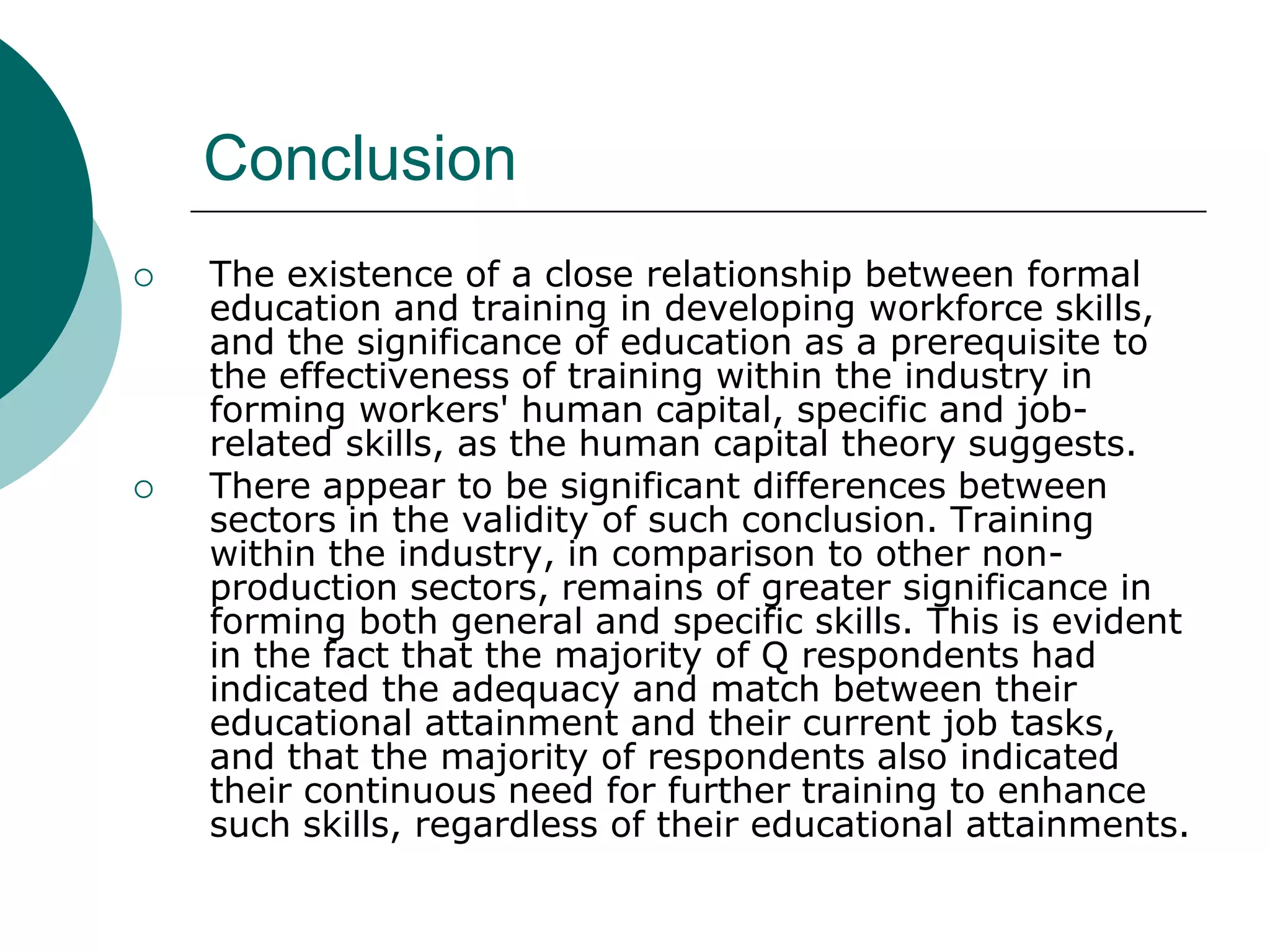
Performance Appraisal Scheme (PAS)
   68% were evaluated 'less than 5 times' under this
    scheme (47% had achieved the 'meet expectations' level
    in comparison to 31% who had achieved 'above
    expectations').
   In terms of educational attainment, the high performance
    level of respondents, 'above expectations and meet
    expectations', was achieved by Q employees who hold
    technical secondary (92%), technical diploma holders
    (91%), university degree holder (82%), and general
    secondary certificate holders (68%).
   It may be suggested that there is a poor PAS-job balance
    or match (influence of cultural factors such as social
    relationships, nepotism, 'Wasta', and connections in the
    practices which firms use to evaluate national workers,
    workers are evaluated based on personal relationships
    more than the suitability of their performance,
    experience, and qualifications for the new promotion).
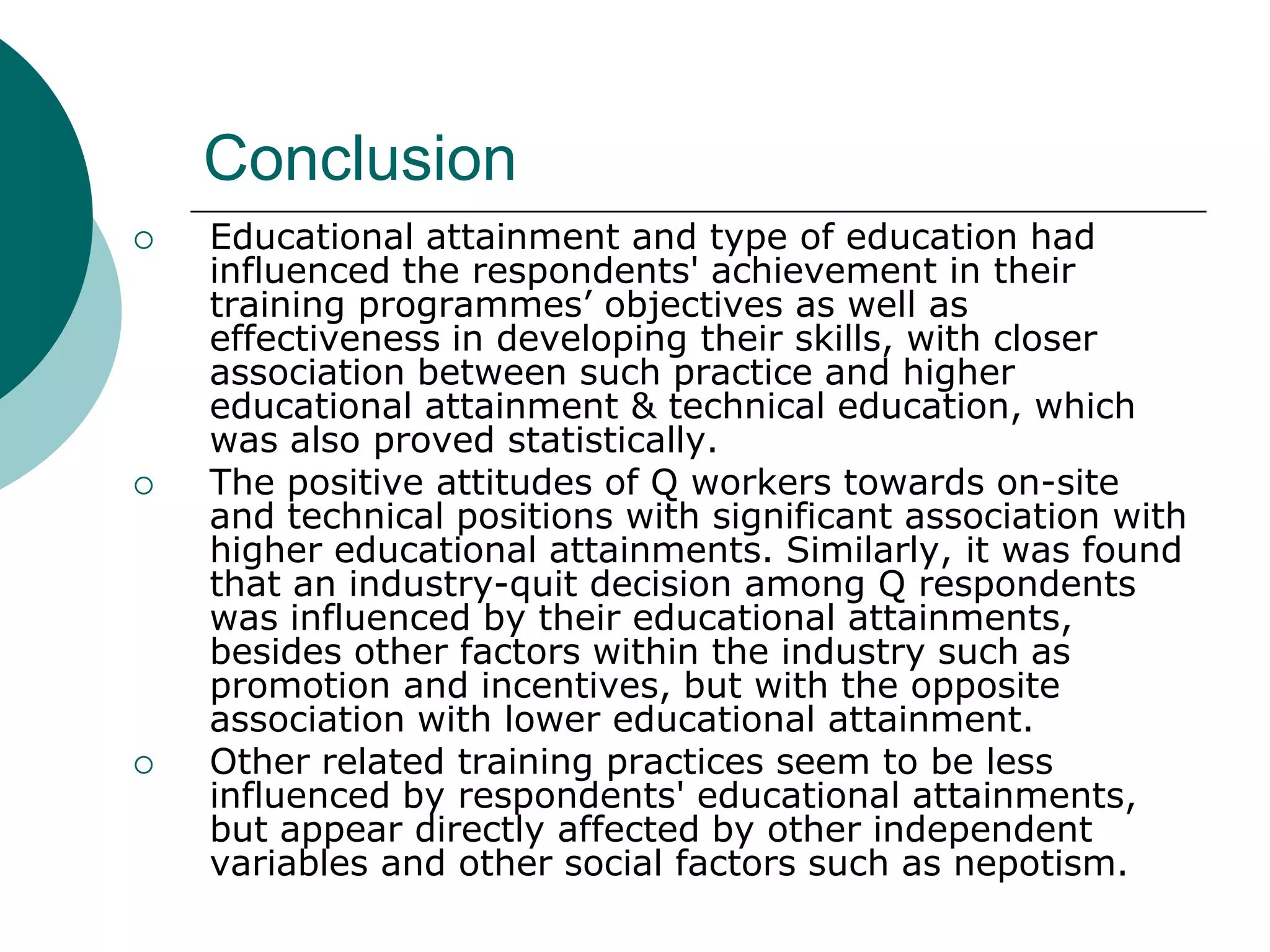
Conclusion
   The existence of a close relationship between formal
    education and training in developing workforce skills,
    and the significance of education as a prerequisite to
    the effectiveness of training within the industry in
    forming workers' human capital, specific and job-
    related skills, as the human capital theory suggests.
   There appear to be significant differences between
    sectors in the validity of such conclusion. Training
    within the industry, in comparison to other non-
    production sectors, remains of greater significance in
    forming both general and specific skills. This is evident
    in the fact that the majority of Q respondents had
    indicated the adequacy and match between their
    educational attainment and their current job tasks,
    and that the majority of respondents also indicated
    their continuous need for further training to enhance
    such skills, regardless of their educational attainments.
Conclusion
   Educational attainment and type of education had
    influenced the respondents' achievement in their
    training programmes’ objectives as well as
    effectiveness in developing their skills, with closer
    association between such practice and higher
    educational attainment & technical education, which
    was also proved statistically.
   The positive attitudes of Q workers towards on-site
    and technical positions with significant association with
    higher educational attainments. Similarly, it was found
    that an industry-quit decision among Q respondents
    was influenced by their educational attainments,
    besides other factors within the industry such as
    promotion and incentives, but with the opposite
    association with lower educational attainment.
   Other related training practices seem to be less
    influenced by respondents' educational attainments,
    but appear directly affected by other independent
    variables and other social factors such as nepotism.
Policy Implications:
   At the national level and for Q skills to be developed
    effectively there is a need for constant cooperation
    between educational institutions, especially technical
    institutions, and the industry to generate and develop
    workers' job-related skills and hence improve their
    performance. At the industry level, training should
    continue to be a major means of generating and
    developing workers' specific skills and to some extent
    their general skills.
   Internal organizational factors that affect training
    effectiveness such as promotion and PAS need to be
    readjusted in accordance with workers' performance
    rather than job classification, which in turn is expected to
    enhance stability and the commitment of Qatari workers
    towards their jobs and hence firms.
Training in Oil & Bas Based Industry
                    (OGBI)

   Thank You for your Attention!


   Any questions ?

Training in the Qatari Oil&Gas Industries

  • 1.
    Training in Oil& Gas Based Industry (OGBI): Employees Perspective Dr. Hend Al Muftah March 2005
  • 2.
    Statement of theProblem 1. From Economic Perspective • Economic diversification. • Extensive use of non-national labour (Q 46% in 2001, 38% OGBI in 2002). 2. From Industry Perspective • Manufacturing industry characteristics • Associated results • OGBI places a major emphasis on training
  • 3.
    Investigated Sector  Qatar Petroleum QP,  Qatar Petrochemical Company QAPCO,  Qatar Fertilizer Company QAFCO,  Qatar Fuel Additive Company QAFAC,  Qatar Chemical Company Q-Chem, and  Qatar Vinyl Company QVC
  • 4.
    Main Questions 1. Towhat extent educational attainment of Q workers within the OGBI is adequate to their current job-tasks? To what extent Q workers need further training programs to develop their job- related skills? To what extent do the OGBI provide educational and training opportunities to Qatari workers?
  • 5.
    Main Questions 2. Towhat extent do Q workers' educational attainments affect the effectiveness of their training programmes, related practices and their attitudes towards technical and production jobs and labour turnover?
  • 6.
    Main Questions 3. Towhat extent do other practices such as promotion, performance appraisal schemes, and training difficulties influence the effectiveness of training of Q workers within the OGBI?
  • 7.
    Respondent’s profile Background info Frequency % Background info Frequency % ---------------------------------------------------------------------------------------------------------------- -- Gender Job position classification Male 156 81 Administrative 62 32 Female 37 19 Technician 127 66 Other 4 2 --------------------------------------------------------------------------------------------------------------- ---  Age Working year Less than 20 26 14 Less than 5 68 68 21 – 30 99 51 5 – 10 10 31 – 40 44 23 11 – 15 9 41 – 50 17 9 16 – 20 9 51 – 60 6 3 20 + 4 Educational level Secondary 41 Technical secondary 7 Technical diploma 6 University 46 ---------------------------------------------------------------------------------------------------------------- --  Reason for joining the industry  High wages 59 31  Education & training 57 30  New experience 54 28  Working environment 20 10
  • 8.
    Question 1: Significance of Education as a Pre- requisite for Training Not-s ignif. at all V ery s ignificant 3.1% 37.3% Not signific ant 14.0% Neutral 4.1% Signific ant 41.5%
  • 9.
    Significance of Educationas a Pre- requisite for Training  The HCT prediction that the general- skills level is significant in the development of specific skills, which are formed through training, does not apply to the current study findings.  It may be argued that within the industrial sector, a higher level of education is not necessary to absorb and acquire specific skills, but technical secondary may seem to be a better minimum level for acquiring such skills within any industry.
  • 10.
    To what extentthe current educational attainments of Qatari workers in the OGBI is matching with their current job-tasks? Highly suit bale Not sure 36.8% 37.3% Suit able 25.9%
  • 11.
    To what extentthe current educational attainments of Qatari workers in the OGBI is matching with their current job-tasks?  68% are satisfied with their current educational attainments in managing their current job's  tasks (insignificant statistical relationship between education/job suitability and respondents' educational attainment).  82% indicated their need for further training in order to enhance their job-skills.  Conclusion: though formal education may create basic skills that may be relevant to industry, such skills may only serve the needs of small-scale industries. For a higher level of industrialization as OGBI, both technical education and OJT are essential to meet the requirements for new skills needs.  within OGBI, training is of greater importance when compared to education
  • 12.
    1.3 To whatextent they need further specific-training programs in order to develop their skills required by their current jobs?  82% indicated their need for further training program as follows: 41% technical PT, 34% non-technical PT,18% technical IT, 6% non-technical IT, and 1.6% are interested in the four types of training  Statistically, there was no association between the need for further training programmes and respondents' educational attainment.  It is concluded that:  Education in Qatar plays a significant role in generating and enhancing specific skills among Q.  Education is significant in providing workers with general-skills but not specific-ones, which in turn points to the significance of continuous training in developing workers' specific-skills and its great value in filling gaps between formal education and workplace skills.
  • 13.
    4 To whatextent do the OGBI provide educational and training opportunities to Qatari workers?  67% of Q participants indicated that their education was not upgraded (31% secondary, 29% university). 33% had upgrades their education (20% secondary).  Conclusion: training (short-term) remains a higher priority in comparison to education (long- term) since it is more effective in developing and enhancing workers' general and specific skills.
  • 14.
    1.5 Education/Training Linkssignificance in Forming QHC  42% indicated the significance of education/training close linkages in forming their general & specific HC  Statistically, there was a difference in the significant level of education/training among senior and junior workers, with highest significant level among junior workers and lesser level of significance among senior staff.
  • 15.
    Question 2: To whatextent do Q workers' educational attainments affect the effectiveness of their training programmes, related practices and their attitudes towards technical and production jobs and labour turnover? 2.1 Training Objectives and Achievement  83% strongly agreed with enhancing current job-related skills,  68% strongly agreed with obtaining new job-related skills,  66% strongly agreed with implementing new production/technology,  65% strongly agreed with increasing wages and promotion,  47% strongly agreed with developing general skills
  • 16.
    To what extentdo Q workers' educational attainments affect the effectiveness of their training programmes, related practices and their attitudes towards technical and production jobs and labour turnover? Correlation test revealed a significant relationship between respondents' educational attainment and :  obtaining new job-related skills.  enhancing current job-related skills  increasing wages and promotion.
  • 17.
    These findings:  1) confirm the HCT argument (importance of the level of accumulated knowledge through education to absorb new skills),  2) suggest that the higher the educational attainment of the worker, the higher the degree of achieving the training objective (e.g. U & Technical education), and  3) revealed that implementation of new production/technology is influenced by workers' training rather than his/her educational attainment.
  • 18.
    Training Effectiveness  Majority indicated the effectiveness of training factors as related objectives and curriculum (85%), teaching staff (81%), length (70%), and facilities (68%), etc.  Majority indicated the effectiveness of training in developing their general-skills (94%), developing their know-how skills (94%), developing their specific-skills (89%), developing multi-task skill (83%), developing their abilities in solving job- related problems (68%) and in managing complex tasks (65%), and enhancing their career positions (57%).
  • 19.
    Training Effectiveness  Respondents' educational attainments do not affect training factors as related objectives and curriculum, length, teaching staff and facilities, teaching staff, etc.  There is a strong association between higher levels of educational attainment and effectiveness of training in enhancing and developing the various skills required within the industry.  However, it has been shown that workers with lower educational qualifications (specifically technical secondary) had higher returns, where training was very effective in increasing their ability to develop their general skills 100%, manage multi-tasks, 92%, develop their know-how skills, 92%, and to manage complex tasks, 77%  In turn, this suggests the significance of technical education in influencing employees skills formation process within industry.
  • 20.
    2.3 Agreement withTraining Policy 50 40 42 30 20 21 17 10 10 10 Percent 0 Percent st rongly disagree neit her agree nor di st rongly agree disagree agree
  • 21.
    2.4 Qatari Workers'Attitudes towards On-Site Jobs 300 200 64 55 Curren t e ducatio na l 100 62 Univ ersit y 17 18 Technical diploma 23 Percent 18 Technical Secondary 30 38 0 19 Secondary Not high at all Neutral Very high Not high High
  • 22.
    Qatari Workers' Attitudestowards On-Site Jobs  78% had shown their interest in working on-site.  75% had confirmed their high motivation towards such jobs  the higher the level of education, the higher the motivation is (university holders 64%, technical school 62%, technical diploma holders 55%, and secondary school certificate holders 38%).
  • 23.
    2.5 Qatari Workers’Attitudes towards Technical Jobs  89% showed their interest in becoming technical specialists (91% among university degree holders, 91% among technical secondary certificate holders, 86% among general secondary certificate holders, and 82% among technical diploma holders).  32% are looking to be specialists within the engineering field, 31% and 27% in the production and supervision fields respectively, 10% in other fields such as management, maintenance, services and security, i.e. fire fighters.
  • 24.
    2.6 Acceptance andSearch for other Jobs  Majority of Q (63%, N= 121) are not intending to accept any offer even though similar benefits would be provided.  Statistically, correlation test indicated a significant relationship between:  the acceptance of and search for another job and the employees’ companies (QP (53%), and QAFAC 52%).  the acceptance of & search for another job and respondents' job classification (the higher the job classification the lower the attitude towards accepting and searching for another job).  the acceptance of & search for another job and respondents' educational background (the lower the educational level, the higher degree of accepting & searching for another job).
  • 25.
    Question 3 To whatextent do promotion influence the effectiveness of training of Q workers within the OGBI? Monetary promoti on 25 Positi on promotion 27 No prom otion 41 Other 6 Perce nt 0 10 20 30 40 50 Percent
  • 26.
    To what extentdo promotion influence the effectiveness of training of Q workers within the OGBI?  Completion of any training programme does not necessarily coincide with any promotion or reward although its proven positive effect on work motivation and organizational commitment.
  • 27.
    Performance Appraisal Scheme(PAS)  68% were evaluated 'less than 5 times' under this scheme (47% had achieved the 'meet expectations' level in comparison to 31% who had achieved 'above expectations').  In terms of educational attainment, the high performance level of respondents, 'above expectations and meet expectations', was achieved by Q employees who hold technical secondary (92%), technical diploma holders (91%), university degree holder (82%), and general secondary certificate holders (68%).  It may be suggested that there is a poor PAS-job balance or match (influence of cultural factors such as social relationships, nepotism, 'Wasta', and connections in the practices which firms use to evaluate national workers, workers are evaluated based on personal relationships more than the suitability of their performance, experience, and qualifications for the new promotion).
  • 28.
    Conclusion  The existence of a close relationship between formal education and training in developing workforce skills, and the significance of education as a prerequisite to the effectiveness of training within the industry in forming workers' human capital, specific and job- related skills, as the human capital theory suggests.  There appear to be significant differences between sectors in the validity of such conclusion. Training within the industry, in comparison to other non- production sectors, remains of greater significance in forming both general and specific skills. This is evident in the fact that the majority of Q respondents had indicated the adequacy and match between their educational attainment and their current job tasks, and that the majority of respondents also indicated their continuous need for further training to enhance such skills, regardless of their educational attainments.
  • 29.
    Conclusion  Educational attainment and type of education had influenced the respondents' achievement in their training programmes’ objectives as well as effectiveness in developing their skills, with closer association between such practice and higher educational attainment & technical education, which was also proved statistically.  The positive attitudes of Q workers towards on-site and technical positions with significant association with higher educational attainments. Similarly, it was found that an industry-quit decision among Q respondents was influenced by their educational attainments, besides other factors within the industry such as promotion and incentives, but with the opposite association with lower educational attainment.  Other related training practices seem to be less influenced by respondents' educational attainments, but appear directly affected by other independent variables and other social factors such as nepotism.
  • 30.
    Policy Implications:  At the national level and for Q skills to be developed effectively there is a need for constant cooperation between educational institutions, especially technical institutions, and the industry to generate and develop workers' job-related skills and hence improve their performance. At the industry level, training should continue to be a major means of generating and developing workers' specific skills and to some extent their general skills.  Internal organizational factors that affect training effectiveness such as promotion and PAS need to be readjusted in accordance with workers' performance rather than job classification, which in turn is expected to enhance stability and the commitment of Qatari workers towards their jobs and hence firms.
  • 31.
    Training in Oil& Bas Based Industry (OGBI)  Thank You for your Attention!  Any questions ?