
WELCOME
TRAINING PROGRAM ORGANIZED BY
MANAGING GENERATION Y
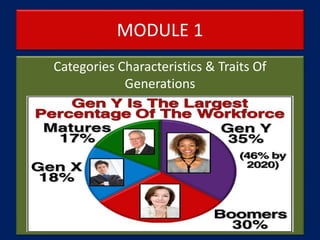
MODULE 1
Categories Characteristics & Traits Of
Generations
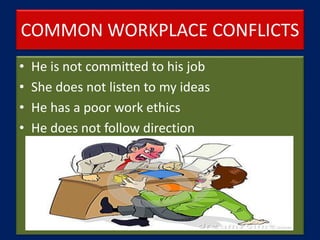
COMMON WORKPLACE CONFLICTS
• He is not committed to his job
• She does not listen to my ideas
• He has a poor work ethics
• He does not follow direction
CATEGORIES OF GENERATIONS
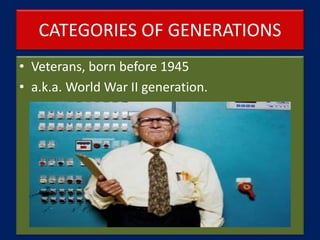
• Veterans, born before 1945
• a.k.a. World War II generation.
CATEGORIES OF GENERATIONS
• Baby boomers (born 1945-1964)
• Grew up in a time of much more prosperity
CATEGORIES OF GENERATIONS
• Generation X (born 1965-1980)
• Raised on technology, with everything from
televisions and microwaves to videocassette
recorders and personal computers becoming
more commonplace early in their lifetime.
CATEGORIES OF GENERATIONS
• Generation Y (born 1981-2000)
• Are just now starting their working lives and
beginning to emerge with yet another unique
generational personality.
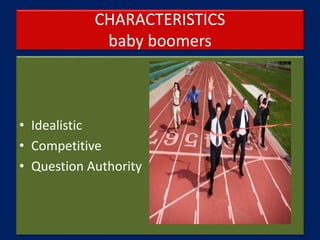
CHARACTERISTICS
baby boomers
• Idealistic
• Competitive
• Question Authority
TRAITS
baby boomers
• Motivated by $, title, recognition, promotion
• Willing to work long hours as long as they see
they will get ahead, earn $ and/or bonus
• On Work-Life Balance: “Work matters most” -
Career Advancement mentality: Prove yourself
with long hours; pay your dues
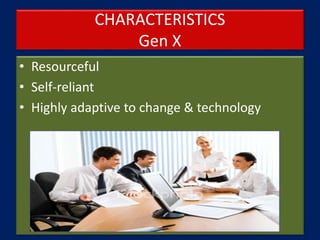
CHARACTERISTICS
Gen X
• Resourceful
• Self-reliant
• Highly adaptive to change & technology
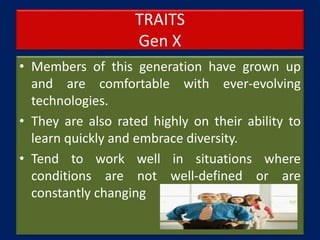
TRAITS
Gen X
• Members of this generation have grown up
and are comfortable with ever-evolving
technologies.
• They are also rated highly on their ability to
learn quickly and embrace diversity.
• Tend to work well in situations where
conditions are not well-defined or are
constantly changing
CHARACTERISTICS
Gen Y
• It’s all about me
• Globally concerned
• Realistic
• Cyber-savvy
TRAITS
Gen Y
• Like multi-tasking, e.g., listening to music,
while texting , & talking
• Easily bored short attention spans - expect
Gen-Y’s to have many job changes
• Personal fulfilment is their motivator
• Workplace flexibility should suit my needs
• People who are used to getting their way
instantly may not be able to handle even small
rejections
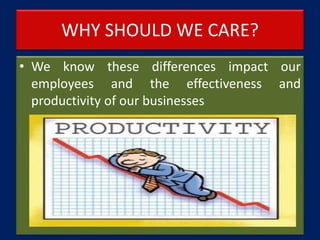
WHY SHOULD WE CARE?
• We know these differences impact our
employees and the effectiveness and
productivity of our businesses
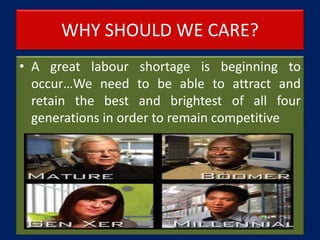
WHY SHOULD WE CARE?
• A great labour shortage is beginning to
occur…We need to be able to attract and
retain the best and brightest of all four
generations in order to remain competitive
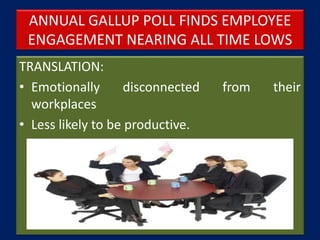
ANNUAL GALLUP POLL FINDS EMPLOYEE
ENGAGEMENT NEARING ALL TIME LOWS
TRANSLATION:
• Emotionally disconnected from their
workplaces
• Less likely to be productive.
MODULE 2
The Importance Of People
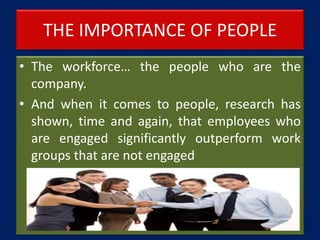
THE IMPORTANCE OF PEOPLE
• The workforce… the people who are the
company.
• And when it comes to people, research has
shown, time and again, that employees who
are engaged significantly outperform work
groups that are not engaged
THREE KEY DRIVERS IMPACT
EMPLOYEE ENGAGEMENT
1. Relationship with immediate supervisor
2. Belief in senior leadership
3. Pride in working for the company
HOW TO WORK WITH GEN Y’S?
share your experience
• Be a role model
• Set clear expectations
• Show them respect
• Challenge them – help them learn
• Be flexible
• Develop social /work relationships
• Have some fun at work
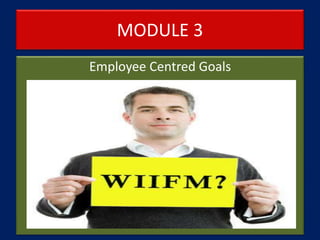
MODULE 3
Employee Centred Goals
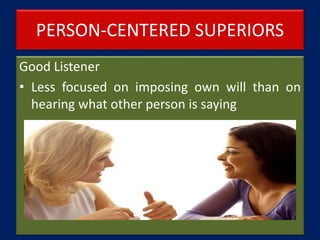
PERSON-CENTERED SUPERIORS
Good Listener
• Less focused on imposing own will than on
hearing what other person is saying
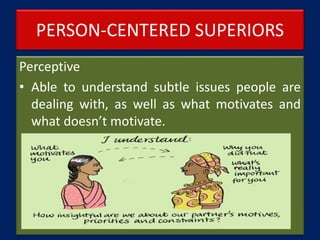
PERSON-CENTERED SUPERIORS
Perceptive
• Able to understand subtle issues people are
dealing with, as well as what motivates and
what doesn’t motivate.
PERSON-CENTERED SUPERIORS
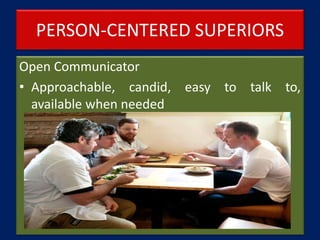
Open Communicator
• Approachable, candid, easy to talk to,
available when needed
PERSON-CENTERED SUPERIORS
Calm Demeanour
• Not excitable, able to remain cool under
stress, I.e., opposite of hot tempered.
PERSON-CENTERED SUPERIORS
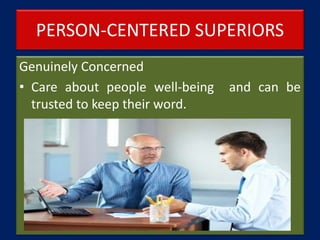
Genuinely Concerned
• Care about people well-being and can be
trusted to keep their word.
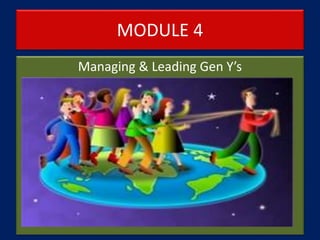
MODULE 4
Managing & Leading Gen Y’s
MANAGING & LEADING GEN Y’s
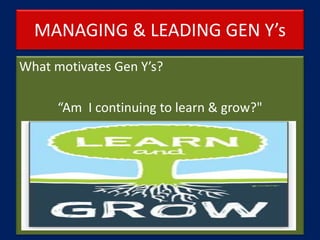
What motivates Gen Y’s?
“Am I continuing to learn & grow?"
MANAGING & LEADING GEN Y’s
Gen Y’s learn and grow through:-
• Social collaboration
MANAGING & LEADING GEN Y’s
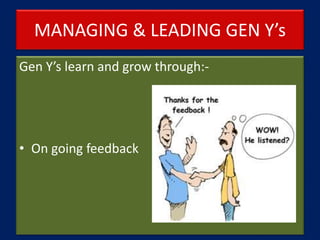
Gen Y’s learn and grow through:-
• On going feedback
MANAGING & LEADING GEN Y’s
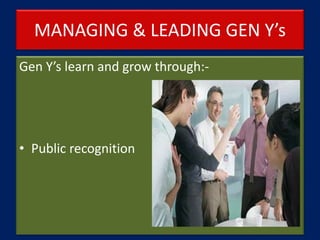
Gen Y’s learn and grow through:-
• Public recognition
WHAT CAN YOU DO FOR GEN Y’S
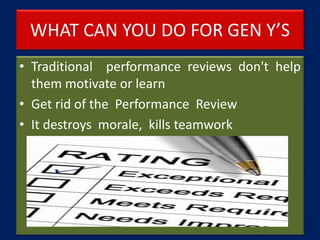
• Traditional performance reviews don't help
them motivate or learn
• Get rid of the Performance Review
• It destroys morale, kills teamwork
WHAT CAN YOU DO FOR GEN Y’S
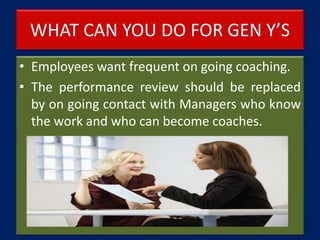
• Employees want frequent on going coaching.
• The performance review should be replaced
by on going contact with Managers who know
the work and who can become coaches.
WHAT CAN YOU DO FOR GEN Y’S
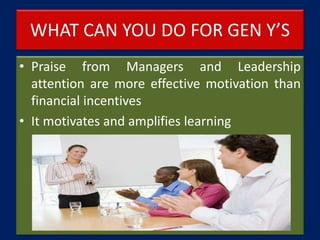
• Praise from Managers and Leadership
attention are more effective motivation than
financial incentives
• It motivates and amplifies learning
IN SUMMARY
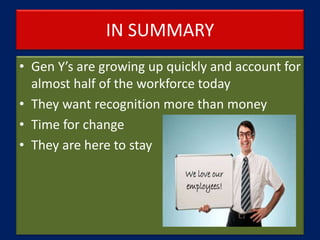
• Gen Y’s are growing up quickly and account for
almost half of the workforce today
• They want recognition more than money
• Time for change
• They are here to stay
THANK YOU

Managing Gen Y @ Workplace

  • 1.
    WELCOME TRAINING PROGRAM ORGANIZEDBY MANAGING GENERATION Y
  • 2.
    MODULE 1 Categories Characteristics& Traits Of Generations
  • 3.
    COMMON WORKPLACE CONFLICTS •He is not committed to his job • She does not listen to my ideas • He has a poor work ethics • He does not follow direction
  • 4.
    CATEGORIES OF GENERATIONS •Veterans, born before 1945 • a.k.a. World War II generation.
  • 5.
    CATEGORIES OF GENERATIONS •Baby boomers (born 1945-1964) • Grew up in a time of much more prosperity
  • 6.
    CATEGORIES OF GENERATIONS •Generation X (born 1965-1980) • Raised on technology, with everything from televisions and microwaves to videocassette recorders and personal computers becoming more commonplace early in their lifetime.
  • 7.
    CATEGORIES OF GENERATIONS •Generation Y (born 1981-2000) • Are just now starting their working lives and beginning to emerge with yet another unique generational personality.
  • 8.
    CHARACTERISTICS baby boomers • Idealistic •Competitive • Question Authority
  • 9.
    TRAITS baby boomers • Motivatedby $, title, recognition, promotion • Willing to work long hours as long as they see they will get ahead, earn $ and/or bonus • On Work-Life Balance: “Work matters most” - Career Advancement mentality: Prove yourself with long hours; pay your dues
  • 10.
    CHARACTERISTICS Gen X • Resourceful •Self-reliant • Highly adaptive to change & technology
  • 11.
    TRAITS Gen X • Membersof this generation have grown up and are comfortable with ever-evolving technologies. • They are also rated highly on their ability to learn quickly and embrace diversity. • Tend to work well in situations where conditions are not well-defined or are constantly changing
  • 12.
    CHARACTERISTICS Gen Y • It’sall about me • Globally concerned • Realistic • Cyber-savvy
  • 13.
    TRAITS Gen Y • Likemulti-tasking, e.g., listening to music, while texting , & talking • Easily bored short attention spans - expect Gen-Y’s to have many job changes • Personal fulfilment is their motivator • Workplace flexibility should suit my needs • People who are used to getting their way instantly may not be able to handle even small rejections
  • 14.
    WHY SHOULD WECARE? • We know these differences impact our employees and the effectiveness and productivity of our businesses
  • 15.
    WHY SHOULD WECARE? • A great labour shortage is beginning to occur…We need to be able to attract and retain the best and brightest of all four generations in order to remain competitive
  • 16.
    ANNUAL GALLUP POLLFINDS EMPLOYEE ENGAGEMENT NEARING ALL TIME LOWS TRANSLATION: • Emotionally disconnected from their workplaces • Less likely to be productive.
  • 17.
  • 18.
    THE IMPORTANCE OFPEOPLE • The workforce… the people who are the company. • And when it comes to people, research has shown, time and again, that employees who are engaged significantly outperform work groups that are not engaged
  • 19.
    THREE KEY DRIVERSIMPACT EMPLOYEE ENGAGEMENT 1. Relationship with immediate supervisor 2. Belief in senior leadership 3. Pride in working for the company
  • 20.
    HOW TO WORKWITH GEN Y’S? share your experience • Be a role model • Set clear expectations • Show them respect • Challenge them – help them learn • Be flexible • Develop social /work relationships • Have some fun at work
  • 21.
  • 22.
    PERSON-CENTERED SUPERIORS Good Listener •Less focused on imposing own will than on hearing what other person is saying
  • 23.
    PERSON-CENTERED SUPERIORS Perceptive • Ableto understand subtle issues people are dealing with, as well as what motivates and what doesn’t motivate.
  • 24.
    PERSON-CENTERED SUPERIORS Open Communicator •Approachable, candid, easy to talk to, available when needed
  • 25.
    PERSON-CENTERED SUPERIORS Calm Demeanour •Not excitable, able to remain cool under stress, I.e., opposite of hot tempered.
  • 26.
    PERSON-CENTERED SUPERIORS Genuinely Concerned •Care about people well-being and can be trusted to keep their word.
  • 27.
    MODULE 4 Managing &Leading Gen Y’s
  • 28.
    MANAGING & LEADINGGEN Y’s What motivates Gen Y’s? “Am I continuing to learn & grow?"
  • 29.
    MANAGING & LEADINGGEN Y’s Gen Y’s learn and grow through:- • Social collaboration
  • 30.
    MANAGING & LEADINGGEN Y’s Gen Y’s learn and grow through:- • On going feedback
  • 31.
    MANAGING & LEADINGGEN Y’s Gen Y’s learn and grow through:- • Public recognition
  • 32.
    WHAT CAN YOUDO FOR GEN Y’S • Traditional performance reviews don't help them motivate or learn • Get rid of the Performance Review • It destroys morale, kills teamwork
  • 33.
    WHAT CAN YOUDO FOR GEN Y’S • Employees want frequent on going coaching. • The performance review should be replaced by on going contact with Managers who know the work and who can become coaches.
  • 34.
    WHAT CAN YOUDO FOR GEN Y’S • Praise from Managers and Leadership attention are more effective motivation than financial incentives • It motivates and amplifies learning
  • 35.
    IN SUMMARY • GenY’s are growing up quickly and account for almost half of the workforce today • They want recognition more than money • Time for change • They are here to stay
  • 36.