Dr. Paul Englert
APAC Director Psytech International
PhD I/O Psychologist
Understanding Young Working
Professionals
Outline	
  
•  Generational	
  differences	
  
•  Managing	
  Generation	
  Y	
  
•  The	
  aging	
  workforce	
  
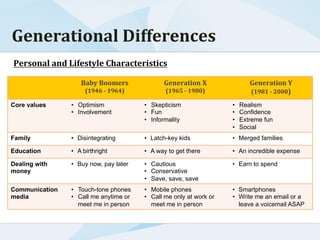
Baby	
  Boomers	
  	
  
(1946	
  -­‐	
  1964)	
  
Generation	
  X	
  	
  
(1965	
  -­‐	
  1980)	
  
Generation	
  Y	
  	
  
(1981	
  -­‐	
  2000)	
  
Core values •  Optimism
•  Involvement
•  Skepticism
•  Fun
•  Informality
•  Realism
•  Confidence
•  Extreme fun
•  Social
Family •  Disintegrating •  Latch-key kids •  Merged families
Education •  A birthright •  A way to get there •  An incredible expense
Dealing with
money
•  Buy now, pay later •  Cautious
•  Conservative
•  Save, save, save
•  Earn to spend
Communication
media
•  Touch-tone phones
•  Call me anytime or
meet me in person
•  Mobile phones
•  Call me only at work or
meet me in person
•  Smartphones
•  Write me an email or a
leave a voicemail ASAP
Personal	
  and	
  Lifestyle	
  Characteristics	
  
Generational	
  Differences	
  
Workplace	
  Characteristics	
  
Generational	
  Differences	
  
Baby	
  Boomers	
  	
  
(1946	
  -­‐	
  1964)	
  
Generation	
  X	
  	
  
(1965	
  -­‐	
  1980)	
  
Generation	
  Y	
  	
  
(1981	
  -­‐	
  2000)	
  
Work is… … an exciting adventure … a difficult challenge
… a contract
… a means to an end
fulfillment
Attitudes toward
authority / rules
•  Some may still be
uncomfortable
interacting with
authority figures
•  Are comfortable with
authorities and are not
impressed with titles or
intimidated by them
•  Find it natural to interact
with their superior
•  Believe that respect must
be earned
Attitudes toward
loyalty to their
employer
•  Value company
commitment and
loyalty
•  65% would like to stay
in their organization for
the rest of their
working life
•  Less loyal to companies
than previous generations
but loyal to people
•  40% would like to stay in
their organisation for the
rest of their working life
•  Committed and loyal
when dedicated to an
idea, cause or product
•  20% would like to stay in
their organization for the
rest of their working life
Baby	
  Boomers	
  	
  
(1946	
  -­‐	
  1964)	
  
Generation	
  X	
  	
  
(1965	
  -­‐	
  1980)	
  
Generation	
  Y	
  	
  
(1981	
  -­‐	
  2000)	
  
Perceived
elements of
success
•  82% are willing to
learn new things
•  77% meet deadlines
•  74% are willing to learn
new things
•  75% meet deadlines
•  58% are willing to learn
new things
•  62% meet deadlines
Preferred
leadership
attributes
•  Credible (74%)
•  Trusted (61%)
•  Farsighted (57%)
•  Credible (71%)
•  Trusted (58%)
•  Farsighted (54%)
•  Listens well (68%)
•  Dependable (66%)
•  Dedicated (63%)
Feedback and
rewards
•  Don’t appreciate it
•  Money
•  Title recognition
•  Ask directly for feedback
•  Freedom is the best
reward
•  Assume to get feedback
whenever they want it
•  Meaningful work
Motivating
messages
•  “You are valued”
•  “You are needed”
•  “Do it your way”
•  “Forget the rules”
•  “You will work with other
bright, creative people”
Interactive style •  Team player
•  Loves to have
meetings
•  Entrepreneur •  Participative
Generational	
  Differences	
  
Workplace	
  Characteristics	
  
Be	
  Jlexible	
  and	
  open-­‐minded!	


Managing	
  Generation	
  Y	
  
•  Listen	
  to	
  millennial	
  employees	
  
•  Provide	
  an	
  employee-­‐centered	
  workplace,	


that	
  allows	
  freedom	
  
•  Encourage	
  the	
  millennial’s	
  “can-­‐do”	
  attitude	
  	
  
•  Challenge	
  them	
  with	
  different	
  tasks	
  
•  Offer	
  opportunities	
  for	
  training	
  and	


provide	
  the	
  chance	
  to	
  grow	
  in	
  the	
  position	
  
But	
  don’t	
  forget	
  to…	


Managing	
  Generation	
  Y	
  
•  Provide	
  structure	
  	
  
•  Provide	
  leadership,	
  guidance	
  and	
  	
  feedback	
  
•  Consider,	
  that	
  every	
  Gen	
  Y	
  employee	
  is	
  different	


(some	
  may	
  prefer	
  a	
  more	
  traditional	
  workplace)	
  
Managing	
  Generation	
  Y	
  
Managing	
  Generation	
  Y	
  is	
  a	
  constant	
  balance:	
  	
  
Provide	
  freedom	
  
and	
  power	
  in	
  the	
  
decision	
  making	
  
process	
  	
  
Provide	
  
structure,	
  
boundaries	
  and	
  
consequences	
  
The	
  Aging	
  Workforce	
  
The	
  Aging	
  Workforce	
  
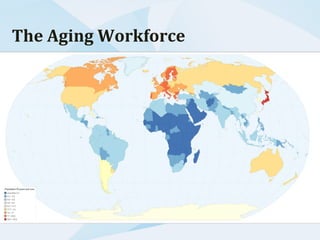
60+	
  segment	
  grows	
  to	
  20%	
  in	
  almost	
  all	
  industrialised	
  nations	
  
http://www.fdu.edu/newspubs/magazine/05ws/generations.htm	
  
http://humanresources.about.com/od/managementtips/a/millenials.htm	
  
http://www.businessinsider.com.au/4-­‐ways-­‐to-­‐manage-­‐gen-­‐y-­‐employees-­‐2013-­‐1	
  	
  
http://blog.clomedia.com/2013/08/how-­‐should-­‐you-­‐manage-­‐gen-­‐y/	
  	
  
http://themindsetlist.com/2013/01/5-­‐mistakes-­‐managers-­‐make-­‐with-­‐gen-­‐y-­‐in-­‐the-­‐
workplace/	
  	
  
http://www.smartcompany.com.au/people/human-­‐resources/34285-­‐the-­‐secret-­‐to-­‐
managing-­‐gen-­‐y.html	
  	
  
http://rtc.umn.edu/docs/2_18_Gen_diff_workplace.pdf	
  
http://www.entrepreneur.com/article/228321	
  
http://chartsbin.com/view/3687	


Resources	
  

Understanding Young Working Professionals

  • 1.
    Dr. Paul Englert APACDirector Psytech International PhD I/O Psychologist Understanding Young Working Professionals
  • 6.
    Outline   •  Generational  differences   •  Managing  Generation  Y   •  The  aging  workforce  
  • 7.
    Baby  Boomers     (1946  -­‐  1964)   Generation  X     (1965  -­‐  1980)   Generation  Y     (1981  -­‐  2000)   Core values •  Optimism •  Involvement •  Skepticism •  Fun •  Informality •  Realism •  Confidence •  Extreme fun •  Social Family •  Disintegrating •  Latch-key kids •  Merged families Education •  A birthright •  A way to get there •  An incredible expense Dealing with money •  Buy now, pay later •  Cautious •  Conservative •  Save, save, save •  Earn to spend Communication media •  Touch-tone phones •  Call me anytime or meet me in person •  Mobile phones •  Call me only at work or meet me in person •  Smartphones •  Write me an email or a leave a voicemail ASAP Personal  and  Lifestyle  Characteristics   Generational  Differences  
  • 8.
    Workplace  Characteristics   Generational  Differences   Baby  Boomers     (1946  -­‐  1964)   Generation  X     (1965  -­‐  1980)   Generation  Y     (1981  -­‐  2000)   Work is… … an exciting adventure … a difficult challenge … a contract … a means to an end fulfillment Attitudes toward authority / rules •  Some may still be uncomfortable interacting with authority figures •  Are comfortable with authorities and are not impressed with titles or intimidated by them •  Find it natural to interact with their superior •  Believe that respect must be earned Attitudes toward loyalty to their employer •  Value company commitment and loyalty •  65% would like to stay in their organization for the rest of their working life •  Less loyal to companies than previous generations but loyal to people •  40% would like to stay in their organisation for the rest of their working life •  Committed and loyal when dedicated to an idea, cause or product •  20% would like to stay in their organization for the rest of their working life
  • 9.
    Baby  Boomers     (1946  -­‐  1964)   Generation  X     (1965  -­‐  1980)   Generation  Y     (1981  -­‐  2000)   Perceived elements of success •  82% are willing to learn new things •  77% meet deadlines •  74% are willing to learn new things •  75% meet deadlines •  58% are willing to learn new things •  62% meet deadlines Preferred leadership attributes •  Credible (74%) •  Trusted (61%) •  Farsighted (57%) •  Credible (71%) •  Trusted (58%) •  Farsighted (54%) •  Listens well (68%) •  Dependable (66%) •  Dedicated (63%) Feedback and rewards •  Don’t appreciate it •  Money •  Title recognition •  Ask directly for feedback •  Freedom is the best reward •  Assume to get feedback whenever they want it •  Meaningful work Motivating messages •  “You are valued” •  “You are needed” •  “Do it your way” •  “Forget the rules” •  “You will work with other bright, creative people” Interactive style •  Team player •  Loves to have meetings •  Entrepreneur •  Participative Generational  Differences   Workplace  Characteristics  
  • 10.
    Be  Jlexible  and  open-­‐minded!         Managing  Generation  Y   •  Listen  to  millennial  employees   •  Provide  an  employee-­‐centered  workplace,                                                         that  allows  freedom   •  Encourage  the  millennial’s  “can-­‐do”  attitude     •  Challenge  them  with  different  tasks   •  Offer  opportunities  for  training  and                                                                                   provide  the  chance  to  grow  in  the  position  
  • 11.
    But  don’t  forget  to…         Managing  Generation  Y   •  Provide  structure     •  Provide  leadership,  guidance  and    feedback   •  Consider,  that  every  Gen  Y  employee  is  different                                   (some  may  prefer  a  more  traditional  workplace)  
  • 12.
    Managing  Generation  Y   Managing  Generation  Y  is  a  constant  balance:     Provide  freedom   and  power  in  the   decision  making   process     Provide   structure,   boundaries  and   consequences  
  • 13.
  • 14.
    The  Aging  Workforce   60+  segment  grows  to  20%  in  almost  all  industrialised  nations  
  • 15.
    http://www.fdu.edu/newspubs/magazine/05ws/generations.htm   http://humanresources.about.com/od/managementtips/a/millenials.htm   http://www.businessinsider.com.au/4-­‐ways-­‐to-­‐manage-­‐gen-­‐y-­‐employees-­‐2013-­‐1     http://blog.clomedia.com/2013/08/how-­‐should-­‐you-­‐manage-­‐gen-­‐y/     http://themindsetlist.com/2013/01/5-­‐mistakes-­‐managers-­‐make-­‐with-­‐gen-­‐y-­‐in-­‐the-­‐ workplace/     http://www.smartcompany.com.au/people/human-­‐resources/34285-­‐the-­‐secret-­‐to-­‐ managing-­‐gen-­‐y.html     http://rtc.umn.edu/docs/2_18_Gen_diff_workplace.pdf   http://www.entrepreneur.com/article/228321   http://chartsbin.com/view/3687         Resources