Presented By:   Rohit Ranganathan  REINSURANCE IN INDIA
WHAT IS REINSURANCE? In simple terms reinsurance is insurance for insurance companies. It is a means by which an insurance company can protect itself from risks. The company who requests for the cover is called the  cedant  and the reinsurer is called the  ceded .
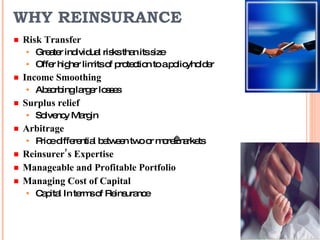
Risk Transfer Greater individual risks than its size  Offer higher limits of protection to a policyholder Income Smoothing Absorbing larger losses  Surplus relief Solvency Margin Arbitrage Price differential between two or more markets Reinsurer’s Expertise Manageable and Profitable Portfolio Managing Cost of Capital Capital In terms of Reinsurance WHY REINSURANCE
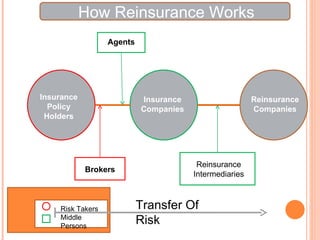
How Reinsurance Works Transfer Of Risk Risk Takers Middle Persons Insurance Policy Holders Insurance Companies Reinsurance Companies Agents Brokers Reinsurance Intermediaries
TYPES OF REINSURANCE There are two types of reinsurance: Facultative Treaty Each type of reinsurance can be structured in one  of the following two ways: Proportional Non Proportional
FACULTATIVE REINSURANCE Facultative reinsurance applies to an individual risk,  i.e., one commercial fire policy or even only one location.  Insurer and reinsurer agree to the reinsurance terms  on each individual agreement.  It is generally used to reinsure: a) Extra-hazardous or unusual risks which might be excluded from treaty reinsurance agreements. b) High valued risks with policy limits exceeding maximum treaty parameters.
TREATY REINSURANCE Applies to an insurance company’s entire book of business. Some of these include all commercial fire polices, all automobile policies, all workers’ compensation policies, all homeowners policies, or, more generally, any combination of the above. Treaty reinsurance is the one in which both pro-data and excess of loss forms are used.
PROPORTIONAL REINSURANCE One or more reinsurers take a stated percent share of each policy that an insurer produces. The reinsurer will receive the stated percentage of each dollar of premiums and will pay that percentage of each dollar of losses. Example:  Surplus share :  Reinsurer assumes pro rata responsibility for only that portion of any risk  which exceeds the company’s established retentions.
NON PROPORTIONAL REINSURANCE This insurance responds when the loss suffered by the insurer exceeds a certain amount. Example: T he insurer is prepared to accept a loss of $1 million for any loss which may occur and they purchase a layer of reinsurance of $4 million in excess of $1 million. If a loss of $3 million  occurs, then insurer will retain 1Million and will recover $2 million from its reinsurer(s).In this example, the reinsured will retain any loss exceeding $5 million unless they have  purchased a further excess layer (second layer) of say $10 million excess of $5 million.
Reinsurance the Reinsurance companies. Reinsurance seller is “Retrocessionaries” Reinsurance buyer is “Retrocedant” RETROCESSION WAYS TO REINSURE Pooled Reinsurance Reciprocity Subsidies
 
The sole domestic reinsurance company of India AAA+ Rating Incorporated on  22 November 1972 Subsidiary companies  of GIC National Insurance Company Limited The New India Assurance Company Limited The Oriental Insurance Company Limited United India Insurance Company Limit GIC Asset Management  to manage GIC Mutual Fund GIC Housing Finance Export Credit Guarantee Corporation  Business  Of GIC Domestic Reinsurance Business(73% of the Revenues GIC + Hannover Deal (60:40) – Life Insurance International Reinsurance Business (27% of the Revenues) Investment and Fund Management GENERAL INSURANCE CORPORATION (GIC)
 
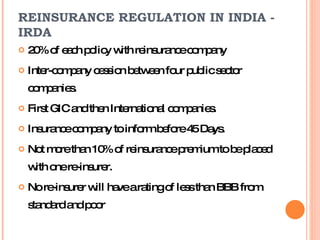
20% of each policy with reinsurance company  Inter-company cession between four public sector companies. First GIC and then International companies. Insurance company to inform before 45 Days. Not more than 10% of reinsurance premium to be placed with one re-insurer. No re-insurer will have a rating of less than BBB from standard and poor REINSURANCE REGULATION IN INDIA - IRDA
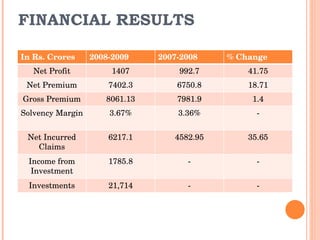
FINANCIAL RESULTS  In Rs. Crores 2008-2009 2007-2008 % Change Net Profit 1407 992.7 41.75 Net Premium 7402.3 6750.8 18.71 Gross Premium 8061.13 7981.9 1.4 Solvency Margin 3.67% 3.36% - Net Incurred Claims 6217.1 4582.95 35.65 Income from Investment 1785.8 - - Investments 21,714 - -
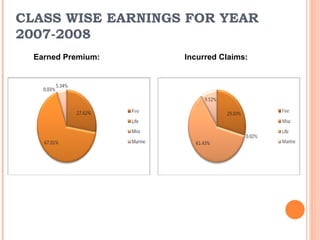
CLASS WISE EARNINGS FOR YEAR 2007-2008 Earned Premium:   Incurred Claims:
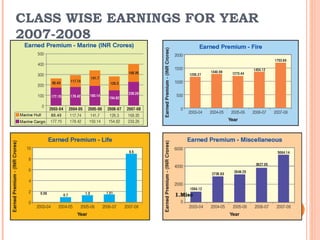
CLASS WISE EARNINGS FOR YEAR 2007-2008 Misc
Covers are not available for liability, professional indemnities, financial risks, oil and energy etc. International competitors don’t quote for small ticket deals Premium rates are costlier as foreign competitors quote more Desirable quotes from the Indian market are not available with promptitude Different dates of finalization of accounts globally Reinsurance cover for terrorist attacks is still a debate CHALLENGES FOR REINSURANCE INDUSTRY IN INDIAN MARKET
CASE STUDIES: CASE 1 – PREMIER INSURANCE COMPANY IN GUJARAT  CASE STUDIES: CASE 2 – REINSURANCE ON TERRORISM Earthquake in 2001 followed by floods 600 Crores of losses Stop the business / receive help GIC to Rescue Socially being responsible by giving incentives and clearing out dues WTC Attack Effect on Indian Industry What next??? Pool – GIC, 4 Subsidiary & 6 Private companies 200 Crores Pool – Which is too less New development regarding this – Debate still on
The End

Reinsurance in India

  • 1.
    Presented By: Rohit Ranganathan REINSURANCE IN INDIA
  • 2.
    WHAT IS REINSURANCE?In simple terms reinsurance is insurance for insurance companies. It is a means by which an insurance company can protect itself from risks. The company who requests for the cover is called the cedant and the reinsurer is called the ceded .
  • 3.
    Risk Transfer Greaterindividual risks than its size Offer higher limits of protection to a policyholder Income Smoothing Absorbing larger losses Surplus relief Solvency Margin Arbitrage Price differential between two or more markets Reinsurer’s Expertise Manageable and Profitable Portfolio Managing Cost of Capital Capital In terms of Reinsurance WHY REINSURANCE
  • 4.
    How Reinsurance WorksTransfer Of Risk Risk Takers Middle Persons Insurance Policy Holders Insurance Companies Reinsurance Companies Agents Brokers Reinsurance Intermediaries
  • 5.
    TYPES OF REINSURANCEThere are two types of reinsurance: Facultative Treaty Each type of reinsurance can be structured in one of the following two ways: Proportional Non Proportional
  • 6.
    FACULTATIVE REINSURANCE Facultativereinsurance applies to an individual risk, i.e., one commercial fire policy or even only one location. Insurer and reinsurer agree to the reinsurance terms on each individual agreement. It is generally used to reinsure: a) Extra-hazardous or unusual risks which might be excluded from treaty reinsurance agreements. b) High valued risks with policy limits exceeding maximum treaty parameters.
  • 7.
    TREATY REINSURANCE Appliesto an insurance company’s entire book of business. Some of these include all commercial fire polices, all automobile policies, all workers’ compensation policies, all homeowners policies, or, more generally, any combination of the above. Treaty reinsurance is the one in which both pro-data and excess of loss forms are used.
  • 8.
    PROPORTIONAL REINSURANCE Oneor more reinsurers take a stated percent share of each policy that an insurer produces. The reinsurer will receive the stated percentage of each dollar of premiums and will pay that percentage of each dollar of losses. Example: Surplus share :  Reinsurer assumes pro rata responsibility for only that portion of any risk which exceeds the company’s established retentions.
  • 9.
    NON PROPORTIONAL REINSURANCEThis insurance responds when the loss suffered by the insurer exceeds a certain amount. Example: T he insurer is prepared to accept a loss of $1 million for any loss which may occur and they purchase a layer of reinsurance of $4 million in excess of $1 million. If a loss of $3 million occurs, then insurer will retain 1Million and will recover $2 million from its reinsurer(s).In this example, the reinsured will retain any loss exceeding $5 million unless they have purchased a further excess layer (second layer) of say $10 million excess of $5 million.
  • 10.
    Reinsurance the Reinsurancecompanies. Reinsurance seller is “Retrocessionaries” Reinsurance buyer is “Retrocedant” RETROCESSION WAYS TO REINSURE Pooled Reinsurance Reciprocity Subsidies
  • 11.
  • 12.
    The sole domesticreinsurance company of India AAA+ Rating Incorporated on 22 November 1972 Subsidiary companies of GIC National Insurance Company Limited The New India Assurance Company Limited The Oriental Insurance Company Limited United India Insurance Company Limit GIC Asset Management to manage GIC Mutual Fund GIC Housing Finance Export Credit Guarantee Corporation Business Of GIC Domestic Reinsurance Business(73% of the Revenues GIC + Hannover Deal (60:40) – Life Insurance International Reinsurance Business (27% of the Revenues) Investment and Fund Management GENERAL INSURANCE CORPORATION (GIC)
  • 13.
  • 14.
    20% of eachpolicy with reinsurance company Inter-company cession between four public sector companies. First GIC and then International companies. Insurance company to inform before 45 Days. Not more than 10% of reinsurance premium to be placed with one re-insurer. No re-insurer will have a rating of less than BBB from standard and poor REINSURANCE REGULATION IN INDIA - IRDA
  • 15.
    FINANCIAL RESULTS In Rs. Crores 2008-2009 2007-2008 % Change Net Profit 1407 992.7 41.75 Net Premium 7402.3 6750.8 18.71 Gross Premium 8061.13 7981.9 1.4 Solvency Margin 3.67% 3.36% - Net Incurred Claims 6217.1 4582.95 35.65 Income from Investment 1785.8 - - Investments 21,714 - -
  • 16.
    CLASS WISE EARNINGSFOR YEAR 2007-2008 Earned Premium: Incurred Claims:
  • 17.
    CLASS WISE EARNINGSFOR YEAR 2007-2008 Misc
  • 18.
    Covers are notavailable for liability, professional indemnities, financial risks, oil and energy etc. International competitors don’t quote for small ticket deals Premium rates are costlier as foreign competitors quote more Desirable quotes from the Indian market are not available with promptitude Different dates of finalization of accounts globally Reinsurance cover for terrorist attacks is still a debate CHALLENGES FOR REINSURANCE INDUSTRY IN INDIAN MARKET
  • 19.
    CASE STUDIES: CASE1 – PREMIER INSURANCE COMPANY IN GUJARAT CASE STUDIES: CASE 2 – REINSURANCE ON TERRORISM Earthquake in 2001 followed by floods 600 Crores of losses Stop the business / receive help GIC to Rescue Socially being responsible by giving incentives and clearing out dues WTC Attack Effect on Indian Industry What next??? Pool – GIC, 4 Subsidiary & 6 Private companies 200 Crores Pool – Which is too less New development regarding this – Debate still on
  • 20.