MANAGEMENT BY
WALKING AROUND

“GET MANAGEMENT OUT OF THE OFFICE”
I y o u wa it fo r p e o p le to c o m e to y o u, y o u’ ll o nly
f
  g e t s m a ll p ro ble m s . Yo u m us t g o a nd find
  the m . The big p ro ble m s a re whe re p e o p le
  d o n’t re a liz e the y ha ve o ne in the firs t p la c e .

                               –W. Edwards Deming
WHAT IS MBWA?
   Unstructured approach
   Involves direct participation by the managers in the work-related affairs of
    their subordinates, in contrast to rigid and distant management.
   In MBWA practice, managers spend a significant amount of their time
    making informal visits to work area and listening to the employees.
   The purpose of this exercise is to collect qualitative information, listen to
    suggestions and complaints, and keep a finger on the pulse of the
    organization.
   Also called management by wandering around.
HOW DID IT START?

   In the 1970s, when their company began
    growing, Bill Hewlett and Dave Packard
    created a management style.
   This technique was marked by personal
    involvement, good listening skills and the
    recognition that everyone in an organization
    wants to do a good job
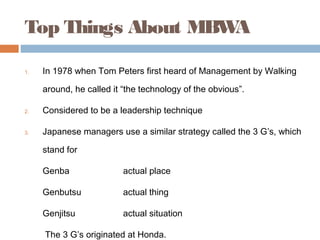
Top Things About MBWA

1.   In 1978 when Tom Peters first heard of Management by Walking

     around, he called it “the technology of the obvious”.

2.   Considered to be a leadership technique

3.   Japanese managers use a similar strategy called the 3 G’s, which

     stand for

     Genba                actual place

     Genbutsu             actual thing

     Genjitsu             actual situation

     The 3 G’s originated at Honda.
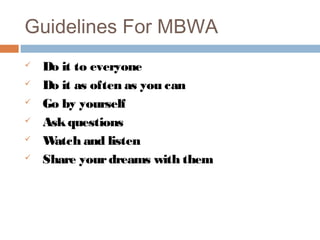
Guidelines For MBWA
   Do it to everyone
   Do it as often as you can
   Go by yourself
   Ask questions
   W atch and listen
   Share your dreams with them
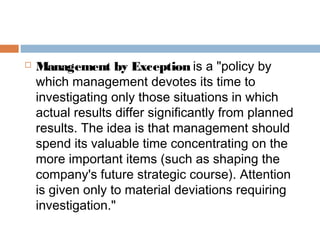
   Management by Exception is a "policy by
    which management devotes its time to
    investigating only those situations in which
    actual results differ significantly from planned
    results. The idea is that management should
    spend its valuable time concentrating on the
    more important items (such as shaping the
    company's future strategic course). Attention
    is given only to material deviations requiring
    investigation."
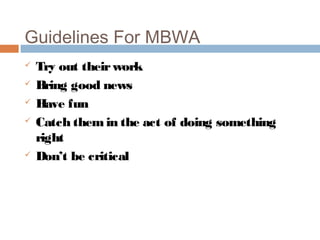
Guidelines For MBWA
   Try out their work
   Bring good news
   Have fun
   Catch them in the act of doing something
    right
   Don’t be critical
Benefits
   Builds trust and relationships.

   Motivates staff by suggesting that management takes an active

    interest in people.

   Encourages staff to achieve individual and collective goals.

   Strengthens ability to drive cultural change for higher organizational

    performance.

   Refreshes organizational values.

   Makes work less formal.

   Creates a healthy organization.
W Some Managers Fail?
 hy
   lack purpose, they seem to walk around the business with no
    specific goal in mind other than to walk around their business
   don’t have a plan, just stopping by the usual people to say
    hello
   are reluctant to be repetitive in their actions and as such are
    unwilling to adopt the required leader behaviour
   get put off by early disappointments
   talk to much and don’t listen enough
IS MBWA STILL RELEVANT?

   In this era of the “www.” is there still room for

    “MBWA?”

   Management by Walking Around is still practiced

    today. It is not seen as much in big corporations,

    but some small companies practice it. Two big

    corporations that do practice it are Hewlett-

    Packard and Kingston Technologies.
The Return of Management by
W alking Around
   It is the driving force behind the popular TV reality shows
    Und e rc o v e r Bo s s , Dirty Jo bs .
   In Und e rc o ve r Bo s s , c o m p a ny e x e c utiv e s wo rk in d is g uis e
    a nd und e rc o ve r in the ir o wn firm s to explore how the
    company really works, what can be improved, and the
    challenges faced by employees.
   The series Dirty Jo bs is jus t tha t. I ho s t p e rfo rm s the
                                           ts
    d is g us ting , s m e lly , m e s s y and sometimes dangerous jobs
    that people do.
MBW is ...Total Success, Big Money and most
   A

          of all.....Happy Employees.
Management+by+walking+around

Management+by+walking+around

  • 1.
    MANAGEMENT BY WALKING AROUND “GETMANAGEMENT OUT OF THE OFFICE”
  • 2.
    I y ou wa it fo r p e o p le to c o m e to y o u, y o u’ ll o nly f g e t s m a ll p ro ble m s . Yo u m us t g o a nd find the m . The big p ro ble m s a re whe re p e o p le d o n’t re a liz e the y ha ve o ne in the firs t p la c e . –W. Edwards Deming
  • 3.
    WHAT IS MBWA?  Unstructured approach  Involves direct participation by the managers in the work-related affairs of their subordinates, in contrast to rigid and distant management.  In MBWA practice, managers spend a significant amount of their time making informal visits to work area and listening to the employees.  The purpose of this exercise is to collect qualitative information, listen to suggestions and complaints, and keep a finger on the pulse of the organization.  Also called management by wandering around.
  • 4.
    HOW DID ITSTART?  In the 1970s, when their company began growing, Bill Hewlett and Dave Packard created a management style.  This technique was marked by personal involvement, good listening skills and the recognition that everyone in an organization wants to do a good job
  • 5.
    Top Things AboutMBWA 1. In 1978 when Tom Peters first heard of Management by Walking around, he called it “the technology of the obvious”. 2. Considered to be a leadership technique 3. Japanese managers use a similar strategy called the 3 G’s, which stand for Genba actual place Genbutsu actual thing Genjitsu actual situation The 3 G’s originated at Honda.
  • 6.
    Guidelines For MBWA  Do it to everyone  Do it as often as you can  Go by yourself  Ask questions  W atch and listen  Share your dreams with them
  • 7.
    Management by Exception is a "policy by which management devotes its time to investigating only those situations in which actual results differ significantly from planned results. The idea is that management should spend its valuable time concentrating on the more important items (such as shaping the company's future strategic course). Attention is given only to material deviations requiring investigation."
  • 8.
    Guidelines For MBWA  Try out their work  Bring good news  Have fun  Catch them in the act of doing something right  Don’t be critical
  • 9.
    Benefits  Builds trust and relationships.  Motivates staff by suggesting that management takes an active interest in people.  Encourages staff to achieve individual and collective goals.  Strengthens ability to drive cultural change for higher organizational performance.  Refreshes organizational values.  Makes work less formal.  Creates a healthy organization.
  • 10.
    W Some ManagersFail? hy  lack purpose, they seem to walk around the business with no specific goal in mind other than to walk around their business  don’t have a plan, just stopping by the usual people to say hello  are reluctant to be repetitive in their actions and as such are unwilling to adopt the required leader behaviour  get put off by early disappointments  talk to much and don’t listen enough
  • 11.
    IS MBWA STILLRELEVANT?  In this era of the “www.” is there still room for “MBWA?”  Management by Walking Around is still practiced today. It is not seen as much in big corporations, but some small companies practice it. Two big corporations that do practice it are Hewlett- Packard and Kingston Technologies.
  • 12.
    The Return ofManagement by W alking Around  It is the driving force behind the popular TV reality shows Und e rc o v e r Bo s s , Dirty Jo bs .  In Und e rc o ve r Bo s s , c o m p a ny e x e c utiv e s wo rk in d is g uis e a nd und e rc o ve r in the ir o wn firm s to explore how the company really works, what can be improved, and the challenges faced by employees.  The series Dirty Jo bs is jus t tha t. I ho s t p e rfo rm s the ts d is g us ting , s m e lly , m e s s y and sometimes dangerous jobs that people do.
  • 13.
    MBW is ...TotalSuccess, Big Money and most A of all.....Happy Employees.