ninth edition

                                   STEPHEN P. ROBBINS          MARY COULTER


                             Chapter
                                       Operations and Value
                             19        Chain Management


© 2007 Prentice Hall, Inc.                              PowerPoint Presentation by Charlie Cook
All rights reserved.                                            The University of West Alabama
LEARNING OUTLINE
Follow this Learning Outline as you read and study this chapter.

   What Is Operations Management and Why Is It
   Important?
      • Explain what operations management is.
      • Contrast manufacturing and services organizations.
      • Describe managers’ role in improving productivity.
      • Discuss the strategic role of operations management.
   Value Chain Management
      • Define value chain and value chain management.
      • Describe the goal of value chain management.
      • Discuss the requirements for successful value chain
        management.
© 2007 Prentice Hall, Inc. All rights
reserved.                                        19–2
L E A R N I N G O U T L I N E (cont’d)
Follow this Learning Outline as you read and study this chapter.

   Value Chain Management (cont’d)
     • Describe the benefits that result from value chain
       management.
     • Explain the obstacles to value chain management.
   Current Issues in Operations Management
     • Discuss technology’s role in manufacturing.
     • Tell some of the various quality dimensions.
     • Explain ISO 9000 and Six Sigma.
     • Describe mass customization and how operations
       management contributes to it.


© 2007 Prentice Hall, Inc. All rights
reserved.                                        19–3
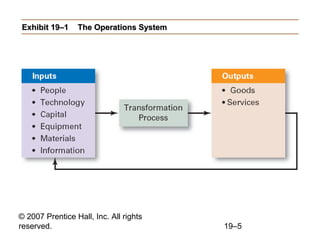
What Is Operations Management?
• Operations Management
     The design, operation, and control of the
      transformation process that converts such resources
      as labor and raw materials into goods and services
      that are sold to customers.
• The Importance of Operations Management
     It encompasses both services and manufacturing.
     It is important in effectively and efficiently managing
      productivity.
     It plays a strategic role in an organization’s
      competitive success.
© 2007 Prentice Hall, Inc. All rights
reserved.                                     19–4
Exhibit 19–1     The Operations System


© 2007 Prentice Hall, Inc. All rights
reserved.                                19–5
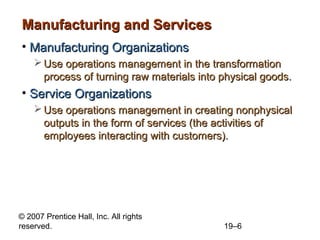
Manufacturing and Services
• Manufacturing Organizations
     Use operations management in the transformation
      process of turning raw materials into physical goods.
• Service Organizations
     Use operations management in creating nonphysical
      outputs in the form of services (the activities of
      employees interacting with customers).


© 2007 Prentice Hall, Inc. All rights
reserved.                                   19–6
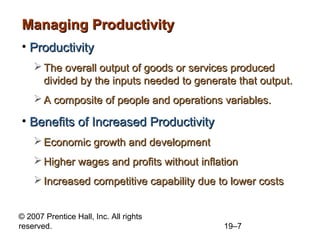
Managing Productivity
• Productivity
     The overall output of goods or services produced
      divided by the inputs needed to generate that output.
     A composite of people and operations variables.

• Benefits of Increased Productivity
     Economic growth and development
     Higher wages and profits without inflation
     Increased competitive capability due to lower costs


© 2007 Prentice Hall, Inc. All rights
reserved.                                   19–7
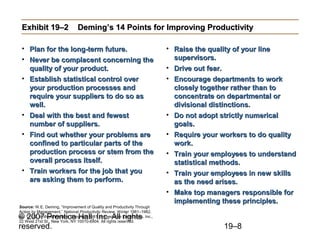
Exhibit 19–2                   Deming’s 14 Points for Improving Productivity

 • Plan for the long-term future.                                            • Raise the quality of your line
 • Never be complacent concerning the                                          supervisors.
   quality of your product.                                                  • Drive out fear.
 • Establish statistical control over                                        • Encourage departments to work
   your production processes and                                               closely together rather than to
   require your suppliers to do so as                                          concentrate on departmental or
   well.                                                                       divisional distinctions.
 • Deal with the best and fewest                                             • Do not adopt strictly numerical
   number of suppliers.                                                        goals.
 • Find out whether your problems are                                        • Require your workers to do quality
   confined to particular parts of the                                         work.
   production process or stem from the                                       • Train your employees to understand
   overall process itself.                                                     statistical methods.
 • Train workers for the job that you                                        • Train your employees in new skills
   are asking them to perform.                                                 as the need arises.
                                                                             • Make top managers responsible for
                                                                               implementing these principles.
Source: W.E. Deming, “Improvement of Quality and Productivity Through
Action by Management,” National Productivity Review, Winter 1981–1982,
© 2007 Prentice Hall, Inc. All rights
pp. 12–22. With permission. Copyright 1981 by Executive Enterprises, Inc.,
22 West 21st St., New York, NY 10010-6904. All rights reserved.
reserved.                                                                                   19–8
Strategic Role of
Operations Management
• The era of modern manufacturing began in the U.S over
  100 years ago.
• After WWII, U.S. manufacturers’ focused on functional
  areas other than manufacturing.
• By the 1970’s, foreign competitors’ integrated
  manufacturing technologies were producing quality
  goods at lower costs.
• U.S manufacturers responded by investing in updated
  technology, restructuring organizations, and including
  production requirements in their strategic planning.
© 2007 Prentice Hall, Inc. All rights
reserved.                                  19–9
Value Chain Management
• Value
     The performance characteristics, features and
      attributes, and any other aspects of goods and
      services for which customers are willing to give up
      resources (i.e., spend money).
• The Value Chain
     The entire series of organizational work activities that
      add value at each step beginning with the processing
      of raw materials and ending with the finished product
      in the hands of end users.


© 2007 Prentice Hall, Inc. All rights
reserved.                                     19–10
Value Chain Management (cont’d)
• What is Value Chain Management?
     The process of managing the entire sequence of
      integrated activities and information about product
      flows along the entire value chain.
• Goal of Value Chain Management
     To create a value chain strategy that fully integrates
      all members into a seamless chain that meets and
      exceeds customers’ needs and creates the highest
      value for the customer.


© 2007 Prentice Hall, Inc. All rights
reserved.                                    19–11
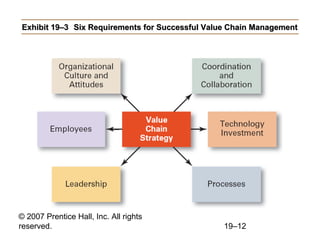
Exhibit 19–3 Six Requirements for Successful Value Chain Management


© 2007 Prentice Hall, Inc. All rights
reserved.                                        19–12
Value Chain Management (cont’d)
• Requirements for Value Chain Management
     A new business model incorporating:
           Coordination and collaboration
           Investment in information technology
           Changes in organizational processes
           Committed leadership
           Flexible jobs and adaptable, capable employees
           A supportive organizational culture and attitudes


© 2007 Prentice Hall, Inc. All rights
reserved.                                              19–13
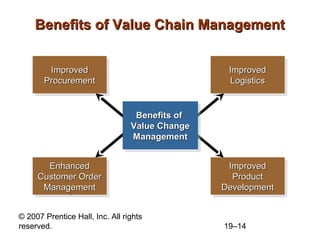
Benefits of Value Chain Management


        Improved
         Improved                                Improved
                                                  Improved
       Procurement
       Procurement                               Logistics
                                                  Logistics


                                  Benefits of
                                  Benefits of
                                 Value Change
                                 Value Change
                                 Management
                                  Management


       Enhanced
        Enhanced                                 Improved
                                                  Improved
     Customer Order
     Customer Order                               Product
                                                   Product
      Management
      Management                                Development
                                                Development

© 2007 Prentice Hall, Inc. All rights
reserved.                                       19–14
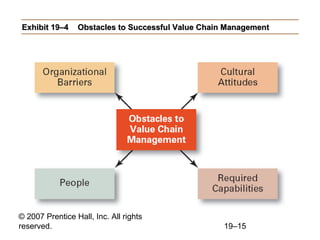
Exhibit 19–4     Obstacles to Successful Value Chain Management


© 2007 Prentice Hall, Inc. All rights
reserved.                                           19–15
Value Chain Management (cont’d)
• Obstacles to Value Chain Management
     Organizational barriers
         Refusal or reluctance to share information
         Reluctance to shake up the status quo
         Security issues

     Cultural attitudes
         Lack of trust and too much trust
         Fear of loss of decision-making power

     Required capabilities
           Lacking or failing to develop the requisite value chain
            management skills


© 2007 Prentice Hall, Inc. All rights
reserved.                                               19–16
Value Chain Management (cont’d)
• Obstacles to Value Chain Management (cont’d)
     People
           Lacking commitment to do whatever it takes
           Refusing to be flexible in meeting the demands of a changing
            situation
           Not being motivated to perform at a high level
           Lack of trained managers to lead value chain initiatives


© 2007 Prentice Hall, Inc. All rights
reserved.                                              19–17
Current Operations Management Issues
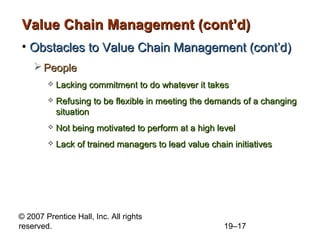
• Technology’s Role in Manufacturing
     Increased automation and integration of production
      facilities with business systems to control costs.
           Predictive maintenance, remote diagnostics, and utility cost
            savings
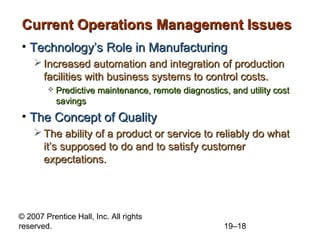
• The Concept of Quality
     The ability of a product or service to reliably do what
      it’s supposed to do and to satisfy customer
      expectations.


© 2007 Prentice Hall, Inc. All rights
reserved.                                              19–18
Current Issues… (cont’d)
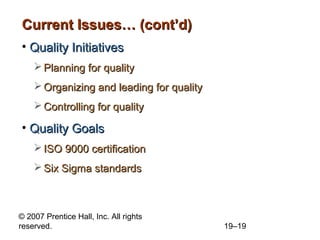
• Quality Initiatives
     Planning for quality
     Organizing and leading for quality
     Controlling for quality

• Quality Goals
     ISO 9000 certification
     Six Sigma standards


© 2007 Prentice Hall, Inc. All rights
reserved.                                  19–19
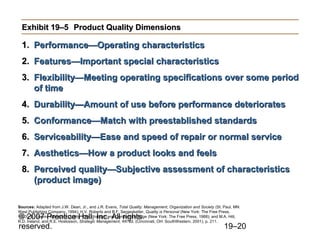
Exhibit 19–5 Product Quality Dimensions

  1. Performance—Operating characteristics
  2. Features—Important special characteristics
  3. Flexibility—Meeting operating specifications over some period
     of time
  4. Durability—Amount of use before performance deteriorates
  5. Conformance—Match with preestablished standards
  6. Serviceability—Ease and speed of repair or normal service
  7. Aesthetics—How a product looks and feels
  8. Perceived quality—Subjective assessment of characteristics
     (product image)

Sources: Adapted from J.W. Dean, Jr., and J.R. Evans, Total Quality: Management, Organization and Society (St. Paul, MN:
West Publishing Company, 1994); H.V. Roberts and B.F. Sergesketter, Quality is Personal (New York: The Free Press,
© 2007 Prentice Hall, Inc. All rights
1993): D. Garvin, Managed Quality: The Strategic and Competitive Edge (New York: The Free Press, 1988); and M.A. Hitt,
R.D. Ireland, and R.E. Hoskisson, Strategic Management, 4th ed. (Cincinnati, OH: SouthWestern, 2001), p. 211.
reserved.                                                                                                      19–20
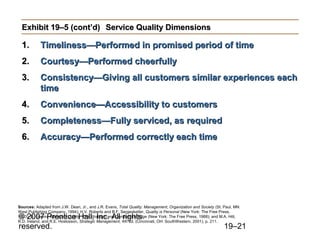
Exhibit 19–5 (cont’d) Service Quality Dimensions

  1.        Timeliness—Performed in promised period of time
  2.        Courtesy—Performed cheerfully
  3.        Consistency—Giving all customers similar experiences each
            time
  4.        Convenience—Accessibility to customers
  5.        Completeness—Fully serviced, as required
  6.        Accuracy—Performed correctly each time


Sources: Adapted from J.W. Dean, Jr., and J.R. Evans, Total Quality: Management, Organization and Society (St. Paul, MN:
West Publishing Company, 1994); H.V. Roberts and B.F. Sergesketter, Quality is Personal (New York: The Free Press,
© 2007 Prentice Hall, Inc. All rights
1993): D. Garvin, Managed Quality: The Strategic and Competitive Edge (New York: The Free Press, 1988); and M.A. Hitt,
R.D. Ireland, and R.E. Hoskisson, Strategic Management, 4th ed. (Cincinnati, OH: SouthWestern, 2001), p. 211.
reserved.                                                                                                      19–21
Current Issues… (cont’d)
• Mass Customization
     Is a design-to-order concept that provides consumers
      with a product when, where, and how they want it.
     Makes heavy use of technology (flexible
      manufacturing techniques) and engages in a
      continual dialogue with customers.
• Benefits of Mass Customization
     Creates an important relationship between the firm
      and the customer in providing loyalty-building value to
      the customer and in garnering valuable market
      information for the firm.
© 2007 Prentice Hall, Inc. All rights
reserved.                                    19–22
Terms to Know
                     • operations management
                     • manufacturing
                        organizations
                     • service organizations
                     • productivity
                     • value
                     • value chain
                     • value chain management
                     • organizational processes
                     • intellectual property
                     • quality
                     • ISO 9000
                     • Six Sigma
                     • mass customization
© 2007 Prentice Hall, Inc. All rights
reserved.                                         19–23

Robbins9 ppt19

  • 1.
    ninth edition STEPHEN P. ROBBINS MARY COULTER Chapter Operations and Value 19 Chain Management © 2007 Prentice Hall, Inc. PowerPoint Presentation by Charlie Cook All rights reserved. The University of West Alabama
  • 2.
    LEARNING OUTLINE Follow thisLearning Outline as you read and study this chapter. What Is Operations Management and Why Is It Important? • Explain what operations management is. • Contrast manufacturing and services organizations. • Describe managers’ role in improving productivity. • Discuss the strategic role of operations management. Value Chain Management • Define value chain and value chain management. • Describe the goal of value chain management. • Discuss the requirements for successful value chain management. © 2007 Prentice Hall, Inc. All rights reserved. 19–2
  • 3.
    L E AR N I N G O U T L I N E (cont’d) Follow this Learning Outline as you read and study this chapter. Value Chain Management (cont’d) • Describe the benefits that result from value chain management. • Explain the obstacles to value chain management. Current Issues in Operations Management • Discuss technology’s role in manufacturing. • Tell some of the various quality dimensions. • Explain ISO 9000 and Six Sigma. • Describe mass customization and how operations management contributes to it. © 2007 Prentice Hall, Inc. All rights reserved. 19–3
  • 4.
    What Is OperationsManagement? • Operations Management  The design, operation, and control of the transformation process that converts such resources as labor and raw materials into goods and services that are sold to customers. • The Importance of Operations Management  It encompasses both services and manufacturing.  It is important in effectively and efficiently managing productivity.  It plays a strategic role in an organization’s competitive success. © 2007 Prentice Hall, Inc. All rights reserved. 19–4
  • 5.
    Exhibit 19–1 The Operations System © 2007 Prentice Hall, Inc. All rights reserved. 19–5
  • 6.
    Manufacturing and Services •Manufacturing Organizations  Use operations management in the transformation process of turning raw materials into physical goods. • Service Organizations  Use operations management in creating nonphysical outputs in the form of services (the activities of employees interacting with customers). © 2007 Prentice Hall, Inc. All rights reserved. 19–6
  • 7.
    Managing Productivity • Productivity  The overall output of goods or services produced divided by the inputs needed to generate that output.  A composite of people and operations variables. • Benefits of Increased Productivity  Economic growth and development  Higher wages and profits without inflation  Increased competitive capability due to lower costs © 2007 Prentice Hall, Inc. All rights reserved. 19–7
  • 8.
    Exhibit 19–2 Deming’s 14 Points for Improving Productivity • Plan for the long-term future. • Raise the quality of your line • Never be complacent concerning the supervisors. quality of your product. • Drive out fear. • Establish statistical control over • Encourage departments to work your production processes and closely together rather than to require your suppliers to do so as concentrate on departmental or well. divisional distinctions. • Deal with the best and fewest • Do not adopt strictly numerical number of suppliers. goals. • Find out whether your problems are • Require your workers to do quality confined to particular parts of the work. production process or stem from the • Train your employees to understand overall process itself. statistical methods. • Train workers for the job that you • Train your employees in new skills are asking them to perform. as the need arises. • Make top managers responsible for implementing these principles. Source: W.E. Deming, “Improvement of Quality and Productivity Through Action by Management,” National Productivity Review, Winter 1981–1982, © 2007 Prentice Hall, Inc. All rights pp. 12–22. With permission. Copyright 1981 by Executive Enterprises, Inc., 22 West 21st St., New York, NY 10010-6904. All rights reserved. reserved. 19–8
  • 9.
    Strategic Role of OperationsManagement • The era of modern manufacturing began in the U.S over 100 years ago. • After WWII, U.S. manufacturers’ focused on functional areas other than manufacturing. • By the 1970’s, foreign competitors’ integrated manufacturing technologies were producing quality goods at lower costs. • U.S manufacturers responded by investing in updated technology, restructuring organizations, and including production requirements in their strategic planning. © 2007 Prentice Hall, Inc. All rights reserved. 19–9
  • 10.
    Value Chain Management •Value  The performance characteristics, features and attributes, and any other aspects of goods and services for which customers are willing to give up resources (i.e., spend money). • The Value Chain  The entire series of organizational work activities that add value at each step beginning with the processing of raw materials and ending with the finished product in the hands of end users. © 2007 Prentice Hall, Inc. All rights reserved. 19–10
  • 11.
    Value Chain Management(cont’d) • What is Value Chain Management?  The process of managing the entire sequence of integrated activities and information about product flows along the entire value chain. • Goal of Value Chain Management  To create a value chain strategy that fully integrates all members into a seamless chain that meets and exceeds customers’ needs and creates the highest value for the customer. © 2007 Prentice Hall, Inc. All rights reserved. 19–11
  • 12.
    Exhibit 19–3 SixRequirements for Successful Value Chain Management © 2007 Prentice Hall, Inc. All rights reserved. 19–12
  • 13.
    Value Chain Management(cont’d) • Requirements for Value Chain Management  A new business model incorporating:  Coordination and collaboration  Investment in information technology  Changes in organizational processes  Committed leadership  Flexible jobs and adaptable, capable employees  A supportive organizational culture and attitudes © 2007 Prentice Hall, Inc. All rights reserved. 19–13
  • 14.
    Benefits of ValueChain Management Improved Improved Improved Improved Procurement Procurement Logistics Logistics Benefits of Benefits of Value Change Value Change Management Management Enhanced Enhanced Improved Improved Customer Order Customer Order Product Product Management Management Development Development © 2007 Prentice Hall, Inc. All rights reserved. 19–14
  • 15.
    Exhibit 19–4 Obstacles to Successful Value Chain Management © 2007 Prentice Hall, Inc. All rights reserved. 19–15
  • 16.
    Value Chain Management(cont’d) • Obstacles to Value Chain Management  Organizational barriers  Refusal or reluctance to share information  Reluctance to shake up the status quo  Security issues  Cultural attitudes  Lack of trust and too much trust  Fear of loss of decision-making power  Required capabilities  Lacking or failing to develop the requisite value chain management skills © 2007 Prentice Hall, Inc. All rights reserved. 19–16
  • 17.
    Value Chain Management(cont’d) • Obstacles to Value Chain Management (cont’d)  People  Lacking commitment to do whatever it takes  Refusing to be flexible in meeting the demands of a changing situation  Not being motivated to perform at a high level  Lack of trained managers to lead value chain initiatives © 2007 Prentice Hall, Inc. All rights reserved. 19–17
  • 18.
    Current Operations ManagementIssues • Technology’s Role in Manufacturing  Increased automation and integration of production facilities with business systems to control costs.  Predictive maintenance, remote diagnostics, and utility cost savings • The Concept of Quality  The ability of a product or service to reliably do what it’s supposed to do and to satisfy customer expectations. © 2007 Prentice Hall, Inc. All rights reserved. 19–18
  • 19.
    Current Issues… (cont’d) •Quality Initiatives  Planning for quality  Organizing and leading for quality  Controlling for quality • Quality Goals  ISO 9000 certification  Six Sigma standards © 2007 Prentice Hall, Inc. All rights reserved. 19–19
  • 20.
    Exhibit 19–5 ProductQuality Dimensions 1. Performance—Operating characteristics 2. Features—Important special characteristics 3. Flexibility—Meeting operating specifications over some period of time 4. Durability—Amount of use before performance deteriorates 5. Conformance—Match with preestablished standards 6. Serviceability—Ease and speed of repair or normal service 7. Aesthetics—How a product looks and feels 8. Perceived quality—Subjective assessment of characteristics (product image) Sources: Adapted from J.W. Dean, Jr., and J.R. Evans, Total Quality: Management, Organization and Society (St. Paul, MN: West Publishing Company, 1994); H.V. Roberts and B.F. Sergesketter, Quality is Personal (New York: The Free Press, © 2007 Prentice Hall, Inc. All rights 1993): D. Garvin, Managed Quality: The Strategic and Competitive Edge (New York: The Free Press, 1988); and M.A. Hitt, R.D. Ireland, and R.E. Hoskisson, Strategic Management, 4th ed. (Cincinnati, OH: SouthWestern, 2001), p. 211. reserved. 19–20
  • 21.
    Exhibit 19–5 (cont’d)Service Quality Dimensions 1. Timeliness—Performed in promised period of time 2. Courtesy—Performed cheerfully 3. Consistency—Giving all customers similar experiences each time 4. Convenience—Accessibility to customers 5. Completeness—Fully serviced, as required 6. Accuracy—Performed correctly each time Sources: Adapted from J.W. Dean, Jr., and J.R. Evans, Total Quality: Management, Organization and Society (St. Paul, MN: West Publishing Company, 1994); H.V. Roberts and B.F. Sergesketter, Quality is Personal (New York: The Free Press, © 2007 Prentice Hall, Inc. All rights 1993): D. Garvin, Managed Quality: The Strategic and Competitive Edge (New York: The Free Press, 1988); and M.A. Hitt, R.D. Ireland, and R.E. Hoskisson, Strategic Management, 4th ed. (Cincinnati, OH: SouthWestern, 2001), p. 211. reserved. 19–21
  • 22.
    Current Issues… (cont’d) •Mass Customization  Is a design-to-order concept that provides consumers with a product when, where, and how they want it.  Makes heavy use of technology (flexible manufacturing techniques) and engages in a continual dialogue with customers. • Benefits of Mass Customization  Creates an important relationship between the firm and the customer in providing loyalty-building value to the customer and in garnering valuable market information for the firm. © 2007 Prentice Hall, Inc. All rights reserved. 19–22
  • 23.
    Terms to Know • operations management • manufacturing organizations • service organizations • productivity • value • value chain • value chain management • organizational processes • intellectual property • quality • ISO 9000 • Six Sigma • mass customization © 2007 Prentice Hall, Inc. All rights reserved. 19–23