Management Defined
Management
The process of getting things done,
effectively and efficiently,
through and with other people
Efficiency
▪ Means doing the thing correctly; refers to the
relationship between inputs and outputs; seeks to
minimize resource costs
Effectiveness
▪ Means doing the right things; goal attainment
3.
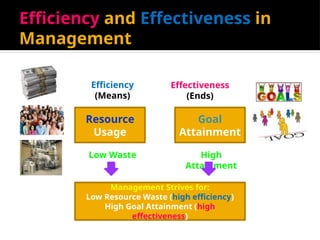
Efficiency and Effectivenessin
Management
Resource
Usage
Goal
Attainment
Management Strives for:
Low Resource Waste (high efficiency)
High Goal Attainment (high
effectiveness)
Low Waste High
Attainment
Efficiency
(Means)
Effectiveness
(Ends)
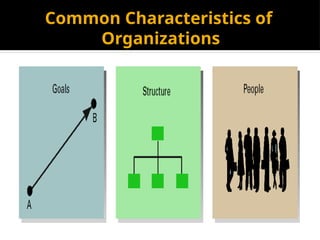
Organizations
A systematicarrangement of people
brought together
to accomplish some specific purpose;
applies to all organizations—for-profit as
well as not-for-profit organizations.
Where managers work (manage)
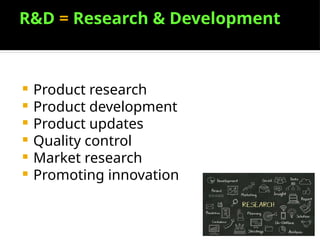
R&D = Research& Development
Product research
Product development
Product updates
Quality control
Market research
Promoting innovation
10.
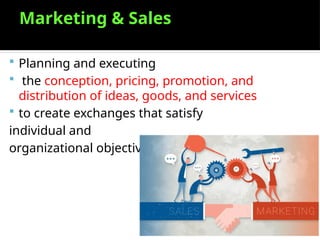
Marketing & Sales
Planning and executing
the conception, pricing, promotion, and
distribution of ideas, goods, and services
to create exchanges that satisfy
individual and
organizational objectives
11.
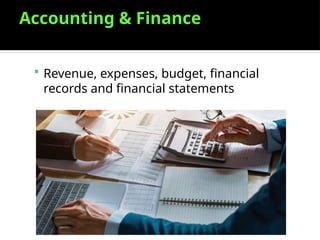
Accounting & Finance
Revenue, expenses, budget, financial
records and financial statements
12.
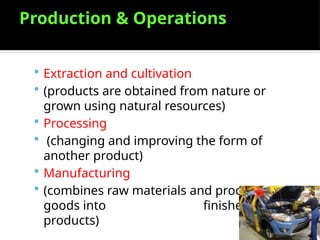
Production & Operations
Extraction and cultivation
(products are obtained from nature or
grown using natural resources)
Processing
(changing and improving the form of
another product)
Manufacturing
(combines raw materials and processes
goods into finished
products)
13.
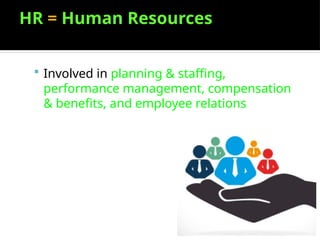
HR = HumanResources
Involved in planning & staffing,
performance management, compensation
& benefits, and employee relations
14.
AIMS, GOALS &OBJECTIVES
An AIM is an expression of a long term
purpose, usually over the course of one or
more years
A GOAL is the outcome of a series of
successfully completed objectives, possibly
measured over a series of days
An OBJECTIVE is a measurable, observable
behavior of less than a day’s duration
16.
Identifying Managers
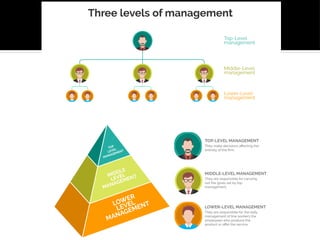
First-linemanagers
Supervisors responsible for directing the day-to-day activities of operative
employees They are often called: supervisor, shift manager, district manager,
department manager, office manager
Middle managers
Individuals at levels of management between the first-line manager and top
management
They are often called: regional manager, project leader, store manager,
division manager
Top managers
Individuals who are responsible for making decisions about the direction of the
organization and establishing policies that affect all organizational members
They are often called: executive vice president, president, managing
director, chief operating officer, chief executive officer
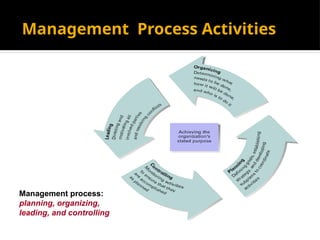
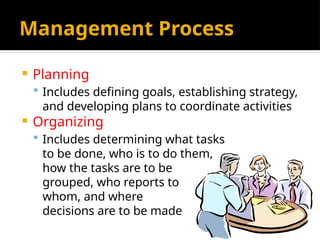
Management Process
Planning
Includes defining goals, establishing strategy,
and developing plans to coordinate activities
Organizing
Includes determining what tasks
to be done, who is to do them,
how the tasks are to be
grouped, who reports to
whom, and where
decisions are to be made
20.
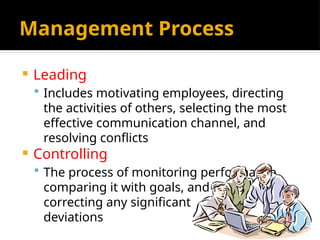
Management Process
Leading
Includes motivating employees, directing
the activities of others, selecting the most
effective communication channel, and
resolving conflicts
Controlling
The process of monitoring performance,
comparing it with goals, and
correcting any significant
deviations