INTRODUCTION
TO THE STRATEGY
ANDMANAGEMENT
TERMINOLOGY
Ing. Veronika Svatošová, Ph.D.
Mendel university in Brno
Faculty of Refional Development and International Studies
Department of Regional and Business Economics
Třída Generála Píky 2005/7
Brno, 613 00, Czech Republic
Contact: veronika.svatosova@mendelu.cz
WEB: http://frrms.mendelu.cz/en/
2.
Content of thecourse
1. Definition and revision of basic
related terminology
2. Case studies
3. SME characterization – benefits
and shortcomings
4. Failures and key success factors
in SME
5. Features of SME management
6. Features of SME strategy
MANAGEMENT (definition)
Managementrepresents a set of validated
views, experiences, recommendations, and
methods that managers use for solving specific
activities (managerial functions) to achieve the
organization's goals, including its prosperity.
The concept of management as science and
art
Interdisciplinary field - draws from various
social and natural sciences, and
recommendations using proven and
generalized methods of achieving goals.
5.
Management is understoodin these
concepts:
Some way of managing people -
management as an activity where the manager does not perform the tasks
himself, but does it through other people. Management is then interpreted as
an art to achieve organizational goals through other workers
A certain group of people in companies or other structures –
like management, are referred to as executives (managers) who perform
managerial functions. If we talk about the top management of a business, then
we mean the top executives of the business
The professional discipline and the field of study –
management is characterized as a set of approaches (opinions,
recommendations, principles, methods, techniques) used by managers to
manage managerial functions and thereby achieve a set of organizational
goals.
6.
Goals of organization
•Goals mean the final state to which all business activities should go.
• Goals are set for different areas of the organization, with typical business
goals being profitable, marketing, growth, social, research and
development goals, improving the efficiency of the production process,
product quality growth.
• Targets can be divided into three main categories:
• Economic goals
• Quantitative goals
• Qualitative goals
7.
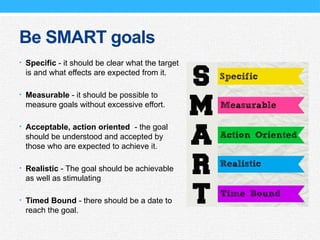
Be SMART goals
•Specific - it should be clear what the target
is and what effects are expected from it.
• Measurable - it should be possible to
measure goals without excessive effort.
• Acceptable, action oriented - the goal
should be understood and accepted by
those who are expected to achieve it.
• Realistic - The goal should be achievable
as well as stimulating
• Timed Bound - there should be a date to
reach the goal.
8.
MANAGER
• The manager,primarily the
profession - the bearer of this
profession is responsible for
achieving the goals of the
assigned organizational units.
• He/she uses a team of co-workers.
• He/she manages work and assume
responsibility for the results of other
people's work.
• The role of the manager is, in
particular, to induce subordinate
workers to achieve their goals.
To achieve this, they must have
certain properties (inborn and
acquired).
9.
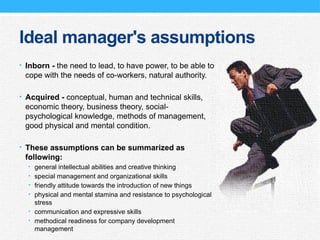
Ideal manager's assumptions
•Inborn - the need to lead, to have power, to be able to
cope with the needs of co-workers, natural authority.
• Acquired - conceptual, human and technical skills,
economic theory, business theory, social-
psychological knowledge, methods of management,
good physical and mental condition.
• These assumptions can be summarized as
following:
• general intellectual abilities and creative thinking
• special management and organizational skills
• friendly attitude towards the introduction of new things
• physical and mental stamina and resistance to psychological
stress
• communication and expressive skills
• methodical readiness for company development
management
10.
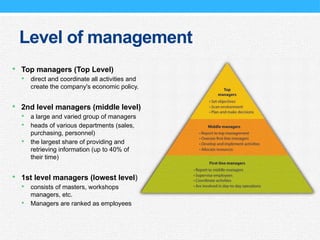
Level of management
Top managers (Top Level)
direct and coordinate all activities and
create the company's economic policy.
2nd level managers (middle level)
a large and varied group of managers
heads of various departments (sales,
purchasing, personnel)
the largest share of providing and
retrieving information (up to 40% of
their time)
1st level managers (lowest level)
consists of masters, workshops
managers, etc.
Managers are ranked as employees
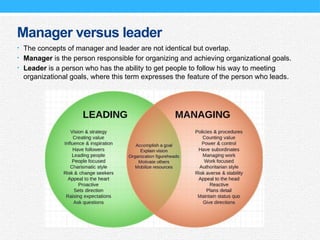
Manager versus leader
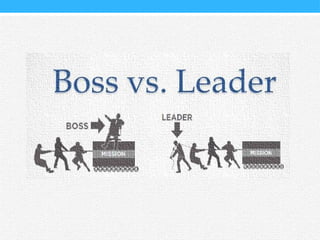
•The concepts of manager and leader are not identical but overlap.
• Manager is the person responsible for organizing and achieving organizational goals.
• Leader is a person who has the ability to get people to follow his way to meeting
organizational goals, where this term expresses the feature of the person who leads.
14.
Strategy
• The conceptand structure of the strategy
• Identification of long-term core goals of the organization and identification the
necessary actions and resources to achieve these goals
• Strategy characterization
• Strategy is a mean of defining an organization in line with long-term goals.
• It is based on the vision of the business and its mission.
• It defines the basic forms of competitive business struggle.
• It is a mean of achieving a competitive advantage by taking advantage of the
strengths and opportunities of the business and eliminating the threats and
weaknesses of the business.
• It is an integrating model for decision making.
• The timeline of the strategy is relative and is influenced by the specific needs and
conditions of the business.
Managerial functions
Themost used classification according to Koontz and
Weihrich:
Sequential managerial functions (gragual)
Planning
Organization
Selection and deployment of co-workers or staffing
Leadership
Controlling
Continuous managerial functions (paralel)
Analysis of solved problems
Decision making
Implementation
18.
Definition of managerialfunctions
• Planning - setting future goals and ways to achieve them.
• Organizing - transfer of plans into activities; security of resources (material, financial, human,
etc.), or conditions for carrying out planned activities.
• Human resources (staffing) - occupying positions in the organizational structure and
maintaining their occupation.
• Leadership - the ability to guide, motivate, stimulate, pull people to properly accomplish the
required tasks to achieve the goals.
• Controlling - verifying the compliance of the plan with reality and accepting conclusions
• Analysis - analysis of existing facts and verification of the accuracy of the information obtained.
• Decision Making - processes for solving decision problems, i.e .problems with more (at least
two) solutions.