APPROACHES TO MANAGEMENT
1) Decision Theory Approach
2) Mathematical Approach
3) Systems Approach
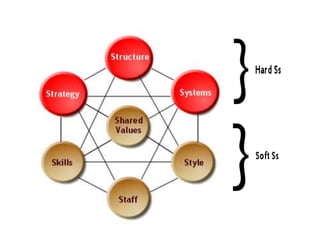
4) McKinsey’s 7-S Approach
DECISION THEORY APPROACH
• Manager – Decision maker
• Organisation – Decision making unit.
• Features
– Management is decision making.
– Members of Organisation - decision makers and problem
solvers.
– Decision making - control point in management
– Increasing efficiency - the quality of decision
– MIS, process & techniques of decision making are the subject
matter of study.
DECISION THEORY APPROACH
• Contributors
– Simon, Forrester, etc.
• Uses
– Tools for making suitable decisions in organisations.
• Limitation
– Does not take the total view of management
– Decision making - one aspect of management
MATHEMATICAL APPROACH
• Management- logical entity
• Actions- Mathematical symbols, Relationships and
measurable data.
• Features
1. Problem Solving mechanism with the help of mathematical
tools and techniques.
2. Problems Expressed in mathematical symbols.
3. Variables in management – quantified.
4. Scope - Decision making, system analysis & some aspect of
human behaviour.
5. Tools - Operations research ,simulation etc.
MATHEMATICAL APPROACH Cont..
• Contributors
– Newman, Charles Hitch, etc.
• Uses
– Provided Exactness in management discipline.
• Limitations
– Not a separate school
– Technique in decision making.
SYSTEMS APPROACH
• An enterprise
• Man-Made system
• Internal parts
• Achieve established goals
• External parts
• Achieve interplay with its environment
• Manager integrates his available facilities with goal
achievement.
• Uses
– Quick Perception
– Better Planning
• Limitations
– Complicated
– Expensive
8
System
• A set of interconnected elements to
achieve a common objective
• Elements are interrelated and
interdependent
• Composed of sub-systems, which in
turn may be made up of other
subsystems
• The set of elements may be: Input(s),
Process(es), or output(s)
9
• Cybernetic systems – self-regulating, self-
monitoring (feedback and control elements
attached)
• A system cannot exist in vacuum
• It exists and functions in an environment,
separated by its boundary
• Several systems may share the same
environment
• Some systems may be connected by a
shared boundary
• Open system: interacts with its environment,
exchanges inputs and outputs
• Closed systems: do not interact, or exchange
any inputs or outputs with its environment
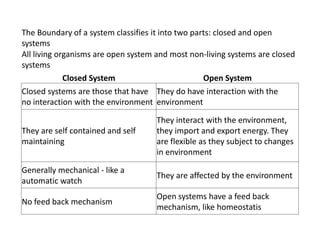
The Boundary of a system classifies it into two parts: closed and open
systems
All living organisms are open system and most non-living systems are closed
systems
Closed System Open System
Closed systems are those that have
no interaction with the environment
They do have interaction with the
environment
They are self contained and self
maintaining
They interact with the environment,
they import and export energy. They
are flexible as they subject to changes
in environment
Generally mechanical - like a
automatic watch
They are affected by the environment
No feed back mechanism
Open systems have a feed back
mechanism, like homeostatis
Strategy: the direction and scope of the company over the long term.
Structure: the basic organization of the company, its departments, reporting
lines, areas of expertise and responsibility (and how they inter-relate).
Systems: formal and informal procedures that govern everyday activity,
covering everything from management information systems, through to the
systems at the point of contact with the customer (retail systems, call center
systems, online systems, etc).
THE HARD S’s
THE SOFT S’s
Skills: the capabilities and competencies that exist within the company. What
it does best.
Shared values: the values and beliefs of the company. Ultimately they guide
employees towards 'valued' behavior.
Staff: the company's people resources and how they are developed, trained
and motivated.
Style: the leadership approach of top management and the company's overall
operating approach.
MANAGEMENT BY OBJECTIVES (MBO)
• MBO is both a philosophy and a technique of management.
• It represents a rational and systematic approach to management wherein
measurable goals are set up in consultation with subordinate managers and the
contribution of each individual is judged in terms of such goals.
• MBO is a process whereby :
1. The superior and the subordinate managers of an enterprise jointly identify its
common goals,
2. Define each individual’s major areas of responsibility in terms of the results
expected of him,
3. Use these measures as guides for operations of the unit and assessing the
contribution of each of its members.
FEATURES OF MBO
• Goal oriented:
MBO focuses attention on what must be accomplished (goals) rather than on
how it is to be accomplished (methods) . It is a goal-oriented rather than work-
oriented approach.
• Participation of Subordinate Managers:
MBO involves participation of subordinate managers in the goal setting process.
It requires all key personnel to contribute maximum to achieve the overall
objectives.
• MBO stresses measurable and verifiable goals in key result areas. It attempts
to blend and balance the goals of all key personnel.
• MBO is an overall philosophy of management that allows management to attain
maximum results from available resources. It is not a set of procedures but a way
of thinking about managing.
• MBO has an operational thrust involving linking between organizational goals
and individuals goals.
• MBO is a continuous process of goal setting, periodic appraisals and
modification of goals and performance.
• It sets an evaluative mechanism by which the contribution of each individual can
be measured.
• MBO is a dynamic system which seeks to integrate the company’s need to
achieve its objectives with the manager’s need to contribute and develop himself.
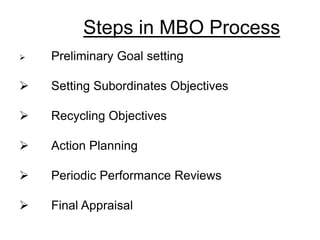
Steps in MBO Process
 Preliminary Goal setting
 Setting Subordinates Objectives
 Recycling Objectives
 Action Planning
 Periodic Performance Reviews
 Final Appraisal
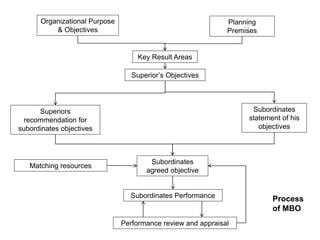
Organizational Purpose
& Objectives
Planning
Premises
Key Result Areas
Superior’s Objectives
Subordinates
statement of his
objectives
Superiors
recommendation for
subordinates objectives
Subordinates
agreed objective
Matching resources
Subordinates Performance
Performance review and appraisal
Process
of MBO
Benefits of MBO
 Motivation and Morale
 Improved Planning
 Effective Self-control
Objective Appraisal
 Co operative decision in Work
 Increases Efficiency
 Reduction in Cost and Optimum Utilization of Resources
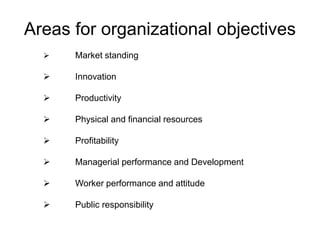
 Market standing
 Innovation
 Productivity
 Physical and financial resources
 Profitability
 Managerial performance and Development
 Worker performance and attitude
 Public responsibility
Areas for organizational objectives

Appch+mbo

  • 1.
  • 2.
    APPROACHES TO MANAGEMENT 1)Decision Theory Approach 2) Mathematical Approach 3) Systems Approach 4) McKinsey’s 7-S Approach
  • 3.
    DECISION THEORY APPROACH •Manager – Decision maker • Organisation – Decision making unit. • Features – Management is decision making. – Members of Organisation - decision makers and problem solvers. – Decision making - control point in management – Increasing efficiency - the quality of decision – MIS, process & techniques of decision making are the subject matter of study.
  • 4.
    DECISION THEORY APPROACH •Contributors – Simon, Forrester, etc. • Uses – Tools for making suitable decisions in organisations. • Limitation – Does not take the total view of management – Decision making - one aspect of management
  • 5.
    MATHEMATICAL APPROACH • Management-logical entity • Actions- Mathematical symbols, Relationships and measurable data. • Features 1. Problem Solving mechanism with the help of mathematical tools and techniques. 2. Problems Expressed in mathematical symbols. 3. Variables in management – quantified. 4. Scope - Decision making, system analysis & some aspect of human behaviour. 5. Tools - Operations research ,simulation etc.
  • 6.
    MATHEMATICAL APPROACH Cont.. •Contributors – Newman, Charles Hitch, etc. • Uses – Provided Exactness in management discipline. • Limitations – Not a separate school – Technique in decision making.
  • 7.
    SYSTEMS APPROACH • Anenterprise • Man-Made system • Internal parts • Achieve established goals • External parts • Achieve interplay with its environment • Manager integrates his available facilities with goal achievement. • Uses – Quick Perception – Better Planning • Limitations – Complicated – Expensive
  • 8.
    8 System • A setof interconnected elements to achieve a common objective • Elements are interrelated and interdependent • Composed of sub-systems, which in turn may be made up of other subsystems • The set of elements may be: Input(s), Process(es), or output(s)
  • 9.
    9 • Cybernetic systems– self-regulating, self- monitoring (feedback and control elements attached) • A system cannot exist in vacuum • It exists and functions in an environment, separated by its boundary • Several systems may share the same environment • Some systems may be connected by a shared boundary • Open system: interacts with its environment, exchanges inputs and outputs • Closed systems: do not interact, or exchange any inputs or outputs with its environment
  • 10.
    The Boundary ofa system classifies it into two parts: closed and open systems All living organisms are open system and most non-living systems are closed systems Closed System Open System Closed systems are those that have no interaction with the environment They do have interaction with the environment They are self contained and self maintaining They interact with the environment, they import and export energy. They are flexible as they subject to changes in environment Generally mechanical - like a automatic watch They are affected by the environment No feed back mechanism Open systems have a feed back mechanism, like homeostatis
  • 12.
    Strategy: the directionand scope of the company over the long term. Structure: the basic organization of the company, its departments, reporting lines, areas of expertise and responsibility (and how they inter-relate). Systems: formal and informal procedures that govern everyday activity, covering everything from management information systems, through to the systems at the point of contact with the customer (retail systems, call center systems, online systems, etc). THE HARD S’s
  • 13.
    THE SOFT S’s Skills:the capabilities and competencies that exist within the company. What it does best. Shared values: the values and beliefs of the company. Ultimately they guide employees towards 'valued' behavior. Staff: the company's people resources and how they are developed, trained and motivated. Style: the leadership approach of top management and the company's overall operating approach.
  • 14.
    MANAGEMENT BY OBJECTIVES(MBO) • MBO is both a philosophy and a technique of management. • It represents a rational and systematic approach to management wherein measurable goals are set up in consultation with subordinate managers and the contribution of each individual is judged in terms of such goals. • MBO is a process whereby : 1. The superior and the subordinate managers of an enterprise jointly identify its common goals, 2. Define each individual’s major areas of responsibility in terms of the results expected of him, 3. Use these measures as guides for operations of the unit and assessing the contribution of each of its members.
  • 15.
    FEATURES OF MBO •Goal oriented: MBO focuses attention on what must be accomplished (goals) rather than on how it is to be accomplished (methods) . It is a goal-oriented rather than work- oriented approach. • Participation of Subordinate Managers: MBO involves participation of subordinate managers in the goal setting process. It requires all key personnel to contribute maximum to achieve the overall objectives. • MBO stresses measurable and verifiable goals in key result areas. It attempts to blend and balance the goals of all key personnel.
  • 16.
    • MBO isan overall philosophy of management that allows management to attain maximum results from available resources. It is not a set of procedures but a way of thinking about managing. • MBO has an operational thrust involving linking between organizational goals and individuals goals. • MBO is a continuous process of goal setting, periodic appraisals and modification of goals and performance. • It sets an evaluative mechanism by which the contribution of each individual can be measured. • MBO is a dynamic system which seeks to integrate the company’s need to achieve its objectives with the manager’s need to contribute and develop himself.
  • 17.
    Steps in MBOProcess  Preliminary Goal setting  Setting Subordinates Objectives  Recycling Objectives  Action Planning  Periodic Performance Reviews  Final Appraisal
  • 18.
    Organizational Purpose & Objectives Planning Premises KeyResult Areas Superior’s Objectives Subordinates statement of his objectives Superiors recommendation for subordinates objectives Subordinates agreed objective Matching resources Subordinates Performance Performance review and appraisal Process of MBO
  • 19.
    Benefits of MBO Motivation and Morale  Improved Planning  Effective Self-control Objective Appraisal  Co operative decision in Work  Increases Efficiency  Reduction in Cost and Optimum Utilization of Resources
  • 20.
     Market standing Innovation  Productivity  Physical and financial resources  Profitability  Managerial performance and Development  Worker performance and attitude  Public responsibility Areas for organizational objectives