









MANAGEMENT OF
UPPER GI BLEEDING
Dr. Nadia Gulnaz
Speciality doctor surgery
OVERVIEW
• Acute upper gastrointestinal bleed (AUGIB)
is one of the most common medical
emergencies in the UK, roughly one
presentation every 6 min.
• Despite advances, mortality has remained
high, with over 9,000 deaths annually in
the UK;
• In 2015 UK National Confidential Enquiry
into Patient Outcome and Death in AUGIB
highlighted variations in practice, and has
raised concerns regarding suboptimal
patient care and released a series of
recommendations.
OVERVIEW
• This review incorporates
• The latest available evidence and UK-
relevant guidelines ,
• Summarises the optimal
– Pre-endoscopic,
– Endoscopic,
– Post-endoscopic approach in
• Management of non-variceal and
variceal AUGIB
An U.GI Bleed Presents….
DIAGNOSIS
Bleeding in the upper gastrointestinal tract
proximal to the ligament of Treitz,7 should
be suspected in patients with;
• haematemesis,
• coffee-ground vomiting,
• melaena
• unexplained fall in haemoglobin.
• In up to 20% of cases, AUGIB may mimic
lower gastrointestinal bleeding
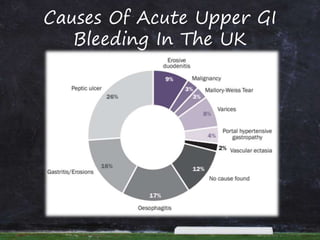
Causes Of Acute Upper GI
Bleeding In The UK
Pragmatically, divided into
• Variceal
• Non- variceal UGIB (NVUGIB) causes
There are important differences in management
strategies.
Variceal bleeding has doubled from 4% to 8% in
2007
Peptic ulcer disease (pud) still remains the most
common cause of augib, despite reductions in
pud incidence and mortality over the last three
decades.
Causes Of Acute Upper GI
Bleeding In The UK
MANAGEMENT OUTLINE
• Pre-endoscopic management
– 1. Assessment and resuscitation
– 2. Risk Assessment
– 3. Medical management
• Endoscopic management
– 1. NVUGIB
– 2. Variceal
• Post Endoscopic management
– 1. NVUGIB
– 2. Variceal
– 3. Rebleed management
PRE-ENDOSCOPIC
MANAGEMENT
• ABC
• In unstable patients, early assistance from the
intensive care team should be considered, especially in
– airway compromise from haematemesis,
– Hypoxia, or
– reduced level of consciousness from decompensated liver
disease
• Standard blood tests including COAG and group and
save
• Major haemorrhage protocols in line with national
standards
• Endoscopist should be notified within 1 h of diagnosis,
• The patient placed nil by mouth
Risk Assesment
• Following resus a focused history and
examination should be performed.
• NICE advocates a two-step risk
assessment strategy
– Cause assessment
– Severity assessment
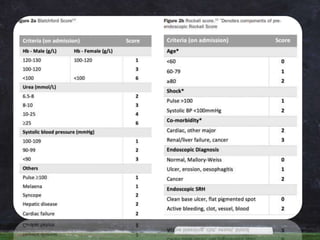
• The Blatchford
• Rockall scores predict endoscopic and
clinical outcomes
• AIMS65 new tool (not yet adopted in UK)
Risk Assessment
• High risk scores should be prioritised for
endoscopy,
• All cases endo within 24 h of admission.
• Low-risk patients, i.E. Blatchford score of
0–1, may be considered for discharge with
outpatient endoscopy.
• Recently, the aims65 score has been
introduced as another pre-endoscopic risk
assessment tool,
– Comprising albumin (< 3 g/l),
– Inr > 1.5,
– Mental state alteration,
– Systolic blood pressure < 90,
– Age > 65.
After Risk Assessment
Medical Mangement
• Address coagulopathy
– ESGE recommends the INR be corrected to < 2.5 prior
to performing endoscopy
– Patients with AUGIB while on novel oral anticoagulants,
should be discussed with local haematologists
• Proton pump inhibitors (PPI)
– A 2010 Cochrane meta-analysis of six randomised
controlled trials (RCTs) (n = 2223) showed that PPIs
before endoscopy significantly reduced stigmata of
recent haemorrhage at index endoscopy but has less
effect on rebleeding, surgery, or mortality.
– may mask targets for therapy,
– NICE and BSG do not recommend while ESGE
recommends PPIs
Medical Mangement
• Variceal measures (terlipressin and antibiotics)
– Terlipressin, increases systemic vascular resistance,
reduces cardiac output, and reduces portal
pressures by approximately 20%
– The dose in variceal haemorrhage is 2 mg four
times a day
• Antibiotic prophylaxis is a standard in cirrhotic
patients
– A meta- analysis of 12 RCTs has associated
Gram-negative antibiotic prophylaxis with reduced
mortality (RR 0.79, 95% CI 0.63– 0.98) and
rebleeding (RR 0.53, 95% CI 0.38–0.74).
• Prokinetics and tranexmic acid
THE ENDOSCOPIST ARRIVES
ENDOSCOPIC MANAGEMENT
NVUGIB
– active bleeding,
– a non-bleeding visible vessel,
– adherent clot.
• Endoscopic haemostasis of such lesions has
been shown to reduce mortality, rebleeding
risk and the need for surgery.
• Endoscopic therapies for NVUGIB comprise
– injection therapy,
– thermal treatments,
– mechanical adjuncts and
– spray therapy (Cook medical)
ENDOSCOPIC MANAGEMENT
• VUGIB
• Endoscopic options for variceal bleeding
include;
– band ligation, (VBL superior to sclero)
– sclerotherapy
– Cyanoacrylate and thrombin
– Sengstaken tube insertion.
– Covered stents
• Management of gastric varices depend
on the anatomical subtype
BSG and NICE
recommendations
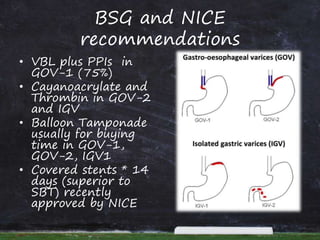
• VBL plus PPIs in
GOV-1 (75%)
• Cayanoacrylate and
Thrombin in GOV-2
and IGV
• Balloon Tamponade
usually for buying
time in GOV-1,
GOV-2, IGV1
• Covered stents * 14
days (superior to
SBT) recently
approved by NICE
POST-ENDOSCOPIC
MANAGEMENT NVUGIB
• PPIs
– RCT Hong Kong and Cochrane review
showed that continuous omeprazole
infusion (80 mg intravenous bolus followed
by 8 mg/h for 72 h) after endotherapy for
peptic ulcer was superior to placebo in
reducing recurrent bleeding, transfusion
requirements and hospital stay
– NICE recommends routine administration
of PPI to patients with NVUGIB
• Helicobacter pylori treatment
POST-ENDOSCOPIC
MANAGEMENT NVUGIB
• Transfusions thresholds
– TRIGGER trial RCT (n = 936), showed no
significant difference in outcomes between the
restrictive (80 g/L) and liberal (100 g/L)
strategies.
– Based on this NICE and ESGE recommends a
restrictive transfusion strategy (target
haemoglobin between 70 –90 g/L) after
haemostasis
• Iron supplementation;
– not in AUGIB guidelines but can be considered
• Antithrombotic drugs
– NICE and ESGE recommends continuing low-dose
aspirin for secondary prevention of vascular events
What if Re bleed occurs?
In addition to this……
Post-endoscopic Re Bleeding
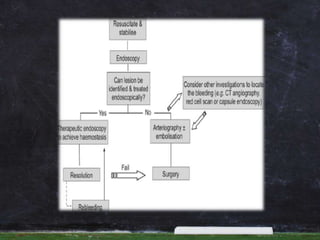
Management in NVUGIB
• Rebleeding occurs in approximately 13–
23% of cases.
– NICE recommends offering repeat endoscopy
and possibly additional colonoscopy to patients
– Who rebleed, or
– If there is doubt regarding adequate
haemostasis at index endoscopy.
– If there is a failure of endoscopic haemostasis,
• Stable patients should be considered for
interventional radiology Unstable for
surgery
POST-ENDOSCOPIC
MANAGEMENT VUGIB
• Terlipressin
– NICE recommends continuing until certainty of
haemostasis or after 5 days
• Non-selective beta blockers
– After the first variceal haemorrhage, the risk of
rebleeding is 15–30% within the subsequent 6 weeks.
– Currently, the mainstay of pharmacological secondary
prophylaxis is with non-selective beta-blockers, such as
propranolol or carvedilol
• Elective VBL
– Elective repeat endoscopy 2–4 weeks after variceal
haemorrhage until eradication of varices,
• Transjugular intrahepatic portosystemic shunt
(TIPSS)
What if Re bleed occurs?
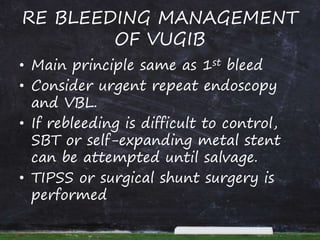
RE BLEEDING MANAGEMENT
OF VUGIB
• Main principle same as 1st bleed
• Consider urgent repeat endoscopy
and VBL.
• If rebleeding is difficult to control,
SBT or self-expanding metal stent
can be attempted until salvage.
• TIPSS or surgical shunt surgery is
performed
TAKE HOME MESSAGE
Management of upper gi bleeding email copy

Management of upper gi bleeding email copy

  • 2.
    MANAGEMENT OF UPPER GIBLEEDING Dr. Nadia Gulnaz Speciality doctor surgery
  • 3.
    OVERVIEW • Acute uppergastrointestinal bleed (AUGIB) is one of the most common medical emergencies in the UK, roughly one presentation every 6 min. • Despite advances, mortality has remained high, with over 9,000 deaths annually in the UK; • In 2015 UK National Confidential Enquiry into Patient Outcome and Death in AUGIB highlighted variations in practice, and has raised concerns regarding suboptimal patient care and released a series of recommendations.
  • 4.
    OVERVIEW • This reviewincorporates • The latest available evidence and UK- relevant guidelines , • Summarises the optimal – Pre-endoscopic, – Endoscopic, – Post-endoscopic approach in • Management of non-variceal and variceal AUGIB
  • 5.
    An U.GI BleedPresents….
  • 6.
    DIAGNOSIS Bleeding in theupper gastrointestinal tract proximal to the ligament of Treitz,7 should be suspected in patients with; • haematemesis, • coffee-ground vomiting, • melaena • unexplained fall in haemoglobin. • In up to 20% of cases, AUGIB may mimic lower gastrointestinal bleeding
  • 7.
    Causes Of AcuteUpper GI Bleeding In The UK Pragmatically, divided into • Variceal • Non- variceal UGIB (NVUGIB) causes There are important differences in management strategies. Variceal bleeding has doubled from 4% to 8% in 2007 Peptic ulcer disease (pud) still remains the most common cause of augib, despite reductions in pud incidence and mortality over the last three decades.
  • 8.
    Causes Of AcuteUpper GI Bleeding In The UK
  • 9.
    MANAGEMENT OUTLINE • Pre-endoscopicmanagement – 1. Assessment and resuscitation – 2. Risk Assessment – 3. Medical management • Endoscopic management – 1. NVUGIB – 2. Variceal • Post Endoscopic management – 1. NVUGIB – 2. Variceal – 3. Rebleed management
  • 10.
    PRE-ENDOSCOPIC MANAGEMENT • ABC • Inunstable patients, early assistance from the intensive care team should be considered, especially in – airway compromise from haematemesis, – Hypoxia, or – reduced level of consciousness from decompensated liver disease • Standard blood tests including COAG and group and save • Major haemorrhage protocols in line with national standards • Endoscopist should be notified within 1 h of diagnosis, • The patient placed nil by mouth
  • 12.
    Risk Assesment • Followingresus a focused history and examination should be performed. • NICE advocates a two-step risk assessment strategy – Cause assessment – Severity assessment • The Blatchford • Rockall scores predict endoscopic and clinical outcomes • AIMS65 new tool (not yet adopted in UK)
  • 14.
    Risk Assessment • Highrisk scores should be prioritised for endoscopy, • All cases endo within 24 h of admission. • Low-risk patients, i.E. Blatchford score of 0–1, may be considered for discharge with outpatient endoscopy. • Recently, the aims65 score has been introduced as another pre-endoscopic risk assessment tool, – Comprising albumin (< 3 g/l), – Inr > 1.5, – Mental state alteration, – Systolic blood pressure < 90, – Age > 65.
  • 15.
  • 16.
    Medical Mangement • Addresscoagulopathy – ESGE recommends the INR be corrected to < 2.5 prior to performing endoscopy – Patients with AUGIB while on novel oral anticoagulants, should be discussed with local haematologists • Proton pump inhibitors (PPI) – A 2010 Cochrane meta-analysis of six randomised controlled trials (RCTs) (n = 2223) showed that PPIs before endoscopy significantly reduced stigmata of recent haemorrhage at index endoscopy but has less effect on rebleeding, surgery, or mortality. – may mask targets for therapy, – NICE and BSG do not recommend while ESGE recommends PPIs
  • 17.
    Medical Mangement • Varicealmeasures (terlipressin and antibiotics) – Terlipressin, increases systemic vascular resistance, reduces cardiac output, and reduces portal pressures by approximately 20% – The dose in variceal haemorrhage is 2 mg four times a day • Antibiotic prophylaxis is a standard in cirrhotic patients – A meta- analysis of 12 RCTs has associated Gram-negative antibiotic prophylaxis with reduced mortality (RR 0.79, 95% CI 0.63– 0.98) and rebleeding (RR 0.53, 95% CI 0.38–0.74). • Prokinetics and tranexmic acid
  • 18.
  • 19.
    ENDOSCOPIC MANAGEMENT NVUGIB – activebleeding, – a non-bleeding visible vessel, – adherent clot. • Endoscopic haemostasis of such lesions has been shown to reduce mortality, rebleeding risk and the need for surgery. • Endoscopic therapies for NVUGIB comprise – injection therapy, – thermal treatments, – mechanical adjuncts and – spray therapy (Cook medical)
  • 20.
    ENDOSCOPIC MANAGEMENT • VUGIB •Endoscopic options for variceal bleeding include; – band ligation, (VBL superior to sclero) – sclerotherapy – Cyanoacrylate and thrombin – Sengstaken tube insertion. – Covered stents • Management of gastric varices depend on the anatomical subtype
  • 21.
    BSG and NICE recommendations •VBL plus PPIs in GOV-1 (75%) • Cayanoacrylate and Thrombin in GOV-2 and IGV • Balloon Tamponade usually for buying time in GOV-1, GOV-2, IGV1 • Covered stents * 14 days (superior to SBT) recently approved by NICE
  • 22.
    POST-ENDOSCOPIC MANAGEMENT NVUGIB • PPIs –RCT Hong Kong and Cochrane review showed that continuous omeprazole infusion (80 mg intravenous bolus followed by 8 mg/h for 72 h) after endotherapy for peptic ulcer was superior to placebo in reducing recurrent bleeding, transfusion requirements and hospital stay – NICE recommends routine administration of PPI to patients with NVUGIB • Helicobacter pylori treatment
  • 23.
    POST-ENDOSCOPIC MANAGEMENT NVUGIB • Transfusionsthresholds – TRIGGER trial RCT (n = 936), showed no significant difference in outcomes between the restrictive (80 g/L) and liberal (100 g/L) strategies. – Based on this NICE and ESGE recommends a restrictive transfusion strategy (target haemoglobin between 70 –90 g/L) after haemostasis • Iron supplementation; – not in AUGIB guidelines but can be considered • Antithrombotic drugs – NICE and ESGE recommends continuing low-dose aspirin for secondary prevention of vascular events
  • 24.
    What if Rebleed occurs?
  • 25.
    In addition tothis……
  • 26.
    Post-endoscopic Re Bleeding Managementin NVUGIB • Rebleeding occurs in approximately 13– 23% of cases. – NICE recommends offering repeat endoscopy and possibly additional colonoscopy to patients – Who rebleed, or – If there is doubt regarding adequate haemostasis at index endoscopy. – If there is a failure of endoscopic haemostasis, • Stable patients should be considered for interventional radiology Unstable for surgery
  • 27.
    POST-ENDOSCOPIC MANAGEMENT VUGIB • Terlipressin –NICE recommends continuing until certainty of haemostasis or after 5 days • Non-selective beta blockers – After the first variceal haemorrhage, the risk of rebleeding is 15–30% within the subsequent 6 weeks. – Currently, the mainstay of pharmacological secondary prophylaxis is with non-selective beta-blockers, such as propranolol or carvedilol • Elective VBL – Elective repeat endoscopy 2–4 weeks after variceal haemorrhage until eradication of varices, • Transjugular intrahepatic portosystemic shunt (TIPSS)
  • 28.
    What if Rebleed occurs?
  • 30.
    RE BLEEDING MANAGEMENT OFVUGIB • Main principle same as 1st bleed • Consider urgent repeat endoscopy and VBL. • If rebleeding is difficult to control, SBT or self-expanding metal stent can be attempted until salvage. • TIPSS or surgical shunt surgery is performed
  • 32.