PRESENTED BY- Dr Pratyush Kumar
GUIDED BY- Dr Satyabhama Marandi
Management of acute
PID : Recent
Guidelines
CONTENTS
 Definition
 Risk factors
 Transmission
 Pathogenesis
 Clinical features
 Management :
Clinical diagnostic criteria and staging
 Investigations
Treatment
Follow-up
Complications
 Preventive measures
Definition
 Spectrum of infection and inflammation of the
upper genital tract organs typically involving the
uterus(endometrium), fallopian tubes, ovaries,
pelvic peritoneum and surrounding structures.
Risk factors
 Menstruating teenagers
 Multiple sexual partners
 Absence of contraceptive pills
 Previous history of acute PID
 IUD users
 Area with high prevalence of STDs
Transmission
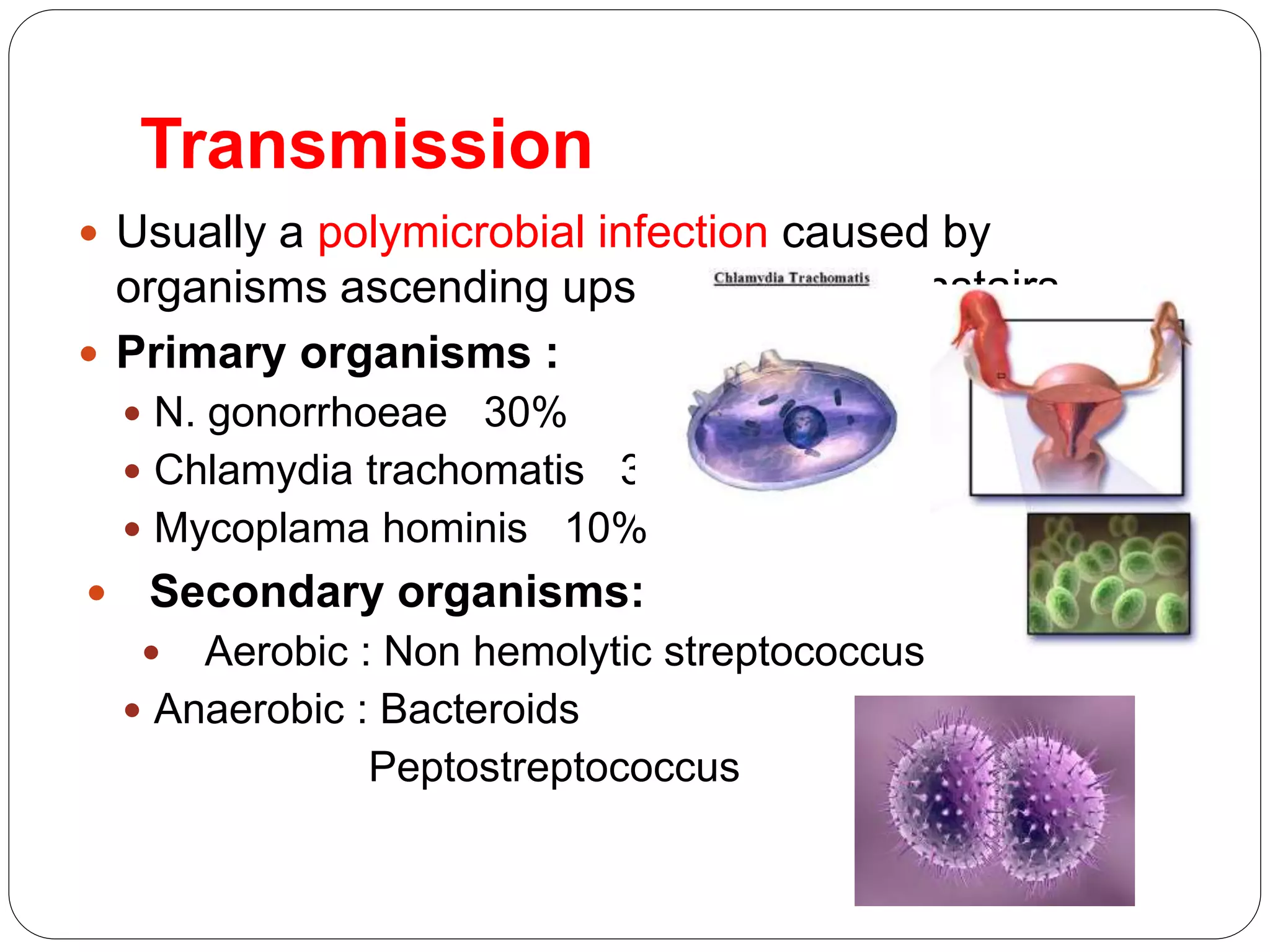
 Usually a polymicrobial infection caused by
organisms ascending upstairs from downstairs.
 Primary organisms :
 N. gonorrhoeae 30%
 Chlamydia trachomatis 30%
 Mycoplama hominis 10%
 Secondary organisms:
 Aerobic : Non hemolytic streptococcus
 Anaerobic : Bacteroids
Peptostreptococcus
 Route :
 Through mucosal continuity and contiguity
 Reflux of menstrual blood into fallopian tubes
 Spread across parametrium e.g. Mycoplasma
hominis
 Lymphatics
 From gut(rarely)
Pathogenesis
STD
Agents
Cervicitis
Endometritis
Endogenous (polymicrobial)
flora
Bacterial vaginosis
Initiation of
tubal damage
Compromised
host resistance
Abortions, D&C, IUD
insertion, other
gyaenecologic
procedures
Salpingitis
Restoration of
normal
anatomy
Tubal
deciliation
Tubal
occlusio
n
Pelvic
adhesion
Pelvic
absces
s
Clinical Features
 Fever > 38⁰C
 B/L lower abdominal tenderness with radiation to
the legs
 Abnormal vaginal discharge
 Deep dyspareunia
 On bimanual examination:
 Cervical motion tenderness
 Adnexal tenderness
Clinical Diagnostic Criteria(FOGSI-
ICOG)
 Minimum criteria:
 Lower abdominal tenderness
 Adnexal tenderness
 Cervical motion tenderness
 Additional criteria:
 Oral temperature > 38.3⁰C
 Mucopurulent cervical or vaginal discharge
 Raised C- reactive protein &/or ESR
 Laboratory documentation of positive cervical
infection with Gonorrhoea or C. trachomatis
 Definitive criteria:
 Histopathologic evidence of endometritis on biopsy
 Imaging study (TVS / MRI) evidence of thickened
fluid filled tubes ± tubo-ovarian complex
 Laparoscopic evidence of PID
CINICAL STAGES OF ACUTE
PID
 Stage I : Acute salpingitis w/o peritonitis
 Stage II : Acute salpingitis with peritonitis
 Stage III : Acute salpingitis with superimposed
tubal occlusion or tubo-ovarian
complex
 Stage IV : Ruptured tubo-ovarian abscess
 Stage V : Tubercular salpingitis
Investigations
 Identification of organisms:
 Discharge from urethra or Bartholin’s gland
 Cervical canal
 Collected pus from fallopian tubes during laparotomy or
laparoscopy
 Blood:
 Leucocytosis and an elevated ESR value > 15mm/hr
 Sonography:
 Dilated and fluid filled tubes
 Fluid in Pouch of Douglas
 Adnexal masses
 Laparoscopy:
 Gold standard
 Reserved only in those cases in which differential
diagnosis includes salpingitis, appendicitis or ectopic
pregnancy
 Mild: Tubes – Edema, Erythema, No purulent
exudates and mobile
 Moderate: Purulent exudates from the fimbrial ends,
Tubes not freely mobile
 Severe: Pyosalpinx, Inflammatory complex, Abscess
 Violin string like adhesions in the pelvis and around
the liver suggests chlamydial infection (Fitz- Hugh-
Curtis Syndrome)
 Culdocentesis:
 Aspiration of peritoneal fluid and its white cell count,
Symptoms & Signs Acute Salpingitis Acute Appendicitis Disturbed Ectopic
Pain Acute lower
abdominal on both
the sides
Starts near
umbilicus but settles
to right iliac fossa
Acute lower
abdominal on one
side
Amenorrhea &
bleeding PV
Unrelated Unrelated Usually present
Nausea & vomiting Inconsistently
present
Usual Absent
General look Face- flushed Toxic Pale
Tongue No significant
change
Furred Pale
Temperature More raised Slightly raised Not raised
Tenderness Lower abdomen on
both sides
On Mc Burney’s
point
Lower abdomen
more on one side
Pulse Rapid but
proportionate with
temperature
Rapid, out of
proportion to
temperature
Persistent rise even
with normal
temperature
Per vaginum Tenderness on both
fornices. A mass
may be felt
Tenderness on right
fornix and high up
Mass may be felt
through one fornix
extending up to
pouch of Douglas
ICOG Guidelines for Outpatient
therapy
 Regimen A:
 Oral Ofloxacin 400mg BD PLUS oral Metronidazole
400mg BD for 14 days
 Oral Levofloxacin 500mg OD PLUS oral
Metronidazole 400mg BD for 14 days
 Regimen B:
 IM Ceftriaxone 250mg single dose or IM Cefoxitin
2gm single dose with oral Probenecid 1gm followed
by oral Doxycycline 100mg BD PLUS oral
Metronidazole 400mg BD for 14 days
 The patient should be re-evaluated after 48hrs
and if no response, are to be hospitalised.
Criteria for hospitalization
 Inability to exclude surgical emergency (e.g.
appendicitis)
 Presence of tubo-ovarian abscess
 PID in pregnancy
 Clinically severe disease
 Failure to respond to outpatient oral therapy
 Intolerance to oral therapy (e.g. severe nausea/
vomiting)
Inpatient therapy
 Regimen A:
 Cefoxitin 2gm IV 6hrly or Ceftriaxone 2gm IV infusion
daily + Doxycycline 100mg oral / IV every 12 hrly for 48
hrs followed by oral Doxycycline 100mg BD PLUS oral
Metronidazole 400mg BD for 14 days
 Regimen B:
 Clindamycin 900mg IV 8 hrly + Gentamicin IV/IM
(2mg/kg load, then 1.5mg/kg 8hrly) for 48hrs followed by
oral Doxycycline 100mg BD PLUS oral Metronidazole
400mg BD for 14 days or oral Clindamycin 450mg 4 times
daily for 14 days
 Alternative regimen:
 IV Ofloxacin 400mg BD PLUS IV Metronidazole 500mg 8
hrly for 14 days
 IV Ciprofloxacin 200mg BD PLUS IV/ oral Doxycycline
100mg BD PLUS IV Metronidazole 500mg TID for 14
days
Treatment in pregnancy
 In an ongoing intrauterine pregnancy, PID is
extremely rare, except in the case of septic abortion.
 Cervicitis may occur and is associated with
increased maternal and fetal morbidity including pre-
term delivery.
 Treatment regimens will dependent on organisms
isolated.
 A combination of Cefotaxime, Azithromycin and
Metronidazole for 14 days may be used.
 Treatment in children:
 Acute PID is rarely seen in very young girls.
 In girls over 12 yrs, Doxycycline can be safely used.
 Treatment in a woman with an IUCD:
 An IUCD may be left in-situ in women with clinically
mild PID but should be removed in cases of severe
disease and, especially, if symptoms have not
resolved within 72 hrs.
 Treatment in a woman with HIV:
 Women with PID who are also infected with HIV
should be treated with the same antibiotic regimens
as women who are HIV negative.
 Low CD4 count is an indication for hospitalization.
Surgical treatment
 Indication:
Generalised peritonitis
Pelvic abscess
Tubo-ovarian abscess
 Laparotomy/ laparoscopy may help early resolution
of the disease by division of adhesions and drainage
of pelvic abscesses.
 Ultrasound-guided aspiration of pelvic fluid
collections is less invasive and may be equally
effective.
 It is also possible to perform adhesiolysis in cases of
peri-hepatitis due to Chlamydia.
Follow-up
 In the outpatient setting, review at 72hrs is
recommended particularly for those with a
moderate or severe clinical presentation.
 Failure to improve suggests the need for further
investigations, parenteral therapy and/or surgical
intervention.
 A full screen for all STDs including Hepatitis B
and HIV should be offered for persistent
infections.
RCOG guidelines
 Outpatient therapy:
 IM Ceftriaxone 500mg single dose followed by oral
Doxycycline 100mg BD PLUS oral Metronidazole
400mg BD for 14 days
 Alternative regimen for outpatient therapy:
 IM Ceftriaxone 500mg immediately, followed by
Azithromycin 1gm/week for 2 weeks.
COMPLICATIONS
IMMEDIATE:
 Pelvic peritonitis or even generalised peritonotis
 Septicemia
LATE:
 Dyspareunia
 Infertility either due to cornual block or damage to
the wall of the tube. Risk increased with severity
and no of episodes.
 Chronic PID
 Formation of adhesions or Hydrosalpinx or
Pyosalpinx
 Tubo-ovarian abscess
 Increased risk of ectopic pregnancy (6-10 folds)
PREVENTIVE MEASURES
 Reproductive Health Education to be given to
young girls.
 Importance of menstrual hygiene to be reinforced.
 Safe sexual practices to be advocated.
 Pamphlets/ Brochures regarding PID.
 Awareness program through mass media.
 Screening for infections in high risk group
 Rapid diagnosis and effective treatment of STDs
& UTI
TAKE HOME MESSAGE
 Fallopian tubes ultimately bears the brunt of
acute infection.
 It is a major problem to the reproductive health of
young women.
 It may be asymptomatic or subclinical. Patient
usually presents with chronic symptoms.
 The primary organisms of PID are predominantly
sexually transmitted.
 Acute PID is polymicrobial in nature. As the
symptoms are non specific, over treatment is
preferred to missed diagnosis.
Management of acute pid

Management of acute pid

  • 1.
    PRESENTED BY- DrPratyush Kumar GUIDED BY- Dr Satyabhama Marandi Management of acute PID : Recent Guidelines
  • 2.
    CONTENTS  Definition  Riskfactors  Transmission  Pathogenesis  Clinical features  Management : Clinical diagnostic criteria and staging  Investigations Treatment Follow-up Complications  Preventive measures
  • 3.
    Definition  Spectrum ofinfection and inflammation of the upper genital tract organs typically involving the uterus(endometrium), fallopian tubes, ovaries, pelvic peritoneum and surrounding structures.
  • 4.
    Risk factors  Menstruatingteenagers  Multiple sexual partners  Absence of contraceptive pills  Previous history of acute PID  IUD users  Area with high prevalence of STDs
  • 5.
    Transmission  Usually apolymicrobial infection caused by organisms ascending upstairs from downstairs.  Primary organisms :  N. gonorrhoeae 30%  Chlamydia trachomatis 30%  Mycoplama hominis 10%  Secondary organisms:  Aerobic : Non hemolytic streptococcus  Anaerobic : Bacteroids Peptostreptococcus
  • 6.
     Route : Through mucosal continuity and contiguity  Reflux of menstrual blood into fallopian tubes  Spread across parametrium e.g. Mycoplasma hominis  Lymphatics  From gut(rarely)
  • 7.
    Pathogenesis STD Agents Cervicitis Endometritis Endogenous (polymicrobial) flora Bacterial vaginosis Initiationof tubal damage Compromised host resistance Abortions, D&C, IUD insertion, other gyaenecologic procedures Salpingitis Restoration of normal anatomy Tubal deciliation Tubal occlusio n Pelvic adhesion Pelvic absces s
  • 8.
    Clinical Features  Fever> 38⁰C  B/L lower abdominal tenderness with radiation to the legs  Abnormal vaginal discharge  Deep dyspareunia  On bimanual examination:  Cervical motion tenderness  Adnexal tenderness
  • 9.
    Clinical Diagnostic Criteria(FOGSI- ICOG) Minimum criteria:  Lower abdominal tenderness  Adnexal tenderness  Cervical motion tenderness  Additional criteria:  Oral temperature > 38.3⁰C  Mucopurulent cervical or vaginal discharge  Raised C- reactive protein &/or ESR  Laboratory documentation of positive cervical infection with Gonorrhoea or C. trachomatis
  • 10.
     Definitive criteria: Histopathologic evidence of endometritis on biopsy  Imaging study (TVS / MRI) evidence of thickened fluid filled tubes ± tubo-ovarian complex  Laparoscopic evidence of PID
  • 11.
    CINICAL STAGES OFACUTE PID  Stage I : Acute salpingitis w/o peritonitis  Stage II : Acute salpingitis with peritonitis  Stage III : Acute salpingitis with superimposed tubal occlusion or tubo-ovarian complex  Stage IV : Ruptured tubo-ovarian abscess  Stage V : Tubercular salpingitis
  • 12.
    Investigations  Identification oforganisms:  Discharge from urethra or Bartholin’s gland  Cervical canal  Collected pus from fallopian tubes during laparotomy or laparoscopy  Blood:  Leucocytosis and an elevated ESR value > 15mm/hr  Sonography:  Dilated and fluid filled tubes  Fluid in Pouch of Douglas  Adnexal masses
  • 13.
     Laparoscopy:  Goldstandard  Reserved only in those cases in which differential diagnosis includes salpingitis, appendicitis or ectopic pregnancy  Mild: Tubes – Edema, Erythema, No purulent exudates and mobile  Moderate: Purulent exudates from the fimbrial ends, Tubes not freely mobile  Severe: Pyosalpinx, Inflammatory complex, Abscess  Violin string like adhesions in the pelvis and around the liver suggests chlamydial infection (Fitz- Hugh- Curtis Syndrome)  Culdocentesis:  Aspiration of peritoneal fluid and its white cell count,
  • 15.
    Symptoms & SignsAcute Salpingitis Acute Appendicitis Disturbed Ectopic Pain Acute lower abdominal on both the sides Starts near umbilicus but settles to right iliac fossa Acute lower abdominal on one side Amenorrhea & bleeding PV Unrelated Unrelated Usually present Nausea & vomiting Inconsistently present Usual Absent General look Face- flushed Toxic Pale Tongue No significant change Furred Pale Temperature More raised Slightly raised Not raised Tenderness Lower abdomen on both sides On Mc Burney’s point Lower abdomen more on one side Pulse Rapid but proportionate with temperature Rapid, out of proportion to temperature Persistent rise even with normal temperature Per vaginum Tenderness on both fornices. A mass may be felt Tenderness on right fornix and high up Mass may be felt through one fornix extending up to pouch of Douglas
  • 16.
    ICOG Guidelines forOutpatient therapy  Regimen A:  Oral Ofloxacin 400mg BD PLUS oral Metronidazole 400mg BD for 14 days  Oral Levofloxacin 500mg OD PLUS oral Metronidazole 400mg BD for 14 days  Regimen B:  IM Ceftriaxone 250mg single dose or IM Cefoxitin 2gm single dose with oral Probenecid 1gm followed by oral Doxycycline 100mg BD PLUS oral Metronidazole 400mg BD for 14 days  The patient should be re-evaluated after 48hrs and if no response, are to be hospitalised.
  • 17.
    Criteria for hospitalization Inability to exclude surgical emergency (e.g. appendicitis)  Presence of tubo-ovarian abscess  PID in pregnancy  Clinically severe disease  Failure to respond to outpatient oral therapy  Intolerance to oral therapy (e.g. severe nausea/ vomiting)
  • 18.
    Inpatient therapy  RegimenA:  Cefoxitin 2gm IV 6hrly or Ceftriaxone 2gm IV infusion daily + Doxycycline 100mg oral / IV every 12 hrly for 48 hrs followed by oral Doxycycline 100mg BD PLUS oral Metronidazole 400mg BD for 14 days  Regimen B:  Clindamycin 900mg IV 8 hrly + Gentamicin IV/IM (2mg/kg load, then 1.5mg/kg 8hrly) for 48hrs followed by oral Doxycycline 100mg BD PLUS oral Metronidazole 400mg BD for 14 days or oral Clindamycin 450mg 4 times daily for 14 days  Alternative regimen:  IV Ofloxacin 400mg BD PLUS IV Metronidazole 500mg 8 hrly for 14 days  IV Ciprofloxacin 200mg BD PLUS IV/ oral Doxycycline 100mg BD PLUS IV Metronidazole 500mg TID for 14 days
  • 19.
    Treatment in pregnancy In an ongoing intrauterine pregnancy, PID is extremely rare, except in the case of septic abortion.  Cervicitis may occur and is associated with increased maternal and fetal morbidity including pre- term delivery.  Treatment regimens will dependent on organisms isolated.  A combination of Cefotaxime, Azithromycin and Metronidazole for 14 days may be used.
  • 20.
     Treatment inchildren:  Acute PID is rarely seen in very young girls.  In girls over 12 yrs, Doxycycline can be safely used.  Treatment in a woman with an IUCD:  An IUCD may be left in-situ in women with clinically mild PID but should be removed in cases of severe disease and, especially, if symptoms have not resolved within 72 hrs.  Treatment in a woman with HIV:  Women with PID who are also infected with HIV should be treated with the same antibiotic regimens as women who are HIV negative.  Low CD4 count is an indication for hospitalization.
  • 21.
    Surgical treatment  Indication: Generalisedperitonitis Pelvic abscess Tubo-ovarian abscess  Laparotomy/ laparoscopy may help early resolution of the disease by division of adhesions and drainage of pelvic abscesses.  Ultrasound-guided aspiration of pelvic fluid collections is less invasive and may be equally effective.  It is also possible to perform adhesiolysis in cases of peri-hepatitis due to Chlamydia.
  • 22.
    Follow-up  In theoutpatient setting, review at 72hrs is recommended particularly for those with a moderate or severe clinical presentation.  Failure to improve suggests the need for further investigations, parenteral therapy and/or surgical intervention.  A full screen for all STDs including Hepatitis B and HIV should be offered for persistent infections.
  • 23.
    RCOG guidelines  Outpatienttherapy:  IM Ceftriaxone 500mg single dose followed by oral Doxycycline 100mg BD PLUS oral Metronidazole 400mg BD for 14 days  Alternative regimen for outpatient therapy:  IM Ceftriaxone 500mg immediately, followed by Azithromycin 1gm/week for 2 weeks.
  • 24.
    COMPLICATIONS IMMEDIATE:  Pelvic peritonitisor even generalised peritonotis  Septicemia LATE:  Dyspareunia  Infertility either due to cornual block or damage to the wall of the tube. Risk increased with severity and no of episodes.  Chronic PID  Formation of adhesions or Hydrosalpinx or Pyosalpinx  Tubo-ovarian abscess  Increased risk of ectopic pregnancy (6-10 folds)
  • 25.
    PREVENTIVE MEASURES  ReproductiveHealth Education to be given to young girls.  Importance of menstrual hygiene to be reinforced.  Safe sexual practices to be advocated.  Pamphlets/ Brochures regarding PID.  Awareness program through mass media.  Screening for infections in high risk group  Rapid diagnosis and effective treatment of STDs & UTI
  • 26.
    TAKE HOME MESSAGE Fallopian tubes ultimately bears the brunt of acute infection.  It is a major problem to the reproductive health of young women.  It may be asymptomatic or subclinical. Patient usually presents with chronic symptoms.  The primary organisms of PID are predominantly sexually transmitted.  Acute PID is polymicrobial in nature. As the symptoms are non specific, over treatment is preferred to missed diagnosis.