ACUTE PELVIC
INFLAMMATORY DISEASE
PRESENTED BY:
DR.SABIHA NAZ
CONTENTS:
1) INTRODUCTION
2) EPIDEMIOLOGY
3) RISK FACTORS FOR PID
4) MICROBIOLOGY
5) MODE OF AFFECTION
6) PATHOLOGY
7) STAGES OF PID
8) CLINICAL FEATURES
9) CLINICAL DIAGNOSTIC CRITERIA OF PID (CDC-2010B)
10) MANAGEMENT
11) PELVIC INFECTIONS FOLLOWING ABORTIONS & DELIVERY
12) IUCD AND PELVIC INFECTION
INTRODUCTION
 DEFINITION:-
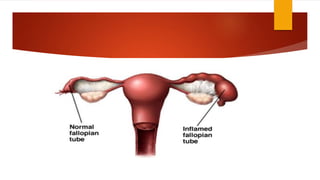
It is a spectrum of infection and inflammation of the upper genital tract organs
typically involving the uterus (endometrium), fallopian tubes, ovaries, pelvic
peritoneum and surrounding structures (parametrium).
***It is not associated with pregnancy or surgery.
- Jeffcoate’s Principles of Gynaecology ; 8th Edition(2014)
 It is attributed to the ascending spread of microorganisms from the
cervicovaginal canal to the contiguous pelvic structures.
 Infection may include any or all of the following anatomic sites and it is
described as:
 Endometritis
 Salpingitis
 Pelvic peritonitis
 Tubo-ovarian abcess
 Parametritis
EPIDEMIOLOGY:
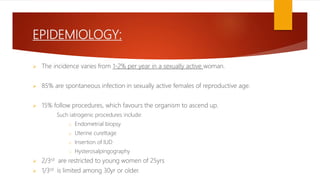
 The incidence varies from 1-2% per year in a sexually active woman.
 85% are spontaneous infection in sexually active females of reproductive age.
 15% follow procedures, which favours the organism to ascend up.
Such iatrogenic procedures include:
o Endometrial biopsy
o Uterine curettage
o Insertion of IUD
o Hysterosalpingography
 2/3rd are restricted to young women of 25yrs
 1/3rd is limited among 30yr or older.
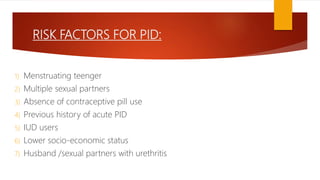
RISK FACTORS FOR PID:
1) Menstruating teenger
2) Multiple sexual partners
3) Absence of contraceptive pill use
4) Previous history of acute PID
5) IUD users
6) Lower socio-economic status
7) Husband /sexual partners with urethritis
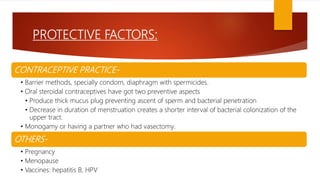
PROTECTIVE FACTORS:
CONTRACEPTIVE PRACTICE-
• Barrier methods, specially condom, diaphragm with spermicides.
• Oral steroidal contraceptives have got two preventive aspects
• Produce thick mucus plug preventing ascent of sperm and bacterial penetration
• Decrease in duration of menstruation creates a shorter interval of bacterial colonization of the
upper tract.
• Monogamy or having a partner who had vasectomy.
OTHERS-
• Pregnancy
• Menopause
• Vaccines: hepatitis B, HPV
MICROBIOLOGY:
 PRIMARY ORGANISMS (mostly sexually transmitted ones)
i. N. gonorrhea in 30%
ii. Chlamydia trachomatis in 30%
iii. Mycoplasma hominis in 10%
 SECONDARY ORGANISMS (normally found in the vagina)
Aerobic Anaerobic
i. Non hemolytic Streptococci i. Bacteroides
ii. E. coli ii. Peptostreptococcus
iii. Group B Streptococcus iii. Peptococcus
iv. Staphylococcus
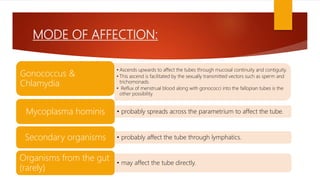
MODE OF AFFECTION:
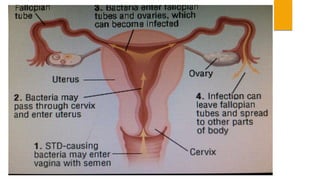
• Ascends upwards to affect the tubes through mucosal continuity and contiguity.
• This ascend is facilitated by the sexually transmitted vectors such as sperm and
trichomonads.
• Reflux of menstrual blood along with gonococci into the fallopian tubes is the
other possibility.
Gonococcus &
Chlamydia
• probably spreads across the parametrium to affect the tube.Mycoplasma hominis
• probably affect the tube through lymphatics.Secondary organisms
• may affect the tube directly.
Organisms from the gut
(rarely)
PATHOLOGY:
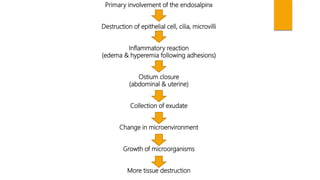
Primary involvement of the endosalpinx
Destruction of epithelial cell, cilia, microvilli
Inflammatory reaction
(edema & hyperemia following adhesions)
Ostium closure
(abdominal & uterine)
Collection of exudate
Change in microenvironment
Growth of microorganisms
More tissue destruction
 The involvement of the tube is almost always bilateral and usually following
menses due to loss of genital defence.
 As the serous coat is not much affected, the resulting adhesions of the tube
with the surrounding structures are not so dense, in fact flimsy, unlike pyogenic
or tubercular infection.
 On occasions, the exudate pour through the abdominal ostium to produce
pelvic peritonitis and pelvic abscess or may affect the ovary producing ovarian
abscess.
STAGES OF PID:
 STAGE I – Acute salpingitis without peritonitis
 STAGE II – Acute salpingitis with peritonitis
 STAGE III – Acute salpingitis with superimposed tubal occlusion or tubo-
ovarian complex
 STAGE IV – Ruptured tubo-ovarian abscess
 STAGE V – Tubercular salpingitis
CLINICAL FEATURES:
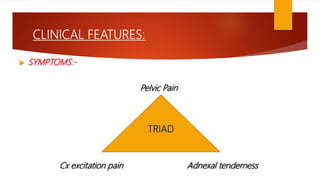
 SYMPTOMS:-
Pelvic Pain
Cx excitation pain Adnexal tenderness
TRIAD
 Bilateral lower abdominal and pelvic plain which is dull in nature.
 Fever, lassitude and headache.
 Irregular and excessive vaginal bleeding (usually due to associated endometritis).
 Abnormal vaginal discharge which becomes purulent and or copious.
 Nausea and vomiting
 Dyspareunia
 Pain and discomfort in the right hypochondrium due to concomitant perihepatitis
(FITZ-HUGH-CURTIS SYNDROME)may occur in 5-10% of cases of acute salpingitis. The
liver is involved due to transperitoneal or vascular dissemination of either gonococcal
or chlamydial infection.
 SIGNS:-
 TEMPERATURE >38.3ºC.
 Tongue shows DEHYDRATION and is COATED.
 P/A - tenderness of both the quadrants of lower abdomen. The liver may b enlarged
and tender (perihepatitis).
 P/V -
i. Abnormal vaginal discharge which may b purulent
ii. Congested external urethral meatus or openings of Bartholin’s ducts through which pus
may be seen escaping out on pressure
 P/S- congested cervix with purulent discharge from the canal
 BIMANUAL EXAMINATION
-b/l tenderness on fornix palpation increases more with movement of the cervix (cervical
motion tenderness).
-There may be thickening or a definite mass felt through the fornices.
CLINICAL DIAGNOSTIC CRITERIA OF PID
(CDC-2010B)
MINIMUM CRITERIA-
Lower abdominal tenderness
Adnexal tenderness
Cervical motion tenderness
ADDDITIONAL CRITERIA-
Oral temperature > 38.3ºC (101.6ºF)
Mucopurulent cervical or vaginal discharge
Abundant WBC’s on saline microscope of cervical secretions
Raised C-reactive protein and/or ESR
Laboratory documentation of positive cervical infection with
Gonorrhea or C.trachomatis
DEFINITIVE CRITERIA-
Histopathologic evidence of Endometritis on
biopsy
Imaging study (TVS/MRI) evidence of
thickened fluid filled tubes ± tubo-ovarian
complex
Laparoscopic evidence of PID
INVESTIGATIONS:
 IDENTIFICATION OF ORGANISMS- materials are collected from the following available
sources and sent for Gram stain and Culture:
 Discharge from the urethra or Bartholin’s gland
 Cervical canal
 Pus from the fallopian tubes during laparoscopy or laparotomy.
 BLOOD-
 TLC- shows leukocytosis to more than 10,000 per cu mm
 Elevated ESR to more than 15mm per hour
 Serological test for syphilis should be carried out for both the partners in all cases.
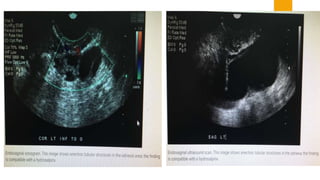
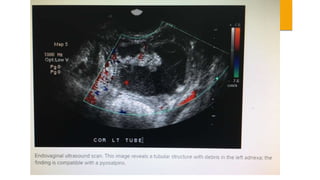
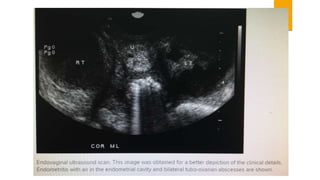
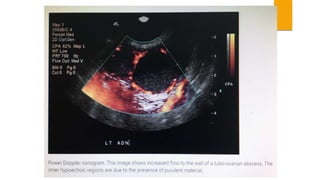
 SONOGRAPHY- Dilated and fluid-filled tubes, fluid in the pouch of
doughlas or adnexal mass are suggestive of PID.
 CULDOCENTESIS- Aspiration of peritoneal fluid and its white cell
count, if exceeds 30,000/mL. is significant in acute PID. Bacterial
culture from the fluid is not informative because of vaginal
contamination.
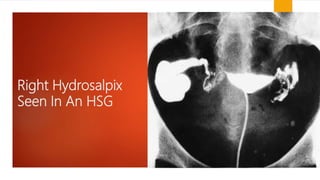
Right Hydrosalpix
Seen In An HSG
 LAPAROSCOPY- It is considered as the GOLD STANDARD and is the most reliable
aid to support the clinical diagnosis. The laparoscopic findings and the severity of PID
• MILD:- Tubes: edema, erythema, no purulent exudates and are mobile.
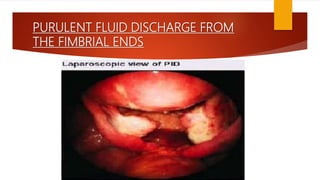
• MODERATE:- Purulent exudates from the fimbrial ends, tubes not freely movable.
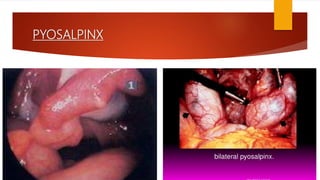
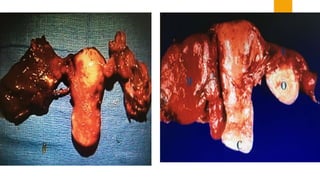
• SEVERE:- Pyosalpix, inflammatory complex, abcess
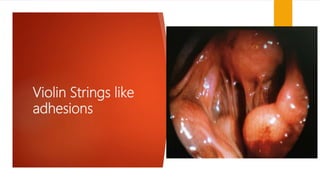
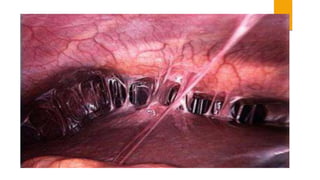
• ‘VIOLIN STRING’:like adhesions in the pelvis and around the liver suggests chlamydial
infection.
 Investigations are also to be extended to male partner and smear and culture are made
urethral secretion.
PURULENT FLUID DISCHARGE FROM
THE FIMBRIAL ENDS
PYOSALPINX
Violin Strings like
adhesions
DIFFERENTIAL DIAGNOSIS:
1. Appendicitis
2. Disturbed ectopic pregnancy
3. Tortion of ovarian pedicle. Hemorrhage or rupture of ovarian cyst
4. Endometriosis
5. Diverticulitis
6. Urinary tract infection
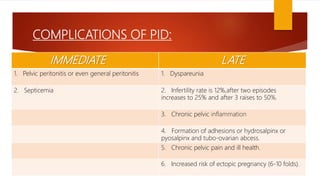
COMPLICATIONS OF PID:
IMMEDIATE LATE
1. Pelvic peritonitis or even general peritonitis 1. Dyspareunia
2. Septicemia 2. Infertility rate is 12%,after two episodes
increases to 25% and after 3 raises to 50%.
3. Chronic pelvic inflammation
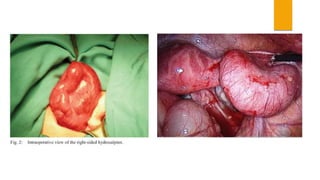
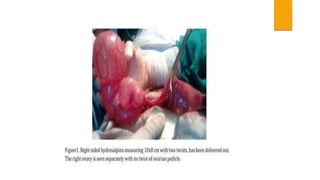
4. Formation of adhesions or hydrosalpinx or
pyosalpinx and tubo-ovarian abcess.
5. Chronic pelvic pain and ill health.
6. Increased risk of ectopic pregnancy (6-10 folds).
TREATMENT:
 Essential steps in the prevention are:
 Community based approach to increase public health awareness.
 Prevention of sexually transmitted infections with the knowledge of healthy and
safer sex.
 Liberal use of contraception.
 Routine screening of high-risk population.
 The principles of therapy are:
To control the infection energetically.
To prevent infertility and late sequelae.
To prevent reinfection.
CDC-RECOMMENDED TREATMENT
REGIMENS FOR ORAL THERAPY OF ACUTE
PID:
 Levofloxacin 5oomg OD x 14days
OR
 Ofloxacin 400mg OD x 14 days
 With or without Metronidazole 500mg BD x 14days
REGIMEN A
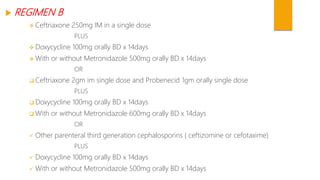
 REGIMEN B
 Ceftriaxone 250mg IM in a single dose
PLUS
 Doxycycline 100mg orally BD x 14days
 With or without Metronidazole 500mg orally BD x 14days
OR
 Ceftriaxone 2gm im single dose and Probenecid 1gm orally single dose
PLUS
 Doxycycline 100mg orally BD x 14days
 With or without Metronidazole 600mg orally BD x 14days
OR
 Other parenteral third generation cephalosporins ( ceftizomine or cefotaxime)
PLUS
 Doxycycline 100mg orally BD x 14days
 With or without Metronidazole 500mg orally BD x 14days
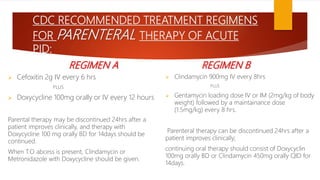
CDC RECOMMENDED TREATMENT REGIMENS
FOR PARENTERAL THERAPY OF ACUTE
PID:
REGIMEN A
 Cefoxitin 2g IV every 6 hrs
PLUS
 Doxycycline 100mg orally or IV every 12 hours
Parental therapy may be discontinued 24hrs after a
patient improves clinically, and therapy with
Doxycycline 100 mg orally BD for 14days should be
continued.
When T.O abcess is present, Clindamycin or
Metronidazole with Doxycycline should be given.
REGIMEN B
 Clindamycin 900mg IV every 8hrs
PLUS
 Gentamycin loading dose IV or IM (2mg/kg of body
weight) followed by a maintainance dose
(1.5mg/kg) every 8 hrs.
Parenteral therapy can be discontinued 24hrs after a
patient improves clinically;
continuing oral therapy should consist of Doxycyclin
100mg orally BD or Clindamycin 450mg orally QID for
14days.
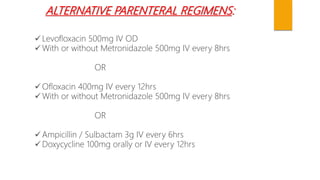
ALTERNATIVE PARENTERAL REGIMENS:
 Levofloxacin 500mg IV OD
 With or without Metronidazole 500mg IV every 8hrs
OR
 Ofloxacin 400mg IV every 12hrs
 With or without Metronidazole 500mg IV every 8hrs
OR
 Ampicillin / Sulbactam 3g IV every 6hrs
 Doxycycline 100mg orally or IV every 12hrs
Both oral and parenteral administration is to
be continued till 24 hours after a patient
improves clinically.
INDICATIONS FOR HOSPITALIZATION (CDC-
2006)
1. Suspected tubo-ovarian abscess.
2. Severe illness, vomiting, temperature > 38ºC.
3. Uncertain diagnosis-where surgical emergencies, (e.g. appendicitis)
cannot be excluded.
4. Unresponsive for out-patient therapy for 48hrs.
5. Intolerance to oral antibiotics.
6. Co-existing pregnancy.
7. Patient is known to have HIV infection.
INDICATIONS OF SURGERY:
1. Generalized peritonitis
2. Pelvic abscess
3. Tubo-ovarian abscess which does not respond (48hrs) to antimicrobial
therapy.
TO PREVENT REINFECTION:
1. Educating the patient to avoid reinfection and the potential hazards of it.
2. The patient should be warned against multiple sexual partners.
3. To use contraception[ barrier].
4. The sexual partner or partners are to be traced and properly investigated to
find out the organisms and treated effectively.
If sexual partner have got non gonococcal urethritis, they should be treated
with
- tetracycline 500mg 6 hourly or Doxycycline 100mg twice daily for 7 days.
FOLLOW UP:
 Repeat smears and cultures from the discharge are to be done 7
days after the full course of treatment.
 The tests are to be repeated following each menstrual period until it
becomes negative for three consecutive reports when the patient is
declared cured.
 Abstinence should be practiced by patient until she is cured and her
sexual partner(s) have been treated and cured.
PELVIC INFECTIONS FOLLOWING
ABORTIONS & DELIVERY
PELVIC INFECTIONS FOLLOWING DELIVERY
AND ABORTIONS:
 ORGANISMS INVOLVED:-
o Anaerobic Streptoococcus
o Staphylococcus pyogenes
o Nonhemolytic Streptococcus
o E. coli
o Bacteroides group
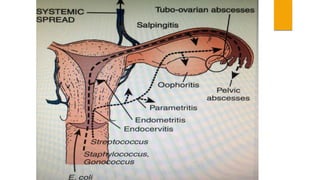
 PATHOLOGY:-
The infection is either ;
 localized to the cervix, producing acute CERVICITIS;
 may affect the placental site producing ENDOMETRITIS.
 may spread to the myometrium producing ENDOMYOMETRITIS.
 occasionally,spreads to the parametrium, usually to one or both sides, through lymphatics
or directly through the tear of the cervix; thereby to cause PARAMETRITIS.
 spread upwards through the tubal openings into the tubal lumen producing
ENDOSALPINGITIS.
 The ovary may be affected through involvement of the tube or following pelvic peritonitis.
Thus an ACUTE TUBO-OVARIAN MASS is formed.
 SPREAD OF INFECTION:
The infection is localized principally to the cervix and subsequently
develops into chronic cervicitis.
The parametrial exudate may resolute completely leaving behind scarring
or fibrosis or may undergo suppuration. The abcess so formed usually
points above the inguinal ligament. The tubal affection results in cornual
block, hydrosalpinx or pyosalpinx following blockage of the fimbrial end.
There may be peritonitis either localized or generalized.
In other, tube may be adherent with thwe ovary, intestine and omentum
producing tubo-ovarian mass.
The pelvic veins may be involved producing thrombophlebitis.
CLINICAL FEATURES:
SYMPTOMS
 Fever
 Lower abdominal and pelvic pain
 Offensive vaginal discharge following delivery or abortion
 SIGNS
 Patient looks ill
 May be restless
 Like to lie down on her back with the legs flexed.
 Rapid pulse rate
 P/A- tenderness or even rigidity on abdomen.
 P/V- it is painful.
 Discharge is offensive
 Uterus is tender
 Depending upon the spread , there may be unilateral or bilateral mass (tubo-ovarian)
An unilateral tender indurated mass pushing the uterus to the contralateral side is parametritis.
Bulging fluctuating mass felt through the posterior fornix is a pelvic abscess.
COMPLICATIONS OF ACUTE PID FOLLOWING
DELIVERY/ABORTIONS:
1. Endotoxic shock
2. Oliguria or anuria
3. DIC
4. Gram-negative septicemia
5. Tubo-ovarian abcess
6. Peritonitis
7. Parametritis
8. Thrombophlebitis (after 7-10 days)
9. Pulmonary embolism
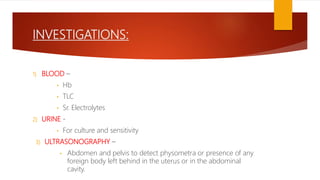
INVESTIGATIONS:
1) BLOOD –
• Hb
• TLC
• Sr. Electrolytes
2) URINE -
• For culture and sensitivity
3) ULTRASONOGRAPHY –
• Abdomen and pelvis to detect physometra or presence of any
foreign body left behind in the uterus or in the abdominal
cavity.
TREATMENT:-
[PROPHYLACTIC+CURATIVE]
 PROPHYLAXIS:-
a) To maintain asepsis and antiseptic measures during labour.
b) To avoid traumatic and difficult vaginal deliveries.
c) To use prophylactic antibiotic when labour is delayed following
rupture of membranes or when there are intrauterine
manipulations like forceps or manual removal of placenta.
d) To encourage family planning acceptance to prevent the
unwanted pregnancies.
TREATMENT:-
[PROPHYLACTIC+CURATIVE]
 CURATIVE:-
a) HOSPITALIZATION
b) TRIPLE SWABS are to be taken- one from high
vagina, one from the endocervix and the third from
the urethra and are sent fro culture , drug sensitivity
and gram staining.
Swabs are to be taken prior to bimanual
examination.
c) VAGINAL and RECTAL examinations are then made
to note the extent of pelvic infection.
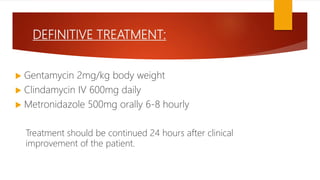
DEFINITIVE TREATMENT:
 Gentamycin 2mg/kg body weight
 Clindamycin IV 600mg daily
 Metronidazole 500mg orally 6-8 hourly
Treatment should be continued 24 hours after clinical
improvement of the patient.
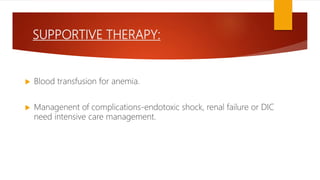
SUPPORTIVE THERAPY:
 Blood transfusion for anemia.
 Managenent of complications-endotoxic shock, renal failure or DIC
need intensive care management.
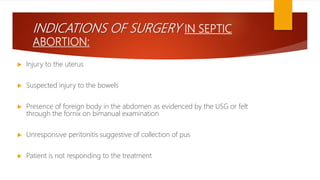
INDICATIONS OF SURGERY IN SEPTIC
ABORTION:
 Injury to the uterus
 Suspected injury to the bowels
 Presence of foreign body in the abdomen as evidenced by the USG or felt
through the fornix on bimanual examination
 Unresponsive peritonitis suggestive of collection of pus
 Patient is not responding to the treatment
TYPES OF ACTIVE SURGERY:
 Evacuation of uterus
 Posterior colpotomy
 Laparotomy- in a suspected case of acute appendicitis or ruptured tubo-ovarian abcess
LATE SEQUELAE OF PID:
 Infertility; either due to corneal block or damage to the wall of the tube.
 Chronic infection
 Chronic pelvic pain ; dysmenorrhea
 Pelvic adhesion disease
 Ectopic pregnancy
 Residual infection with periodic acute exacerbation
 Intestinal obstruction
 Chronic ill-health
 Dyspareunia and marital dysharmony
PELVICINFECTIONSFOLLOWING
GYNAECOLOGICALPROCEDURES
PELVIC INFECTIONS FOLLOWING
GYNAECOLOGICAL PROCEDURES:
 Infection of the residual pelvic organs or cellular tissues is not uncommon
following hysterectomy, more in vaginal than in abdominal one.
 ORGANISMS: E. coli and Bacteroides fragilis
 PATHOLOGY:
 the vaginal cuff may be indurated due to infected hematoma  pelvic
cellulitis  abcess/T.O.mass.
PELVIC INFECTIONS FOLLOWING
GYNAECOLOGICAL PROCEDURES
 CLINICAL FEATURES: fever, lower abdominal pain or pelvic pain.
 P/V: discharge is offensive and the vaginal vault is indurated and is tender.
 P/S: exposed vaginal cuff with purulent discharge coming through the gaping
vault.
 P/R: reveals induration on the vault or its extension to one side(parametritis).
Rarely, a fluctuant mass may be felt (pelvic abcess)
TREATMENT:
[PROPHYLACTIC + CURATIVE]
PROPHYLACTIC:
-preoperative cleaning of vagina with antiseptic lotion,
-perfect hemostasis during surgery and
-leaving behind the vault open in infected cases could reduce the postoperative
infection.
-Metronidazole 500mg IV 8hrly and ceftriaxone 1g IV given during the operation
and 1-2 doses after the operation.
CURATIVE :
Antibiotics and drainage of pus through the vault.
Adnexal abcess requires urgent exploration and removal of the infected mass.
IUCDANDPELVICINFECTION
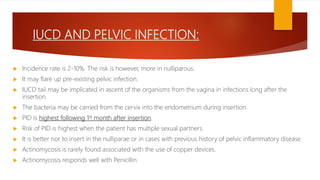
IUCD AND PELVIC INFECTION:
 Incidence rate is 2-10%. The risk is however, more in nulliparous.
 It may flare up pre-existing pelvic infection.
 IUCD tail may be implicated in ascent of the organisms from the vagina in infections long after the
insertion.
 The bacteria may be carried from the cervix into the endometrium during insertion.
 PID is highest following 1st month after insertion.
 Risk of PID is highest when the patient has multiple sexual partners.
 It is better nor to insert in the nulliparae or in cases with previous history of pelvic inflammatory disease.
 Actinomycosis is rarely found associated with the use of copper devices.
 Actinomycosis responds well with Penicillin.
THANK YOUANDHAVEA NICE
DAY…!

Acute pelvic inflammatory disease

  • 1.
  • 2.
    CONTENTS: 1) INTRODUCTION 2) EPIDEMIOLOGY 3)RISK FACTORS FOR PID 4) MICROBIOLOGY 5) MODE OF AFFECTION 6) PATHOLOGY 7) STAGES OF PID 8) CLINICAL FEATURES 9) CLINICAL DIAGNOSTIC CRITERIA OF PID (CDC-2010B) 10) MANAGEMENT 11) PELVIC INFECTIONS FOLLOWING ABORTIONS & DELIVERY 12) IUCD AND PELVIC INFECTION
  • 3.
    INTRODUCTION  DEFINITION:- It isa spectrum of infection and inflammation of the upper genital tract organs typically involving the uterus (endometrium), fallopian tubes, ovaries, pelvic peritoneum and surrounding structures (parametrium). ***It is not associated with pregnancy or surgery. - Jeffcoate’s Principles of Gynaecology ; 8th Edition(2014)  It is attributed to the ascending spread of microorganisms from the cervicovaginal canal to the contiguous pelvic structures.
  • 4.
     Infection mayinclude any or all of the following anatomic sites and it is described as:  Endometritis  Salpingitis  Pelvic peritonitis  Tubo-ovarian abcess  Parametritis
  • 5.
    EPIDEMIOLOGY:  The incidencevaries from 1-2% per year in a sexually active woman.  85% are spontaneous infection in sexually active females of reproductive age.  15% follow procedures, which favours the organism to ascend up. Such iatrogenic procedures include: o Endometrial biopsy o Uterine curettage o Insertion of IUD o Hysterosalpingography  2/3rd are restricted to young women of 25yrs  1/3rd is limited among 30yr or older.
  • 6.
    RISK FACTORS FORPID: 1) Menstruating teenger 2) Multiple sexual partners 3) Absence of contraceptive pill use 4) Previous history of acute PID 5) IUD users 6) Lower socio-economic status 7) Husband /sexual partners with urethritis
  • 7.
    PROTECTIVE FACTORS: CONTRACEPTIVE PRACTICE- •Barrier methods, specially condom, diaphragm with spermicides. • Oral steroidal contraceptives have got two preventive aspects • Produce thick mucus plug preventing ascent of sperm and bacterial penetration • Decrease in duration of menstruation creates a shorter interval of bacterial colonization of the upper tract. • Monogamy or having a partner who had vasectomy. OTHERS- • Pregnancy • Menopause • Vaccines: hepatitis B, HPV
  • 8.
    MICROBIOLOGY:  PRIMARY ORGANISMS(mostly sexually transmitted ones) i. N. gonorrhea in 30% ii. Chlamydia trachomatis in 30% iii. Mycoplasma hominis in 10%  SECONDARY ORGANISMS (normally found in the vagina) Aerobic Anaerobic i. Non hemolytic Streptococci i. Bacteroides ii. E. coli ii. Peptostreptococcus iii. Group B Streptococcus iii. Peptococcus iv. Staphylococcus
  • 9.
    MODE OF AFFECTION: •Ascends upwards to affect the tubes through mucosal continuity and contiguity. • This ascend is facilitated by the sexually transmitted vectors such as sperm and trichomonads. • Reflux of menstrual blood along with gonococci into the fallopian tubes is the other possibility. Gonococcus & Chlamydia • probably spreads across the parametrium to affect the tube.Mycoplasma hominis • probably affect the tube through lymphatics.Secondary organisms • may affect the tube directly. Organisms from the gut (rarely)
  • 10.
  • 11.
    Primary involvement ofthe endosalpinx Destruction of epithelial cell, cilia, microvilli Inflammatory reaction (edema & hyperemia following adhesions) Ostium closure (abdominal & uterine) Collection of exudate Change in microenvironment Growth of microorganisms More tissue destruction
  • 12.
     The involvementof the tube is almost always bilateral and usually following menses due to loss of genital defence.  As the serous coat is not much affected, the resulting adhesions of the tube with the surrounding structures are not so dense, in fact flimsy, unlike pyogenic or tubercular infection.  On occasions, the exudate pour through the abdominal ostium to produce pelvic peritonitis and pelvic abscess or may affect the ovary producing ovarian abscess.
  • 14.
    STAGES OF PID: STAGE I – Acute salpingitis without peritonitis  STAGE II – Acute salpingitis with peritonitis  STAGE III – Acute salpingitis with superimposed tubal occlusion or tubo- ovarian complex  STAGE IV – Ruptured tubo-ovarian abscess  STAGE V – Tubercular salpingitis
  • 15.
    CLINICAL FEATURES:  SYMPTOMS:- PelvicPain Cx excitation pain Adnexal tenderness TRIAD
  • 16.
     Bilateral lowerabdominal and pelvic plain which is dull in nature.  Fever, lassitude and headache.  Irregular and excessive vaginal bleeding (usually due to associated endometritis).  Abnormal vaginal discharge which becomes purulent and or copious.  Nausea and vomiting  Dyspareunia  Pain and discomfort in the right hypochondrium due to concomitant perihepatitis (FITZ-HUGH-CURTIS SYNDROME)may occur in 5-10% of cases of acute salpingitis. The liver is involved due to transperitoneal or vascular dissemination of either gonococcal or chlamydial infection.
  • 17.
     SIGNS:-  TEMPERATURE>38.3ºC.  Tongue shows DEHYDRATION and is COATED.  P/A - tenderness of both the quadrants of lower abdomen. The liver may b enlarged and tender (perihepatitis).  P/V - i. Abnormal vaginal discharge which may b purulent ii. Congested external urethral meatus or openings of Bartholin’s ducts through which pus may be seen escaping out on pressure  P/S- congested cervix with purulent discharge from the canal  BIMANUAL EXAMINATION -b/l tenderness on fornix palpation increases more with movement of the cervix (cervical motion tenderness). -There may be thickening or a definite mass felt through the fornices.
  • 18.
    CLINICAL DIAGNOSTIC CRITERIAOF PID (CDC-2010B) MINIMUM CRITERIA- Lower abdominal tenderness Adnexal tenderness Cervical motion tenderness
  • 19.
    ADDDITIONAL CRITERIA- Oral temperature> 38.3ºC (101.6ºF) Mucopurulent cervical or vaginal discharge Abundant WBC’s on saline microscope of cervical secretions Raised C-reactive protein and/or ESR Laboratory documentation of positive cervical infection with Gonorrhea or C.trachomatis
  • 20.
    DEFINITIVE CRITERIA- Histopathologic evidenceof Endometritis on biopsy Imaging study (TVS/MRI) evidence of thickened fluid filled tubes ± tubo-ovarian complex Laparoscopic evidence of PID
  • 21.
    INVESTIGATIONS:  IDENTIFICATION OFORGANISMS- materials are collected from the following available sources and sent for Gram stain and Culture:  Discharge from the urethra or Bartholin’s gland  Cervical canal  Pus from the fallopian tubes during laparoscopy or laparotomy.  BLOOD-  TLC- shows leukocytosis to more than 10,000 per cu mm  Elevated ESR to more than 15mm per hour  Serological test for syphilis should be carried out for both the partners in all cases.
  • 22.
     SONOGRAPHY- Dilatedand fluid-filled tubes, fluid in the pouch of doughlas or adnexal mass are suggestive of PID.  CULDOCENTESIS- Aspiration of peritoneal fluid and its white cell count, if exceeds 30,000/mL. is significant in acute PID. Bacterial culture from the fluid is not informative because of vaginal contamination.
  • 27.
  • 28.
     LAPAROSCOPY- Itis considered as the GOLD STANDARD and is the most reliable aid to support the clinical diagnosis. The laparoscopic findings and the severity of PID • MILD:- Tubes: edema, erythema, no purulent exudates and are mobile. • MODERATE:- Purulent exudates from the fimbrial ends, tubes not freely movable. • SEVERE:- Pyosalpix, inflammatory complex, abcess • ‘VIOLIN STRING’:like adhesions in the pelvis and around the liver suggests chlamydial infection.  Investigations are also to be extended to male partner and smear and culture are made urethral secretion.
  • 30.
    PURULENT FLUID DISCHARGEFROM THE FIMBRIAL ENDS
  • 31.
  • 32.
  • 37.
    DIFFERENTIAL DIAGNOSIS: 1. Appendicitis 2.Disturbed ectopic pregnancy 3. Tortion of ovarian pedicle. Hemorrhage or rupture of ovarian cyst 4. Endometriosis 5. Diverticulitis 6. Urinary tract infection
  • 38.
    COMPLICATIONS OF PID: IMMEDIATELATE 1. Pelvic peritonitis or even general peritonitis 1. Dyspareunia 2. Septicemia 2. Infertility rate is 12%,after two episodes increases to 25% and after 3 raises to 50%. 3. Chronic pelvic inflammation 4. Formation of adhesions or hydrosalpinx or pyosalpinx and tubo-ovarian abcess. 5. Chronic pelvic pain and ill health. 6. Increased risk of ectopic pregnancy (6-10 folds).
  • 39.
    TREATMENT:  Essential stepsin the prevention are:  Community based approach to increase public health awareness.  Prevention of sexually transmitted infections with the knowledge of healthy and safer sex.  Liberal use of contraception.  Routine screening of high-risk population.
  • 40.
     The principlesof therapy are: To control the infection energetically. To prevent infertility and late sequelae. To prevent reinfection.
  • 41.
    CDC-RECOMMENDED TREATMENT REGIMENS FORORAL THERAPY OF ACUTE PID:  Levofloxacin 5oomg OD x 14days OR  Ofloxacin 400mg OD x 14 days  With or without Metronidazole 500mg BD x 14days REGIMEN A
  • 42.
     REGIMEN B Ceftriaxone 250mg IM in a single dose PLUS  Doxycycline 100mg orally BD x 14days  With or without Metronidazole 500mg orally BD x 14days OR  Ceftriaxone 2gm im single dose and Probenecid 1gm orally single dose PLUS  Doxycycline 100mg orally BD x 14days  With or without Metronidazole 600mg orally BD x 14days OR  Other parenteral third generation cephalosporins ( ceftizomine or cefotaxime) PLUS  Doxycycline 100mg orally BD x 14days  With or without Metronidazole 500mg orally BD x 14days
  • 43.
    CDC RECOMMENDED TREATMENTREGIMENS FOR PARENTERAL THERAPY OF ACUTE PID: REGIMEN A  Cefoxitin 2g IV every 6 hrs PLUS  Doxycycline 100mg orally or IV every 12 hours Parental therapy may be discontinued 24hrs after a patient improves clinically, and therapy with Doxycycline 100 mg orally BD for 14days should be continued. When T.O abcess is present, Clindamycin or Metronidazole with Doxycycline should be given. REGIMEN B  Clindamycin 900mg IV every 8hrs PLUS  Gentamycin loading dose IV or IM (2mg/kg of body weight) followed by a maintainance dose (1.5mg/kg) every 8 hrs. Parenteral therapy can be discontinued 24hrs after a patient improves clinically; continuing oral therapy should consist of Doxycyclin 100mg orally BD or Clindamycin 450mg orally QID for 14days.
  • 44.
    ALTERNATIVE PARENTERAL REGIMENS: Levofloxacin 500mg IV OD  With or without Metronidazole 500mg IV every 8hrs OR  Ofloxacin 400mg IV every 12hrs  With or without Metronidazole 500mg IV every 8hrs OR  Ampicillin / Sulbactam 3g IV every 6hrs  Doxycycline 100mg orally or IV every 12hrs
  • 45.
    Both oral andparenteral administration is to be continued till 24 hours after a patient improves clinically.
  • 46.
    INDICATIONS FOR HOSPITALIZATION(CDC- 2006) 1. Suspected tubo-ovarian abscess. 2. Severe illness, vomiting, temperature > 38ºC. 3. Uncertain diagnosis-where surgical emergencies, (e.g. appendicitis) cannot be excluded. 4. Unresponsive for out-patient therapy for 48hrs. 5. Intolerance to oral antibiotics. 6. Co-existing pregnancy. 7. Patient is known to have HIV infection.
  • 47.
    INDICATIONS OF SURGERY: 1.Generalized peritonitis 2. Pelvic abscess 3. Tubo-ovarian abscess which does not respond (48hrs) to antimicrobial therapy.
  • 48.
    TO PREVENT REINFECTION: 1.Educating the patient to avoid reinfection and the potential hazards of it. 2. The patient should be warned against multiple sexual partners. 3. To use contraception[ barrier]. 4. The sexual partner or partners are to be traced and properly investigated to find out the organisms and treated effectively. If sexual partner have got non gonococcal urethritis, they should be treated with - tetracycline 500mg 6 hourly or Doxycycline 100mg twice daily for 7 days.
  • 49.
    FOLLOW UP:  Repeatsmears and cultures from the discharge are to be done 7 days after the full course of treatment.  The tests are to be repeated following each menstrual period until it becomes negative for three consecutive reports when the patient is declared cured.  Abstinence should be practiced by patient until she is cured and her sexual partner(s) have been treated and cured.
  • 50.
  • 51.
    PELVIC INFECTIONS FOLLOWINGDELIVERY AND ABORTIONS:  ORGANISMS INVOLVED:- o Anaerobic Streptoococcus o Staphylococcus pyogenes o Nonhemolytic Streptococcus o E. coli o Bacteroides group
  • 52.
     PATHOLOGY:- The infectionis either ;  localized to the cervix, producing acute CERVICITIS;  may affect the placental site producing ENDOMETRITIS.  may spread to the myometrium producing ENDOMYOMETRITIS.  occasionally,spreads to the parametrium, usually to one or both sides, through lymphatics or directly through the tear of the cervix; thereby to cause PARAMETRITIS.  spread upwards through the tubal openings into the tubal lumen producing ENDOSALPINGITIS.  The ovary may be affected through involvement of the tube or following pelvic peritonitis. Thus an ACUTE TUBO-OVARIAN MASS is formed.
  • 54.
     SPREAD OFINFECTION: The infection is localized principally to the cervix and subsequently develops into chronic cervicitis. The parametrial exudate may resolute completely leaving behind scarring or fibrosis or may undergo suppuration. The abcess so formed usually points above the inguinal ligament. The tubal affection results in cornual block, hydrosalpinx or pyosalpinx following blockage of the fimbrial end. There may be peritonitis either localized or generalized. In other, tube may be adherent with thwe ovary, intestine and omentum producing tubo-ovarian mass. The pelvic veins may be involved producing thrombophlebitis.
  • 55.
    CLINICAL FEATURES: SYMPTOMS  Fever Lower abdominal and pelvic pain  Offensive vaginal discharge following delivery or abortion
  • 56.
     SIGNS  Patientlooks ill  May be restless  Like to lie down on her back with the legs flexed.  Rapid pulse rate  P/A- tenderness or even rigidity on abdomen.  P/V- it is painful.  Discharge is offensive  Uterus is tender  Depending upon the spread , there may be unilateral or bilateral mass (tubo-ovarian) An unilateral tender indurated mass pushing the uterus to the contralateral side is parametritis. Bulging fluctuating mass felt through the posterior fornix is a pelvic abscess.
  • 57.
    COMPLICATIONS OF ACUTEPID FOLLOWING DELIVERY/ABORTIONS: 1. Endotoxic shock 2. Oliguria or anuria 3. DIC 4. Gram-negative septicemia 5. Tubo-ovarian abcess 6. Peritonitis 7. Parametritis 8. Thrombophlebitis (after 7-10 days) 9. Pulmonary embolism
  • 58.
    INVESTIGATIONS: 1) BLOOD – •Hb • TLC • Sr. Electrolytes 2) URINE - • For culture and sensitivity 3) ULTRASONOGRAPHY – • Abdomen and pelvis to detect physometra or presence of any foreign body left behind in the uterus or in the abdominal cavity.
  • 59.
    TREATMENT:- [PROPHYLACTIC+CURATIVE]  PROPHYLAXIS:- a) Tomaintain asepsis and antiseptic measures during labour. b) To avoid traumatic and difficult vaginal deliveries. c) To use prophylactic antibiotic when labour is delayed following rupture of membranes or when there are intrauterine manipulations like forceps or manual removal of placenta. d) To encourage family planning acceptance to prevent the unwanted pregnancies.
  • 60.
    TREATMENT:- [PROPHYLACTIC+CURATIVE]  CURATIVE:- a) HOSPITALIZATION b)TRIPLE SWABS are to be taken- one from high vagina, one from the endocervix and the third from the urethra and are sent fro culture , drug sensitivity and gram staining. Swabs are to be taken prior to bimanual examination. c) VAGINAL and RECTAL examinations are then made to note the extent of pelvic infection.
  • 61.
    DEFINITIVE TREATMENT:  Gentamycin2mg/kg body weight  Clindamycin IV 600mg daily  Metronidazole 500mg orally 6-8 hourly Treatment should be continued 24 hours after clinical improvement of the patient.
  • 62.
    SUPPORTIVE THERAPY:  Bloodtransfusion for anemia.  Managenent of complications-endotoxic shock, renal failure or DIC need intensive care management.
  • 63.
    INDICATIONS OF SURGERYIN SEPTIC ABORTION:  Injury to the uterus  Suspected injury to the bowels  Presence of foreign body in the abdomen as evidenced by the USG or felt through the fornix on bimanual examination  Unresponsive peritonitis suggestive of collection of pus  Patient is not responding to the treatment
  • 64.
    TYPES OF ACTIVESURGERY:  Evacuation of uterus  Posterior colpotomy  Laparotomy- in a suspected case of acute appendicitis or ruptured tubo-ovarian abcess
  • 65.
    LATE SEQUELAE OFPID:  Infertility; either due to corneal block or damage to the wall of the tube.  Chronic infection  Chronic pelvic pain ; dysmenorrhea  Pelvic adhesion disease  Ectopic pregnancy  Residual infection with periodic acute exacerbation  Intestinal obstruction  Chronic ill-health  Dyspareunia and marital dysharmony
  • 66.
  • 67.
    PELVIC INFECTIONS FOLLOWING GYNAECOLOGICALPROCEDURES:  Infection of the residual pelvic organs or cellular tissues is not uncommon following hysterectomy, more in vaginal than in abdominal one.  ORGANISMS: E. coli and Bacteroides fragilis  PATHOLOGY:  the vaginal cuff may be indurated due to infected hematoma  pelvic cellulitis  abcess/T.O.mass.
  • 68.
    PELVIC INFECTIONS FOLLOWING GYNAECOLOGICALPROCEDURES  CLINICAL FEATURES: fever, lower abdominal pain or pelvic pain.  P/V: discharge is offensive and the vaginal vault is indurated and is tender.  P/S: exposed vaginal cuff with purulent discharge coming through the gaping vault.  P/R: reveals induration on the vault or its extension to one side(parametritis). Rarely, a fluctuant mass may be felt (pelvic abcess)
  • 69.
    TREATMENT: [PROPHYLACTIC + CURATIVE] PROPHYLACTIC: -preoperativecleaning of vagina with antiseptic lotion, -perfect hemostasis during surgery and -leaving behind the vault open in infected cases could reduce the postoperative infection. -Metronidazole 500mg IV 8hrly and ceftriaxone 1g IV given during the operation and 1-2 doses after the operation. CURATIVE : Antibiotics and drainage of pus through the vault. Adnexal abcess requires urgent exploration and removal of the infected mass.
  • 70.
  • 71.
    IUCD AND PELVICINFECTION:  Incidence rate is 2-10%. The risk is however, more in nulliparous.  It may flare up pre-existing pelvic infection.  IUCD tail may be implicated in ascent of the organisms from the vagina in infections long after the insertion.  The bacteria may be carried from the cervix into the endometrium during insertion.  PID is highest following 1st month after insertion.  Risk of PID is highest when the patient has multiple sexual partners.  It is better nor to insert in the nulliparae or in cases with previous history of pelvic inflammatory disease.  Actinomycosis is rarely found associated with the use of copper devices.  Actinomycosis responds well with Penicillin.
  • 72.