Pelvic Inflammatory Disease   Dr. Subha Patel Editable  Presentation will be available on  www.livetalent.org  in download area
Pelvic Inflammatory Disease   Infection & inflammation of the upper genital tract involving fallopian tubes as well as the ovaries.  Sometime infection can extend beyond the reproductive tract to cause pelvic peritonitis, generalise peritonitis or pelvic abscess.  Usually refer to ascending infection from cervix / vagina.
Barrier to spread of infection   Natural :  Acidic pH of vaginal secretion  Closure of Os with cervical plug  Down ward ciliary movement of endometrial lining  Symbiotic bacterial flora  Physiological amenorrhea  Artificial : Barrier contraceptive use  OCP use
How these barriers are impaired   1. During menstruation, after abortion     & delivery :  Cervical canal is dilated  Endothelium sheds  Presence of raw surface in the uterine cavity  Vaginal pH is increased.
How these barriers are impaired (cont...)   2. Intrauterine manipulation:  Curettage & evacuation  Manual removal of placenta  Presence of foreign body (eg. IUCD)  3. Vaginal douching  
Risk factors   Menstruating female  Multiple sexual partners  Residence in areas with high prevalence of sexually transmitted disease  IUCD use  Vaginal douching  Previous history of PID
Etiology   Cervical Pathogens : Neisseria gonorrhoeae  Chlamydia trachomatis  Vaginal Flora Components : Anaerobic bacteria : Prevotella etc  Facultative bacteria : Enterobacteriaceae  Mycoplasms
Etiology Cont...   First episode is likely to be due to N. gono -rrhoeae, chlamydia trachomatis, but they are implicated somewhat less often in :  Recurrent PID  IUCD associated PID  HIV associated PID  PID associated with intrauterine manipulation
Etiology Con..   Difficult to determine exact microbial etiology of PID because of :  Frequency of mixed infection  Difficulty in sampling the fallopian tube itself  Complexity of the microbiological techniques to detect fastidious organisms  Implication are  Syndromic approach to empirical antimicrobial treatment of PID
Pathogenesis   Factors possibly contributing to upward spread of microorganisms in susceptible host are : Estrogen dominated (thin) cervical mucus  Subendometrial myometrial contractions, which move particulate matter from the cervix to the fundus of the uterus  Attachment to sperm that migrate upward into the tubes in rare instance
Pathogenesis cont...   Gonococci attach to surface pili and taken into secretory cells by endocytosis.  Extruded into submucosal connective tissue by exocytosis from the base of the cells.  Ciliated cells are sloughed from the mucosa .  Increased suceptibility to infection with other organisms.
Pathogenesis cont...   C.trachomatis also infect columnar cells of the fallopian tube, but produce little damage by itself .  May often goes unnoticed.  Leads to activation of host immune response  Greatest tissue damage due to subacute /chronic nature of inflammation .
Pathogenesis cont...   Pathogenesis due to mycoplasma & other organisms is less well studied
Clinical manifestation   Acute onset is more often associated with gonococcal infection. Polymicrobial PID more often have tubal or pelvic abscess formation.  Any time  1 st  half of menses 1 st  half of menses Chronic  Sub acute /chronic Acute  Symp. Onset Older  Young Young Age
Clinical manifestation evolves from history   Abscess formation  Adenexal swelling pelvic abscess  Peri appendicitis  Right upper quadrant pain  Peri appendicitis  Symptoms similar to appendicitis  Peritonitis  Nausea, vomiting, increased abdomen tenderness  Endometritis  Mildine abdominal pain, abnormal vaginal bleeding  Mucopurulent  cervicitis/ bacterial  vaginosis  Yellow / malodorous discharge  Clinical manifestation  History
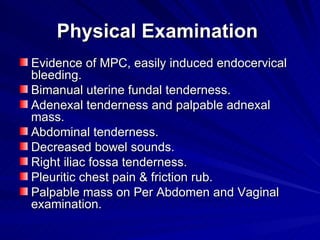
Physical Examination   Evidence of MPC, easily induced endocervical bleeding.  Bimanual uterine fundal tenderness.  Adenexal tenderness and palpable adnexal mass.  Abdominal tenderness.  Decreased bowel sounds.  Right iliac fossa tenderness.  Pleuritic chest pain & friction rub.  Palpable mass on Per Abdomen and Vaginal examination.
Diagnosis   No readily available clinical finding or lab test, short of laparoscopy, definitively identifies salpingitis.  Delayed seeking care is 3 times more likely to result in subsequent infertility and ectopic pregnancy.  Early diagnosis and initiation of therapy are essential to minimize tubal scarring.  It is better to err on the side of over diagnosis and over treatment.
Clinical Diagnosis   Lower abdominal pain of < 3 weeks duration  Pelvic tenderness on bimanual pelvic examination  Evidence of lower genital tract infection (e.g., MPC)  Identifies approximately 60% of laproscopy proven salpingitis. Additional clinical findings: Rectal temperature > 38oC  Palpable adnexal mass  ESR > 15 mm/hr
Radiological Diagnosis   1. Ultrasonography 2. Magnetic Resonance Imaging  Identification of tubo-ovarian or pelvic abscess  Increased tubal diameter, intratubal fluid, tubal wall thickening in cases of salpingitis.
Laparoscopic Diagnosis   - Most specific method for diagnosis of salpingitis. - Indications for laparoscopy are :  Unilateral pain / pelvic mass  Atypical clinical finding  Absence of lower genital tract infection  Missed menstrual period  Positive pregnancy test  Failure to respond to therapy
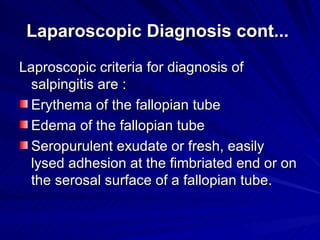
Laparoscopic Diagnosis cont...   Laproscopic criteria for diagnosis of salpingitis are : Erythema of the fallopian tube  Edema of the fallopian tube  Seropurulent exudate or fresh, easily lysed adhesion at the fimbriated end or on the serosal surface of a fallopian tube.
Etiologic diagnosis   Specimens may be obtained by endocervical swab, endometrial aspiration, culdocentesis,or by laproscopy.  Specimens should be subjected to Gram staining .  Culture and DNA –PCR based tests for N. gonorrhoeae and chlamydia. Detection in endocervical specimen does not prove presence in upper genital tract, but strongly support the diagnosis in appropriate clinical situations.
Treatment   Treatment should cover N. Gonorrhoeae, C. trachomatis, Gm-ve facultative bacteria (eg. E.coli, H. influenzae) vaginal anaerobes and group –B streptococci.  Sexual partners should be examined for STDs and treated adequately.  Clinical follow up after 48-72 hrs of treatment.
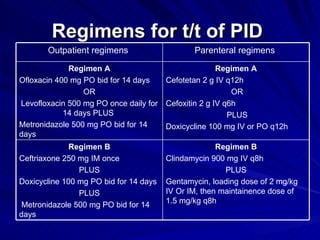
Regimens for t/t of PID   Regimen B Clindamycin 900 mg IV q8h PLUS Gentamycin, loading dose of 2 mg/kg IV Or IM, then maintainence dose of 1.5 mg/kg q8h  Regimen B Ceftriaxone 250 mg IM once PLUS Doxicycline 100 mg PO bid for 14 days  PLUS Metronidazole 500 mg PO bid for 14 days Regimen A Cefotetan 2 g IV q12h   OR Cefoxitin 2 g IV q6h    PLUS Doxicycline 100 mg IV or PO q12h  Regimen A Ofloxacin 400 mg PO bid for 14 days  OR Levofloxacin 500 mg PO once daily for 14 days PLUS  Metronidazole 500 mg PO bid for 14 days Parenteral regimens  Outpatient regimens
Indication for in-hospital treatment   If diagnosis is uncertain and surgical emergencies such as appendicitis and ectopic pregnancy cannot be excluded. Pelvic abscess is suspected.  Severe illness precluding out patient management.  Failure to respond to out patient therapy.  Presence of HIV infection.  Initiate parenteral therapy with either of the above parenteral regimens & continue until 48h after clinical improvement; then change to outpatient therapy .
Role of surgery   Drainage of abscess Threatened rupture of tubo ovarian abscess  Conservative surgical management is usually adequate.
Sequele   Infertility  Ectopic pregnancy  Chronic pelvic pain  Recurrent salpingitis
Thanks Want to download editable copy of this presentation? Please visit download section at  www.livetalent.org

Pelvic inflammatory disease

  • 1.
    Pelvic Inflammatory Disease Dr. Subha Patel Editable Presentation will be available on www.livetalent.org in download area
  • 2.
    Pelvic Inflammatory Disease Infection & inflammation of the upper genital tract involving fallopian tubes as well as the ovaries. Sometime infection can extend beyond the reproductive tract to cause pelvic peritonitis, generalise peritonitis or pelvic abscess. Usually refer to ascending infection from cervix / vagina.
  • 3.
    Barrier to spreadof infection Natural : Acidic pH of vaginal secretion Closure of Os with cervical plug Down ward ciliary movement of endometrial lining Symbiotic bacterial flora Physiological amenorrhea Artificial : Barrier contraceptive use OCP use
  • 4.
    How these barriersare impaired 1. During menstruation, after abortion     & delivery : Cervical canal is dilated Endothelium sheds Presence of raw surface in the uterine cavity Vaginal pH is increased.
  • 5.
    How these barriersare impaired (cont...) 2. Intrauterine manipulation: Curettage & evacuation Manual removal of placenta Presence of foreign body (eg. IUCD) 3. Vaginal douching  
  • 6.
    Risk factors Menstruating female Multiple sexual partners Residence in areas with high prevalence of sexually transmitted disease IUCD use Vaginal douching Previous history of PID
  • 7.
    Etiology Cervical Pathogens : Neisseria gonorrhoeae Chlamydia trachomatis Vaginal Flora Components : Anaerobic bacteria : Prevotella etc Facultative bacteria : Enterobacteriaceae Mycoplasms
  • 8.
    Etiology Cont... First episode is likely to be due to N. gono -rrhoeae, chlamydia trachomatis, but they are implicated somewhat less often in : Recurrent PID IUCD associated PID HIV associated PID PID associated with intrauterine manipulation
  • 9.
    Etiology Con.. Difficult to determine exact microbial etiology of PID because of : Frequency of mixed infection Difficulty in sampling the fallopian tube itself Complexity of the microbiological techniques to detect fastidious organisms Implication are Syndromic approach to empirical antimicrobial treatment of PID
  • 10.
    Pathogenesis Factors possibly contributing to upward spread of microorganisms in susceptible host are : Estrogen dominated (thin) cervical mucus Subendometrial myometrial contractions, which move particulate matter from the cervix to the fundus of the uterus Attachment to sperm that migrate upward into the tubes in rare instance
  • 11.
    Pathogenesis cont... Gonococci attach to surface pili and taken into secretory cells by endocytosis. Extruded into submucosal connective tissue by exocytosis from the base of the cells. Ciliated cells are sloughed from the mucosa . Increased suceptibility to infection with other organisms.
  • 12.
    Pathogenesis cont... C.trachomatis also infect columnar cells of the fallopian tube, but produce little damage by itself . May often goes unnoticed. Leads to activation of host immune response Greatest tissue damage due to subacute /chronic nature of inflammation .
  • 13.
    Pathogenesis cont... Pathogenesis due to mycoplasma & other organisms is less well studied
  • 14.
    Clinical manifestation Acute onset is more often associated with gonococcal infection. Polymicrobial PID more often have tubal or pelvic abscess formation. Any time 1 st half of menses 1 st half of menses Chronic Sub acute /chronic Acute Symp. Onset Older Young Young Age
  • 15.
    Clinical manifestation evolvesfrom history Abscess formation Adenexal swelling pelvic abscess Peri appendicitis Right upper quadrant pain Peri appendicitis Symptoms similar to appendicitis Peritonitis Nausea, vomiting, increased abdomen tenderness Endometritis Mildine abdominal pain, abnormal vaginal bleeding Mucopurulent  cervicitis/ bacterial  vaginosis Yellow / malodorous discharge Clinical manifestation History
  • 16.
    Physical Examination Evidence of MPC, easily induced endocervical bleeding. Bimanual uterine fundal tenderness. Adenexal tenderness and palpable adnexal mass. Abdominal tenderness. Decreased bowel sounds. Right iliac fossa tenderness. Pleuritic chest pain & friction rub. Palpable mass on Per Abdomen and Vaginal examination.
  • 17.
    Diagnosis No readily available clinical finding or lab test, short of laparoscopy, definitively identifies salpingitis. Delayed seeking care is 3 times more likely to result in subsequent infertility and ectopic pregnancy. Early diagnosis and initiation of therapy are essential to minimize tubal scarring. It is better to err on the side of over diagnosis and over treatment.
  • 18.
    Clinical Diagnosis Lower abdominal pain of < 3 weeks duration Pelvic tenderness on bimanual pelvic examination Evidence of lower genital tract infection (e.g., MPC) Identifies approximately 60% of laproscopy proven salpingitis. Additional clinical findings: Rectal temperature > 38oC Palpable adnexal mass ESR > 15 mm/hr
  • 19.
    Radiological Diagnosis 1. Ultrasonography 2. Magnetic Resonance Imaging Identification of tubo-ovarian or pelvic abscess Increased tubal diameter, intratubal fluid, tubal wall thickening in cases of salpingitis.
  • 20.
    Laparoscopic Diagnosis - Most specific method for diagnosis of salpingitis. - Indications for laparoscopy are : Unilateral pain / pelvic mass Atypical clinical finding Absence of lower genital tract infection Missed menstrual period Positive pregnancy test Failure to respond to therapy
  • 21.
    Laparoscopic Diagnosis cont... Laproscopic criteria for diagnosis of salpingitis are : Erythema of the fallopian tube Edema of the fallopian tube Seropurulent exudate or fresh, easily lysed adhesion at the fimbriated end or on the serosal surface of a fallopian tube.
  • 22.
    Etiologic diagnosis Specimens may be obtained by endocervical swab, endometrial aspiration, culdocentesis,or by laproscopy. Specimens should be subjected to Gram staining . Culture and DNA –PCR based tests for N. gonorrhoeae and chlamydia. Detection in endocervical specimen does not prove presence in upper genital tract, but strongly support the diagnosis in appropriate clinical situations.
  • 23.
    Treatment Treatment should cover N. Gonorrhoeae, C. trachomatis, Gm-ve facultative bacteria (eg. E.coli, H. influenzae) vaginal anaerobes and group –B streptococci. Sexual partners should be examined for STDs and treated adequately. Clinical follow up after 48-72 hrs of treatment.
  • 24.
    Regimens for t/tof PID Regimen B Clindamycin 900 mg IV q8h PLUS Gentamycin, loading dose of 2 mg/kg IV Or IM, then maintainence dose of 1.5 mg/kg q8h Regimen B Ceftriaxone 250 mg IM once PLUS Doxicycline 100 mg PO bid for 14 days PLUS Metronidazole 500 mg PO bid for 14 days Regimen A Cefotetan 2 g IV q12h   OR Cefoxitin 2 g IV q6h   PLUS Doxicycline 100 mg IV or PO q12h Regimen A Ofloxacin 400 mg PO bid for 14 days OR Levofloxacin 500 mg PO once daily for 14 days PLUS Metronidazole 500 mg PO bid for 14 days Parenteral regimens Outpatient regimens
  • 25.
    Indication for in-hospitaltreatment If diagnosis is uncertain and surgical emergencies such as appendicitis and ectopic pregnancy cannot be excluded. Pelvic abscess is suspected. Severe illness precluding out patient management. Failure to respond to out patient therapy. Presence of HIV infection. Initiate parenteral therapy with either of the above parenteral regimens & continue until 48h after clinical improvement; then change to outpatient therapy .
  • 26.
    Role of surgery Drainage of abscess Threatened rupture of tubo ovarian abscess Conservative surgical management is usually adequate.
  • 27.
    Sequele Infertility Ectopic pregnancy Chronic pelvic pain Recurrent salpingitis
  • 28.
    Thanks Want todownload editable copy of this presentation? Please visit download section at www.livetalent.org