RELEVANCE OF
RAMAYANA IN
MANAGEMENT BBA400
1
BUSINES
S
ETHICS
&
VALUES
BY- YASH SHARMA
SHIKHAR BANSAL
SHIVALI
SRIVASTAVA
INTRODUCTION
There are number of books,
journals and articles available,
which talks about various
management theories. They
focussed management as a
‘Science’ and an ‘Art’ of life.
But the way before
modern days management gurus
gave their theories, principles and
concepts of management the great
writers like Tulsidas, Valmiki had
explained them in the ancient
Hindu epic Ramayana.
The
answer isyes…..
then, lets see how
Ramayana helps
us in getting
things done!!!!!!!
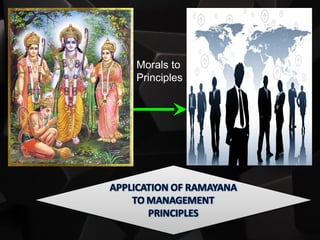
Morals to
Principles
This is what ‘Management’ is all about…..This is what ‘Management’ is all about…..
Ascertaining the goals, or job to be
done.
•Getting mentally prepared for it.
•Having a right plan.
•SWOT Analysis [strength, weakness,
opportunities and threats] of your
business.
•Leading a team- ‘Leadership’.
•Organizing the resources required.
•Coordinating with the people.
•Controlling : checking things are
happening as per the plan.
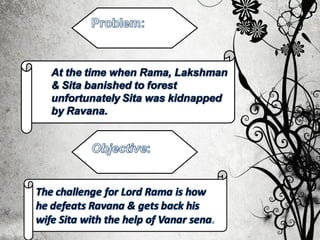
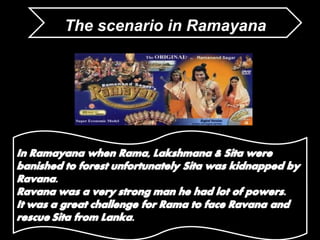
The scenario in Ramayana
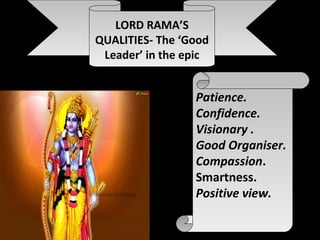
LORD RAMA’S
QUALITIES- The ‘Good
Leader’ in the epic
LORD RAMA’S
QUALITIES- The ‘Good
Leader’ in the epic
Patience.
Confidence.
Visionary .
Good Organiser.
Compassion.
Smartness.
Positive view.
Patience.
Confidence.
Visionary .
Good Organiser.
Compassion.
Smartness.
Positive view.
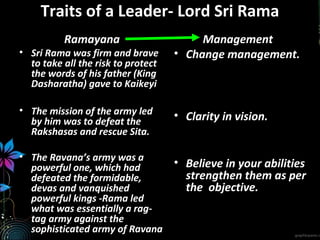
Traits of a Leader- Lord Sri Rama
Ramayana
• Sri Rama was firm and brave
to take all the risk to protect
the words of his father (King
Dasharatha) gave to Kaikeyi
• The mission of the army led
by him was to defeat the
Rakshasas and rescue Sita.
• The Ravana’s army was a
powerful one, which had
defeated the formidable,
devas and vanquished
powerful kings -Rama led
what was essentially a rag-
tag army against the
sophisticated army of Ravana
Management
• Change management.
• Clarity in vision.
• Believe in your abilities
strengthen them as per
the objective.
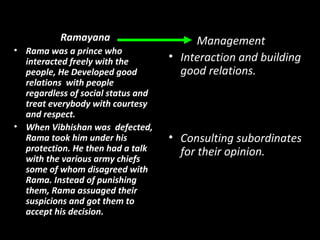
Ramayana
• Rama was a prince who
interacted freely with the people,
He Developed good relations
with people regardless of social
status and treat everybody with
courtesy and respect.
• When Vibhishan was defected,
Rama took him under his
protection. He then had a talk
with the various army chiefs
some of whom disagreed with
Rama. Instead of punishing them,
Rama assuaged their suspicions
and got them to accept his
decision.
Management
• Interaction and building
good relations.
• Consulting subordinates
for their opinion.
Ramayana
• Rama was a prince who
interacted freely with the
people, He Developed good
relations with people
regardless of social status and
treat everybody with courtesy
and respect.
• When Vibhishan was defected,
Rama took him under his
protection. He then had a talk
with the various army chiefs
some of whom disagreed with
Rama. Instead of punishing
them, Rama assuaged their
suspicions and got them to
accept his decision.
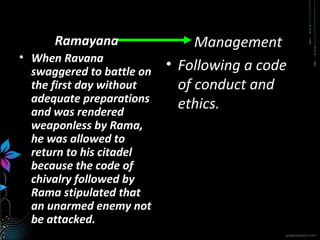
Ramayana Management
• Following a code
of conduct and
ethics.
Ramayana
• When Ravana
swaggered to battle on
the first day without
adequate preparations
and was rendered
weaponless by Rama,
he was allowed to
return to his citadel
because the code of
chivalry followed by
Rama stipulated that
an unarmed enemy not
be attacked.
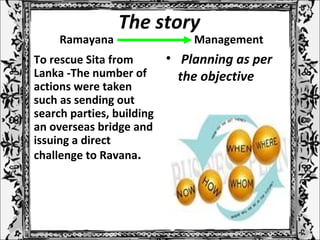
The story
Ramayana Management
• Planning as per
the objective
• To rescue Sita from
Lanka -The number of
actions were taken
such as sending out
search parties, building
an overseas bridge and
issuing a direct
challenge to Ravana.
Ramayana Management
• Organizing
resources which
are required.
• Lord Sri Rama took
the army of vanara
king Sugriva
teached them the
skills of facing the
enemy, motivated
and inspired them
for the mission of
war.
Ramayana Management
• Coordinating with
people to know
their abilities &
strengths, guiding
them to over
come the areas of
improvement as
per the objective.
• Lord Sri Rama had
good relations with
the people even
though he was a king,
his actions and
thoughts were like a
common man, he
analyzed the ability of
each individual and
gave opportunity to
all….. Hanuman the
best example.
Ramayana Management
• Directing as per the
plans and policies.
• Rama divided Vanaras
into 4 groups, to search
Sita and one of the group
was headed by
Jambavanta in which
‘Hanuman’ was a team
player. After which Rama
directed the ways to
become proficient in
Gadayudda to strengthen
the team- and the group
of Jambavanta were
successful – Hanuman
discovered Sita in Lanka.
RAMAYANA
• Lord Rama insisted his
team of Vanaras to
construct a Ram Setuve
over the sea to connect the
Lanka. This helped Rama &
Vanaras to defeat his
opponent Ravana & rescue
Sita with less life risk of
Vanaras.
MANAGEMENT
• Management control-
motivation & energizing
of the team,
communication & risk
management, planning &
scheduling, execution,
allocation of the
appropriate resources for
a particular task, decision-
making, out-of-box
thinking to solve
problems, winning
strategy, rewards.
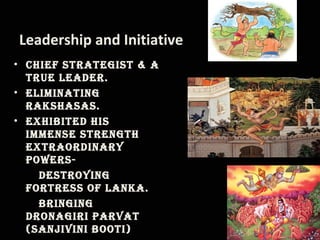
Leadership and Initiative
• Chief strategist & a
true leader.
• eliminating
rakshasas.
• exhibited his
immense strength
extraordinary
powers-
destroying
fortress of lanka.
bringing
dronagiri parvat
(sanjivini booti)
examples from ramayana
Motivation & SWOT Analysis –
One of the most obvious incidences, in
which management were used is very clearly
visible is that of Hanuman going to Lanka. His
mission was to locate Sita there and give her
Lord Ram’s message. When it became clear
that Sita was in Lanka, Jambvant asked
Hanuman to go there. He helped him in
realising his true potential and motivated him
to go in the enemy’s camp.
Once mentally prepared for the job
and reached there, first thing which Hanuman
did was to completely analyse the situation in
Lanka. He did a complete study about the
Lankan’s, assessing their strengths and
weaknesses, the various threats and
Hanuman- An overview as per
management perspective.
He might have killed
Ravana the day he
discovered Lanka. He had
all the abilities to kill
Ravana, but he waited for
the Sri Ram’s directions -
‘abiding for rules
regulations as directed by
management’
He might have killed
Ravana the day he
discovered Lanka. He had
all the abilities to kill
Ravana, but he waited for
the Sri Ram’s directions -
‘abiding for rules
regulations as directed by
management’
He was very strong man physically and also with his
moral thoughts.
When he got an information that Sita was in Lanka,
Jambvant motivated Hanuman to go there.-
Hanauman took ‘initiative and got ready for the
challenge’.
He was very strong man physically and also with his
moral thoughts.
When he got an information that Sita was in Lanka,
Jambvant motivated Hanuman to go there.-
Hanauman took ‘initiative and got ready for the
challenge’.
hanuman-
an overview as
per management
perspeCtive.
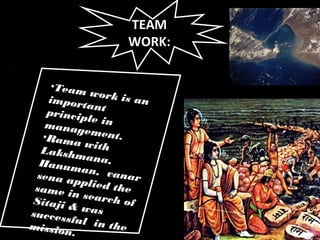
TEAM
WORK:
TEAM
WORK:
•Team work is animportantprinciple inmanagement.•Rama withLakshmana,Hanuman, vanarsena applied thesame in search ofSitaji & wassuccessful in themission.
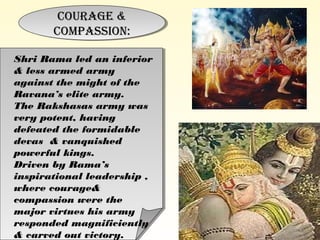
Courage &
Compassion:
Courage &
Compassion:
Shri Rama led an inferior
& less armed army
against the might of the
Ravana’s elite army.
The Rakshasas army was
very potent, having
defeated the formidable
devas & vanquished
powerful kings.
Driven by Rama’s
inspirational leadership ,
where courage&
compassion were the
major virtues his army
responded magnificiently
& carved out victory.
Ramayana by yash sharma

Ramayana by yash sharma

  • 1.
    RELEVANCE OF RAMAYANA IN MANAGEMENTBBA400 1 BUSINES S ETHICS & VALUES BY- YASH SHARMA SHIKHAR BANSAL SHIVALI SRIVASTAVA
  • 2.
    INTRODUCTION There are numberof books, journals and articles available, which talks about various management theories. They focussed management as a ‘Science’ and an ‘Art’ of life. But the way before modern days management gurus gave their theories, principles and concepts of management the great writers like Tulsidas, Valmiki had explained them in the ancient Hindu epic Ramayana.
  • 3.
    The answer isyes….. then, letssee how Ramayana helps us in getting things done!!!!!!!
  • 4.
  • 6.
    This is what‘Management’ is all about…..This is what ‘Management’ is all about….. Ascertaining the goals, or job to be done. •Getting mentally prepared for it. •Having a right plan. •SWOT Analysis [strength, weakness, opportunities and threats] of your business. •Leading a team- ‘Leadership’. •Organizing the resources required. •Coordinating with the people. •Controlling : checking things are happening as per the plan.
  • 7.
  • 8.
    LORD RAMA’S QUALITIES- The‘Good Leader’ in the epic LORD RAMA’S QUALITIES- The ‘Good Leader’ in the epic Patience. Confidence. Visionary . Good Organiser. Compassion. Smartness. Positive view. Patience. Confidence. Visionary . Good Organiser. Compassion. Smartness. Positive view.
  • 9.
    Traits of aLeader- Lord Sri Rama Ramayana • Sri Rama was firm and brave to take all the risk to protect the words of his father (King Dasharatha) gave to Kaikeyi • The mission of the army led by him was to defeat the Rakshasas and rescue Sita. • The Ravana’s army was a powerful one, which had defeated the formidable, devas and vanquished powerful kings -Rama led what was essentially a rag- tag army against the sophisticated army of Ravana Management • Change management. • Clarity in vision. • Believe in your abilities strengthen them as per the objective.
  • 10.
    Ramayana • Rama wasa prince who interacted freely with the people, He Developed good relations with people regardless of social status and treat everybody with courtesy and respect. • When Vibhishan was defected, Rama took him under his protection. He then had a talk with the various army chiefs some of whom disagreed with Rama. Instead of punishing them, Rama assuaged their suspicions and got them to accept his decision. Management • Interaction and building good relations. • Consulting subordinates for their opinion. Ramayana • Rama was a prince who interacted freely with the people, He Developed good relations with people regardless of social status and treat everybody with courtesy and respect. • When Vibhishan was defected, Rama took him under his protection. He then had a talk with the various army chiefs some of whom disagreed with Rama. Instead of punishing them, Rama assuaged their suspicions and got them to accept his decision.
  • 11.
    Ramayana Management • Followinga code of conduct and ethics. Ramayana • When Ravana swaggered to battle on the first day without adequate preparations and was rendered weaponless by Rama, he was allowed to return to his citadel because the code of chivalry followed by Rama stipulated that an unarmed enemy not be attacked.
  • 12.
    The story Ramayana Management •Planning as per the objective • To rescue Sita from Lanka -The number of actions were taken such as sending out search parties, building an overseas bridge and issuing a direct challenge to Ravana.
  • 13.
    Ramayana Management • Organizing resourceswhich are required. • Lord Sri Rama took the army of vanara king Sugriva teached them the skills of facing the enemy, motivated and inspired them for the mission of war.
  • 14.
    Ramayana Management • Coordinatingwith people to know their abilities & strengths, guiding them to over come the areas of improvement as per the objective. • Lord Sri Rama had good relations with the people even though he was a king, his actions and thoughts were like a common man, he analyzed the ability of each individual and gave opportunity to all….. Hanuman the best example.
  • 15.
    Ramayana Management • Directingas per the plans and policies. • Rama divided Vanaras into 4 groups, to search Sita and one of the group was headed by Jambavanta in which ‘Hanuman’ was a team player. After which Rama directed the ways to become proficient in Gadayudda to strengthen the team- and the group of Jambavanta were successful – Hanuman discovered Sita in Lanka.
  • 16.
    RAMAYANA • Lord Ramainsisted his team of Vanaras to construct a Ram Setuve over the sea to connect the Lanka. This helped Rama & Vanaras to defeat his opponent Ravana & rescue Sita with less life risk of Vanaras. MANAGEMENT • Management control- motivation & energizing of the team, communication & risk management, planning & scheduling, execution, allocation of the appropriate resources for a particular task, decision- making, out-of-box thinking to solve problems, winning strategy, rewards.
  • 18.
    Leadership and Initiative •Chief strategist & a true leader. • eliminating rakshasas. • exhibited his immense strength extraordinary powers- destroying fortress of lanka. bringing dronagiri parvat (sanjivini booti)
  • 19.
    examples from ramayana Motivation& SWOT Analysis – One of the most obvious incidences, in which management were used is very clearly visible is that of Hanuman going to Lanka. His mission was to locate Sita there and give her Lord Ram’s message. When it became clear that Sita was in Lanka, Jambvant asked Hanuman to go there. He helped him in realising his true potential and motivated him to go in the enemy’s camp. Once mentally prepared for the job and reached there, first thing which Hanuman did was to completely analyse the situation in Lanka. He did a complete study about the Lankan’s, assessing their strengths and weaknesses, the various threats and
  • 20.
    Hanuman- An overviewas per management perspective. He might have killed Ravana the day he discovered Lanka. He had all the abilities to kill Ravana, but he waited for the Sri Ram’s directions - ‘abiding for rules regulations as directed by management’ He might have killed Ravana the day he discovered Lanka. He had all the abilities to kill Ravana, but he waited for the Sri Ram’s directions - ‘abiding for rules regulations as directed by management’ He was very strong man physically and also with his moral thoughts. When he got an information that Sita was in Lanka, Jambvant motivated Hanuman to go there.- Hanauman took ‘initiative and got ready for the challenge’. He was very strong man physically and also with his moral thoughts. When he got an information that Sita was in Lanka, Jambvant motivated Hanuman to go there.- Hanauman took ‘initiative and got ready for the challenge’. hanuman- an overview as per management perspeCtive.
  • 21.
    TEAM WORK: TEAM WORK: •Team work isanimportantprinciple inmanagement.•Rama withLakshmana,Hanuman, vanarsena applied thesame in search ofSitaji & wassuccessful in themission.
  • 22.
    Courage & Compassion: Courage & Compassion: ShriRama led an inferior & less armed army against the might of the Ravana’s elite army. The Rakshasas army was very potent, having defeated the formidable devas & vanquished powerful kings. Driven by Rama’s inspirational leadership , where courage& compassion were the major virtues his army responded magnificiently & carved out victory.