

Presented by
 Ata-Ur-Rehman
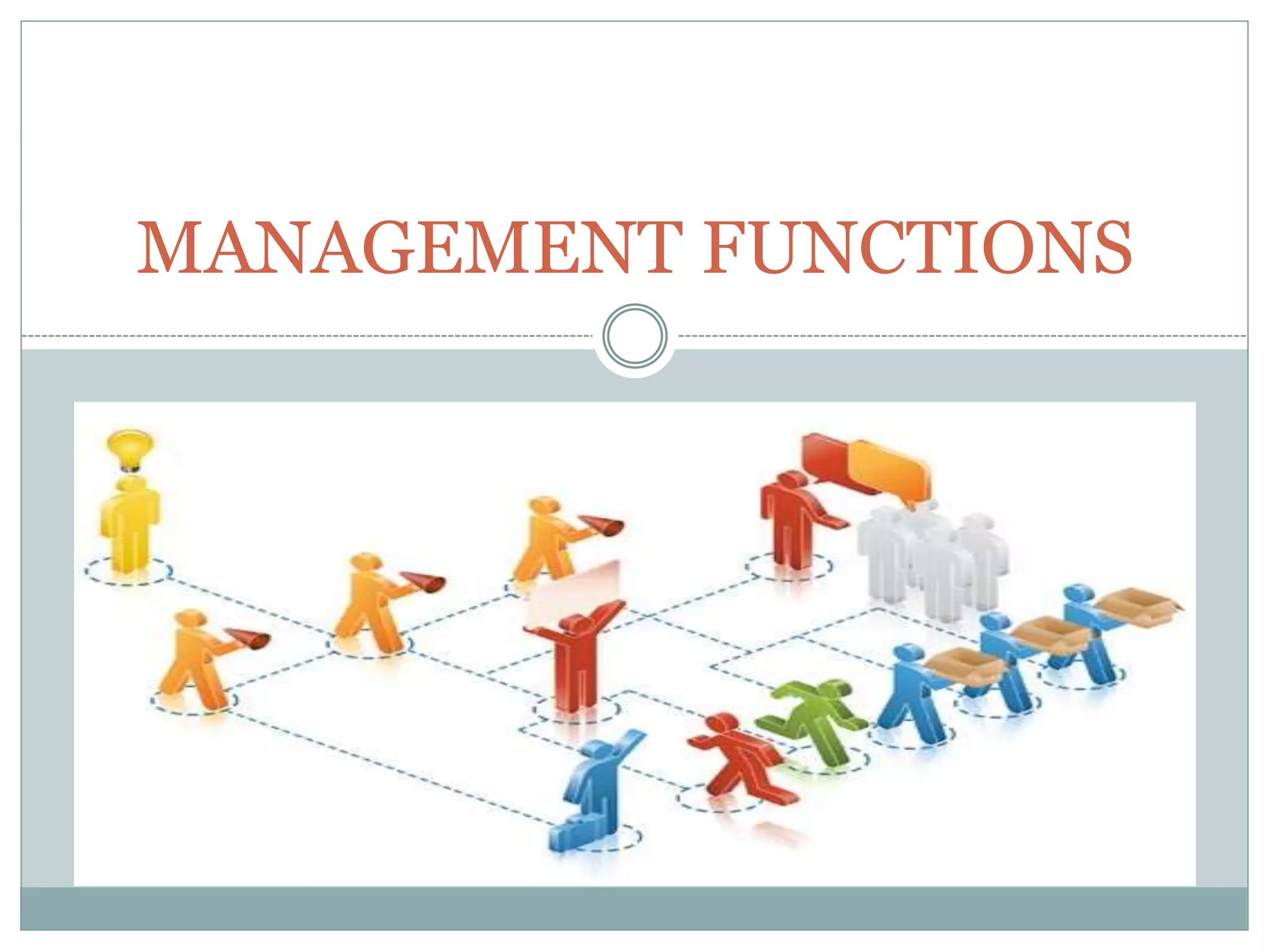
MANAGEMENT FUNCTIONS
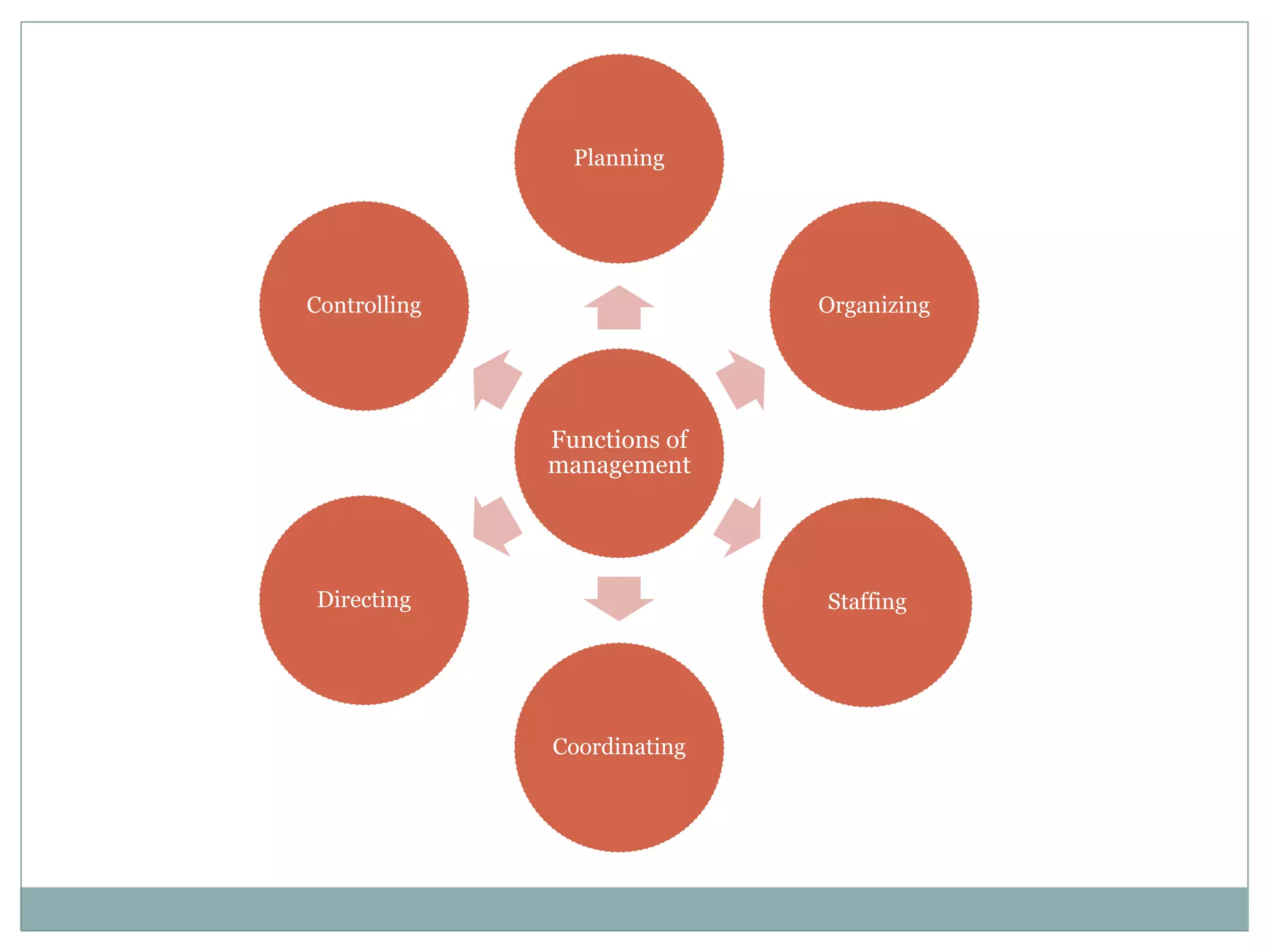
Functions of
management
Planning
Organizing
Staffing
Coordinating
Directing
Controlling
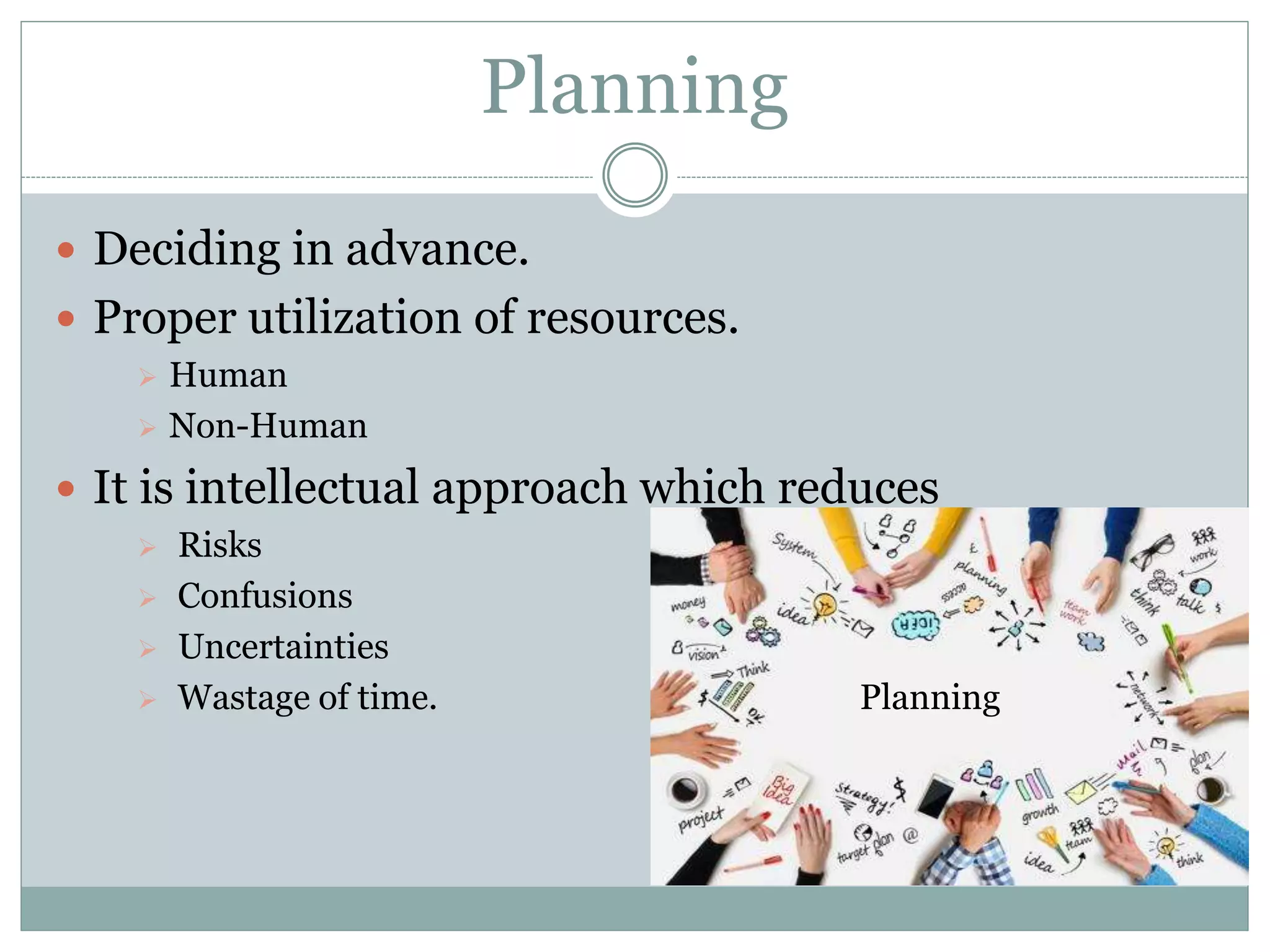
Planning
 Deciding in advance.
 Proper utilization of resources.
 Human
 Non-Human
 It is intellectual approach which reduces
 Risks
 Confusions
 Uncertainties
 Wastage of time. Planning
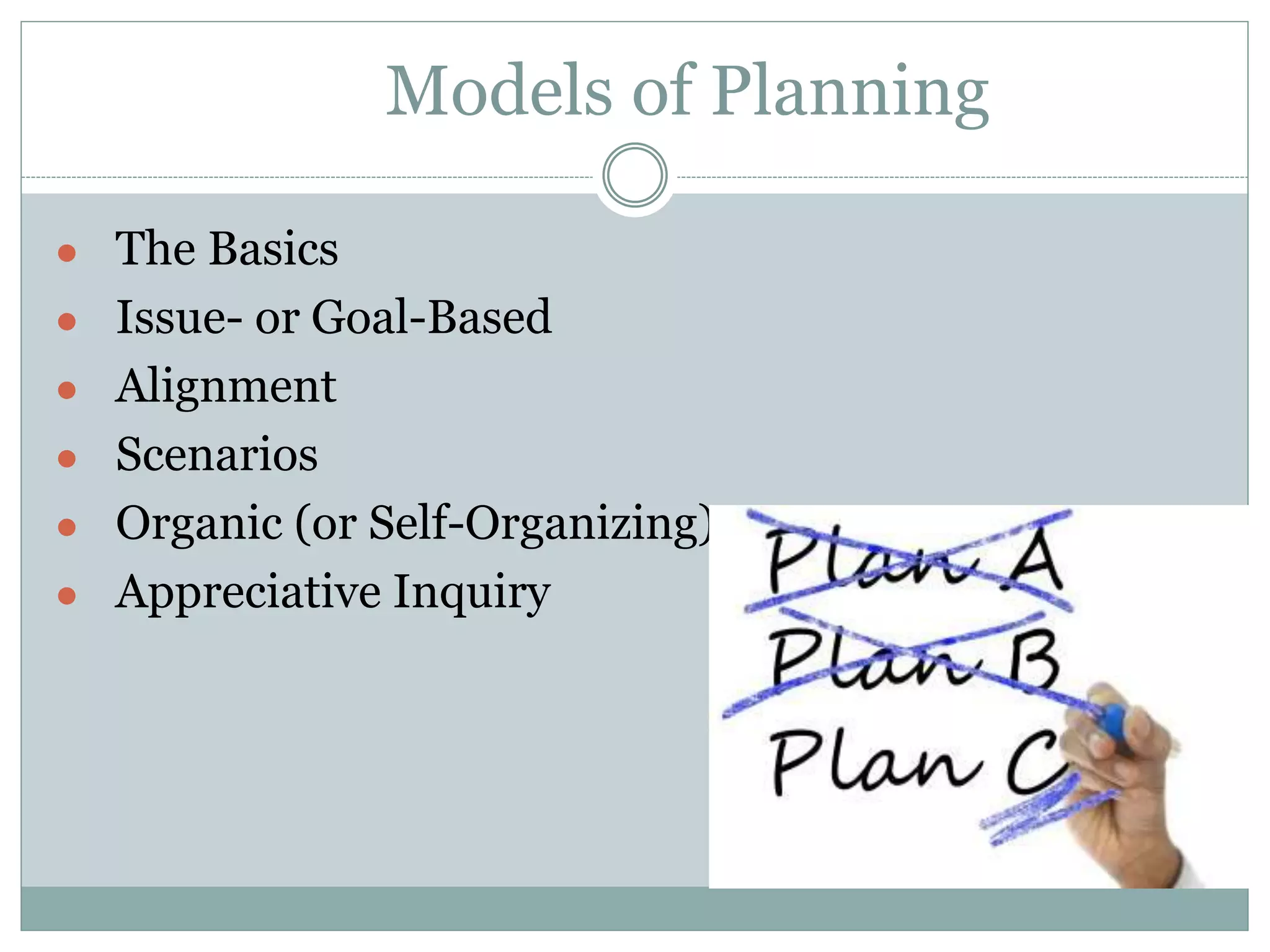
Models of Planning
● The Basics
● Issue- or Goal-Based
● Alignment
● Scenarios
● Organic (or Self-Organizing)
● Appreciative Inquiry
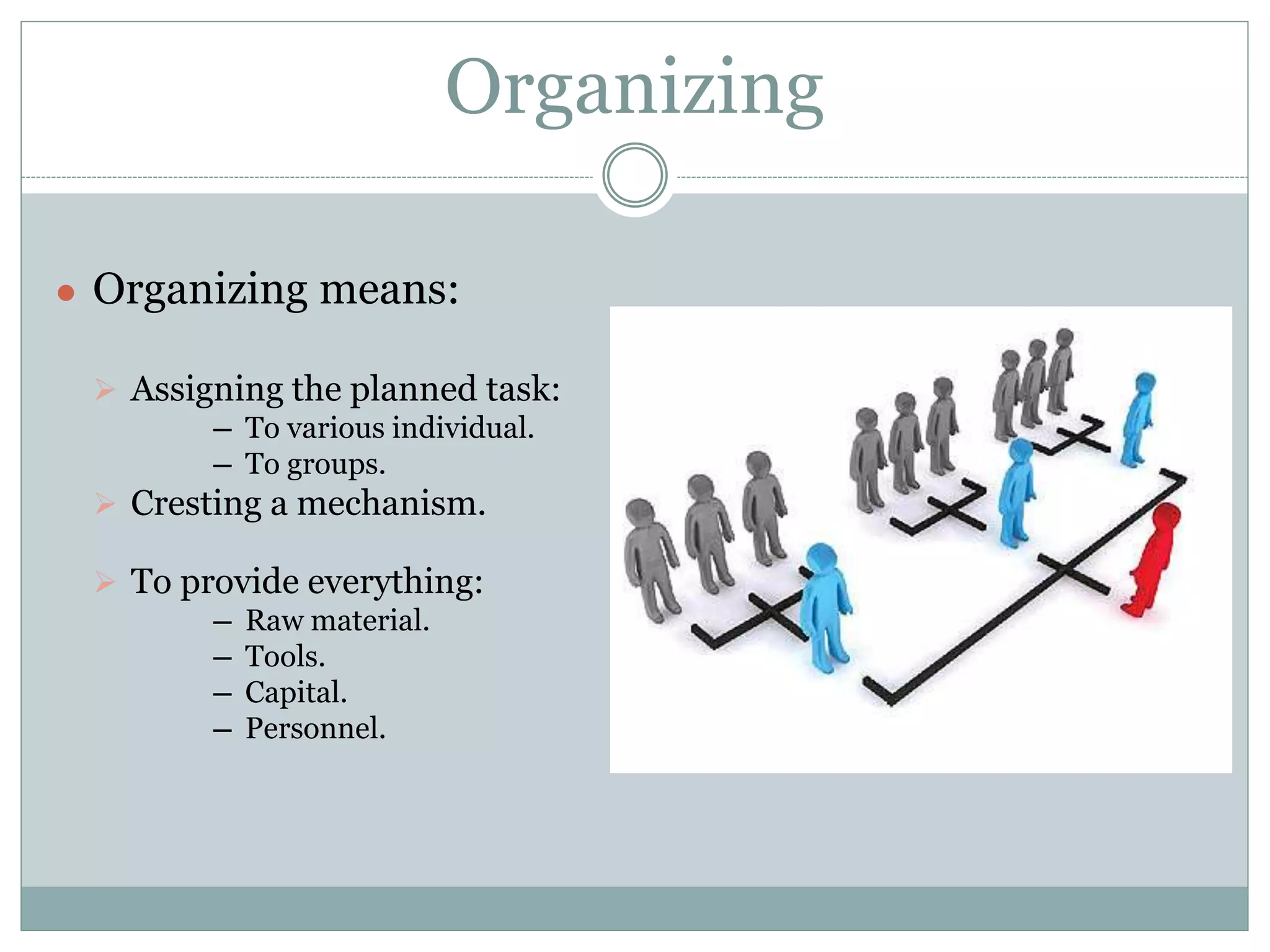
Organizing
● Organizing means:
 Assigning the planned task:
─ To various individual.
─ To groups.
 Cresting a mechanism.
 To provide everything:
─ Raw material.
─ Tools.
─ Capital.
─ Personnel.
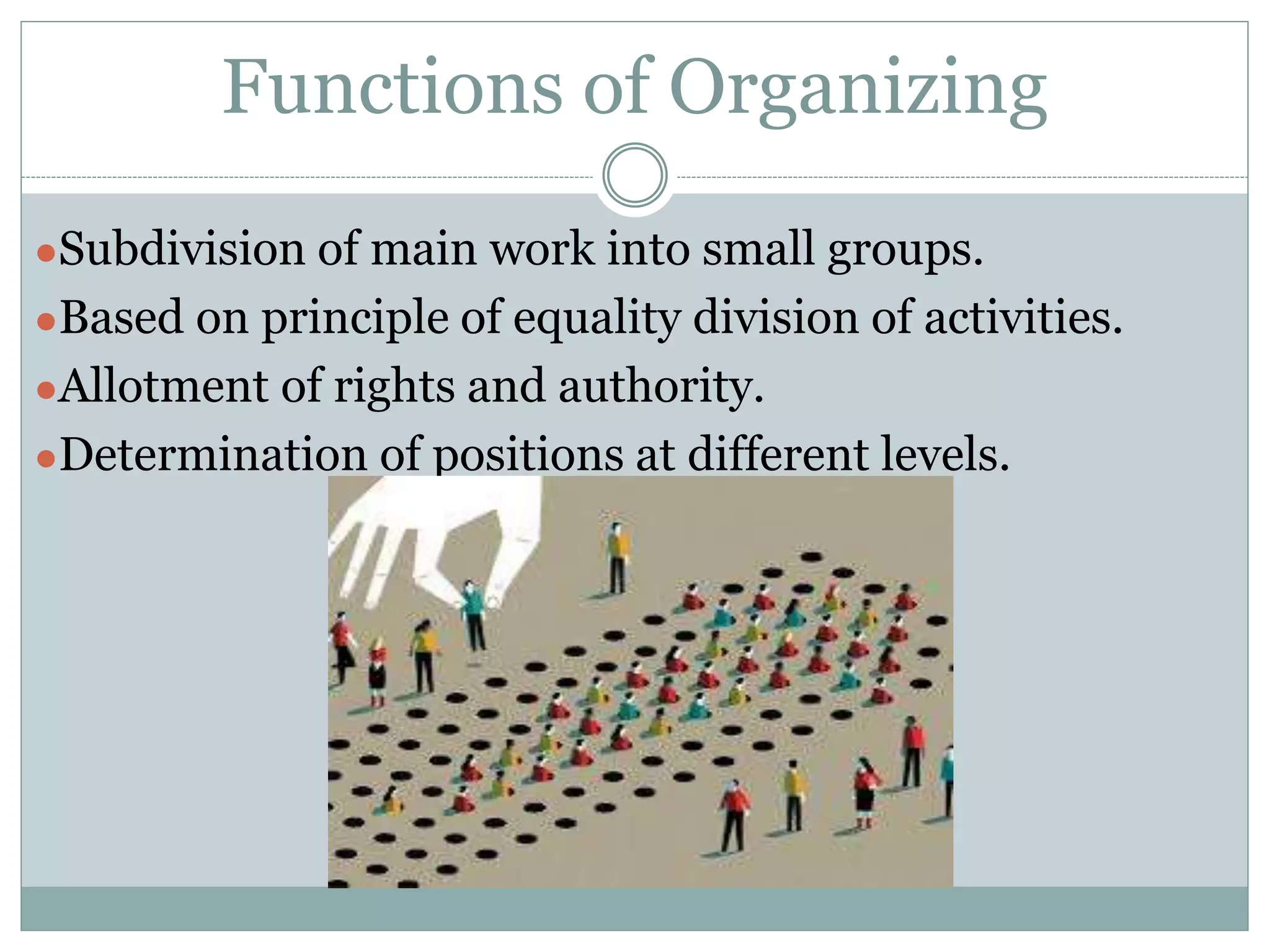
Functions of Organizing
●Subdivision of main work into small groups.
●Based on principle of equality division of activities.
●Allotment of rights and authority.
●Determination of positions at different levels.
Importance of Organizing
● Makes the management simple and efficient
● Encourage specialization
● Improves techniques
● Increase productivity
● Accelerates the progress
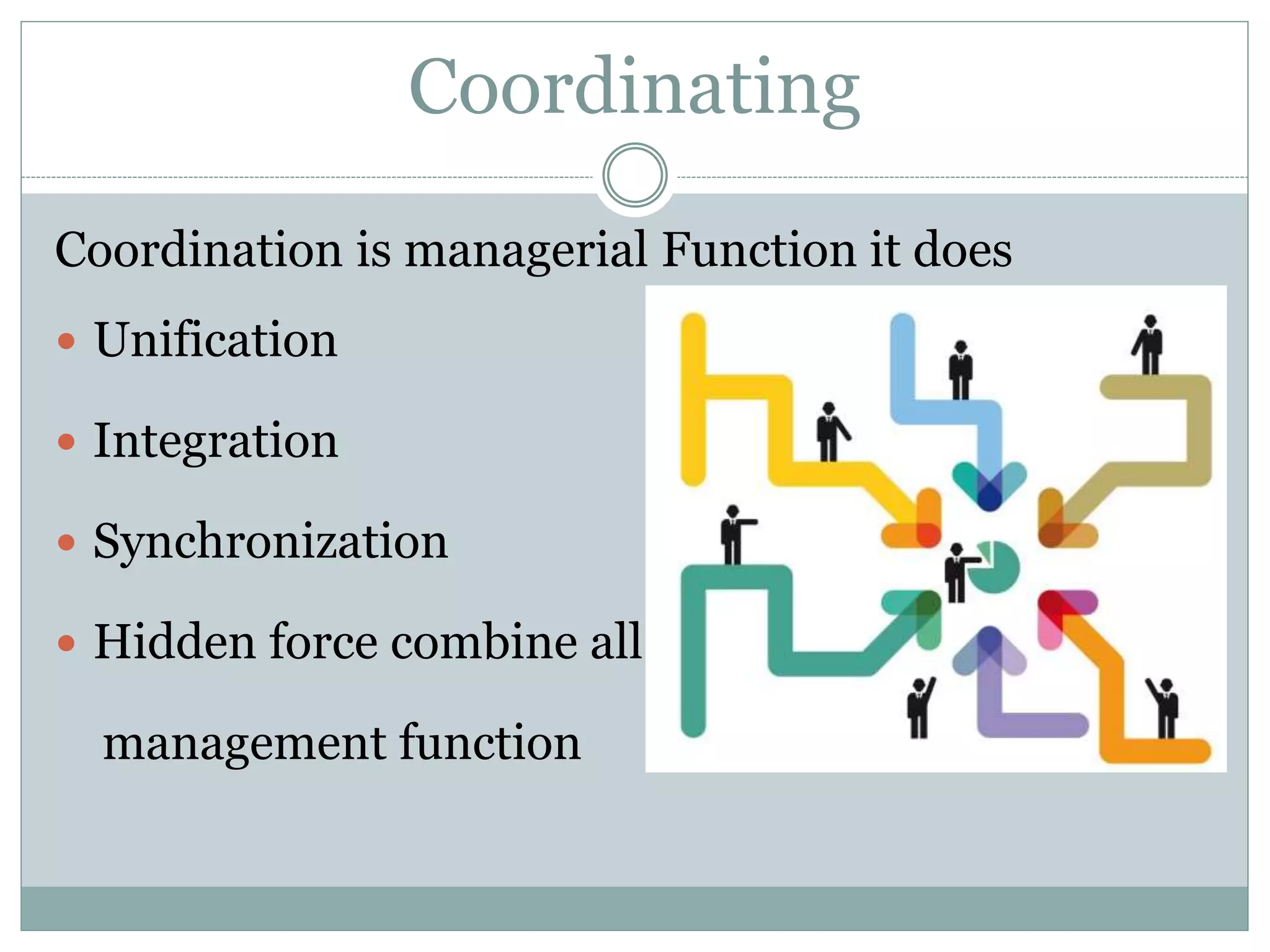
Coordination is managerial Function it does
 Unification
 Integration
 Synchronization
 Hidden force combine all
management function
Coordinating
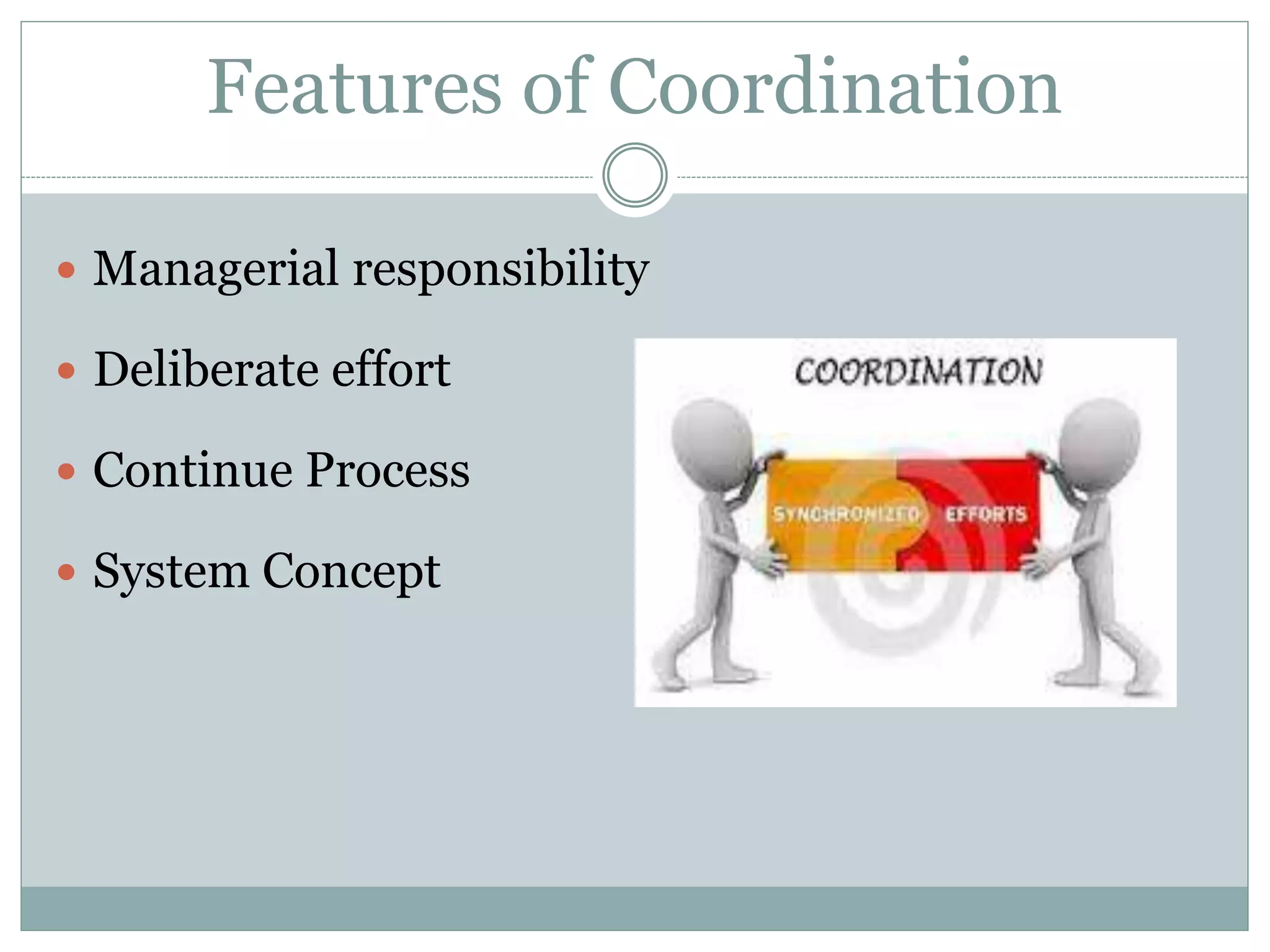
Features of Coordination
 Managerial responsibility
 Deliberate effort
 Continue Process
 System Concept
Techniques of Coordination
 Sound Planning
 Simplified Organization
 Coordination by Committees
 Effective Communication
 Effective Leadership and Supervision
Conclusion
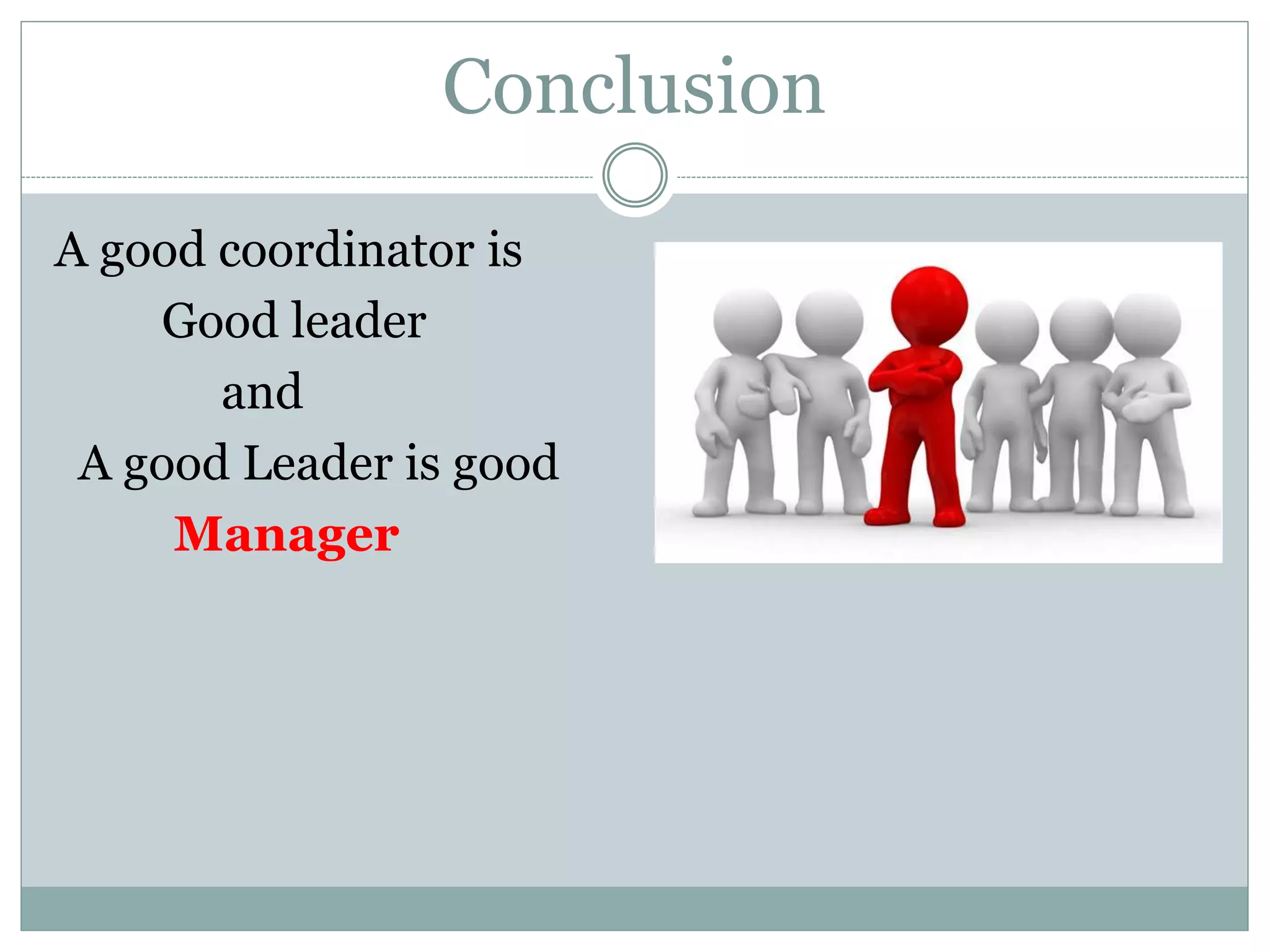
A good coordinator is
Good leader
and
A good Leader is good
Manager
 Process in which the managers
 Instruct
 Guide
 Oversee the performance of the workers.
 Heart of management process
 Initiate Action
Directing
Characteristics of Direction
 Pervasive Function
 Continuous Activity
 Human Factor
 Creative Activity
 Executive Function
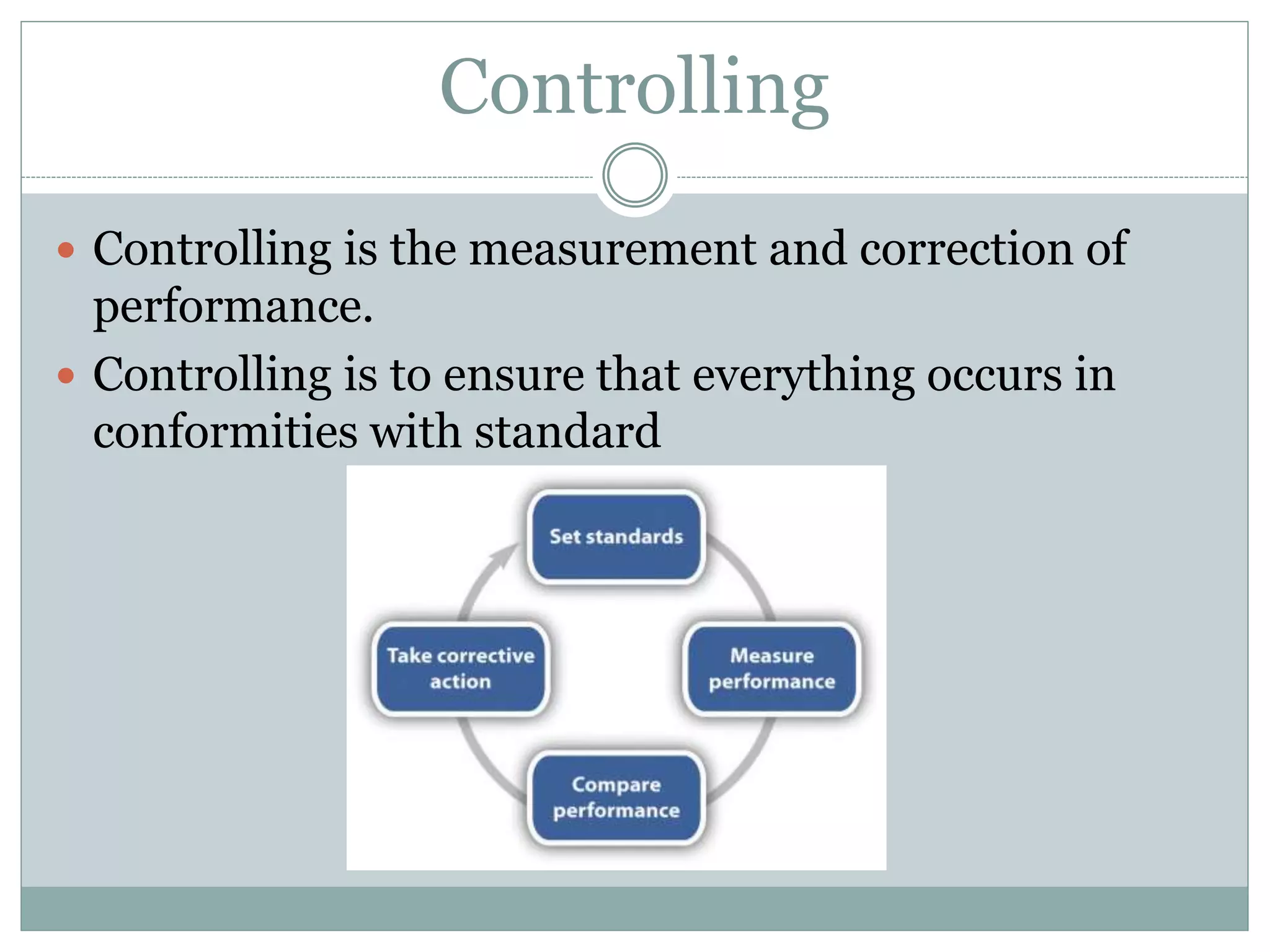
Controlling
 Controlling is the measurement and correction of
performance.
 Controlling is to ensure that everything occurs in
conformities with standard
Importance of Controlling
 Helps in achieving organisational goals
 Judging accuracy of standards
 Improving employee motivation
 Ensures order and discipline
 Controlling helps in improving the performance of
the employees
Determination Of Objective and
Goal
Approaches to Establishing Goals
 Goal provide direction to management.
 Organization member work according to goals.
 Goal establishing process
 Traditional goal setting
 Management by objectives
Characteristics of well designed goal
Specific
 Measurable
Attainable
Realistic
Timely
Specific
 Specific goals answer the following questions:
Who: Who is involved?
What: What do I want to accomplish?
Where: Identify a location.
When: Establish a time frame.
Which: Identify requirements/constraints.
Why: Specific reasons, purpose or
benefits of accomplishing the goal.
Measurable
 To determine if your goal is measurable, ask
questions such as
 How much?
 How many?
 How will I know when it is accomplished?
Attainable
 The goal is “do-able”
 It is action-oriented
 It is “within reach” of mortals!
Realistic
 The goal must be an objective toward which you
are both willing and able to work.
 Again, it must be “do-able”
 People must believe it can be accomplished
Timely
 You should establish a timeframe
 The timeframe must be realistic
 Everyone needs to know the timeframe…make it
public
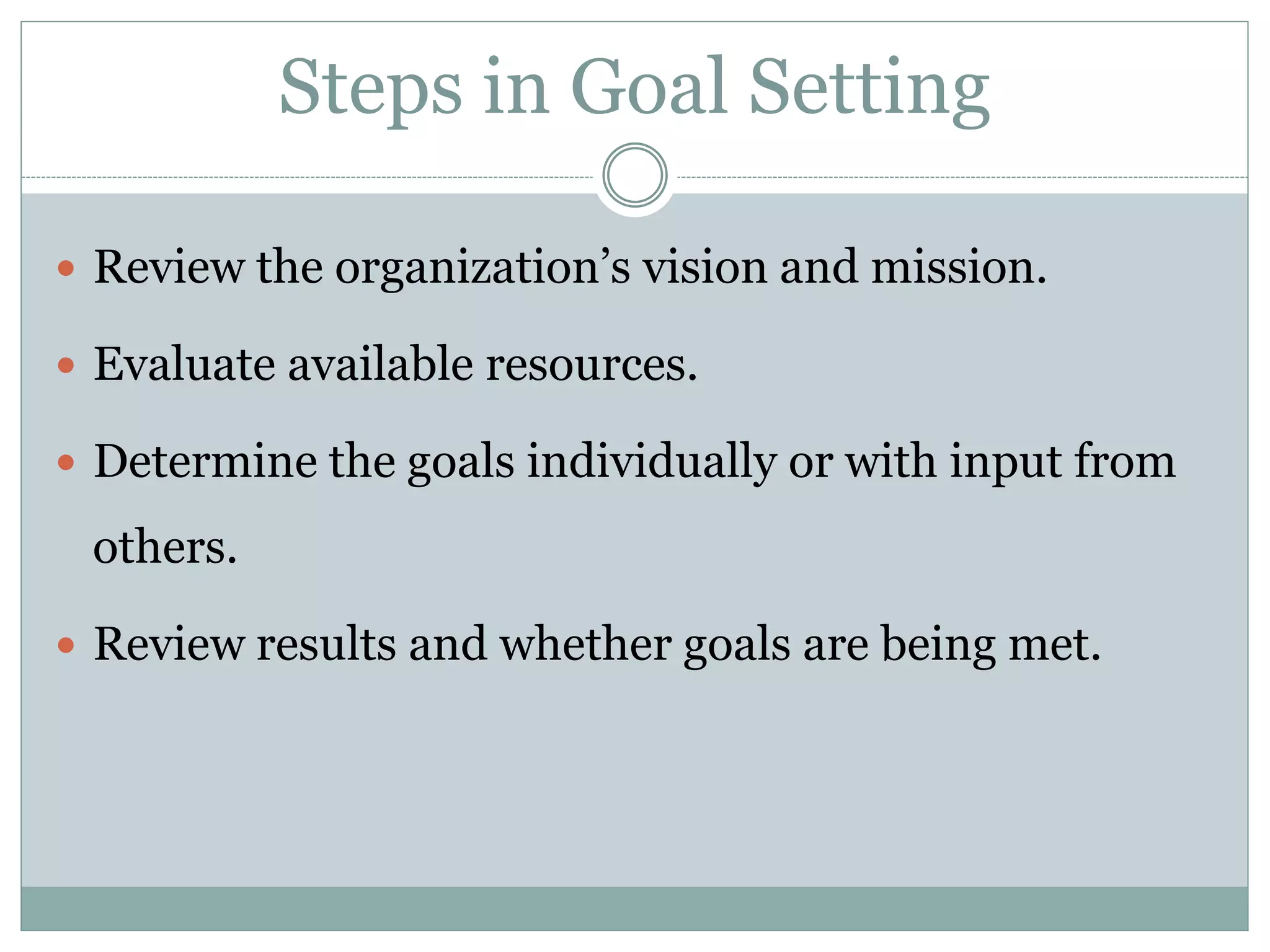
Steps in Goal Setting
 Review the organization’s vision and mission.
 Evaluate available resources.
 Determine the goals individually or with input from
others.
 Review results and whether goals are being met.
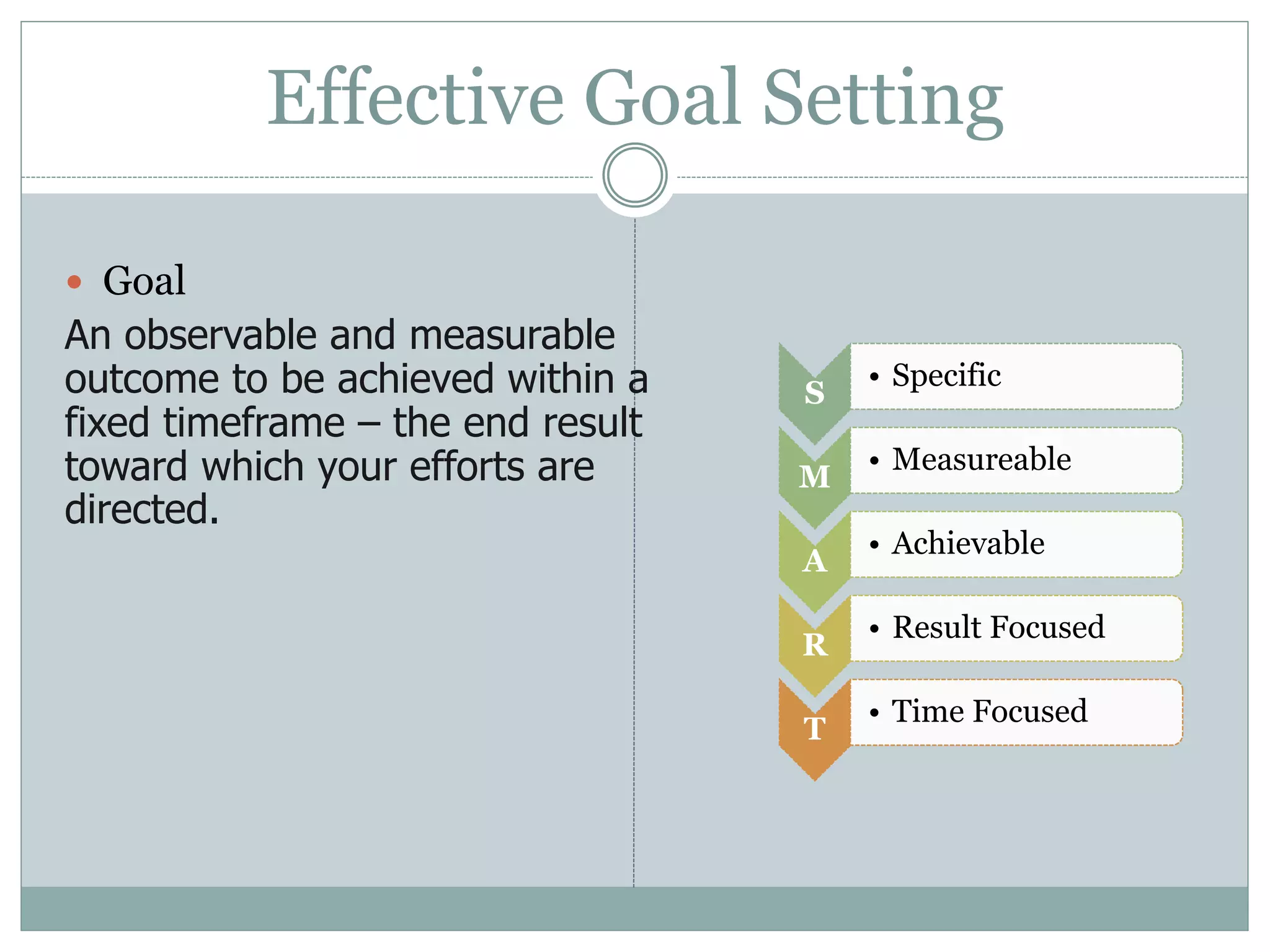
Effective Goal Setting
 Goal
An observable and measurable
outcome to be achieved within a
fixed timeframe – the end result
toward which your efforts are
directed.
S
• Specific
M
• Measureable
A
• Achievable
R
• Result Focused
T
• Time Focused
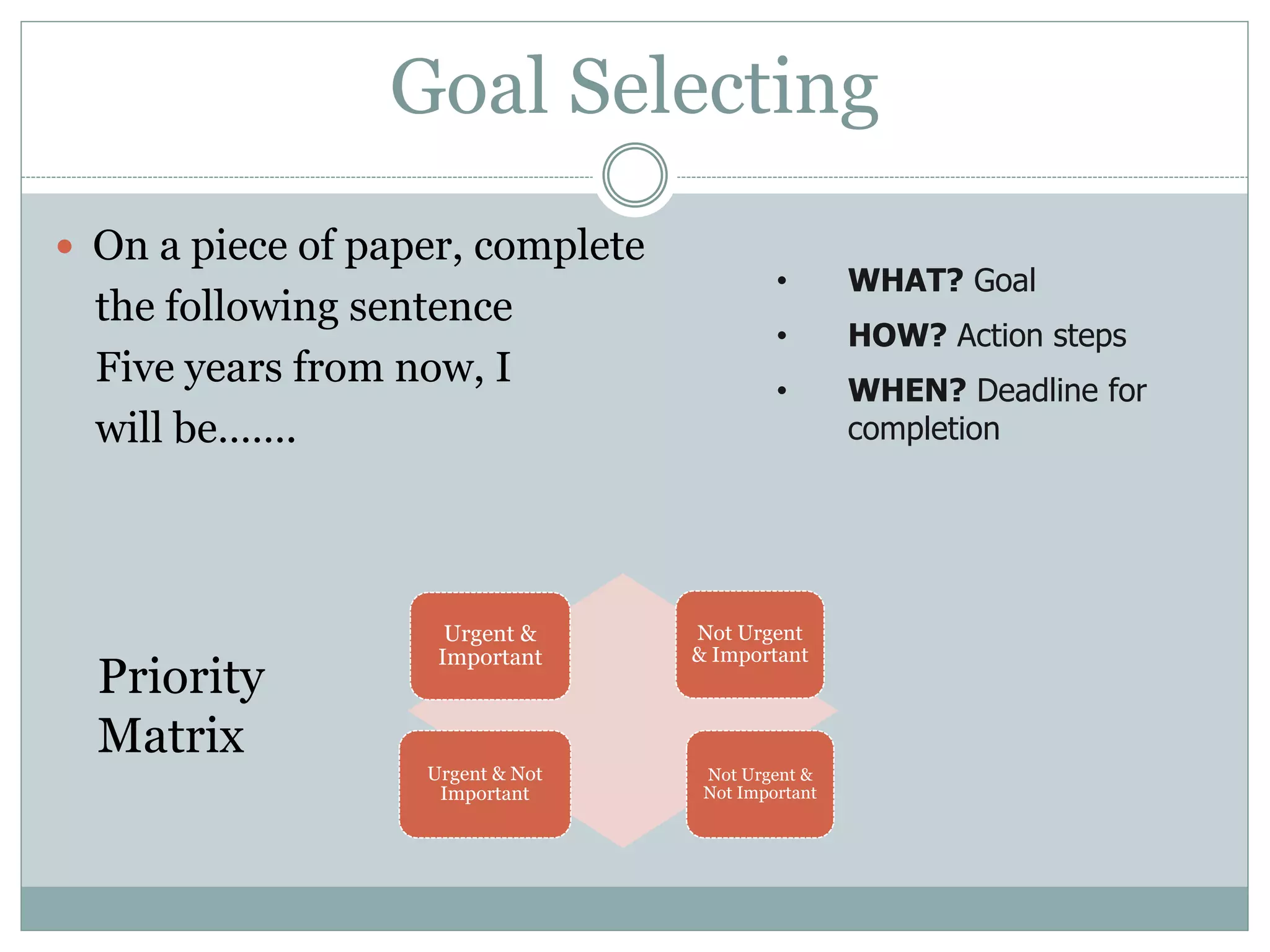
Goal Selecting
• WHAT? Goal
• HOW? Action steps
• WHEN? Deadline for
completion
Priority
Matrix
Urgent &
Important
Not Urgent
& Important
Urgent & Not
Important
Not Urgent &
Not Important
 On a piece of paper, complete
the following sentence
Five years from now, I
will be…….
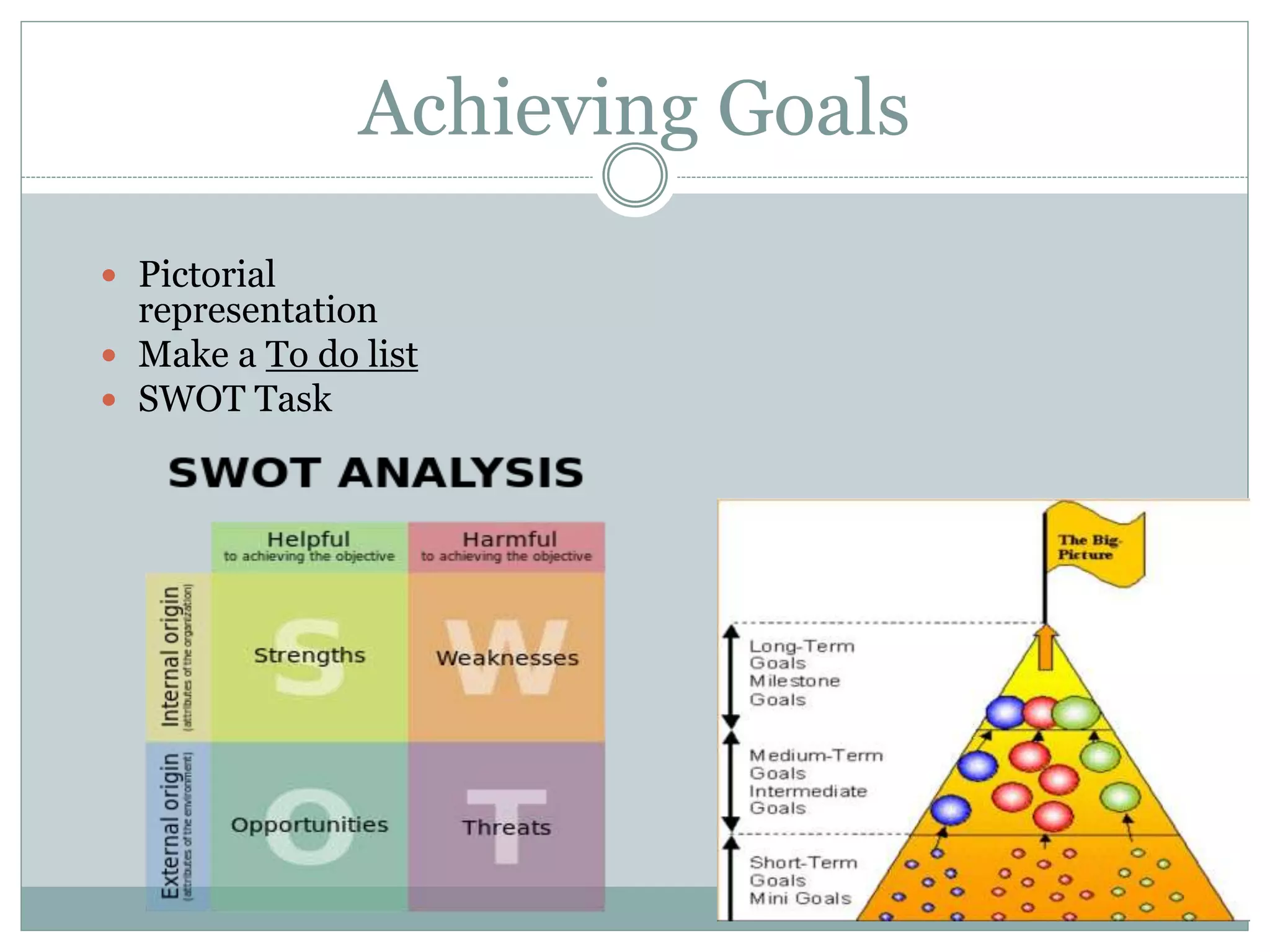
Achieving Goals
 Pictorial
representation
 Make a To do list
 SWOT Task
Management by Objective
 Comprehensive managerial system
 Integrates managerial activities systematically
 Measurable and participative set objectives
 Effective and efficient achievement of organizational
objectives
History and Background of MBO
 Peter Drueker gave birth of the concept in 1954 “The
Practice of Management”.
 Some say; it may be a
 Appraisal tool
 Motivational technique
 Planning and control device
 Or a combination
Benefits of MBO
 Control and systematic Evaluation
 Effective Feedback
 Improving Productivity
 Locating weak and Problem Areas
 Motivating the subordinates
Limitations of MBO
 Failure in goal setting
 Emphasis on short-run goals
 Danger of inflexibility
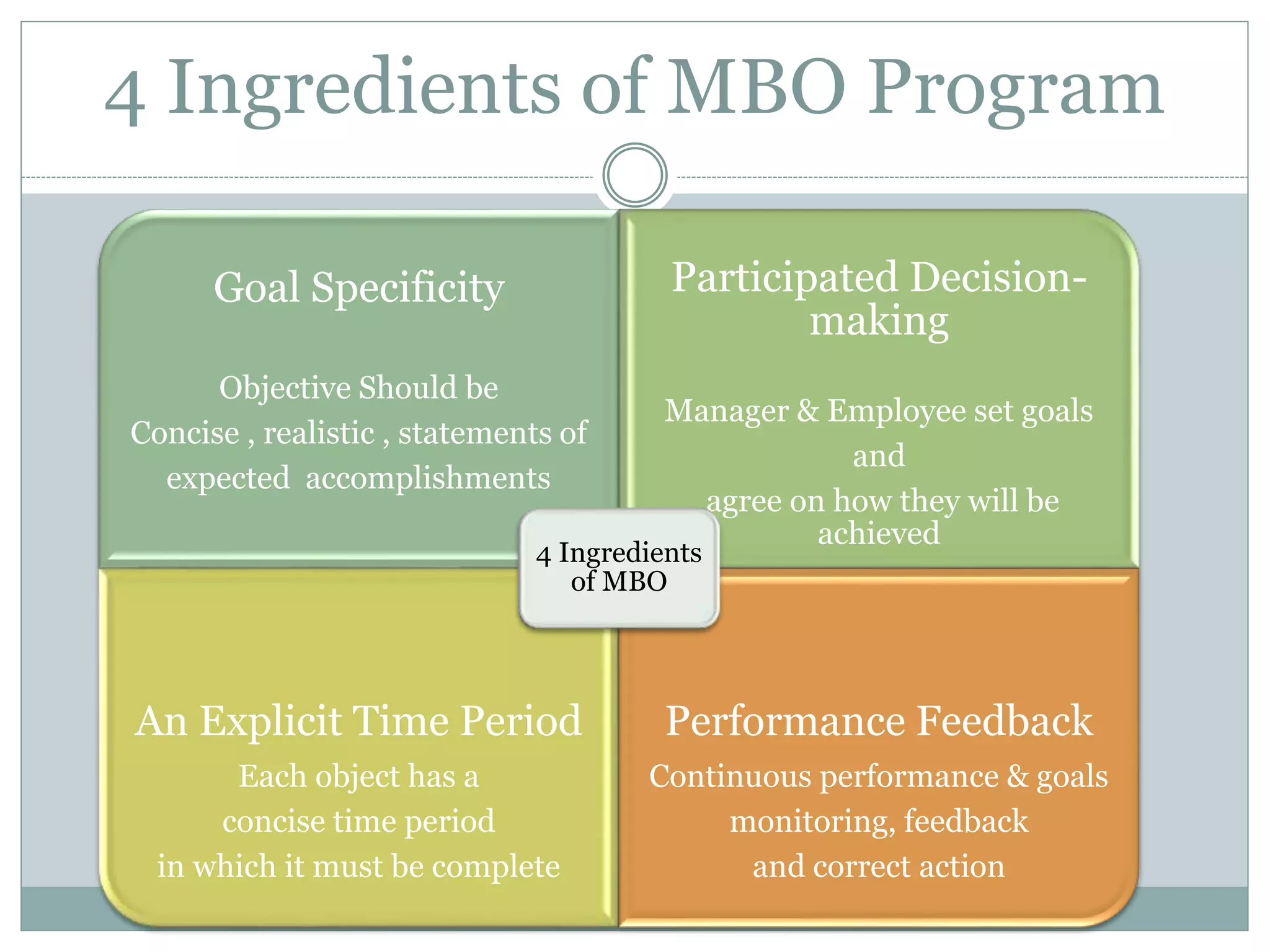
4 Ingredients of MBO Program
Goal Specificity
Objective Should be
Concise , realistic , statements of
expected accomplishments
Participated Decision-
making
Manager & Employee set goals
and
agree on how they will be
achieved
An Explicit Time Period
Each object has a
concise time period
in which it must be complete
Performance Feedback
Continuous performance & goals
monitoring, feedback
and correct action
4 Ingredients
of MBO
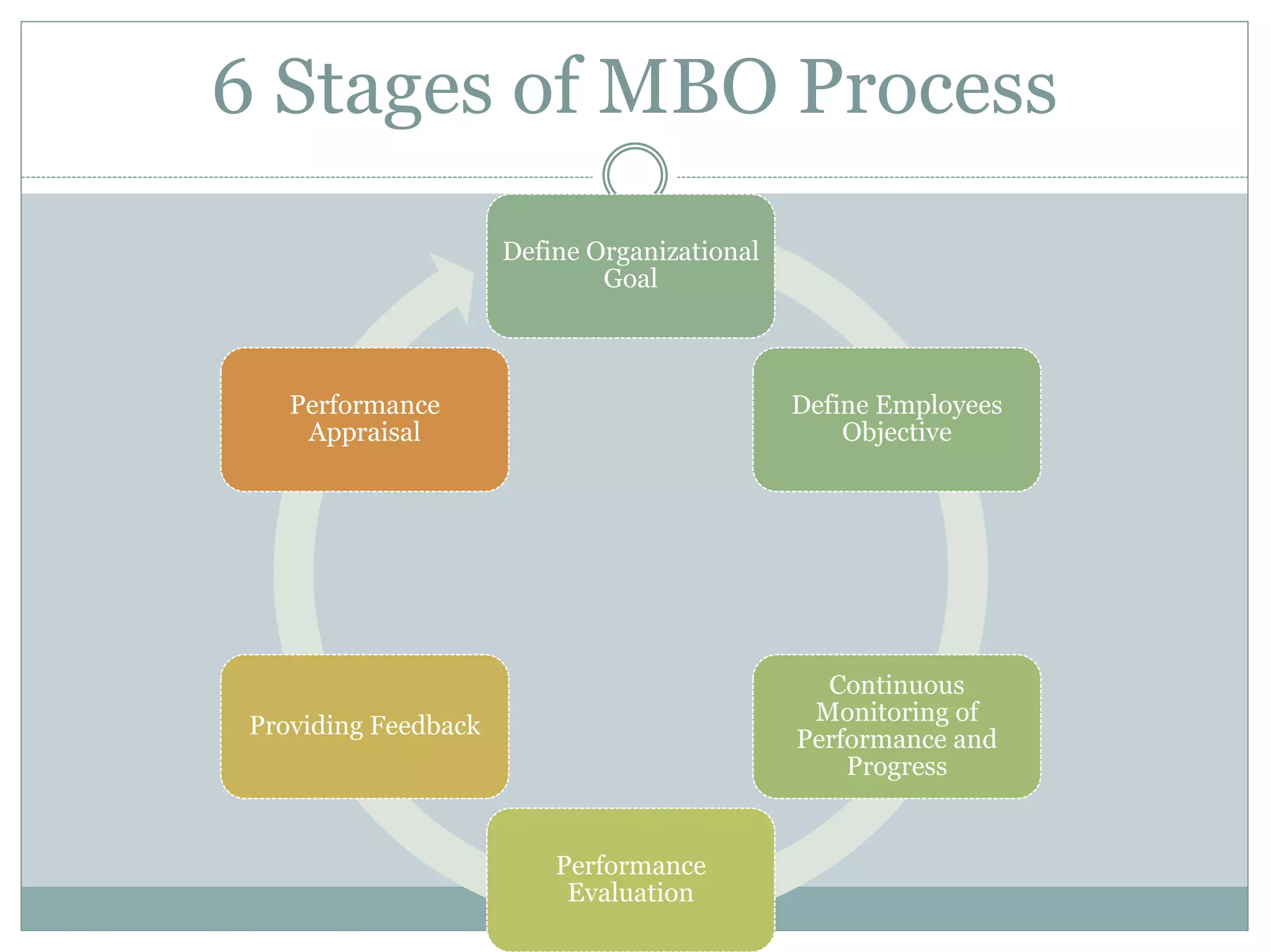
6 Stages of MBO Process
Define Organizational
Goal
Define Employees
Objective
Continuous
Monitoring of
Performance and
Progress
Performance
Evaluation
Providing Feedback
Performance
Appraisal
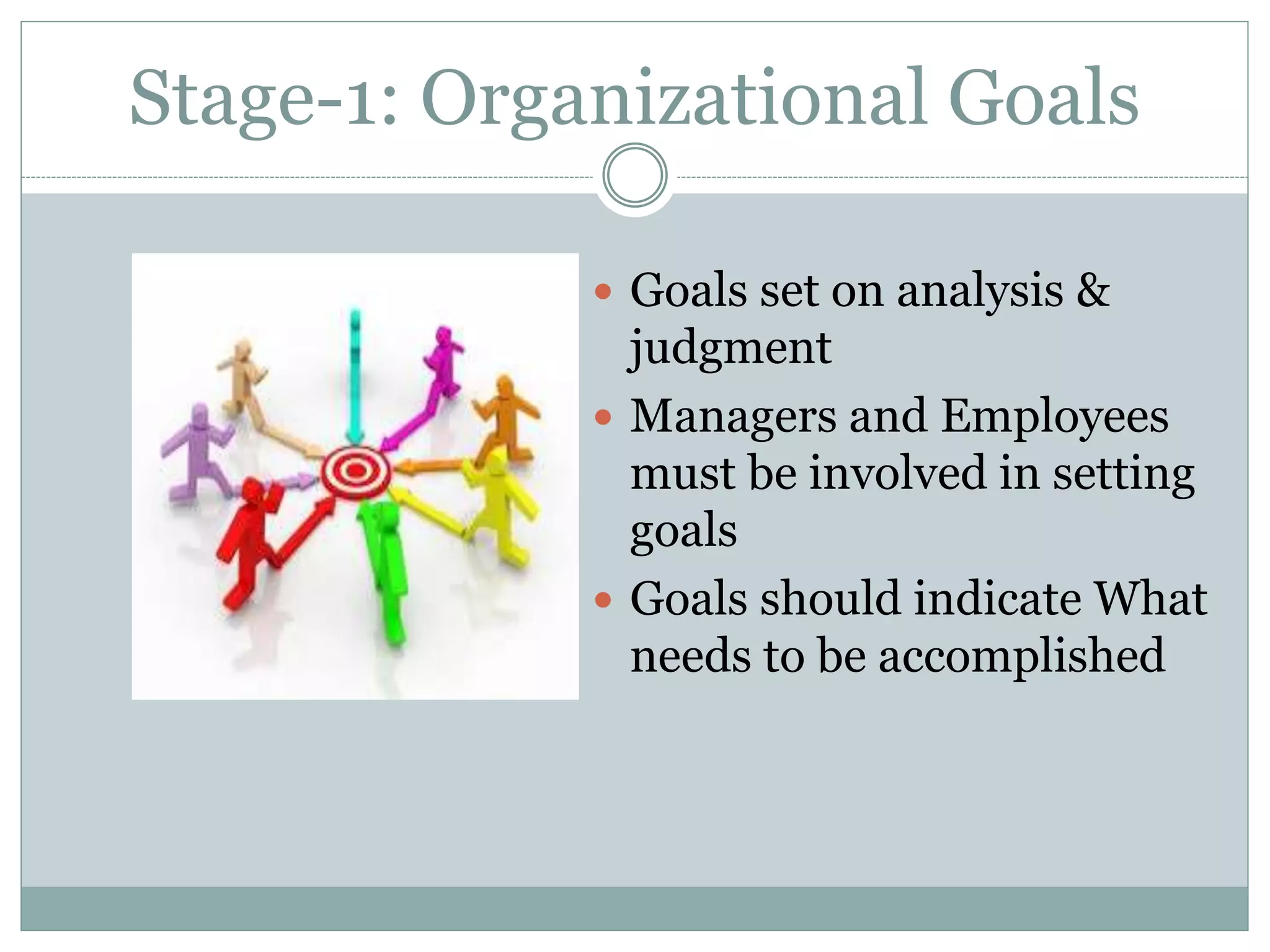
Stage-1: Organizational Goals
 Goals set on analysis &
judgment
 Managers and Employees
must be involved in setting
goals
 Goals should indicate What
needs to be accomplished
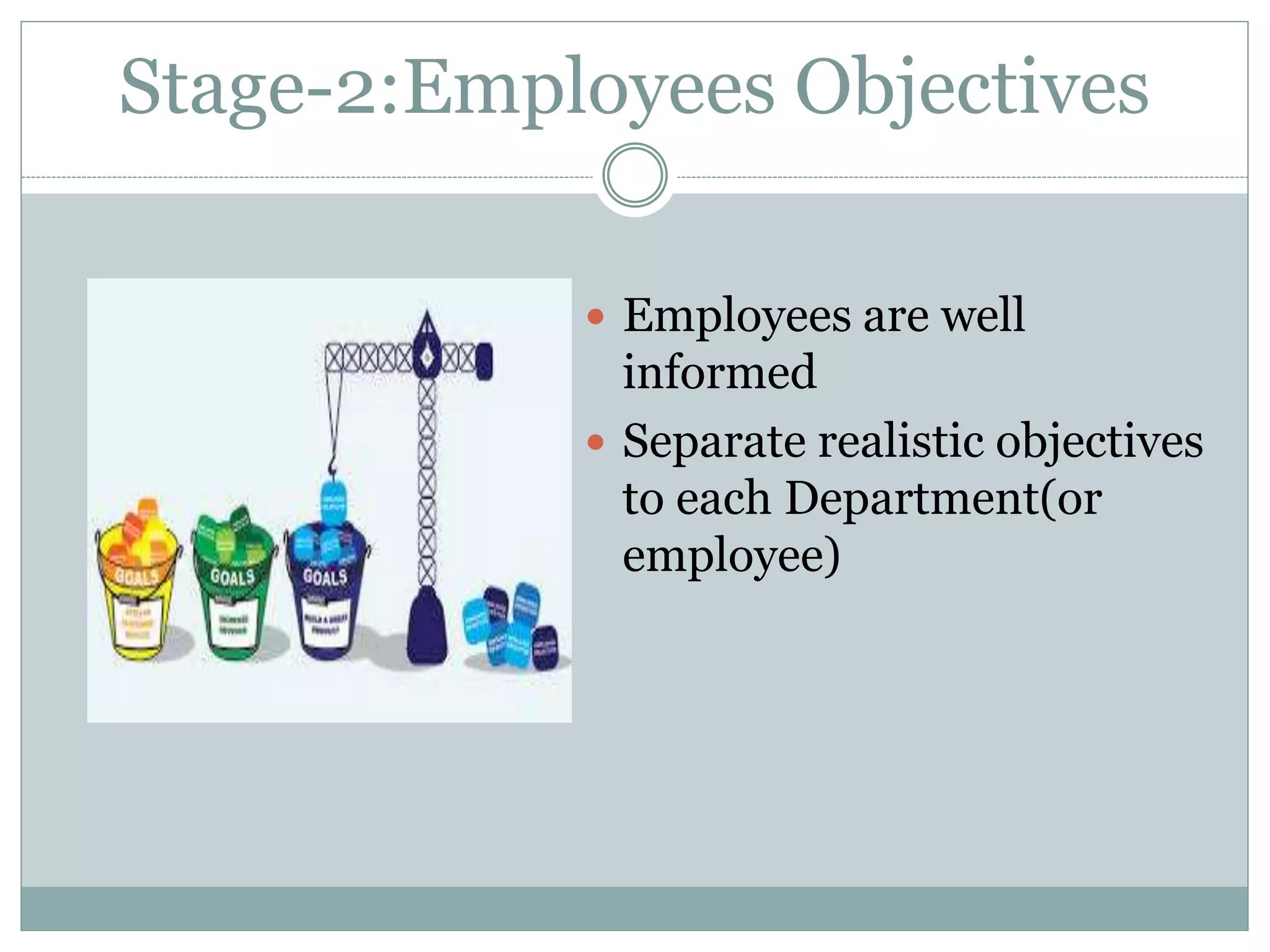
Stage-2:Employees Objectives
 Employees are well
informed
 Separate realistic objectives
to each Department(or
employee)
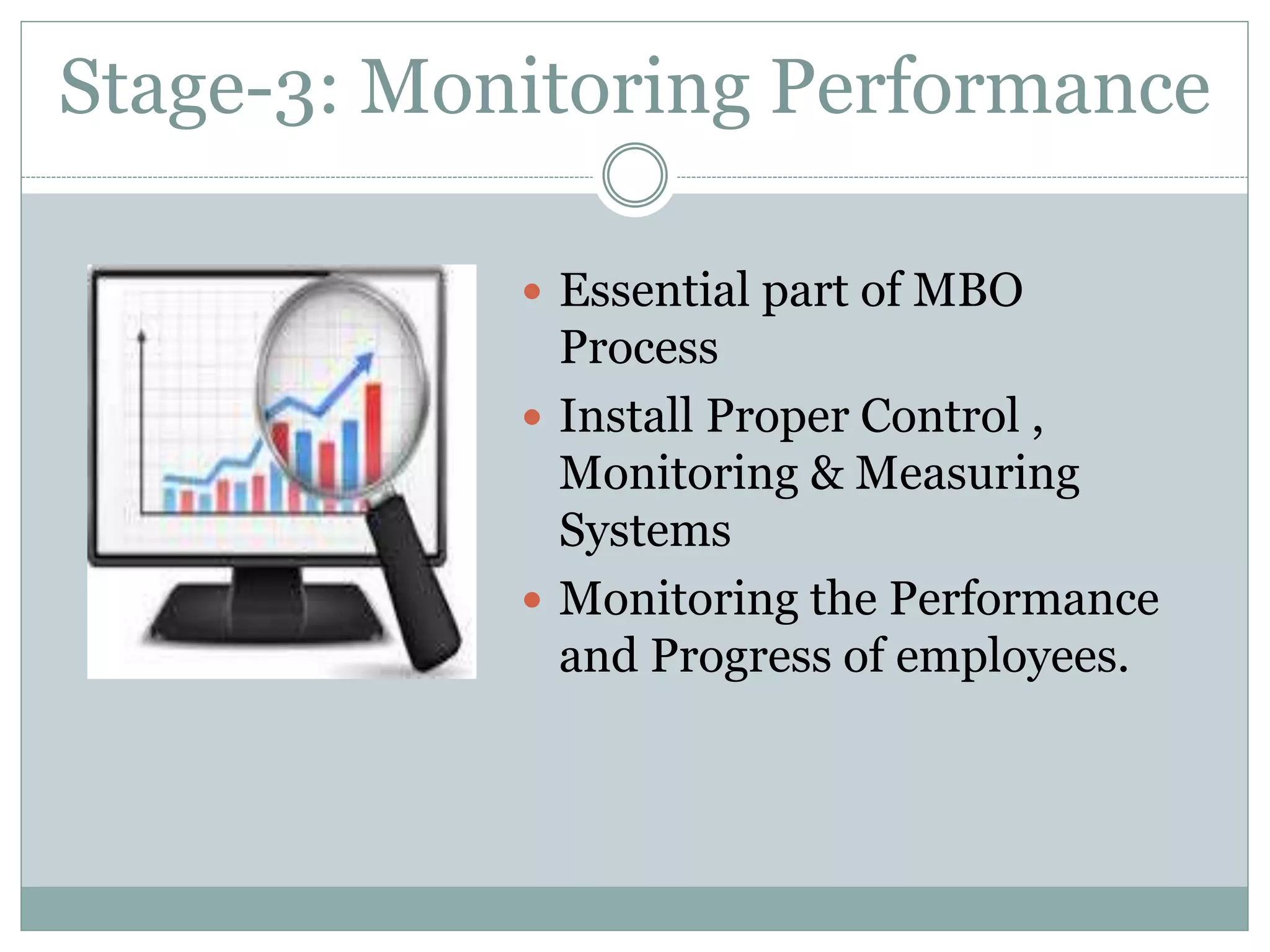
Stage-3: Monitoring Performance
 Essential part of MBO
Process
 Install Proper Control ,
Monitoring & Measuring
Systems
 Monitoring the Performance
and Progress of employees.
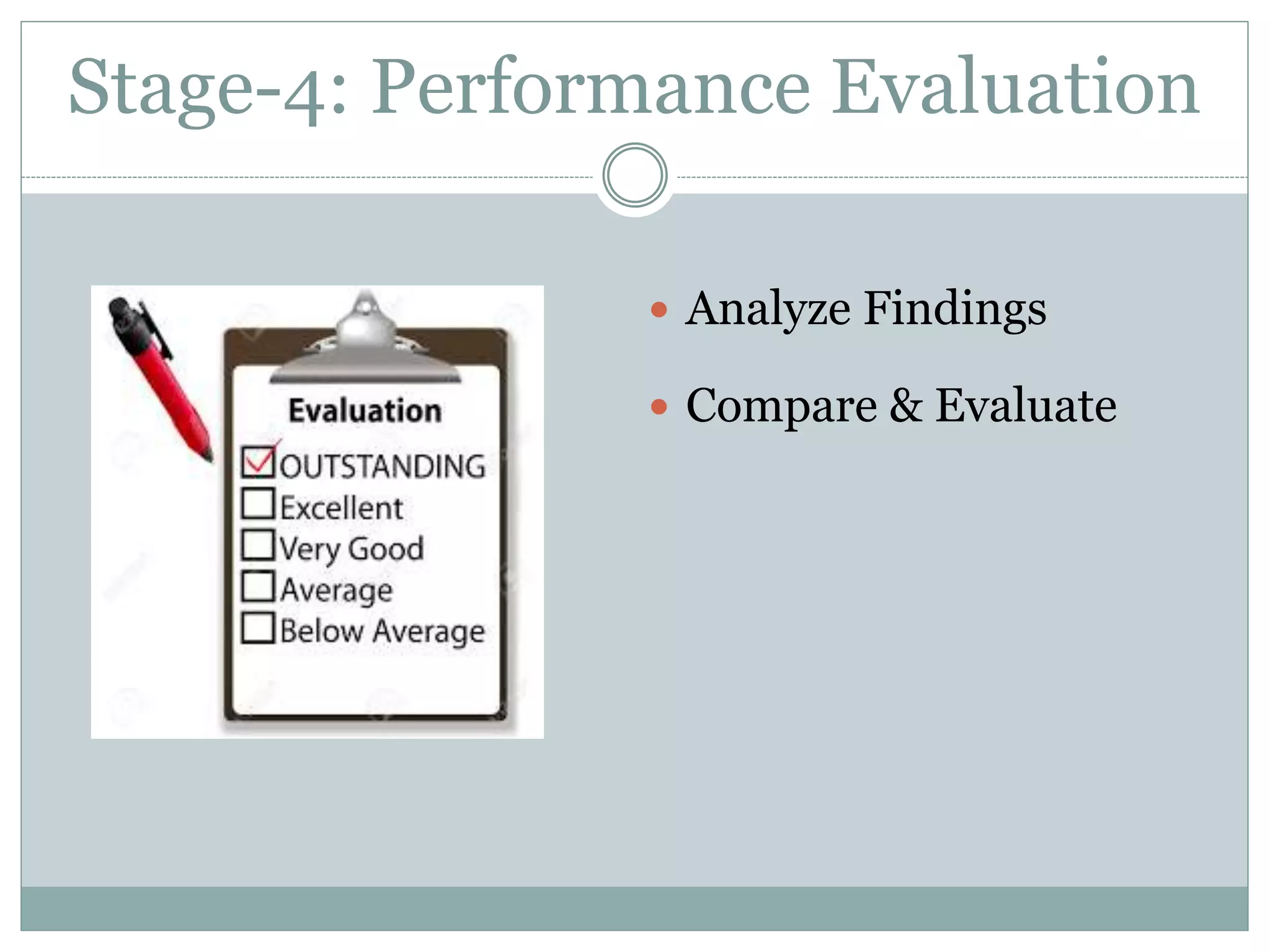
Stage-4: Performance Evaluation
 Analyze Findings
 Compare & Evaluate
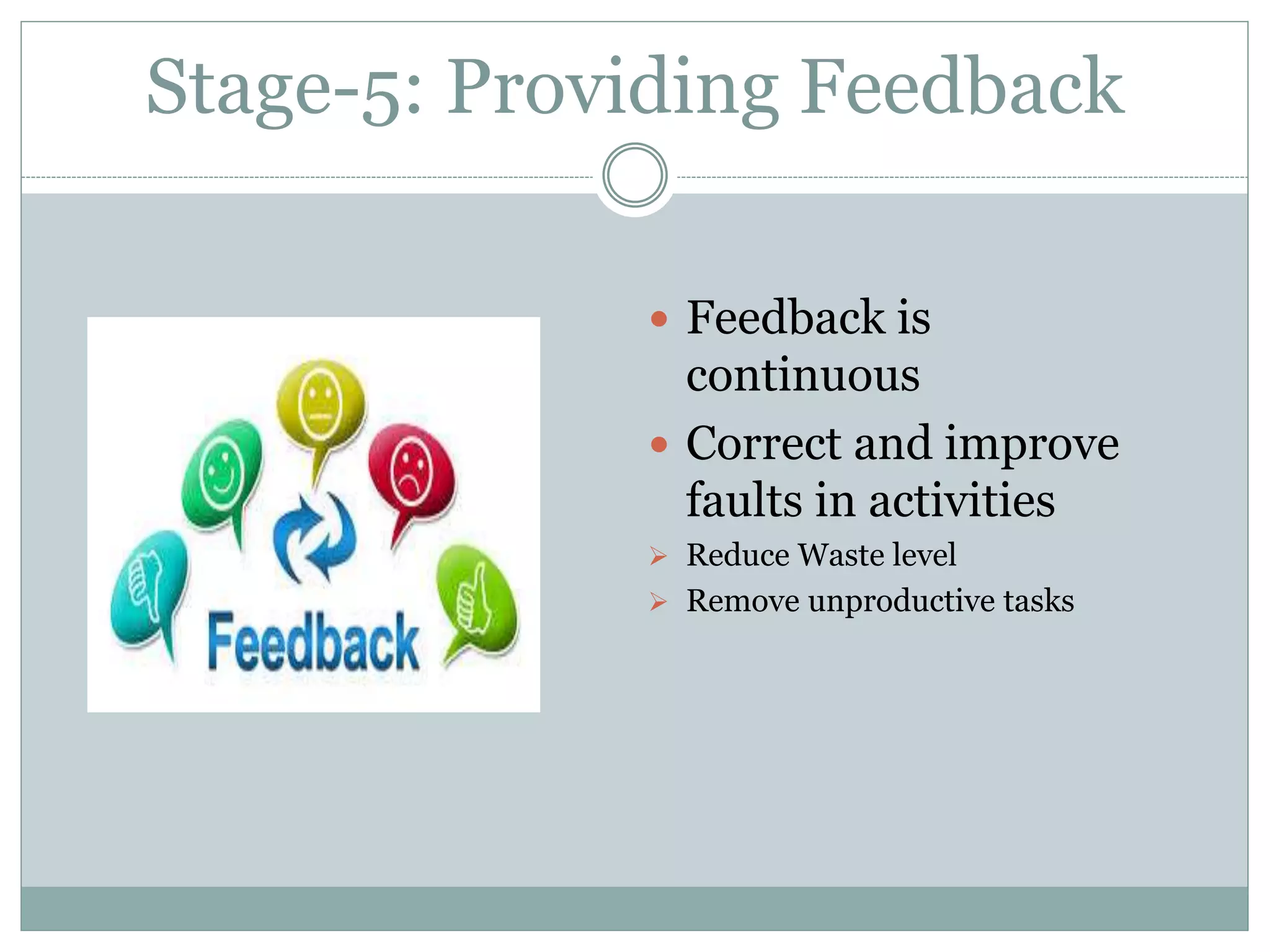
Stage-5: Providing Feedback
 Feedback is
continuous
 Correct and improve
faults in activities
 Reduce Waste level
 Remove unproductive tasks
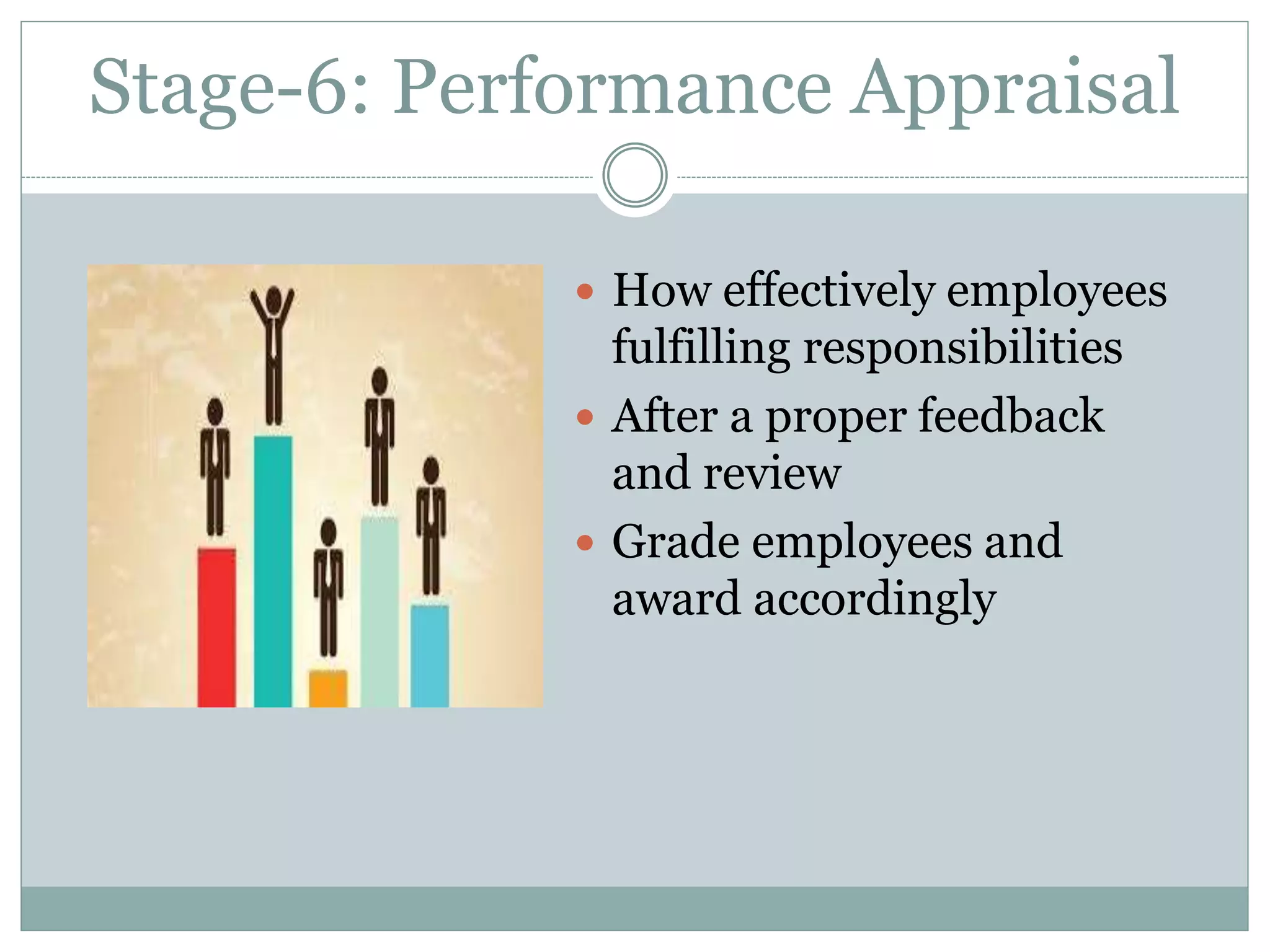
Stage-6: Performance Appraisal
 How effectively employees
fulfilling responsibilities
 After a proper feedback
and review
 Grade employees and
award accordingly
To Sum UP……. MBO
 Participative Goal Setting Management Approach.
 Measureable Actual Performance With Set Standard.
 Look For Ways To Improve Productivity , Efficiency
and Effectiveness.
MANAGEMENT FUNCTIONS

MANAGEMENT FUNCTIONS

  • 2.
  • 3.
  • 4.
  • 5.
    Planning  Deciding inadvance.  Proper utilization of resources.  Human  Non-Human  It is intellectual approach which reduces  Risks  Confusions  Uncertainties  Wastage of time. Planning
  • 6.
    Models of Planning ●The Basics ● Issue- or Goal-Based ● Alignment ● Scenarios ● Organic (or Self-Organizing) ● Appreciative Inquiry
  • 7.
    Organizing ● Organizing means: Assigning the planned task: ─ To various individual. ─ To groups.  Cresting a mechanism.  To provide everything: ─ Raw material. ─ Tools. ─ Capital. ─ Personnel.
  • 8.
    Functions of Organizing ●Subdivisionof main work into small groups. ●Based on principle of equality division of activities. ●Allotment of rights and authority. ●Determination of positions at different levels.
  • 9.
    Importance of Organizing ●Makes the management simple and efficient ● Encourage specialization ● Improves techniques ● Increase productivity ● Accelerates the progress
  • 10.
    Coordination is managerialFunction it does  Unification  Integration  Synchronization  Hidden force combine all management function Coordinating
  • 11.
    Features of Coordination Managerial responsibility  Deliberate effort  Continue Process  System Concept
  • 12.
    Techniques of Coordination Sound Planning  Simplified Organization  Coordination by Committees  Effective Communication  Effective Leadership and Supervision
  • 13.
    Conclusion A good coordinatoris Good leader and A good Leader is good Manager
  • 14.
     Process inwhich the managers  Instruct  Guide  Oversee the performance of the workers.  Heart of management process  Initiate Action Directing
  • 15.
    Characteristics of Direction Pervasive Function  Continuous Activity  Human Factor  Creative Activity  Executive Function
  • 16.
    Controlling  Controlling isthe measurement and correction of performance.  Controlling is to ensure that everything occurs in conformities with standard
  • 17.
    Importance of Controlling Helps in achieving organisational goals  Judging accuracy of standards  Improving employee motivation  Ensures order and discipline  Controlling helps in improving the performance of the employees
  • 18.
  • 19.
    Approaches to EstablishingGoals  Goal provide direction to management.  Organization member work according to goals.  Goal establishing process  Traditional goal setting  Management by objectives
  • 20.
    Characteristics of welldesigned goal Specific  Measurable Attainable Realistic Timely
  • 21.
    Specific  Specific goalsanswer the following questions: Who: Who is involved? What: What do I want to accomplish? Where: Identify a location. When: Establish a time frame. Which: Identify requirements/constraints. Why: Specific reasons, purpose or benefits of accomplishing the goal.
  • 22.
    Measurable  To determineif your goal is measurable, ask questions such as  How much?  How many?  How will I know when it is accomplished?
  • 23.
    Attainable  The goalis “do-able”  It is action-oriented  It is “within reach” of mortals!
  • 24.
    Realistic  The goalmust be an objective toward which you are both willing and able to work.  Again, it must be “do-able”  People must believe it can be accomplished
  • 25.
    Timely  You shouldestablish a timeframe  The timeframe must be realistic  Everyone needs to know the timeframe…make it public
  • 26.
    Steps in GoalSetting  Review the organization’s vision and mission.  Evaluate available resources.  Determine the goals individually or with input from others.  Review results and whether goals are being met.
  • 27.
    Effective Goal Setting Goal An observable and measurable outcome to be achieved within a fixed timeframe – the end result toward which your efforts are directed. S • Specific M • Measureable A • Achievable R • Result Focused T • Time Focused
  • 28.
    Goal Selecting • WHAT?Goal • HOW? Action steps • WHEN? Deadline for completion Priority Matrix Urgent & Important Not Urgent & Important Urgent & Not Important Not Urgent & Not Important  On a piece of paper, complete the following sentence Five years from now, I will be…….
  • 29.
    Achieving Goals  Pictorial representation Make a To do list  SWOT Task
  • 30.
    Management by Objective Comprehensive managerial system  Integrates managerial activities systematically  Measurable and participative set objectives  Effective and efficient achievement of organizational objectives
  • 31.
    History and Backgroundof MBO  Peter Drueker gave birth of the concept in 1954 “The Practice of Management”.  Some say; it may be a  Appraisal tool  Motivational technique  Planning and control device  Or a combination
  • 32.
    Benefits of MBO Control and systematic Evaluation  Effective Feedback  Improving Productivity  Locating weak and Problem Areas  Motivating the subordinates
  • 33.
    Limitations of MBO Failure in goal setting  Emphasis on short-run goals  Danger of inflexibility
  • 34.
    4 Ingredients ofMBO Program Goal Specificity Objective Should be Concise , realistic , statements of expected accomplishments Participated Decision- making Manager & Employee set goals and agree on how they will be achieved An Explicit Time Period Each object has a concise time period in which it must be complete Performance Feedback Continuous performance & goals monitoring, feedback and correct action 4 Ingredients of MBO
  • 35.
    6 Stages ofMBO Process Define Organizational Goal Define Employees Objective Continuous Monitoring of Performance and Progress Performance Evaluation Providing Feedback Performance Appraisal
  • 36.
    Stage-1: Organizational Goals Goals set on analysis & judgment  Managers and Employees must be involved in setting goals  Goals should indicate What needs to be accomplished
  • 37.
    Stage-2:Employees Objectives  Employeesare well informed  Separate realistic objectives to each Department(or employee)
  • 38.
    Stage-3: Monitoring Performance Essential part of MBO Process  Install Proper Control , Monitoring & Measuring Systems  Monitoring the Performance and Progress of employees.
  • 39.
    Stage-4: Performance Evaluation Analyze Findings  Compare & Evaluate
  • 40.
    Stage-5: Providing Feedback Feedback is continuous  Correct and improve faults in activities  Reduce Waste level  Remove unproductive tasks
  • 41.
    Stage-6: Performance Appraisal How effectively employees fulfilling responsibilities  After a proper feedback and review  Grade employees and award accordingly
  • 42.
    To Sum UP…….MBO  Participative Goal Setting Management Approach.  Measureable Actual Performance With Set Standard.  Look For Ways To Improve Productivity , Efficiency and Effectiveness.

Editor's Notes

  • #13 http://www.slideshare.net/dishasareen96/co-ordinationppt