SUBJECT: Technological Innovation Management & Entrepreneurship
SUBJECT CODE: BEC501
MODULE – 1
Management: Nature and Functions of Management – Importance,
Definition, Management Functions, Levels of Management, Roles of
Manager, Managerial Skills, Management & Administration,
Management as a Science, Art & Profession (Selected topics of Chapter
1, Text 1).
Planning: Planning-Nature, Importance, Types, Steps and Limitations of
Planning; Decision Making – Meaning, Types and Steps in Decision
Making (Selected topics from Chapters 4 & 5, Text 1).
Text 1:
 Principles of Management – P.C Tripathi, P.N Reddy, McGraw Hill
Education, 6th Edition, 2017. ISBN-13:978-93-5260-535-4.
DEFINITION OF MANAGEMENT
• Management is the art of getting things done through people
- Mary Parker Follet
• Management is a process consisting of planning, organizing,
directing and controlling, performed to determine and
accomplish the objectives by the use of people and resources.
- George R Terry
• Management is a function of guidance and leadership control of
efforts of a group of people or individuals in order to
achieve goals or objectives of an organization.
IMPORTANCE OF MANAGEMENT:
• Management is a critical element in economic growth
of a country
• Management is essential in all organized efforts
• Management is the dynamic, life giving element in
every organization
NATURE OF MANAGEMENT:
Nature can be explained in following features:
1. Management is universal
• Essential element irrespective of size or type of activity.
• For ex: Family, Club etc.
2. Management is goal oriented
• Also called as group goals or organizational goals
• Basic goal is to ensure efficiency and economy. Thus making
management purposeful.
3. Management is an integrative force
•The essence of management lies in the coordination of
individual efforts into a team.
•It integrates human and other resources.
4. Management is a social process
•Management is done by people, through people and for people.
•Human factor is important element in management.
5. Management is multidisciplinary
•Management has to deal with human behavior under dynamic
conditions and several disciplines like Engineering, Sociology
6. Management is continuous process
•Its Dynamic and on-going process.
• It continue to operate until there is organized action for
the achievement of group goals.
7. Management is intangible
•Unseen and Invisible Force. Cant be seen but felt in the forms
of results.
8 Management is an Art as well as science
•It contains systematic body of theoretical knowledge and it involves
the practical application of the knowledge.
MANAGEMENT FUNCTIONS
There are Five well accepted functions of management. They are:
a) Planning
b) Organizing
c) Staffing
d) Directing (Leading)
e) Controlling
PLANNING
• It is the function that determines in advance what should be done.
• It is the process of deciding the business objectives.
• Planning is done in every division, Department and sub-unit of the
organization.
• It is performed by managers at all levels-top, Planning
• lower and middle.
MANAGEMENT FUNCTIONS CONTINUED….
ORGANISING
• To organize a business is to provide them personnel, raw
materials, tools etc.
• This is divided into human organization and material
organization.
• Once managers have established objectives, they must design
and develop human organization that is required to carry out
the plans successfully.
STAFFING
• Here manager attempts to find the right person for each job.
• Manager recruits enough man power to fill the various
positions
needed in the organization,
• It involves training of future mangers and sustainable system
of compensation.
MANAGEMENT FUNCTIONS CONTINUED….
DIRECTING
• It refers to leading people towards the defined objectives.
• It involves 3-sub functions-Communication, Leadership
and motivation.
• Communication is the process of passing information
and understanding from one person to another.
• Leadership is the process in which a manager guides
and influence the work of his subordinator.
• Motivation means arousing desire in the minds of employees of
the organization.
CONTROLLING
• It is measuring and correcting activities of Subordinates.
• Helps in establishing standards of performance.
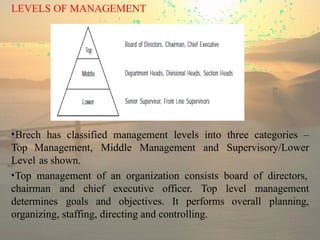
LEVELS OF MANAGEMENT
•Brech has classified management levels into three categories –
Top Management, Middle Management and Supervisory/Lower
Level as shown.
•Top management of an organization consists board of directors,
chairman and chief executive officer. Top level management
determines goals and objectives. It performs overall planning,
organizing, staffing, directing and controlling.
LEVELS OF MANAGEMENT CONTINUED….
•Middle level management establishes programs for department and
carries out functions for achieving specific goals.
•The other functions of middle level management are training
and development of employees, integrating various parts of
the department.
•Supervisory management is concerned with efficiency in using
resources of the organization.
•A supervisor is an executor of policies and procedures making a
series of decisions with well-defined and specified premises.
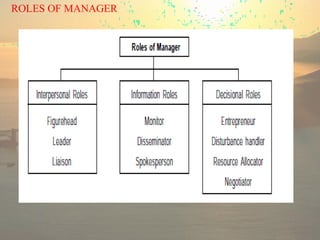
ROLES OF MANAGER
INTERPERSONAL ROLES
• Figurehead: Perform some duties that are ceremonial in
nature.
• Leader: As a leader manager has to encourage and motivate his
employees.
• Liaison: Every manger must cultivate contacts with outside
people and collect useful information for the well being of
the organization.
INFORMATION ROLES
• Monitor: manager continuously collects information about all the
factors which affects his activities. Such factors may be within or
outside organization.
• Disseminator: In the disseminator role, manager possesses some
of his privileged information to his subordinates who otherwise
not be in a position to collect it.
• Spokesperson: As a spokesperson manager represents his
organization while interacting with outsiders like
customers, suppliers, financers, government and other
agencies of the society.
DECISIONAL ROLES
• Entrepreneur: As an entrepreneur, a manager assumes certain
risks in terms of outcome of an action. A manager
constantly
looks out for new ideas and seeks to improve his unit by adopting
it to dynamic environment.
• Disturbance handler: In this role manager works like a fire-
fighter manager contains forces and events which disturb
normal functioning of his organization. The forces and
events may be
employee complaints and grievances, strikes, shortage of raw
materials etc.
DECISIONAL ROLES
• Resource Allocator: As a resource allocator, the manager divide
the work and delegate authority among his subordinates
and allocates the required resource to the workers to
complete the work
• Negotiator: In his role of negotiator, manager negotiates with
various groups in the organization. Such groups are
employees, shareholders and other outside agencies.
MANAGERIAL SKILLS
Skill is an individuals ability to perform physical or mental tasks
with a specified outcome.
• Conceptual Skill
• Technical skill
• Human relation skill
MANAGERIAL SKILLS
• Conceptual Skill: it is the ability of a manager to conceptualize
the environment, the organization and his own job so that he
can set appropriate goals for his organization, for himself
and his team.
• Technical skill: It is the manager s
‟ understanding of the nature of
the job that people under him have to perform. It refers to
person s
‟ knowledge and proficiency in any type of process
or technique.
• Human relation skill: It is the ability to interact effectively with
people at all levels. This skills helps manager
i) To recognize the feelings and statements of others.
MANAGEMENT AND ADMINISTRATION
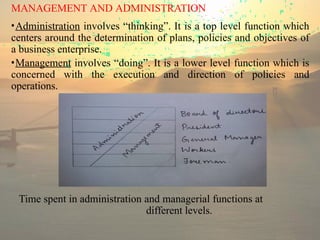
•Administration involves “thinking”. It is a top level function which
centers around the determination of plans, policies and objectives of
a business enterprise.
•Management involves “doing”. It is a lower level function which is
concerned with the execution and direction of policies and
operations.
Time spent in administration and managerial functions at
different levels.
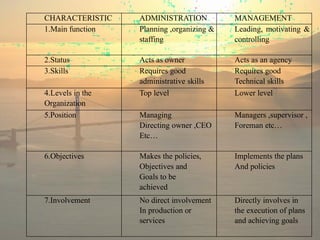
CHARACTERISTIC ADMINISTRATION MANAGEMENT
1.Main function Planning ,organizing &
staffing
Leading, motivating &
controlling
2.Status Acts as owner Acts as an agency
3.Skills Requires good
administrative skills
Requires good
Technical skills
4.Levels in the
Organization
Top level Lower level
5.Position Managing
Directing owner ,CEO
Etc…
Managers ,supervisor ,
Foreman etc…
6.Objectives Makes the policies,
Objectives and
Goals to be
achieved
Implements the plans
And policies
7.Involvement No direct involvement
In production or
services
Directly involves in
the execution of plans
and achieving goals
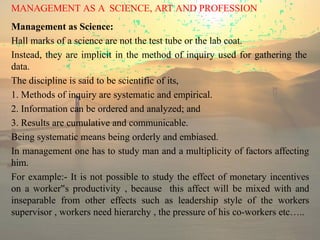
MANAGEMENT AS A SCIENCE, ART AND PROFESSION
Management as Science:
Hall marks of a science are not the test tube or the lab coat.
Instead, they are implicit in the method of inquiry used for gathering the
data.
The discipline is said to be scientific of its,
1. Methods of inquiry are systematic and empirical.
2. Information can be ordered and analyzed; and
3. Results are cumulative and communicable.
Being systematic means being orderly and embiased.
In management one has to study man and a multiplicity of factors affecting
him.
For example:- It is not possible to study the effect of monetary incentives
on a worker s
‟ productivity , because this affect will be mixed with and
inseparable from other effects such as leadership style of the workers
supervisor , workers need hierarchy , the pressure of his co-workers etc…..
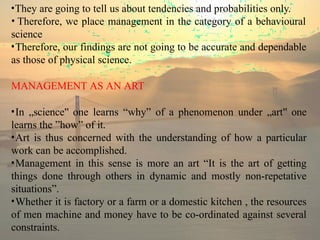
•They are going to tell us about tendencies and probabilities only.
• Therefore, we place management in the category of a behavioural
science
•Therefore, our findings are not going to be accurate and dependable
as those of physical science.
MANAGEMENT AS AN ART
•In „science‟ one learns “why” of a phenomenon under „art‟ one
learns the ”how” of it.
•Art is thus concerned with the understanding of how a particular
work can be accomplished.
•Management in this sense is more an art “It is the art of getting
things done through others in dynamic and mostly non-repetative
situations”.
•Whether it is factory or a farm or a domestic kitchen , the resources
of men machine and money have to be co-ordinated against several
constraints.
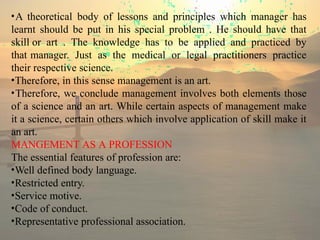
•A theoretical body of lessons and principles which manager has
learnt should be put in his special problem . He should have that
skill or art . The knowledge has to be applied and practiced by
that manager. Just as the medical or legal practitioners practice
their respective science.
•Therefore, in this sense management is an art.
•Therefore, we conclude management involves both elements those
of a science and an art. While certain aspects of management make
it a science, certain others which involve application of skill make it
an art.
MANGEMENT AS A PROFESSION
The essential features of profession are:
•Well defined body language.
•Restricted entry.
•Service motive.
•Code of conduct.
•Representative professional association.
PLANNING
PLANNING
“Planning is deciding in advance what to do, how to do it, when to
do it and who is to do it. It bridges the gap from where we are and
to where we want to go. It is in essence the exercise of foresight”.
-Koontz and O’Donnel
NATURE OR FEATURES OR CHARACTERISTICS OF
PLANNING
1. Planning Is An Intellectual Process
• It requires managers to think before acting.
• It is thinking in advance.
2. Planning is decision making
• Decision making is an integral part of planning.
• It is the process of choosing among alternatives.
3. Planning is a continuous process
•Manager should constantly watch the progress of his plans
•Manager should be right than being consistent.
4. Planning must be flexible
•Flexibilityof planning means its ability to change the direction to
adapt to changing situations.
5. Planning is all pervasive
•Planning is important to all managers regardless of their level in
the organzation i, e from CEO to first time supervisors.
IMPORTANCE OF PLANNING
Four concrete reasons for the importance of planning functions are
1) Minimizes risk and uncertainty
2) Leads to success
3) Focuses attention on the organization's goals.
4) Facilitates control and trains executives.
5) Minimizes risk and uncertainty
• Organisation have to function and survive in an environment that is
changing too fast.
• In such situations, planning based on hard facts and data help mangers
to minimizes risk and uncertainties.
2) Leads to success
• Planning leads to success by doing beyond mere adaptation to market
fluctuations.
3) Focuses attention on the organisation s
‟ goals.
•Planning makes easier to coordinate the resources of the
organization more economically.
• Planning helps manager to think in-advance an orderly sequence
of steps for realization of an organizations goals and to avoid
needless overlapping of activities.
4) Planning facilitates control
The function of control is to ensure that the activities confirm to the
plans.
5) Planning trains executives
• Planning is also an excellent means for training executives.
Then executives becomes involved in the activities of the
organization.
6) Planning ensures coordination
7) Planning encourage innovation and creativity
8) Planning helps in decision making
TYPES OF PLAN
VISION:
•This is the dream that entrepreneur creates about the direction
that hisbusiness should pursue in future.
•Vision is an on-going process. Vision reshapes as
organization
proceeds.
MISSION:
•It is the unique aim that sets organization sets apart.
•Mission decides scope of business.
•Mission is not revised every now and then in response to every new
turn in the economy.
OBJECTIVE:
Objectives are the goals, aims or purposes that the organizations
wish to achieve over varying periods of time”
CHARACTERISTICS OF OBJECTIVES
Objectives are multiple in numbers: Every business enterprise has
a package of objectives set in various key areas. Peter Drucker has
emphasized setting objectives in eight key areas namely market
standing, innovation, productivity, physical and financial resources,
profitability, manager performance and development, worker
performance and attitude, and public responsibility.
Objectives are tangible or intangible: Some of the objectives such
as productivity, physical and financial resources are tangible; where
as objectives in the areas of manager s
‟ performance, workers morale
is completely intangible.
Objectives have a priority: At a given point of time one objective
may be important than another. For example maintaining minimum
cash balance is important than due date of payment.
CHARACTERISTICS OF OBJECTIVES CONTINUED....
Objectives are generally arranged in hierarchy: It implies that
organization has corporate objectives at the top and divisional,
departmental and sectional objectives at the lower level of
organization.
Objectives some time clash with each other: An objective of one
department may clash with the objectives of other department. For
example the objectives of production of low unit cost achievement
through mass production of low quality products may conflict with
goal of sales department selling high quality products.
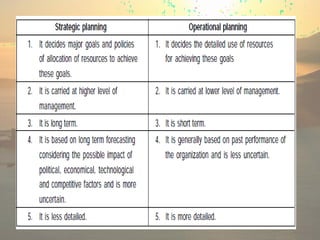
STRATEGIES:
A strategy is a plan which takes into these factors and provides an
optimal match between the firm and external environment. Two
activities are involved in strategy formulation namely environmental
appraisal and corporate appraisal.
STRATEGIES CONTINUED....
Environmental appraisal involves identifying and analysis of the
following factors:
(1)Political and legal factors: Stability of government, taxation
and licensing laws, fiscal policies, restrictions on capital etc.
(2)Economic factors: Economic development, distribution
of personal income, trend in prices, exchange rates etc.,
(3)Competitive factors: Identifying principal competitors
and analysis of their performance, anti-monopoly laws,
protection of patents, brand names etc.
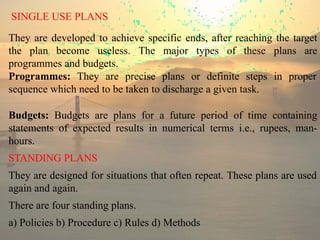
SINGLE USE PLANS
They are developed to achieve specific ends, after reaching the target
the plan become useless. The major types of these plans are
programmes and budgets.
Programmes: They are precise plans or definite steps in proper
sequence which need to be taken to discharge a given task.
Budgets: Budgets are plans for a future period of time containing
statements of expected results in numerical terms i.e., rupees, man-
hours.
STANDING PLANS
They are designed for situations that often repeat. These plans are used
again and again.
There are four standing plans.
a) Policies b) Procedure c) Rules d) Methods
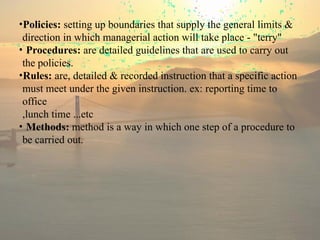
•Policies: setting up boundaries that supply the general limits &
direction in which managerial action will take place - "terry"
• Procedures: are detailed guidelines that are used to carry out
the policies.
•Rules: are, detailed & recorded instruction that a specific action
must meet under the given instruction. ex: reporting time to
office
,lunch time ...etc
• Methods: method is a way in which one step of a procedure to
be carried out.
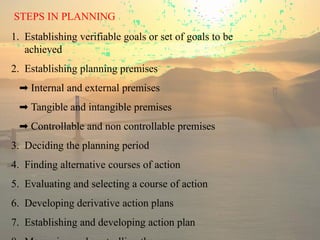
STEPS IN PLANNING
1. Establishing verifiable goals or set of goals to be
achieved
2. Establishing planning premises
➡ Internal and external premises
➡ Tangible and intangible premises
➡ Controllable and non controllable premises
3. Deciding the planning period
4. Finding alternative courses of action
5. Evaluating and selecting a course of action
6. Developing derivative action plans
7. Establishing and developing action plan
1. Establishing verifiable goals or set of goals to be achieved
The first step in planning is to determine the enterprise objectives. It is set by
upper level or top level manager.
2. Establishing planning premises
a) Internal and external premises :
Internal and external premises within the organization. some of the examples
are policies, forecast, investment, availability of equipment, funds flow.. Etc
external premises are outside the organization they include government
policies, technology changes, business environment, demand etc
b)Tangible and intangible
premises Tangible are measurable
premises.
Ex : population, investment and demand. Intangible premises are which cannot
be quantitatively measurable. Ex: business environment, economic conditions.
c) Controllable and non controllable premises :
Some of the premises are controllable like, technical man power, input
technology, machinery etc. Some other premises like strikes, non availability
of raw materials, phase shifts are uncontrollable by the organization
3) Deciding planning period
Once upper level managers have selected basic long-term goals and planning
premises, the next task is to determine the period of the plan.
4) Finding alternative courses of action :
The fourth step in planning is to search and examine alternative courses of action.
Ex: technical know how may be taken by engaging or foreign technician or by
training staff abroad.
6) Developing derivative plans :
Once the plan for the organization has been formulated, middle and lower level
managers must draw up the appropriate plans for their sub units.
7) Establishing and deploying action plans
Managers may not know how to turn the derivative plans into action.
Action plan identifies particular activities necessary for this purpose and specifies
the who, what, when and how of each action item .
8) Measuring and controlling the progress :
Without monitoring plan will get ruined. Hence process of controlling is critical
part of any plan. Managers need to check the progress of their plans.
LIMITATIONS OF PLANNING
• Planning is an expensive and time consuming process. It includes
money, energy and risk, but gives no assurance of the fulfilment
of organisation s
‟ objectives.
• Planning restricts the organisation to risk-free opportunities.
Planning forces manager to operate within the limits,
planning cause delay in decision making.
• For industries producing fashionable articles or for industries
engaged in a publication of textbooks, working on a day-to-
day basis is more economical than on a planned basis.
• Establishment of advance plans may make administration
inflexible. When unforeseen changes in the environment such
as business recursion, crop failure take place then original
plan loses its value and fresh plan need to be done.
• There is difficulty in formulating accurate premises, because future
cannot be known with accuracy.
• Planning May sometimes face people s
‟ resistance to do it.
DECISION MAKING-MEANING
A decision is a choice between two or more
alternatives. This implies three things,
1. When manager make decision they are choosing.
2.Managers have alternatives when they
are making decision. [Evaluate several alternatives and select the
best one].
3.Managers have a purpose in mind
when they are making a decision.
TYPES OF DECISIONS
•Programmed and non-programmed decision.
•Major or minor decision.
•Routine and strategic decision.
•Individual and group decision.
TYPES OF DECISION CONTINUED……
Programmed and non-programmed decision:
Programmed decisions are those that are made in accordance with
some policy, rule or procedure and they do not have to be handled
each time they occur. They are repetitive routine.
Example: determining salary payment to employs who have been
ill.
Non programmed decisions are natural and non repetitive. If
a problem has not arisen before then it must be handled by a
non- programmed decision. Example: What to do about a
failing product line, how community relations should be improved
etc...
TYPES OF DECISION CONTINUED……
Major or minor decision:
•Degree of futurity of decision
•Impact of the decision on other functional areas
•Qualitative factors that enter the decision
•Recurrence of decision
Routine and strategic decision:
•Routine and tactical or housekeeping decisions are those which are supportive.
They relate to the present.
•Their purpose is to achieve as high degree of efficiency possible in companies
ongoing activities Example: Air conditioning (ac), better lighting etc. Lowering
price of product, changing the product line are strategic decisions.
TYPES OF DECISION CONTINUED……
Individual and group decisions:
Decision may be taken as either by an individual or by a group.
Individual decisions are taken where problem is of routine nature
Important and strategic decisions may result in some change in
organisation is a group decision.
STEPS IN DECISION MAKING
There are seven steps in decision making
•Recognizing the problem.
•Deciding Priorities among problems
•Diagnosing the problem.
•Developing alternative solutions or course of action.
•Measuring and comparing sequences of alternative solutions
•Converting the decision into effective action
•Follow-up
STEPS IN DECISION MAKING CONTINUED……
Recognizing the Problem:
It is the first step in decision making.A problem exists:
When there is deviation from past experience.
When there is deviation from plan
When other people bring problems to the manager.
Deciding Priorities among problem:
Manager should identify the problem which
a) He can solve
b) His subordinates can solve.
c) Are to be referred to the higher officers.
STEPS IN DECISION MAKING CONTINUED……
Diagnosis problem
Manager should follow systems approach in diagnosing a problem. He
should make a through study of all sides of a problem along with orgaisation
before arriving at a solution.
Development of Alternate Solution
After diagnosis next step is to find alternate solutions.
Alternates do exists. In the absence of past history of alternate solutions,
managers should find alternatives of his own.
Measuring and comparing Sequences
This comparison involves comparing a quality and acceptability of these
alternatives.
STEPS IN DECISION MAKING CONTINUED……
Decision implementation:
This requires the communications of the decisions to the concerned
employees in clear and simple terms.
Follow up:
In final step, the action should be continuously followed up to ensure
whether the decision is achieving its purpose.

Module Time notes for 5th sem ECE 2022 scheme

  • 1.
    SUBJECT: Technological InnovationManagement & Entrepreneurship SUBJECT CODE: BEC501 MODULE – 1 Management: Nature and Functions of Management – Importance, Definition, Management Functions, Levels of Management, Roles of Manager, Managerial Skills, Management & Administration, Management as a Science, Art & Profession (Selected topics of Chapter 1, Text 1). Planning: Planning-Nature, Importance, Types, Steps and Limitations of Planning; Decision Making – Meaning, Types and Steps in Decision Making (Selected topics from Chapters 4 & 5, Text 1). Text 1:  Principles of Management – P.C Tripathi, P.N Reddy, McGraw Hill Education, 6th Edition, 2017. ISBN-13:978-93-5260-535-4.
  • 2.
    DEFINITION OF MANAGEMENT •Management is the art of getting things done through people - Mary Parker Follet • Management is a process consisting of planning, organizing, directing and controlling, performed to determine and accomplish the objectives by the use of people and resources. - George R Terry • Management is a function of guidance and leadership control of efforts of a group of people or individuals in order to achieve goals or objectives of an organization.
  • 3.
    IMPORTANCE OF MANAGEMENT: •Management is a critical element in economic growth of a country • Management is essential in all organized efforts • Management is the dynamic, life giving element in every organization
  • 4.
    NATURE OF MANAGEMENT: Naturecan be explained in following features: 1. Management is universal • Essential element irrespective of size or type of activity. • For ex: Family, Club etc. 2. Management is goal oriented • Also called as group goals or organizational goals • Basic goal is to ensure efficiency and economy. Thus making management purposeful.
  • 5.
    3. Management isan integrative force •The essence of management lies in the coordination of individual efforts into a team. •It integrates human and other resources. 4. Management is a social process •Management is done by people, through people and for people. •Human factor is important element in management. 5. Management is multidisciplinary •Management has to deal with human behavior under dynamic conditions and several disciplines like Engineering, Sociology
  • 6.
    6. Management iscontinuous process •Its Dynamic and on-going process. • It continue to operate until there is organized action for the achievement of group goals. 7. Management is intangible •Unseen and Invisible Force. Cant be seen but felt in the forms of results. 8 Management is an Art as well as science •It contains systematic body of theoretical knowledge and it involves the practical application of the knowledge.
  • 7.
    MANAGEMENT FUNCTIONS There areFive well accepted functions of management. They are: a) Planning b) Organizing c) Staffing d) Directing (Leading) e) Controlling PLANNING • It is the function that determines in advance what should be done. • It is the process of deciding the business objectives. • Planning is done in every division, Department and sub-unit of the organization. • It is performed by managers at all levels-top, Planning • lower and middle.
  • 8.
    MANAGEMENT FUNCTIONS CONTINUED…. ORGANISING •To organize a business is to provide them personnel, raw materials, tools etc. • This is divided into human organization and material organization. • Once managers have established objectives, they must design and develop human organization that is required to carry out the plans successfully. STAFFING • Here manager attempts to find the right person for each job. • Manager recruits enough man power to fill the various positions needed in the organization, • It involves training of future mangers and sustainable system of compensation.
  • 9.
    MANAGEMENT FUNCTIONS CONTINUED…. DIRECTING •It refers to leading people towards the defined objectives. • It involves 3-sub functions-Communication, Leadership and motivation. • Communication is the process of passing information and understanding from one person to another. • Leadership is the process in which a manager guides and influence the work of his subordinator. • Motivation means arousing desire in the minds of employees of the organization. CONTROLLING • It is measuring and correcting activities of Subordinates. • Helps in establishing standards of performance.
  • 10.
    LEVELS OF MANAGEMENT •Brechhas classified management levels into three categories – Top Management, Middle Management and Supervisory/Lower Level as shown. •Top management of an organization consists board of directors, chairman and chief executive officer. Top level management determines goals and objectives. It performs overall planning, organizing, staffing, directing and controlling.
  • 11.
    LEVELS OF MANAGEMENTCONTINUED…. •Middle level management establishes programs for department and carries out functions for achieving specific goals. •The other functions of middle level management are training and development of employees, integrating various parts of the department. •Supervisory management is concerned with efficiency in using resources of the organization. •A supervisor is an executor of policies and procedures making a series of decisions with well-defined and specified premises.
  • 12.
  • 13.
    INTERPERSONAL ROLES • Figurehead:Perform some duties that are ceremonial in nature. • Leader: As a leader manager has to encourage and motivate his employees. • Liaison: Every manger must cultivate contacts with outside people and collect useful information for the well being of the organization.
  • 14.
    INFORMATION ROLES • Monitor:manager continuously collects information about all the factors which affects his activities. Such factors may be within or outside organization. • Disseminator: In the disseminator role, manager possesses some of his privileged information to his subordinates who otherwise not be in a position to collect it. • Spokesperson: As a spokesperson manager represents his organization while interacting with outsiders like customers, suppliers, financers, government and other agencies of the society.
  • 15.
    DECISIONAL ROLES • Entrepreneur:As an entrepreneur, a manager assumes certain risks in terms of outcome of an action. A manager constantly looks out for new ideas and seeks to improve his unit by adopting it to dynamic environment. • Disturbance handler: In this role manager works like a fire- fighter manager contains forces and events which disturb normal functioning of his organization. The forces and events may be employee complaints and grievances, strikes, shortage of raw materials etc.
  • 16.
    DECISIONAL ROLES • ResourceAllocator: As a resource allocator, the manager divide the work and delegate authority among his subordinates and allocates the required resource to the workers to complete the work • Negotiator: In his role of negotiator, manager negotiates with various groups in the organization. Such groups are employees, shareholders and other outside agencies.
  • 17.
    MANAGERIAL SKILLS Skill isan individuals ability to perform physical or mental tasks with a specified outcome. • Conceptual Skill • Technical skill • Human relation skill
  • 18.
    MANAGERIAL SKILLS • ConceptualSkill: it is the ability of a manager to conceptualize the environment, the organization and his own job so that he can set appropriate goals for his organization, for himself and his team. • Technical skill: It is the manager s ‟ understanding of the nature of the job that people under him have to perform. It refers to person s ‟ knowledge and proficiency in any type of process or technique. • Human relation skill: It is the ability to interact effectively with people at all levels. This skills helps manager i) To recognize the feelings and statements of others.
  • 19.
    MANAGEMENT AND ADMINISTRATION •Administrationinvolves “thinking”. It is a top level function which centers around the determination of plans, policies and objectives of a business enterprise. •Management involves “doing”. It is a lower level function which is concerned with the execution and direction of policies and operations. Time spent in administration and managerial functions at different levels.
  • 20.
    CHARACTERISTIC ADMINISTRATION MANAGEMENT 1.Mainfunction Planning ,organizing & staffing Leading, motivating & controlling 2.Status Acts as owner Acts as an agency 3.Skills Requires good administrative skills Requires good Technical skills 4.Levels in the Organization Top level Lower level 5.Position Managing Directing owner ,CEO Etc… Managers ,supervisor , Foreman etc… 6.Objectives Makes the policies, Objectives and Goals to be achieved Implements the plans And policies 7.Involvement No direct involvement In production or services Directly involves in the execution of plans and achieving goals
  • 21.
    MANAGEMENT AS ASCIENCE, ART AND PROFESSION Management as Science: Hall marks of a science are not the test tube or the lab coat. Instead, they are implicit in the method of inquiry used for gathering the data. The discipline is said to be scientific of its, 1. Methods of inquiry are systematic and empirical. 2. Information can be ordered and analyzed; and 3. Results are cumulative and communicable. Being systematic means being orderly and embiased. In management one has to study man and a multiplicity of factors affecting him. For example:- It is not possible to study the effect of monetary incentives on a worker s ‟ productivity , because this affect will be mixed with and inseparable from other effects such as leadership style of the workers supervisor , workers need hierarchy , the pressure of his co-workers etc…..
  • 22.
    •They are goingto tell us about tendencies and probabilities only. • Therefore, we place management in the category of a behavioural science •Therefore, our findings are not going to be accurate and dependable as those of physical science. MANAGEMENT AS AN ART •In „science‟ one learns “why” of a phenomenon under „art‟ one learns the ”how” of it. •Art is thus concerned with the understanding of how a particular work can be accomplished. •Management in this sense is more an art “It is the art of getting things done through others in dynamic and mostly non-repetative situations”. •Whether it is factory or a farm or a domestic kitchen , the resources of men machine and money have to be co-ordinated against several constraints.
  • 23.
    •A theoretical bodyof lessons and principles which manager has learnt should be put in his special problem . He should have that skill or art . The knowledge has to be applied and practiced by that manager. Just as the medical or legal practitioners practice their respective science. •Therefore, in this sense management is an art. •Therefore, we conclude management involves both elements those of a science and an art. While certain aspects of management make it a science, certain others which involve application of skill make it an art. MANGEMENT AS A PROFESSION The essential features of profession are: •Well defined body language. •Restricted entry. •Service motive. •Code of conduct. •Representative professional association.
  • 24.
  • 25.
    PLANNING “Planning is decidingin advance what to do, how to do it, when to do it and who is to do it. It bridges the gap from where we are and to where we want to go. It is in essence the exercise of foresight”. -Koontz and O’Donnel NATURE OR FEATURES OR CHARACTERISTICS OF PLANNING 1. Planning Is An Intellectual Process • It requires managers to think before acting. • It is thinking in advance. 2. Planning is decision making • Decision making is an integral part of planning. • It is the process of choosing among alternatives.
  • 26.
    3. Planning isa continuous process •Manager should constantly watch the progress of his plans •Manager should be right than being consistent. 4. Planning must be flexible •Flexibilityof planning means its ability to change the direction to adapt to changing situations. 5. Planning is all pervasive •Planning is important to all managers regardless of their level in the organzation i, e from CEO to first time supervisors.
  • 27.
    IMPORTANCE OF PLANNING Fourconcrete reasons for the importance of planning functions are 1) Minimizes risk and uncertainty 2) Leads to success 3) Focuses attention on the organization's goals. 4) Facilitates control and trains executives. 5) Minimizes risk and uncertainty • Organisation have to function and survive in an environment that is changing too fast. • In such situations, planning based on hard facts and data help mangers to minimizes risk and uncertainties. 2) Leads to success • Planning leads to success by doing beyond mere adaptation to market fluctuations.
  • 28.
    3) Focuses attentionon the organisation s ‟ goals. •Planning makes easier to coordinate the resources of the organization more economically. • Planning helps manager to think in-advance an orderly sequence of steps for realization of an organizations goals and to avoid needless overlapping of activities. 4) Planning facilitates control The function of control is to ensure that the activities confirm to the plans. 5) Planning trains executives • Planning is also an excellent means for training executives. Then executives becomes involved in the activities of the organization. 6) Planning ensures coordination 7) Planning encourage innovation and creativity 8) Planning helps in decision making
  • 29.
    TYPES OF PLAN VISION: •Thisis the dream that entrepreneur creates about the direction that hisbusiness should pursue in future. •Vision is an on-going process. Vision reshapes as organization proceeds. MISSION: •It is the unique aim that sets organization sets apart. •Mission decides scope of business. •Mission is not revised every now and then in response to every new turn in the economy. OBJECTIVE: Objectives are the goals, aims or purposes that the organizations wish to achieve over varying periods of time”
  • 30.
    CHARACTERISTICS OF OBJECTIVES Objectivesare multiple in numbers: Every business enterprise has a package of objectives set in various key areas. Peter Drucker has emphasized setting objectives in eight key areas namely market standing, innovation, productivity, physical and financial resources, profitability, manager performance and development, worker performance and attitude, and public responsibility. Objectives are tangible or intangible: Some of the objectives such as productivity, physical and financial resources are tangible; where as objectives in the areas of manager s ‟ performance, workers morale is completely intangible. Objectives have a priority: At a given point of time one objective may be important than another. For example maintaining minimum cash balance is important than due date of payment.
  • 31.
    CHARACTERISTICS OF OBJECTIVESCONTINUED.... Objectives are generally arranged in hierarchy: It implies that organization has corporate objectives at the top and divisional, departmental and sectional objectives at the lower level of organization. Objectives some time clash with each other: An objective of one department may clash with the objectives of other department. For example the objectives of production of low unit cost achievement through mass production of low quality products may conflict with goal of sales department selling high quality products. STRATEGIES: A strategy is a plan which takes into these factors and provides an optimal match between the firm and external environment. Two activities are involved in strategy formulation namely environmental appraisal and corporate appraisal.
  • 32.
    STRATEGIES CONTINUED.... Environmental appraisalinvolves identifying and analysis of the following factors: (1)Political and legal factors: Stability of government, taxation and licensing laws, fiscal policies, restrictions on capital etc. (2)Economic factors: Economic development, distribution of personal income, trend in prices, exchange rates etc., (3)Competitive factors: Identifying principal competitors and analysis of their performance, anti-monopoly laws, protection of patents, brand names etc.
  • 34.
    SINGLE USE PLANS Theyare developed to achieve specific ends, after reaching the target the plan become useless. The major types of these plans are programmes and budgets. Programmes: They are precise plans or definite steps in proper sequence which need to be taken to discharge a given task. Budgets: Budgets are plans for a future period of time containing statements of expected results in numerical terms i.e., rupees, man- hours. STANDING PLANS They are designed for situations that often repeat. These plans are used again and again. There are four standing plans. a) Policies b) Procedure c) Rules d) Methods
  • 35.
    •Policies: setting upboundaries that supply the general limits & direction in which managerial action will take place - "terry" • Procedures: are detailed guidelines that are used to carry out the policies. •Rules: are, detailed & recorded instruction that a specific action must meet under the given instruction. ex: reporting time to office ,lunch time ...etc • Methods: method is a way in which one step of a procedure to be carried out.
  • 36.
    STEPS IN PLANNING 1.Establishing verifiable goals or set of goals to be achieved 2. Establishing planning premises ➡ Internal and external premises ➡ Tangible and intangible premises ➡ Controllable and non controllable premises 3. Deciding the planning period 4. Finding alternative courses of action 5. Evaluating and selecting a course of action 6. Developing derivative action plans 7. Establishing and developing action plan
  • 37.
    1. Establishing verifiablegoals or set of goals to be achieved The first step in planning is to determine the enterprise objectives. It is set by upper level or top level manager. 2. Establishing planning premises a) Internal and external premises : Internal and external premises within the organization. some of the examples are policies, forecast, investment, availability of equipment, funds flow.. Etc external premises are outside the organization they include government policies, technology changes, business environment, demand etc b)Tangible and intangible premises Tangible are measurable premises. Ex : population, investment and demand. Intangible premises are which cannot be quantitatively measurable. Ex: business environment, economic conditions. c) Controllable and non controllable premises : Some of the premises are controllable like, technical man power, input technology, machinery etc. Some other premises like strikes, non availability of raw materials, phase shifts are uncontrollable by the organization
  • 38.
    3) Deciding planningperiod Once upper level managers have selected basic long-term goals and planning premises, the next task is to determine the period of the plan. 4) Finding alternative courses of action : The fourth step in planning is to search and examine alternative courses of action. Ex: technical know how may be taken by engaging or foreign technician or by training staff abroad. 6) Developing derivative plans : Once the plan for the organization has been formulated, middle and lower level managers must draw up the appropriate plans for their sub units. 7) Establishing and deploying action plans Managers may not know how to turn the derivative plans into action. Action plan identifies particular activities necessary for this purpose and specifies the who, what, when and how of each action item . 8) Measuring and controlling the progress : Without monitoring plan will get ruined. Hence process of controlling is critical part of any plan. Managers need to check the progress of their plans.
  • 39.
    LIMITATIONS OF PLANNING •Planning is an expensive and time consuming process. It includes money, energy and risk, but gives no assurance of the fulfilment of organisation s ‟ objectives. • Planning restricts the organisation to risk-free opportunities. Planning forces manager to operate within the limits, planning cause delay in decision making. • For industries producing fashionable articles or for industries engaged in a publication of textbooks, working on a day-to- day basis is more economical than on a planned basis. • Establishment of advance plans may make administration inflexible. When unforeseen changes in the environment such as business recursion, crop failure take place then original plan loses its value and fresh plan need to be done. • There is difficulty in formulating accurate premises, because future cannot be known with accuracy. • Planning May sometimes face people s ‟ resistance to do it.
  • 40.
    DECISION MAKING-MEANING A decisionis a choice between two or more alternatives. This implies three things, 1. When manager make decision they are choosing. 2.Managers have alternatives when they are making decision. [Evaluate several alternatives and select the best one]. 3.Managers have a purpose in mind when they are making a decision. TYPES OF DECISIONS •Programmed and non-programmed decision. •Major or minor decision. •Routine and strategic decision. •Individual and group decision.
  • 41.
    TYPES OF DECISIONCONTINUED…… Programmed and non-programmed decision: Programmed decisions are those that are made in accordance with some policy, rule or procedure and they do not have to be handled each time they occur. They are repetitive routine. Example: determining salary payment to employs who have been ill. Non programmed decisions are natural and non repetitive. If a problem has not arisen before then it must be handled by a non- programmed decision. Example: What to do about a failing product line, how community relations should be improved etc...
  • 42.
    TYPES OF DECISIONCONTINUED…… Major or minor decision: •Degree of futurity of decision •Impact of the decision on other functional areas •Qualitative factors that enter the decision •Recurrence of decision Routine and strategic decision: •Routine and tactical or housekeeping decisions are those which are supportive. They relate to the present. •Their purpose is to achieve as high degree of efficiency possible in companies ongoing activities Example: Air conditioning (ac), better lighting etc. Lowering price of product, changing the product line are strategic decisions.
  • 43.
    TYPES OF DECISIONCONTINUED…… Individual and group decisions: Decision may be taken as either by an individual or by a group. Individual decisions are taken where problem is of routine nature Important and strategic decisions may result in some change in organisation is a group decision. STEPS IN DECISION MAKING There are seven steps in decision making •Recognizing the problem. •Deciding Priorities among problems •Diagnosing the problem. •Developing alternative solutions or course of action. •Measuring and comparing sequences of alternative solutions •Converting the decision into effective action •Follow-up
  • 44.
    STEPS IN DECISIONMAKING CONTINUED…… Recognizing the Problem: It is the first step in decision making.A problem exists: When there is deviation from past experience. When there is deviation from plan When other people bring problems to the manager. Deciding Priorities among problem: Manager should identify the problem which a) He can solve b) His subordinates can solve. c) Are to be referred to the higher officers.
  • 45.
    STEPS IN DECISIONMAKING CONTINUED…… Diagnosis problem Manager should follow systems approach in diagnosing a problem. He should make a through study of all sides of a problem along with orgaisation before arriving at a solution. Development of Alternate Solution After diagnosis next step is to find alternate solutions. Alternates do exists. In the absence of past history of alternate solutions, managers should find alternatives of his own. Measuring and comparing Sequences This comparison involves comparing a quality and acceptability of these alternatives.
  • 46.
    STEPS IN DECISIONMAKING CONTINUED…… Decision implementation: This requires the communications of the decisions to the concerned employees in clear and simple terms. Follow up: In final step, the action should be continuously followed up to ensure whether the decision is achieving its purpose.