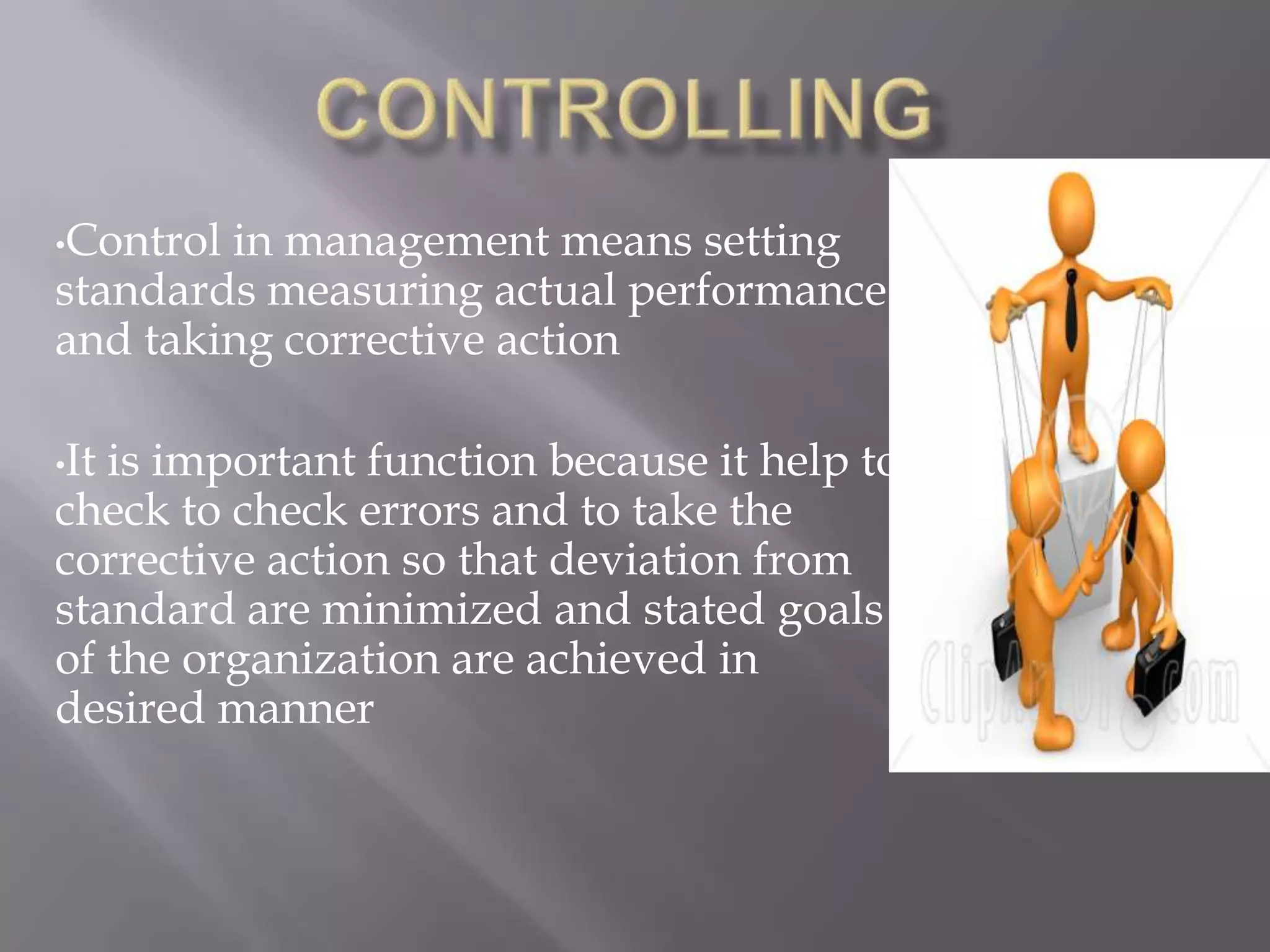
•Controlin management means setting
standards measuring actual performance
and taking corrective action

•Itis important function because it help to
check to check errors and to take the
corrective action so that deviation from
standard are minimized and stated goals
of the organization are achieved in
desired manner
•To maximize the use of scarce
resources
•To achieve purposeful behavior of
organization members
•Improves efficiency and effectiveness

•Make plan effective

•Control aid in decision making
   TRADITIONAL               MODERN
   Personal observation      Management audit
   Break even analysis       Return on investment
   Statistical report        PERT&CPM
   Budgetary control         Management
                               information
•izes
                   wastage
  •IIt ensures optimum utilization of
                resources
•t helps to fix responsibility


•It   motivates employees

•It   minimizes deviation

•It   facilitates delegation
•Controllingmay lower the morale of the staff through
bad supervision in the way of duties are delegated

•Internal
       check system of instituted will frustrate
employees

•It   is usually an expensive system to install and maintain

•Itmay be rigidly designed and not suitable for the type
of business and thus be difficult to sustain
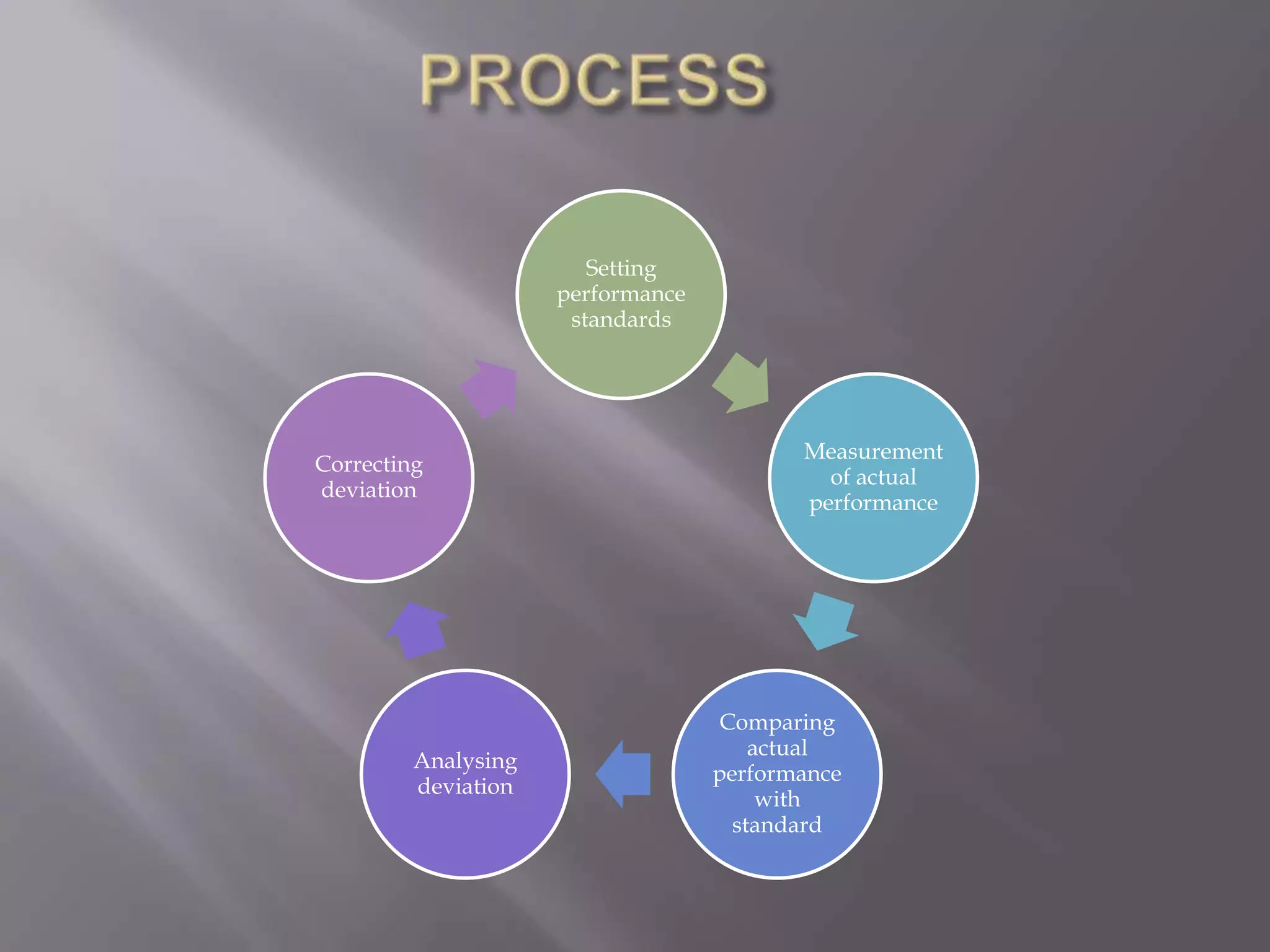
Setting
                     performance
                      standards


                                          Measurement
Correcting
                                            of actual
deviation
                                          performance


                                   Comparing
                                       actual
         Analysing
                                   performance
         deviation
                                        with
                                     standard
•Physical standards
•Cost standards

•Capital standards

•Revenue standards

•Program standards

•Intangible standards

•Goals as standards

•Strategic plans as control points for
strategic control
Standards should be as precise as possible and
  communicated to all persons concerned. Moreover,
 communication alone is not sufficient; understanding
 is necessary. In human systems, standards tend to be
  poorly defined and the allowable range of deviation
from standard also indefinite. For example, how many
  hours each day should a professor be expected to be
  available for student consultation? Or, what kind of
     behavior should be expected by students in the
                       classroom?
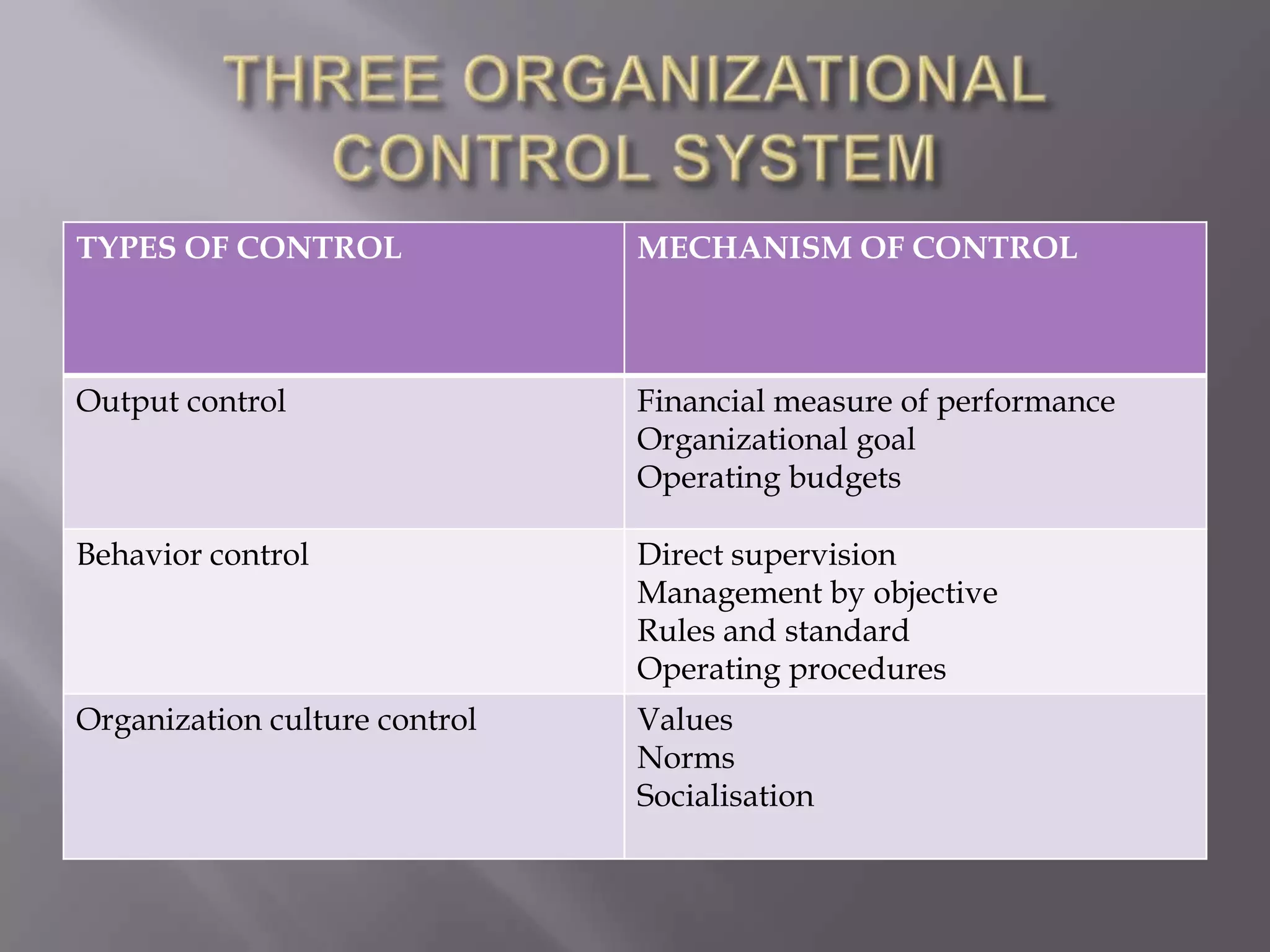
TYPES OF CONTROL               MECHANISM OF CONTROL


Output control                 Financial measure of performance
                               Organizational goal
                               Operating budgets

Behavior control               Direct supervision
                               Management by objective
                               Rules and standard
                               Operating procedures
Organization culture control   Values
                               Norms
                               Socialisation
Brig. (Dr.) R.S. Grewal
Vice Chancellor, Chitkara
University

VIDEO1

Controlling

  • 1.
    •Controlin management meanssetting standards measuring actual performance and taking corrective action •Itis important function because it help to check to check errors and to take the corrective action so that deviation from standard are minimized and stated goals of the organization are achieved in desired manner
  • 2.
    •To maximize theuse of scarce resources •To achieve purposeful behavior of organization members •Improves efficiency and effectiveness •Make plan effective •Control aid in decision making
  • 3.
    TRADITIONAL  MODERN  Personal observation  Management audit  Break even analysis  Return on investment  Statistical report  PERT&CPM  Budgetary control  Management information
  • 4.
    •izes wastage •IIt ensures optimum utilization of resources •t helps to fix responsibility •It motivates employees •It minimizes deviation •It facilitates delegation
  • 5.
    •Controllingmay lower themorale of the staff through bad supervision in the way of duties are delegated •Internal check system of instituted will frustrate employees •It is usually an expensive system to install and maintain •Itmay be rigidly designed and not suitable for the type of business and thus be difficult to sustain
  • 6.
    Setting performance standards Measurement Correcting of actual deviation performance Comparing actual Analysing performance deviation with standard
  • 7.
    •Physical standards •Cost standards •Capitalstandards •Revenue standards •Program standards •Intangible standards •Goals as standards •Strategic plans as control points for strategic control
  • 8.
    Standards should beas precise as possible and communicated to all persons concerned. Moreover, communication alone is not sufficient; understanding is necessary. In human systems, standards tend to be poorly defined and the allowable range of deviation from standard also indefinite. For example, how many hours each day should a professor be expected to be available for student consultation? Or, what kind of behavior should be expected by students in the classroom?
  • 9.
    TYPES OF CONTROL MECHANISM OF CONTROL Output control Financial measure of performance Organizational goal Operating budgets Behavior control Direct supervision Management by objective Rules and standard Operating procedures Organization culture control Values Norms Socialisation
  • 10.
    Brig. (Dr.) R.S.Grewal Vice Chancellor, Chitkara University VIDEO1