Management
Control System
Logistic Management
Management Control
System
Purposes of a management control system
• clearly communicate the organization’s goals
•ensure that every manager and employee understands the
specific actions required of him/her to achieve organizational
goals
• communicate the results of actions across the organization
•ensure that the management control system adjusts to changes
in the environment.
Management Control
System Steps
1. Begin by specifying the organization's goals,
sub goals and objectives.
• Goals are what the organization hopes to
achieve in the long run
• Subgoals or key success factors are more
specific and provide more focus to guide daily
actions
• Objectives are specific benchmarks which
management would like to see achieved
 Important to keep all three in balance to avoid
concentrating solely on short-run achievements
at the expense of long run goals
2. Establish responsibility centers
3. Develop performance measures
4. Measure and report on financial
performance
5. Measure and report on non-
financial performance
Management Control
System Steps
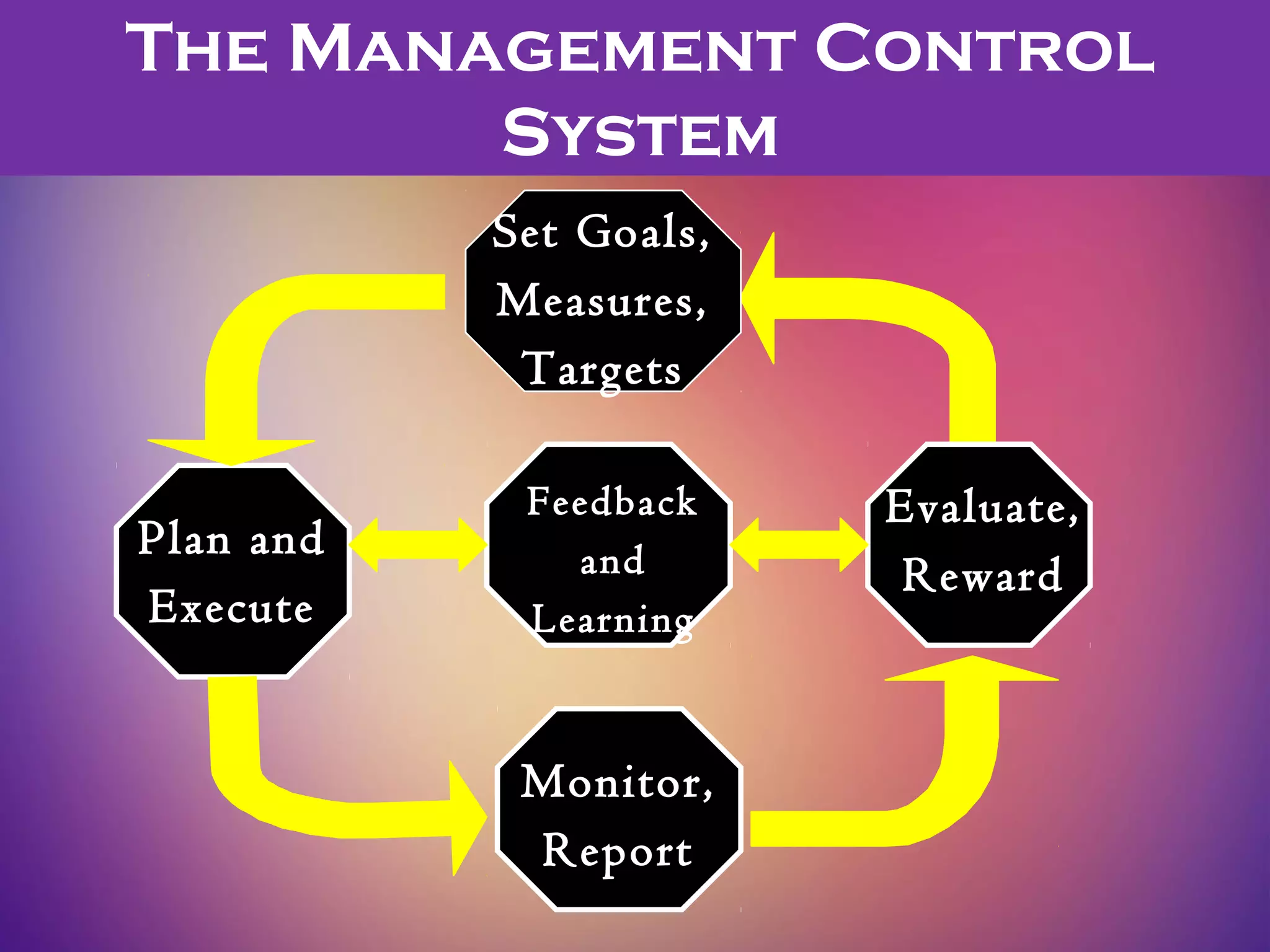
The Management Control
System
Set Goals,
Measures,
Targets
Feedback
and
Learning
Monitor,
Report
Plan and
Execute
Evaluate,
Reward
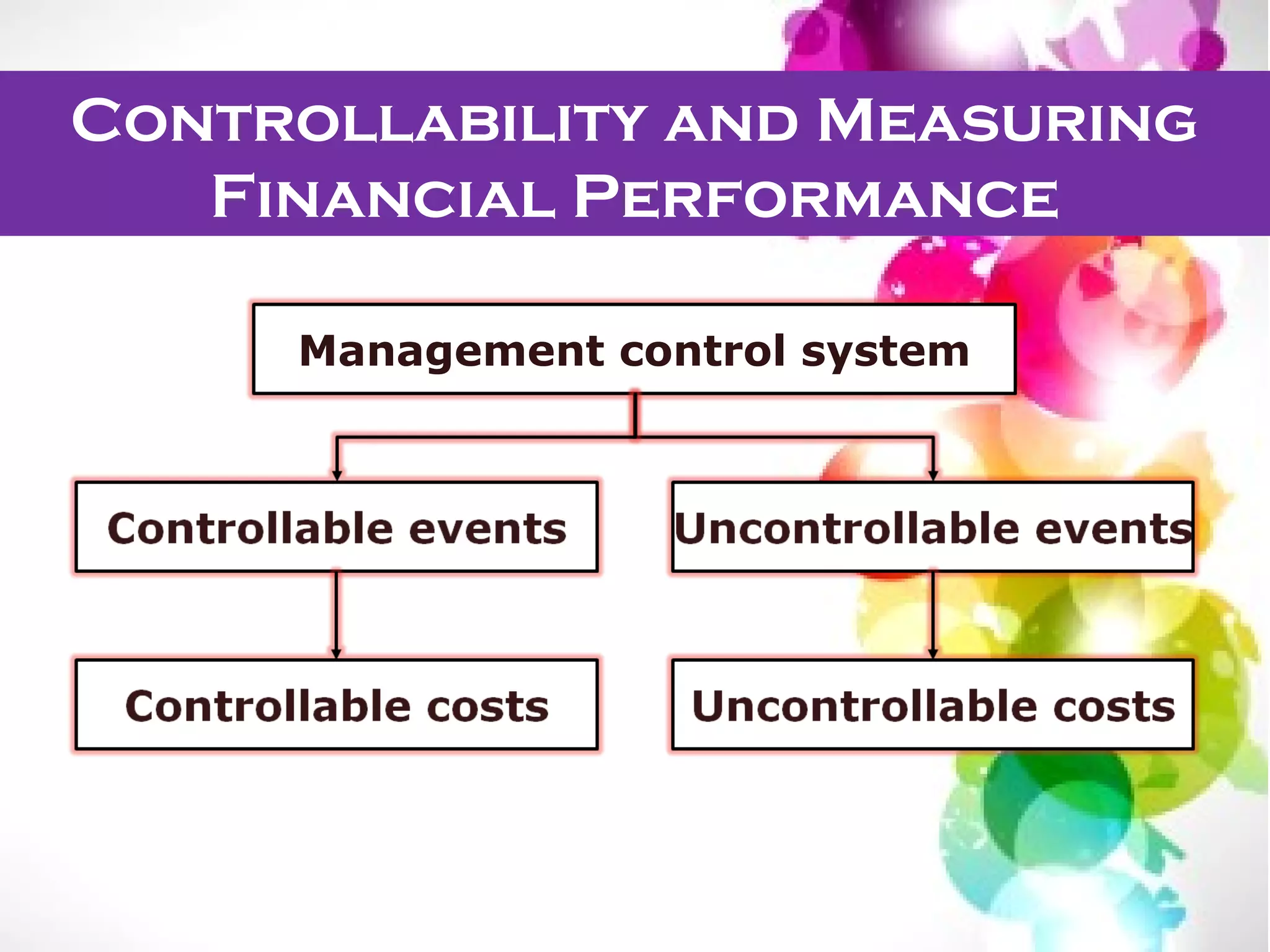
Controllability and Measuring
Financial Performance
Management control system
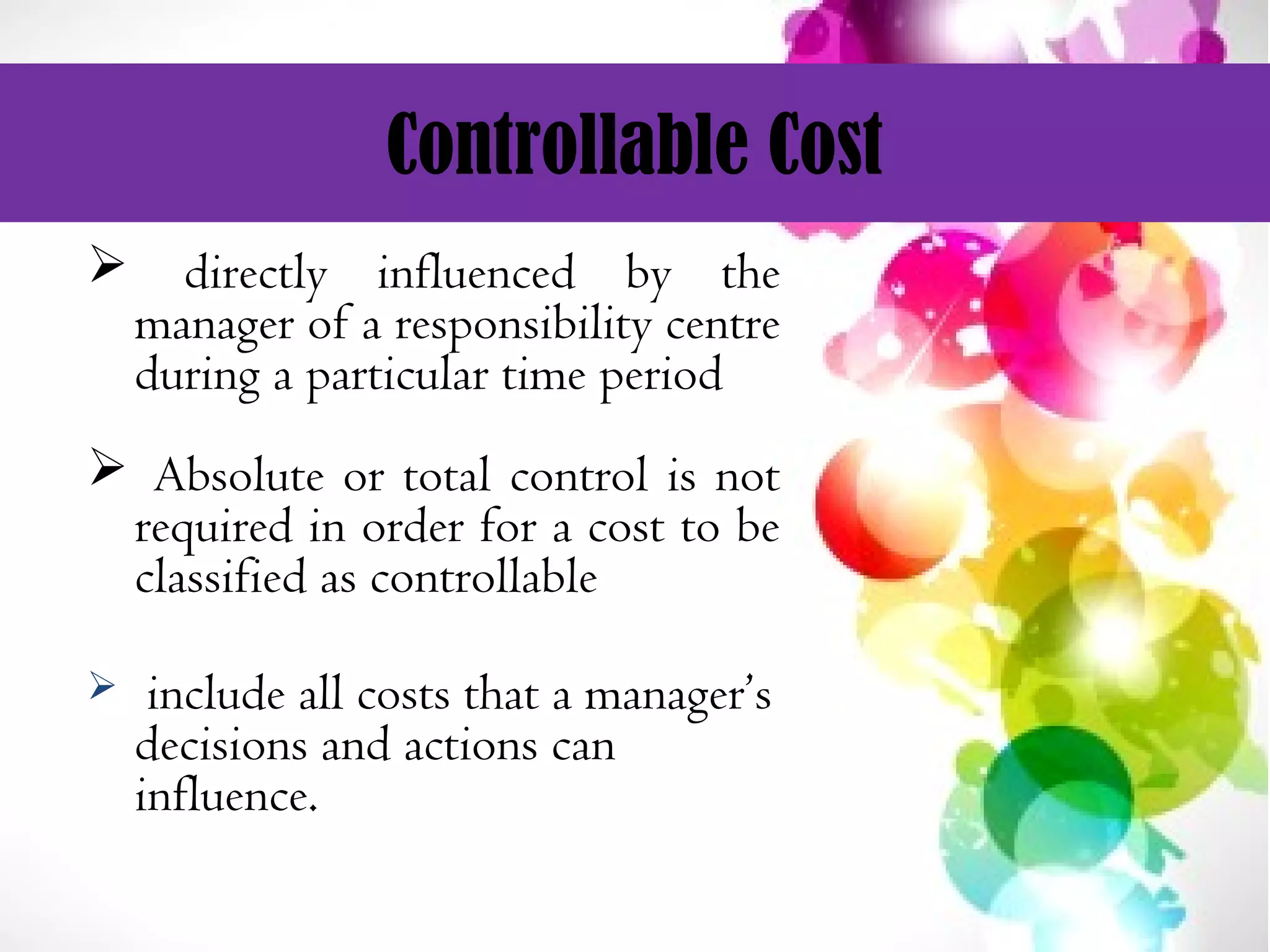
Controllable Cost
 directly influenced by the
manager of a responsibility centre
during a particular time period
 Absolute or total control is not
required in order for a cost to be
classified as controllable
 include all costs that a manager’s
decisions and actions can
influence.
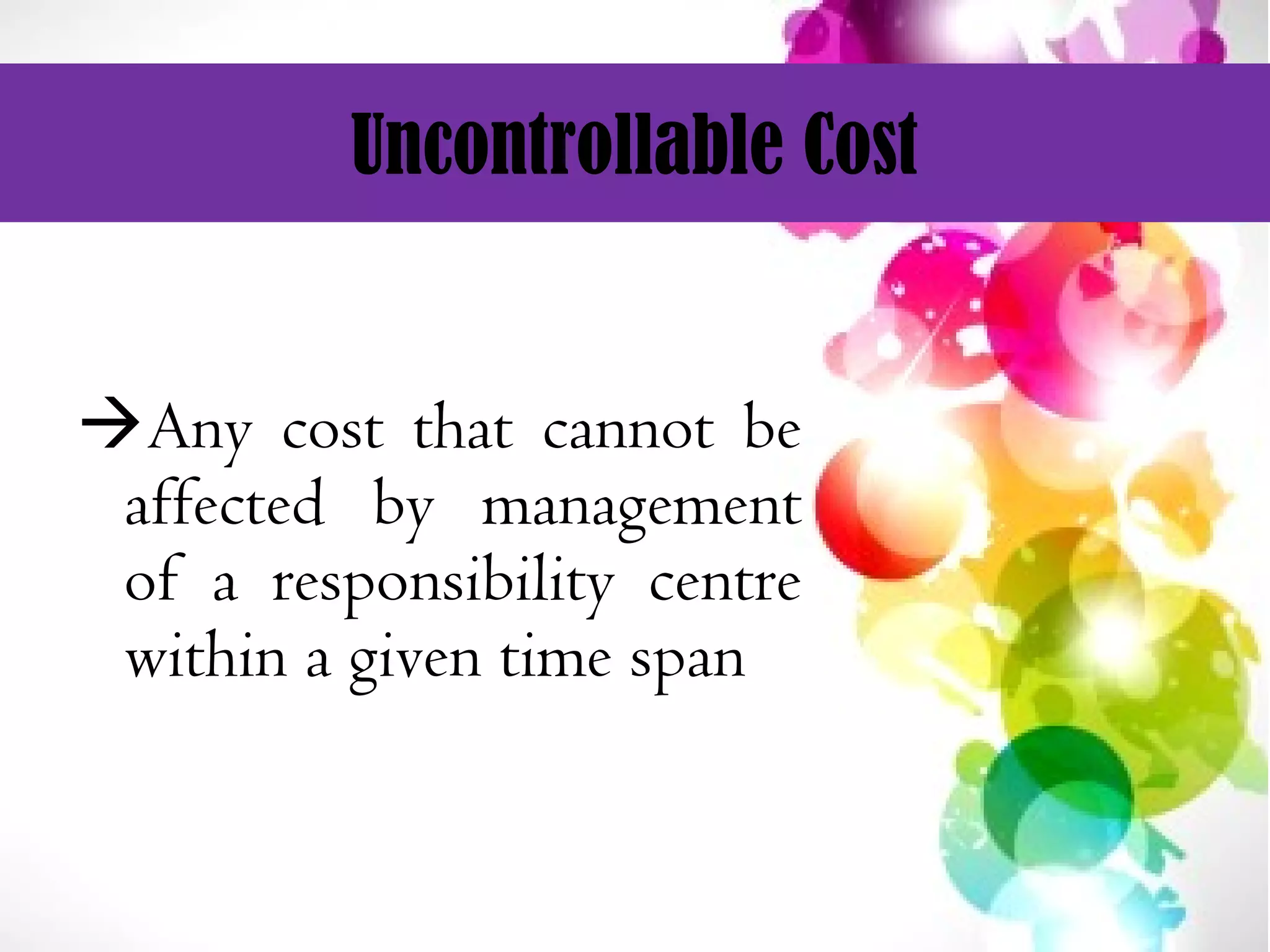
Uncontrollable Cost
Any cost that cannot be
affected by management
of a responsibility centre
within a given time span
Uncontrollable Cost
 Managers help explain the total segment
contribution, but they are responsible only for
the controllable contribution.
 Controllable fixed costs are deducted from the
contribution margin to obtain the contribution
controllable by segment managers.
Controllable costs are usually discretionary fixed
costs such as local advertising and some salaries,
but not the manager’s salary.
Contribution Controllable by
Segment Managers
Performance Measures
1. Control of Quality
2. Control of Cycle Time
3. Control of Productivity
Control of Quality
Quality requires meeting customers'
requirements and maintaining this level
throughout the production and sales process
Four categories:
1. prevention
2. appraisal
3. internal failure
4. external failure
Control of Quality
Prevention costs are the costs incurred to prevent the
production of defective products or delivery of
substandard services.
 Appraisal costs are the costs incurred to identify
defective products or services.
 Internal failure costs are the costs of defective
components and final products or services that are
scrapped or reworked.
 External failure costs are the costs caused by
delivery of defective products or services to customers,
such as field repairs, returns, and warranty expenses.
Control of Cycle Time
 Cycle time is the time taken to complete a
product or service
 The longer a product or service is in
process, the more costs it consumes.
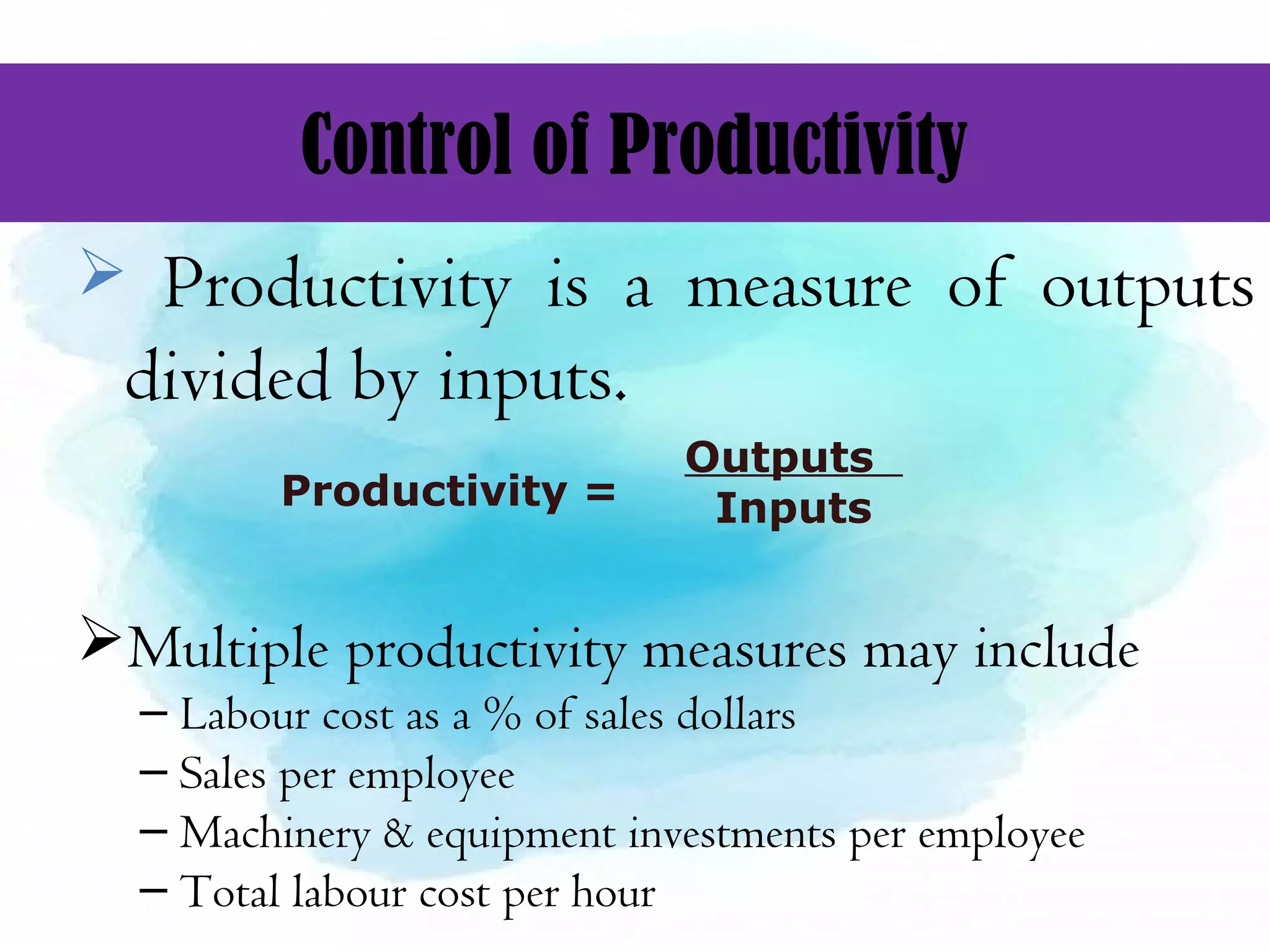
Control of Productivity
 Productivity is a measure of outputs
divided by inputs.
Multiple productivity measures may include
– Labour cost as a % of sales dollars
– Sales per employee
– Machinery & equipment investments per employee
– Total labour cost per hour
Productivity =
Outputs
Inputs
Management Control Systems in Service,
Government and Nonprofit Organizations
Management control systems in nonprofit organizations are not
as highly developed as those in profit-seeking firms because:
 Organizational goals and objectives are less clear.
 Professionals dominate these organizations.
 Measurements are more difficult – no profit measure and heavy fixed
costs.
 Less competitive pressure to improve management control systems.
 The role of budgeting is more a matter of playing bargaining games.
 Motivations and incentives differ from for-profit organizations.
The Future of Management Control
Systems
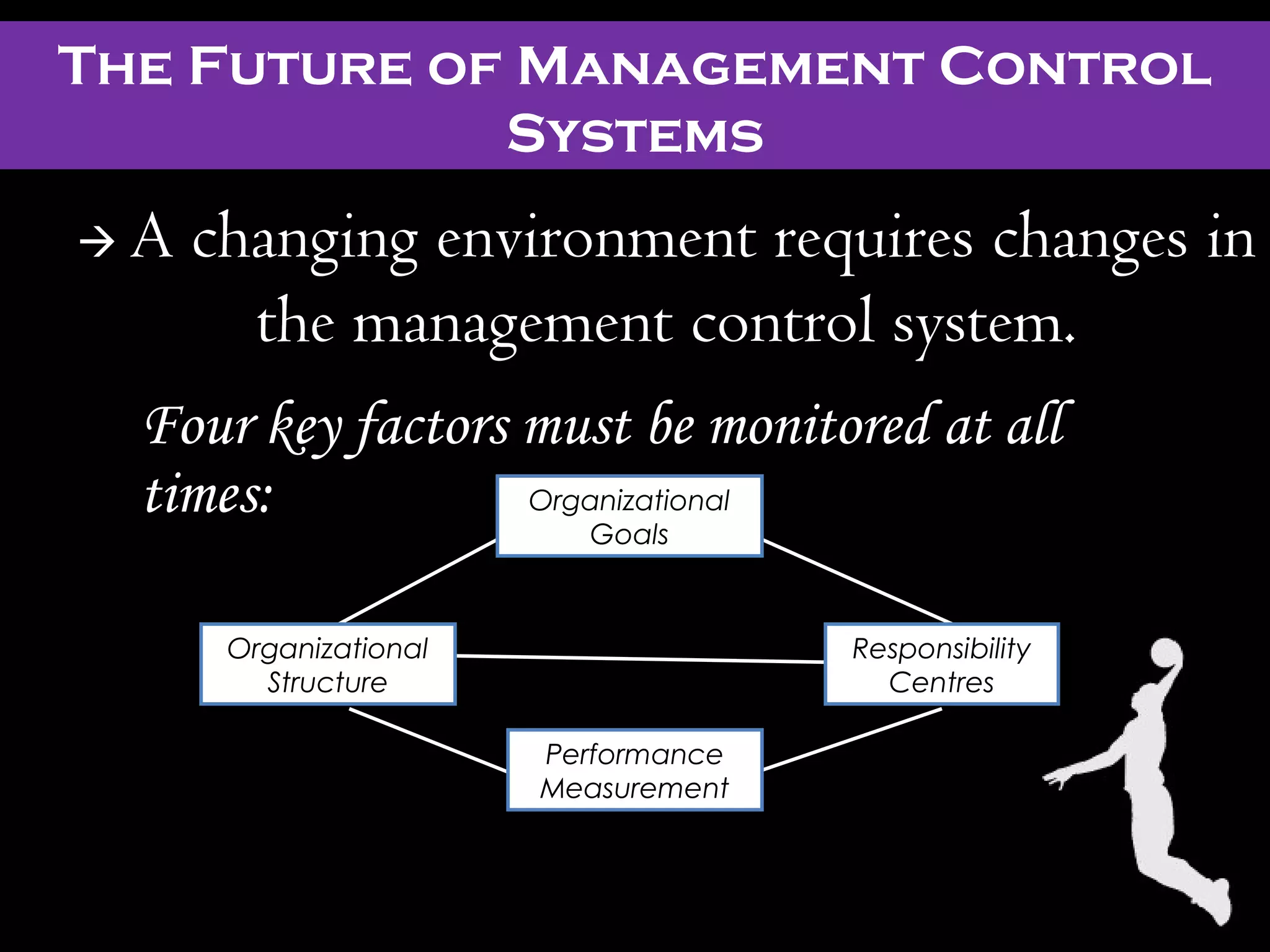
Responsibility
Centres
Organizational
Goals
Organizational
Structure
Performance
Measurement
 A changing environment requires changes in
the management control system.
Four key factors must be monitored at all
times:
The Future of Management Control
Systems
Important factors to keep in mind:
 Individuals will generally behave in their own self-interest
Design systems so that individuals pursuing their own self-
interest will also achieve the organization's objectives
Best benchmark for evaluating current performance is expected or
budgeted performance
Nonfinancial performance is just as important as financial
performance
 Periodically review the success of the management control system
 Learn from your and your competitors' mistakes
Management control system

Management control system

  • 1.
  • 2.
    Management Control System Purposes ofa management control system • clearly communicate the organization’s goals •ensure that every manager and employee understands the specific actions required of him/her to achieve organizational goals • communicate the results of actions across the organization •ensure that the management control system adjusts to changes in the environment.
  • 3.
    Management Control System Steps 1.Begin by specifying the organization's goals, sub goals and objectives. • Goals are what the organization hopes to achieve in the long run • Subgoals or key success factors are more specific and provide more focus to guide daily actions • Objectives are specific benchmarks which management would like to see achieved  Important to keep all three in balance to avoid concentrating solely on short-run achievements at the expense of long run goals
  • 4.
    2. Establish responsibilitycenters 3. Develop performance measures 4. Measure and report on financial performance 5. Measure and report on non- financial performance Management Control System Steps
  • 5.
    The Management Control System SetGoals, Measures, Targets Feedback and Learning Monitor, Report Plan and Execute Evaluate, Reward
  • 6.
    Controllability and Measuring FinancialPerformance Management control system
  • 7.
    Controllable Cost  directlyinfluenced by the manager of a responsibility centre during a particular time period  Absolute or total control is not required in order for a cost to be classified as controllable  include all costs that a manager’s decisions and actions can influence.
  • 8.
    Uncontrollable Cost Any costthat cannot be affected by management of a responsibility centre within a given time span Uncontrollable Cost
  • 9.
     Managers helpexplain the total segment contribution, but they are responsible only for the controllable contribution.  Controllable fixed costs are deducted from the contribution margin to obtain the contribution controllable by segment managers. Controllable costs are usually discretionary fixed costs such as local advertising and some salaries, but not the manager’s salary. Contribution Controllable by Segment Managers
  • 10.
    Performance Measures 1. Controlof Quality 2. Control of Cycle Time 3. Control of Productivity
  • 11.
    Control of Quality Qualityrequires meeting customers' requirements and maintaining this level throughout the production and sales process Four categories: 1. prevention 2. appraisal 3. internal failure 4. external failure
  • 12.
    Control of Quality Preventioncosts are the costs incurred to prevent the production of defective products or delivery of substandard services.  Appraisal costs are the costs incurred to identify defective products or services.  Internal failure costs are the costs of defective components and final products or services that are scrapped or reworked.  External failure costs are the costs caused by delivery of defective products or services to customers, such as field repairs, returns, and warranty expenses.
  • 13.
    Control of CycleTime  Cycle time is the time taken to complete a product or service  The longer a product or service is in process, the more costs it consumes.
  • 14.
    Control of Productivity Productivity is a measure of outputs divided by inputs. Multiple productivity measures may include – Labour cost as a % of sales dollars – Sales per employee – Machinery & equipment investments per employee – Total labour cost per hour Productivity = Outputs Inputs
  • 15.
    Management Control Systemsin Service, Government and Nonprofit Organizations Management control systems in nonprofit organizations are not as highly developed as those in profit-seeking firms because:  Organizational goals and objectives are less clear.  Professionals dominate these organizations.  Measurements are more difficult – no profit measure and heavy fixed costs.  Less competitive pressure to improve management control systems.  The role of budgeting is more a matter of playing bargaining games.  Motivations and incentives differ from for-profit organizations.
  • 16.
    The Future ofManagement Control Systems Responsibility Centres Organizational Goals Organizational Structure Performance Measurement  A changing environment requires changes in the management control system. Four key factors must be monitored at all times:
  • 17.
    The Future ofManagement Control Systems Important factors to keep in mind:  Individuals will generally behave in their own self-interest Design systems so that individuals pursuing their own self- interest will also achieve the organization's objectives Best benchmark for evaluating current performance is expected or budgeted performance Nonfinancial performance is just as important as financial performance  Periodically review the success of the management control system  Learn from your and your competitors' mistakes