Managing and the
Manager’s Job
Lecture One
Safiul Azam, ACMA
Learning Objectives
1–2
After studying this chapter, you should be able to:
1. Describe the nature of management, define management and managers, and
characterize their importance to contemporary organizations.
2. Identify and briefly explain the four basic management functions in
organizations.
3. Describe the kinds of managers found at different levels and in different areas
of the organization.
4. Identify the basic managerial roles that managers may play and the skills they
need in order to be successful.
5. Discuss the science and the art of management, describe how people become
managers, and summarize the scope of management in organizations.
6. Characterize the new workplace that is emerging in organizations today.
Safiul Azam, ACMA
What is Management?
1–3
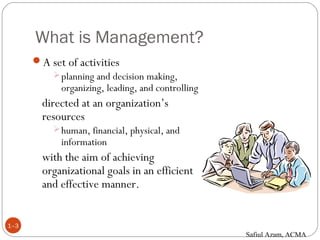
A set of activities
planning and decision making,
organizing, leading, and controlling
directed at an organization’s
resources
human, financial, physical, and
information
with the aim of achieving
organizational goals in an efficient
and effective manner.
Safiul Azam, ACMA
Organizational Resources
1–4
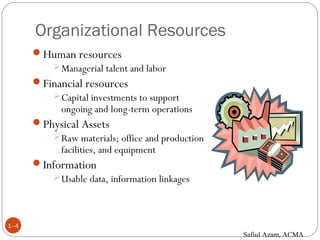
Human resources
Managerial talent and labor
Financial resources
Capital investments to support
ongoing and long-term operations
Physical Assets
Raw materials; office and production
facilities, and equipment
Information
Usable data, information linkages
Safiul Azam, ACMA
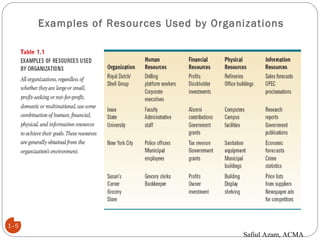
Examples of Resources Used by Organizations
1–5
Safiul Azam, ACMA
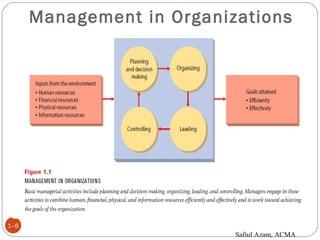
Management in Organizations
1–6
Safiul Azam, ACMA
1–7
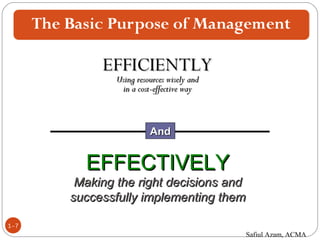
EFFICIENTLYEFFICIENTLY
Using resources wisely andUsing resources wisely and
in a cost-effective wayin a cost-effective way
EFFECTIVELYEFFECTIVELY
Making the right decisions andMaking the right decisions and
successfully implementing themsuccessfully implementing them
AndAnd
Safiul Azam, ACMA
What is a Manager?
1–8
Someone whose primary
responsibility is to carry out the
management process.
Someone who plans and makes
decisions, organizes, leads, and
controls human, financial, physical,
and information resources.
Safiul Azam, ACMA
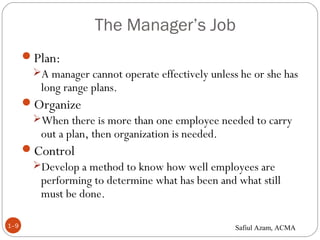
The Manager’s Job
1–9
Plan:
A manager cannot operate effectively unless he or she has
long range plans.
Organize
When there is more than one employee needed to carry
out a plan, then organization is needed.
Control
Develop a method to know how well employees are
performing to determine what has been and what still
must be done.
Safiul Azam, ACMA
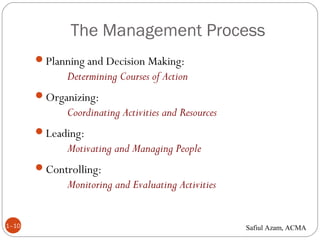
The Management Process
1–10
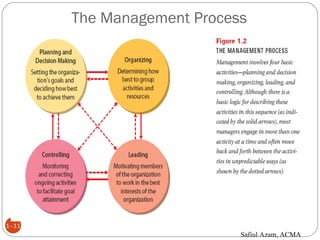
Planning and Decision Making:
Determining Courses of Action
Organizing:
Coordinating Activities and Resources
Leading:
Motivating and Managing People
Controlling:
Monitoring and Evaluating Activities
Safiul Azam, ACMA
The Management Process
1–11
Safiul Azam, ACMA
Kinds of Managers by Level
1–12
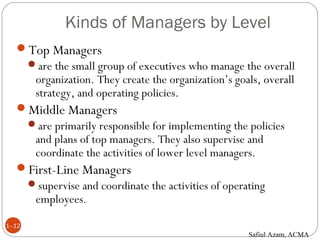
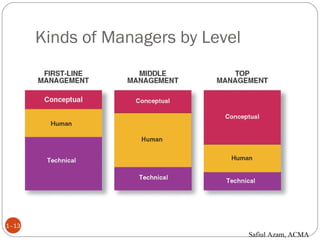
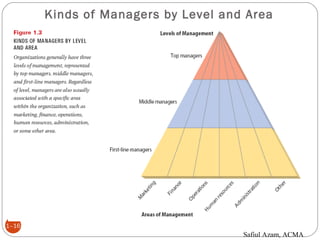
Top Managers
are the small group of executives who manage the overall
organization. They create the organization’s goals, overall
strategy, and operating policies.
Middle Managers
are primarily responsible for implementing the policies
and plans of top managers. They also supervise and
coordinate the activities of lower level managers.
First-Line Managers
supervise and coordinate the activities of operating
employees.
Safiul Azam, ACMA
Kinds of Managers by Level
1–13
Safiul Azam, ACMA
Kinds of Managers by Area
1–14
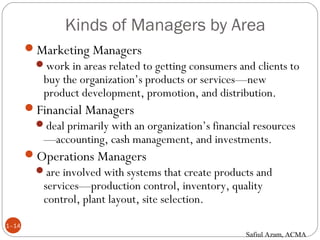
Marketing Managers
work in areas related to getting consumers and clients to
buy the organization’s products or services—new
product development, promotion, and distribution.
Financial Managers
deal primarily with an organization’s financial resources
—accounting, cash management, and investments.
Operations Managers
are involved with systems that create products and
services—production control, inventory, quality
control, plant layout, site selection.
Safiul Azam, ACMA
Kinds of Managers by Area
(cont’d)
1–15
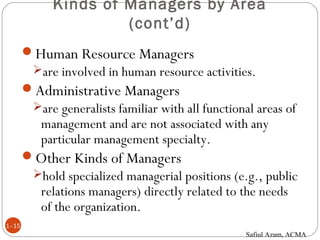
Human Resource Managers
are involved in human resource activities.
Administrative Managers
are generalists familiar with all functional areas of
management and are not associated with any
particular management specialty.
Other Kinds of Managers
hold specialized managerial positions (e.g., public
relations managers) directly related to the needs
of the organization.
Safiul Azam, ACMA
Kinds of Managers by Level and Area
1–16
Safiul Azam, ACMA
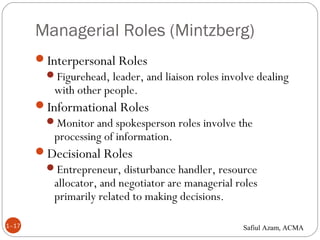
Managerial Roles (Mintzberg)
1–17
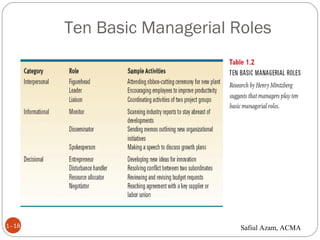
Interpersonal Roles
Figurehead, leader, and liaison roles involve dealing
with other people.
Informational Roles
Monitor and spokesperson roles involve the
processing of information.
Decisional Roles
Entrepreneur, disturbance handler, resource
allocator, and negotiator are managerial roles
primarily related to making decisions.
Safiul Azam, ACMA
Ten Basic Managerial Roles
1–18 Safiul Azam, ACMA
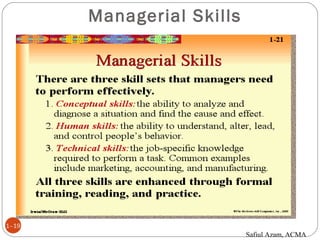
Managerial Skills
1–19
Safiul Azam, ACMA
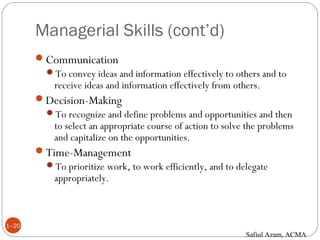
Managerial Skills (cont’d)
1–20
Communication
To convey ideas and information effectively to others and to
receive ideas and information effectively from others.
Decision-Making
To recognize and define problems and opportunities and then
to select an appropriate course of action to solve the problems
and capitalize on the opportunities.
Time-Management
To prioritize work, to work efficiently, and to delegate
appropriately.
Safiul Azam, ACMA
Management: Science or Art?
1–21
The Science of Management
Assumes that problems can be approached using rational, logical,
objective, and systematic ways.
Requires the use of technical, diagnostic, and decision-making skills
and techniques to solve problems.
Art of Management
Making decisions and solving problems using a blend of intuition,
experience, instinct, and personal insights.
Using conceptual, communication, interpersonal, and time-
management skills to accomplish the tasks associated with managerial
activities.
Safiul Azam, ACMA
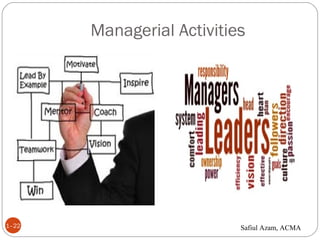
Managerial Activities
1–22 Safiul Azam, ACMA
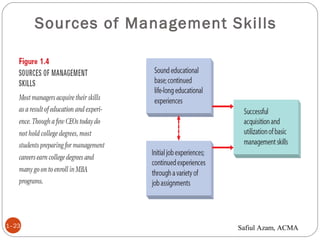
Sources of Management Skills
1–23 Safiul Azam, ACMA
The Management Process
1–24
Management process is a process of planning and controlling
 the organizing and leading execution of any type of activity, such
as:
a project (project management process) or
a process (process management process, sometimes referred
to as the process performance measurement and management
system).
The organization's senior management is responsible for carrying
out its management process. However, this is not always the case
for all management processes; for example, it is the
responsibility of the project manager to carry out a project
management process.
Safiul Azam, ACMA
Nature of Managerial Work
1–25
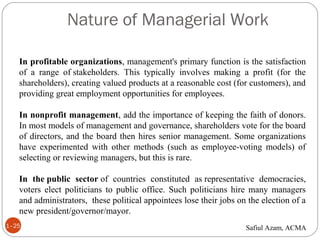
In profitable organizations, management's primary function is the satisfaction
of a range of stakeholders. This typically involves making a profit (for the
shareholders), creating valued products at a reasonable cost (for customers), and
providing great employment opportunities for employees.
In nonprofit management, add the importance of keeping the faith of donors.
In most models of management and governance, shareholders vote for the board
of directors, and the board then hires senior management. Some organizations
have experimented with other methods (such as employee-voting models) of
selecting or reviewing managers, but this is rare.
In the public sector of countries constituted as representative democracies,
voters elect politicians to public office. Such politicians hire many managers
and administrators, these political appointees lose their jobs on the election of a
new president/governor/mayor.
Safiul Azam, ACMA
Managing in Organizations
1–26
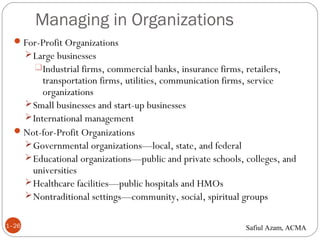
For-Profit Organizations
Large businesses
Industrial firms, commercial banks, insurance firms, retailers,
transportation firms, utilities, communication firms, service
organizations
Small businesses and start-up businesses
International management
Not-for-Profit Organizations
Governmental organizations—local, state, and federal
Educational organizations—public and private schools, colleges, and
universities
Healthcare facilities—public hospitals and HMOs
Nontraditional settings—community, social, spiritual groups
Safiul Azam, ACMA
Key Terms
1–27
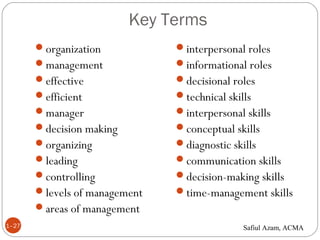
organization
management
effective
efficient
manager
decision making
organizing
leading
controlling
levels of management
areas of management
interpersonal roles
informational roles
decisional roles
technical skills
interpersonal skills
conceptual skills
diagnostic skills
communication skills
decision-making skills
time-management skills
Safiul Azam, ACMA

management by griffin note

  • 1.
    Managing and the Manager’sJob Lecture One Safiul Azam, ACMA
  • 2.
    Learning Objectives 1–2 After studyingthis chapter, you should be able to: 1. Describe the nature of management, define management and managers, and characterize their importance to contemporary organizations. 2. Identify and briefly explain the four basic management functions in organizations. 3. Describe the kinds of managers found at different levels and in different areas of the organization. 4. Identify the basic managerial roles that managers may play and the skills they need in order to be successful. 5. Discuss the science and the art of management, describe how people become managers, and summarize the scope of management in organizations. 6. Characterize the new workplace that is emerging in organizations today. Safiul Azam, ACMA
  • 3.
    What is Management? 1–3 Aset of activities planning and decision making, organizing, leading, and controlling directed at an organization’s resources human, financial, physical, and information with the aim of achieving organizational goals in an efficient and effective manner. Safiul Azam, ACMA
  • 4.
    Organizational Resources 1–4 Human resources Managerialtalent and labor Financial resources Capital investments to support ongoing and long-term operations Physical Assets Raw materials; office and production facilities, and equipment Information Usable data, information linkages Safiul Azam, ACMA
  • 5.
    Examples of ResourcesUsed by Organizations 1–5 Safiul Azam, ACMA
  • 6.
  • 7.
    1–7 EFFICIENTLYEFFICIENTLY Using resources wiselyandUsing resources wisely and in a cost-effective wayin a cost-effective way EFFECTIVELYEFFECTIVELY Making the right decisions andMaking the right decisions and successfully implementing themsuccessfully implementing them AndAnd Safiul Azam, ACMA
  • 8.
    What is aManager? 1–8 Someone whose primary responsibility is to carry out the management process. Someone who plans and makes decisions, organizes, leads, and controls human, financial, physical, and information resources. Safiul Azam, ACMA
  • 9.
    The Manager’s Job 1–9 Plan: Amanager cannot operate effectively unless he or she has long range plans. Organize When there is more than one employee needed to carry out a plan, then organization is needed. Control Develop a method to know how well employees are performing to determine what has been and what still must be done. Safiul Azam, ACMA
  • 10.
    The Management Process 1–10 Planningand Decision Making: Determining Courses of Action Organizing: Coordinating Activities and Resources Leading: Motivating and Managing People Controlling: Monitoring and Evaluating Activities Safiul Azam, ACMA
  • 11.
  • 12.
    Kinds of Managersby Level 1–12 Top Managers are the small group of executives who manage the overall organization. They create the organization’s goals, overall strategy, and operating policies. Middle Managers are primarily responsible for implementing the policies and plans of top managers. They also supervise and coordinate the activities of lower level managers. First-Line Managers supervise and coordinate the activities of operating employees. Safiul Azam, ACMA
  • 13.
    Kinds of Managersby Level 1–13 Safiul Azam, ACMA
  • 14.
    Kinds of Managersby Area 1–14 Marketing Managers work in areas related to getting consumers and clients to buy the organization’s products or services—new product development, promotion, and distribution. Financial Managers deal primarily with an organization’s financial resources —accounting, cash management, and investments. Operations Managers are involved with systems that create products and services—production control, inventory, quality control, plant layout, site selection. Safiul Azam, ACMA
  • 15.
    Kinds of Managersby Area (cont’d) 1–15 Human Resource Managers are involved in human resource activities. Administrative Managers are generalists familiar with all functional areas of management and are not associated with any particular management specialty. Other Kinds of Managers hold specialized managerial positions (e.g., public relations managers) directly related to the needs of the organization. Safiul Azam, ACMA
  • 16.
    Kinds of Managersby Level and Area 1–16 Safiul Azam, ACMA
  • 17.
    Managerial Roles (Mintzberg) 1–17 InterpersonalRoles Figurehead, leader, and liaison roles involve dealing with other people. Informational Roles Monitor and spokesperson roles involve the processing of information. Decisional Roles Entrepreneur, disturbance handler, resource allocator, and negotiator are managerial roles primarily related to making decisions. Safiul Azam, ACMA
  • 18.
    Ten Basic ManagerialRoles 1–18 Safiul Azam, ACMA
  • 19.
  • 20.
    Managerial Skills (cont’d) 1–20 Communication Toconvey ideas and information effectively to others and to receive ideas and information effectively from others. Decision-Making To recognize and define problems and opportunities and then to select an appropriate course of action to solve the problems and capitalize on the opportunities. Time-Management To prioritize work, to work efficiently, and to delegate appropriately. Safiul Azam, ACMA
  • 21.
    Management: Science orArt? 1–21 The Science of Management Assumes that problems can be approached using rational, logical, objective, and systematic ways. Requires the use of technical, diagnostic, and decision-making skills and techniques to solve problems. Art of Management Making decisions and solving problems using a blend of intuition, experience, instinct, and personal insights. Using conceptual, communication, interpersonal, and time- management skills to accomplish the tasks associated with managerial activities. Safiul Azam, ACMA
  • 22.
  • 23.
    Sources of ManagementSkills 1–23 Safiul Azam, ACMA
  • 24.
    The Management Process 1–24 Managementprocess is a process of planning and controlling  the organizing and leading execution of any type of activity, such as: a project (project management process) or a process (process management process, sometimes referred to as the process performance measurement and management system). The organization's senior management is responsible for carrying out its management process. However, this is not always the case for all management processes; for example, it is the responsibility of the project manager to carry out a project management process. Safiul Azam, ACMA
  • 25.
    Nature of ManagerialWork 1–25 In profitable organizations, management's primary function is the satisfaction of a range of stakeholders. This typically involves making a profit (for the shareholders), creating valued products at a reasonable cost (for customers), and providing great employment opportunities for employees. In nonprofit management, add the importance of keeping the faith of donors. In most models of management and governance, shareholders vote for the board of directors, and the board then hires senior management. Some organizations have experimented with other methods (such as employee-voting models) of selecting or reviewing managers, but this is rare. In the public sector of countries constituted as representative democracies, voters elect politicians to public office. Such politicians hire many managers and administrators, these political appointees lose their jobs on the election of a new president/governor/mayor. Safiul Azam, ACMA
  • 26.
    Managing in Organizations 1–26 For-ProfitOrganizations Large businesses Industrial firms, commercial banks, insurance firms, retailers, transportation firms, utilities, communication firms, service organizations Small businesses and start-up businesses International management Not-for-Profit Organizations Governmental organizations—local, state, and federal Educational organizations—public and private schools, colleges, and universities Healthcare facilities—public hospitals and HMOs Nontraditional settings—community, social, spiritual groups Safiul Azam, ACMA
  • 27.
    Key Terms 1–27 organization management effective efficient manager decision making organizing leading controlling levelsof management areas of management interpersonal roles informational roles decisional roles technical skills interpersonal skills conceptual skills diagnostic skills communication skills decision-making skills time-management skills Safiul Azam, ACMA