Chapter One
Chapter One
Management
Management
1–1
Management
Management
Process
Process
Planning
Planning
Planning defines where the organization wants to be in
future and how to get there.
•Example:
• An example of good planning comes from walt Disney
Company, where its CEO and management decided to
revive the company by focusing on resources. Coordinated
planning of the management was they sell tons of CDs,
have their own Disney TV Channels, films and making T–
shirts
Organizing
Organizing
• Organizing involves assigning tasks, grouping
tasks into Departments, delegating authority
and allocating resources across the
organization.
• Example:
• Organization Chart
• Process flow chart
• Jobs description
Leading
Leading
• Leading is the use of influence to motivate employees to
achieve organizational goals. Leading means creating
culture and values, communicating to the people through
the organization.
Controlling
Controlling
Controlling means
monitoring employees’
activities determining
whether the organization is
on target toward its goals,
and making corrections as
necessary.
Organization
Organization
• A deliberate arrangement of people to accomplish
some specific purpose (that individuals independently
could not accomplish alone).
• Common Characteristics of Organizations
• Have a distinct purpose (goal)
• Composed of people
• Have a deliberate structure
Organizational Resources
–Organizational resources are all assets that are available
to use in production process.
• Human Resources
• Financial Resources
• Capital resources
• Physical resources
• Information resources
Efficiency & effectiveness
–Efficiency
– Getting the most output for the least inputs
–Effectiveness
– Attaining organizational goals by doing right things
Organizational Goals
•Vision-Dream of the organization
•Mission-reason of existing an
organization
Management
Management
It is the process of planning, organizing, leading,
and controlling organizational resources
effectively and efficiently to meet organizational
goals.
Exhibit 2–1 Development of Major Management Theories
Major Approaches to Management
• Classical Approach
–Scientific Management
–General Administrative Theory
• Quantitative Approach
• Behavioral Approach
• Contemporary Approach
–Systems Theory
–Contingency Approach
2–15
Classical Approach
Classical Approach
Scientific Management
• Fredrick Winslow Taylor
–The “father” of scientific management
–Published Principles of Scientific Management (1911)
• The theory of scientific management
– Using scientific methods to define the “one best way” for a job to
be done:
»Putting the right person on the job with the correct tools and
equipment.
»Having a standardized method of doing the job.
»Providing an economic incentive to the worker.
2–16
Exhibit 2–2 Taylor’s Four Principles of Management
1. Develop a science for each element of an individual’s
work, which will replace the old rule-of-thumb method.
2. Scientifically select and then train, teach, and develop the
worker.
3. Heartily cooperate with the workers so as to ensure that
all work is done in accordance with the principles of the
science that has been developed.
4. Divide work and responsibility almost equally between
management and workers. Management takes over all
work for which it is better fitted than the workers.
© 2007 Prentice Hall, Inc. All rights
reserved.
2–17
Scientific Management (cont’d)
• Frank and Lillian Gilbreth
–Focused on increasing worker productivity through the
reduction of wasted motion
–Developed the micro chronometer to time worker
motions and optimize work performance
• How Do Today’s Managers Use Scientific
Management?
–Use time and motion studies to increase productivity
–Hire the best qualified employees
–Design incentive systems based on output
© 2007 Prentice Hall, Inc. All rights
reserved.
2–18
General Administrative Theory
• Henri Fayol
–Believed that the practice of management was distinct
from other organizational functions
–Developed fourteen principles of management that
applied to all organizational situations
• Max Weber
–Developed a theory of authority based on an ideal
type of organization (bureaucracy)
• Emphasized rationality, predictability, impersonality,
technical competence, and authoritarianism
2–19
Exhibit 2–3
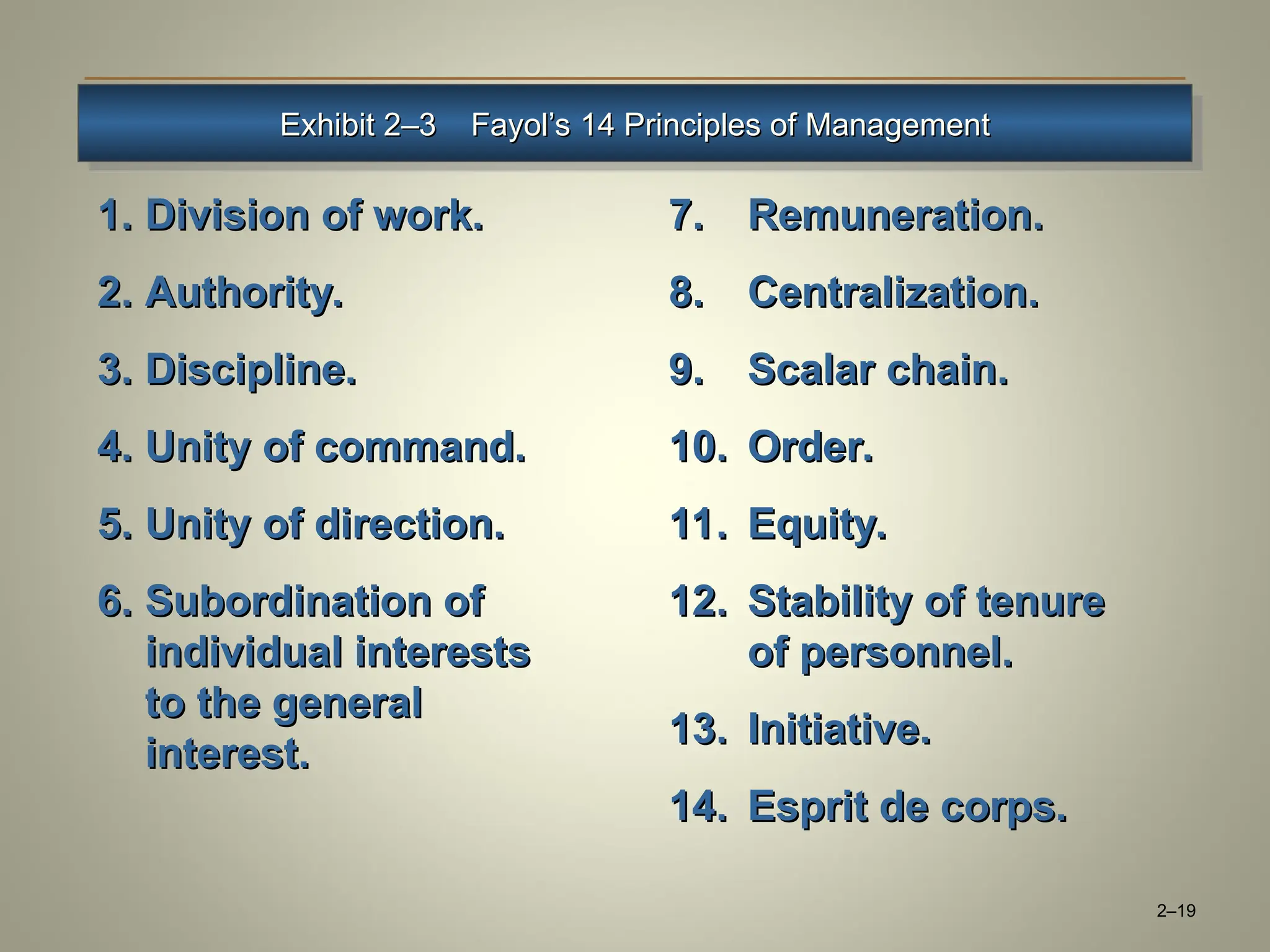
Exhibit 2–3 Fayol’s 14 Principles of Management
Fayol’s 14 Principles of Management
1.
1. Division of work.
Division of work.
2.
2. Authority.
Authority.
3.
3. Discipline.
Discipline.
4.
4. Unity of command.
Unity of command.
5.
5. Unity of direction.
Unity of direction.
6.
6. Subordination of
Subordination of
individual interests
to the general
to the general
interest.
interest.
7.
7. Remuneration.
Remuneration.
8.
8. Centralization.
Centralization.
9.
9. Scalar chain.
Scalar chain.
10.
10. Order.
Order.
11.
11. Equity.
Equity.
12.
12. Stability of tenure
Stability of tenure
of personnel.
of personnel.
13.
13. Initiative.
Initiative.
14.
14. Esprit de corps.
Esprit de corps.
© 2007 Prentice Hall, Inc. All rights
reserved.
2–20
Exhibit 2–4 Weber’s Ideal Bureaucracy
© 2007 Prentice Hall, Inc. All rights
reserved.
2–21
Quantitative Approach to Management
• Quantitative Approach
–Also called operations research or management
science
–Evolved from mathematical and statistical methods
developed to solve WWII military logistics and quality
control problems
–Focuses on improving managerial decision making by
applying:
• Statistics, optimization models, information models, and
computer simulations
© 2007 Prentice Hall, Inc. All rights
reserved.
2–22
Quantitative Approach to Management
(cont’d) …..
• Total Quality Management
–Another area where quantitative techniques are used
–A philosophy of management driven by continual
improvement in the quality of work processes and
responding to customer needs and expectations
–Inspired by the total quality management (TQM) ideas
of Deming and Juran
–Quality is not directly related to cost
–Poor quality results in lower productivity
© 2007 Prentice Hall, Inc. All rights
reserved.
2–23
Main Principles of TQM
• Prevention is better than cure. In the long run, it is
cheaper to stop products defects than trying to find them
• Zero defects The ultimate aim is no (zero) defects - or
exceptionally low defect levels if a product or service is
complicated
• Getting things right first time Better not to produce at
all than produce something defective
• Quality involves everyone Quality is not just the
concern of the production or operations department - it
involves everyone, including marketing, finance and
human resources
© 2007 Prentice Hall, Inc. All rights
reserved.
2–24
Main Principles of TQM
• Continuous improvement Businesses should
always be looking for ways to improve
processes to help quality
• Employee involvement Those involved in
production and operations have a vital role to
play in spotting improvement opportunities for
quality and in identifying quality problems
© 2007 Prentice Hall, Inc. All rights
reserved.
2–25
© 2007 Prentice Hall, Inc. All rights
reserved.
2–26
Behavioral Approach
• Organizational Behavior (OB)
–The study of the actions of people at work; people are
the most important asset of an organization
• Early OB Advocates
–Robert Owen
–Hugo Munsterberg
–Mary Parker Follett
–Chester Barnard
© 2007 Prentice Hall, Inc. All rights
reserved.
2–27
•A series of productivity experiments conducted
A series of productivity experiments conducted
at Western Electric from 1927 to 1932.
•Experimental findings
Experimental findings
Productivity unexpectedly increased under imposed
Productivity unexpectedly increased under imposed
adverse working conditions.
The results indicated that the incentive plan had less
The results indicated that the incentive plan had less
effect on a worker’s output than did group pressure,
acceptance, and security.
•Research conclusion
Research conclusion
Social norms, group standards and attitudes more
Social norms, group standards and attitudes more
strongly influence individual output and work behavior
than do monetary incentives.
The Hawthorne Studies
2–28
Contemporary Approach
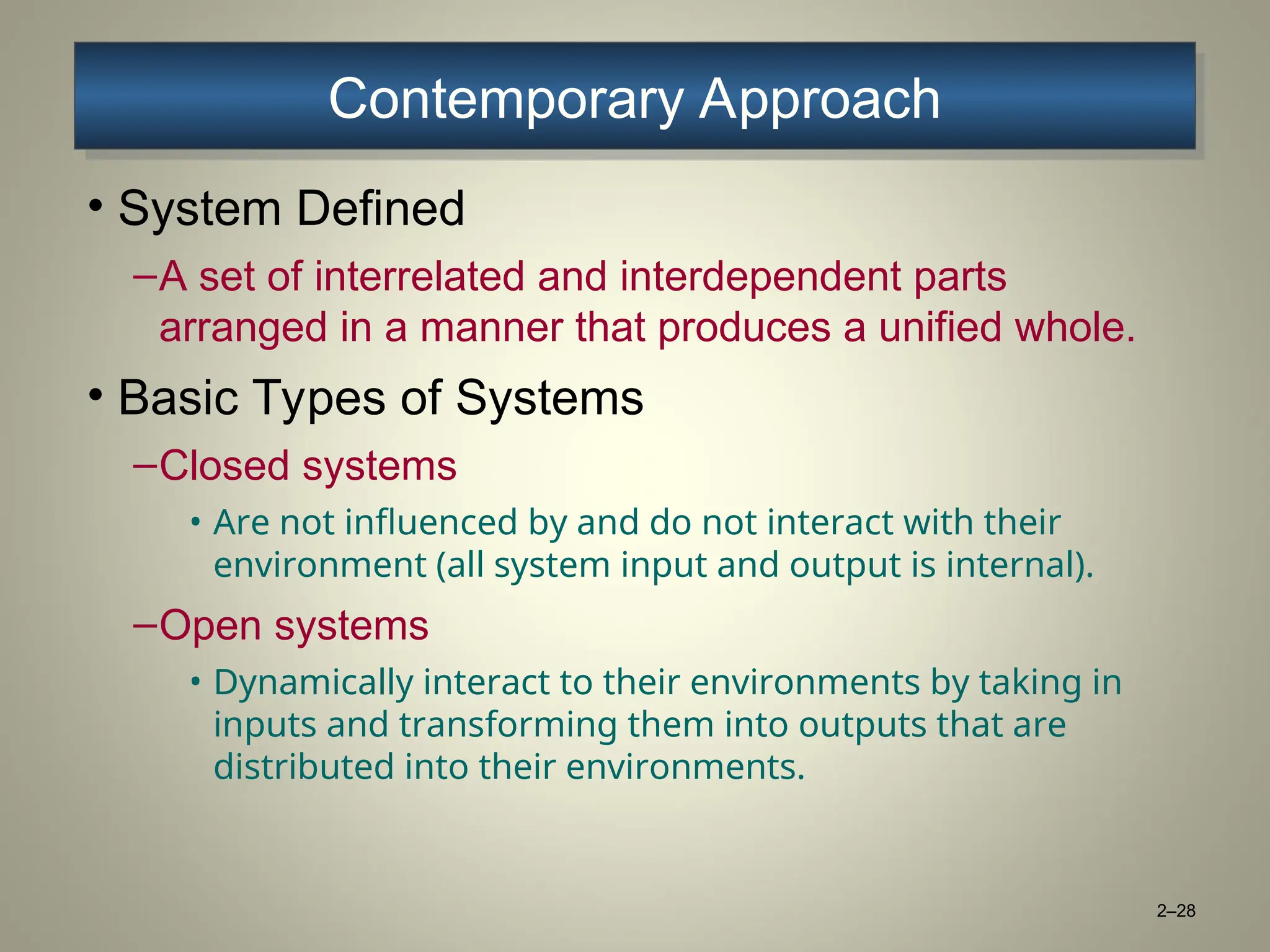
• System Defined
–A set of interrelated and interdependent parts
arranged in a manner that produces a unified whole.
• Basic Types of Systems
–Closed systems
• Are not influenced by and do not interact with their
environment (all system input and output is internal).
–Open systems
• Dynamically interact to their environments by taking in
inputs and transforming them into outputs that are
distributed into their environments.
© 2007 Prentice Hall, Inc. All rights
reserved.
2–29
Exhibit 2–7 The Organization as an Open System
2–30
Implications of the Systems Approach
• Coordination of the organization’s parts is
essential for proper functioning of the entire
organization.
• Decisions and actions taken in one area of the
organization will have an effect in other areas of
the organization.
• Organizations are not self-contained and,
therefore, must adapt to changes in their
external environment.
© 2007 Prentice Hall, Inc. All rights
reserved.
2–31
The Contingency Approach
• Contingency Approach Defined
–Also sometimes called the situational approach.
–There is no one universally applicable set of
management principles (rules) by which to manage
organizations.
–Organizations are individually different, face different
situations (contingency variables), and require
different ways of managing.
2–32
Exhibit 2–8 Popular Contingency Variables
• Organization size
• As size increases, so do the problems of coordination.
• Routineness of task technology
• Routine technologies require organizational structures,
leadership styles, and control systems that differ from
those required by customized or nonroutine technologies.
• Environmental uncertainty
• What works best in a stable and predictable environment
may be totally inappropriate in a rapidly changing and
unpredictable environment.
• Individual differences
• Individuals differ in terms of their desire for growth,
autonomy, tolerance of ambiguity, and expectations.

Chapter 1 Introduction to Management.ppt

  • 1.
  • 2.
  • 3.
  • 4.
    Planning Planning Planning defines wherethe organization wants to be in future and how to get there. •Example: • An example of good planning comes from walt Disney Company, where its CEO and management decided to revive the company by focusing on resources. Coordinated planning of the management was they sell tons of CDs, have their own Disney TV Channels, films and making T– shirts
  • 5.
    Organizing Organizing • Organizing involvesassigning tasks, grouping tasks into Departments, delegating authority and allocating resources across the organization. • Example: • Organization Chart • Process flow chart • Jobs description
  • 6.
    Leading Leading • Leading isthe use of influence to motivate employees to achieve organizational goals. Leading means creating culture and values, communicating to the people through the organization.
  • 7.
    Controlling Controlling Controlling means monitoring employees’ activitiesdetermining whether the organization is on target toward its goals, and making corrections as necessary.
  • 8.
    Organization Organization • A deliberatearrangement of people to accomplish some specific purpose (that individuals independently could not accomplish alone). • Common Characteristics of Organizations • Have a distinct purpose (goal) • Composed of people • Have a deliberate structure
  • 9.
    Organizational Resources Organizational Resources –Organizationalresources are all assets that are available to use in production process. • Human Resources • Financial Resources • Capital resources • Physical resources • Information resources
  • 10.
    Efficiency & effectiveness Efficiency& effectiveness –Efficiency – Getting the most output for the least inputs –Effectiveness – Attaining organizational goals by doing right things
  • 11.
    Organizational Goals Organizational Goals •Vision-Dreamof the organization •Mission-reason of existing an organization
  • 12.
    Management Management It is theprocess of planning, organizing, leading, and controlling organizational resources effectively and efficiently to meet organizational goals.
  • 13.
    Exhibit 2–1 Developmentof Major Management Theories
  • 14.
    Major Approaches toManagement Major Approaches to Management • Classical Approach –Scientific Management –General Administrative Theory • Quantitative Approach • Behavioral Approach • Contemporary Approach –Systems Theory –Contingency Approach
  • 15.
    2–15 Classical Approach Classical Approach ScientificManagement Scientific Management • Fredrick Winslow Taylor –The “father” of scientific management –Published Principles of Scientific Management (1911) • The theory of scientific management – Using scientific methods to define the “one best way” for a job to be done: »Putting the right person on the job with the correct tools and equipment. »Having a standardized method of doing the job. »Providing an economic incentive to the worker.
  • 16.
    2–16 Exhibit 2–2 Taylor’sFour Principles of Management 1. Develop a science for each element of an individual’s work, which will replace the old rule-of-thumb method. 2. Scientifically select and then train, teach, and develop the worker. 3. Heartily cooperate with the workers so as to ensure that all work is done in accordance with the principles of the science that has been developed. 4. Divide work and responsibility almost equally between management and workers. Management takes over all work for which it is better fitted than the workers.
  • 17.
    © 2007 PrenticeHall, Inc. All rights reserved. 2–17 Scientific Management (cont’d) Scientific Management (cont’d) • Frank and Lillian Gilbreth –Focused on increasing worker productivity through the reduction of wasted motion –Developed the micro chronometer to time worker motions and optimize work performance • How Do Today’s Managers Use Scientific Management? –Use time and motion studies to increase productivity –Hire the best qualified employees –Design incentive systems based on output
  • 18.
    © 2007 PrenticeHall, Inc. All rights reserved. 2–18 General Administrative Theory General Administrative Theory • Henri Fayol –Believed that the practice of management was distinct from other organizational functions –Developed fourteen principles of management that applied to all organizational situations • Max Weber –Developed a theory of authority based on an ideal type of organization (bureaucracy) • Emphasized rationality, predictability, impersonality, technical competence, and authoritarianism
  • 19.
    2–19 Exhibit 2–3 Exhibit 2–3Fayol’s 14 Principles of Management Fayol’s 14 Principles of Management 1. 1. Division of work. Division of work. 2. 2. Authority. Authority. 3. 3. Discipline. Discipline. 4. 4. Unity of command. Unity of command. 5. 5. Unity of direction. Unity of direction. 6. 6. Subordination of Subordination of individual interests individual interests to the general to the general interest. interest. 7. 7. Remuneration. Remuneration. 8. 8. Centralization. Centralization. 9. 9. Scalar chain. Scalar chain. 10. 10. Order. Order. 11. 11. Equity. Equity. 12. 12. Stability of tenure Stability of tenure of personnel. of personnel. 13. 13. Initiative. Initiative. 14. 14. Esprit de corps. Esprit de corps.
  • 20.
    © 2007 PrenticeHall, Inc. All rights reserved. 2–20 Exhibit 2–4 Weber’s Ideal Bureaucracy
  • 21.
    © 2007 PrenticeHall, Inc. All rights reserved. 2–21 Quantitative Approach to Management • Quantitative Approach –Also called operations research or management science –Evolved from mathematical and statistical methods developed to solve WWII military logistics and quality control problems –Focuses on improving managerial decision making by applying: • Statistics, optimization models, information models, and computer simulations
  • 22.
    © 2007 PrenticeHall, Inc. All rights reserved. 2–22 Quantitative Approach to Management (cont’d) ….. • Total Quality Management –Another area where quantitative techniques are used –A philosophy of management driven by continual improvement in the quality of work processes and responding to customer needs and expectations –Inspired by the total quality management (TQM) ideas of Deming and Juran –Quality is not directly related to cost –Poor quality results in lower productivity
  • 23.
    © 2007 PrenticeHall, Inc. All rights reserved. 2–23
  • 24.
    Main Principles ofTQM Main Principles of TQM • Prevention is better than cure. In the long run, it is cheaper to stop products defects than trying to find them • Zero defects The ultimate aim is no (zero) defects - or exceptionally low defect levels if a product or service is complicated • Getting things right first time Better not to produce at all than produce something defective • Quality involves everyone Quality is not just the concern of the production or operations department - it involves everyone, including marketing, finance and human resources © 2007 Prentice Hall, Inc. All rights reserved. 2–24
  • 25.
    Main Principles ofTQM Main Principles of TQM • Continuous improvement Businesses should always be looking for ways to improve processes to help quality • Employee involvement Those involved in production and operations have a vital role to play in spotting improvement opportunities for quality and in identifying quality problems © 2007 Prentice Hall, Inc. All rights reserved. 2–25
  • 26.
    © 2007 PrenticeHall, Inc. All rights reserved. 2–26 Behavioral Approach • Organizational Behavior (OB) –The study of the actions of people at work; people are the most important asset of an organization • Early OB Advocates –Robert Owen –Hugo Munsterberg –Mary Parker Follett –Chester Barnard
  • 27.
    © 2007 PrenticeHall, Inc. All rights reserved. 2–27 •A series of productivity experiments conducted A series of productivity experiments conducted at Western Electric from 1927 to 1932. at Western Electric from 1927 to 1932. •Experimental findings Experimental findings Productivity unexpectedly increased under imposed Productivity unexpectedly increased under imposed adverse working conditions. adverse working conditions. The results indicated that the incentive plan had less The results indicated that the incentive plan had less effect on a worker’s output than did group pressure, effect on a worker’s output than did group pressure, acceptance, and security. acceptance, and security. •Research conclusion Research conclusion Social norms, group standards and attitudes more Social norms, group standards and attitudes more strongly influence individual output and work behavior strongly influence individual output and work behavior than do monetary incentives. than do monetary incentives. The Hawthorne Studies
  • 28.
    2–28 Contemporary Approach • SystemDefined –A set of interrelated and interdependent parts arranged in a manner that produces a unified whole. • Basic Types of Systems –Closed systems • Are not influenced by and do not interact with their environment (all system input and output is internal). –Open systems • Dynamically interact to their environments by taking in inputs and transforming them into outputs that are distributed into their environments.
  • 29.
    © 2007 PrenticeHall, Inc. All rights reserved. 2–29 Exhibit 2–7 The Organization as an Open System
  • 30.
    2–30 Implications of theSystems Approach Implications of the Systems Approach • Coordination of the organization’s parts is essential for proper functioning of the entire organization. • Decisions and actions taken in one area of the organization will have an effect in other areas of the organization. • Organizations are not self-contained and, therefore, must adapt to changes in their external environment.
  • 31.
    © 2007 PrenticeHall, Inc. All rights reserved. 2–31 The Contingency Approach • Contingency Approach Defined –Also sometimes called the situational approach. –There is no one universally applicable set of management principles (rules) by which to manage organizations. –Organizations are individually different, face different situations (contingency variables), and require different ways of managing.
  • 32.
    2–32 Exhibit 2–8 PopularContingency Variables • Organization size • As size increases, so do the problems of coordination. • Routineness of task technology • Routine technologies require organizational structures, leadership styles, and control systems that differ from those required by customized or nonroutine technologies. • Environmental uncertainty • What works best in a stable and predictable environment may be totally inappropriate in a rapidly changing and unpredictable environment. • Individual differences • Individuals differ in terms of their desire for growth, autonomy, tolerance of ambiguity, and expectations.

Editor's Notes

  • #18 impersonality uniform application of rules and regulations
  • #19 Scalar chain. The line of authority from top management to the lowest ranks is the scalar chain. Esprit de corps. Promoting team spirit will build harmony and unity within the organization
  • #32 Sap oracle