SESSION ID:
#RSAC
Mark Russinovich
Malware Hunting with the
Sysinternals Tools
CTO, Microsoft Azure
Microsoft
@markrussinovich
HTA-T07R
#RSAC
“When combining the results from all four AV engines, less
than 40% of the binaries were detected.”
Source:
CAMP: Content-Agnostic Malware Protection
Proceedings of 20th Annual Network & Distributed
System Security Symposium
https://www.cs.jhu.edu/~moheeb/aburajab-ndss-13.pdf
#RSAC
#RSAC
#RSAC
About this Talk
 Learn about Sysinternals tools and techniques for analyzing and cleaning
malware
 Professional antimalware analysis requires years of deep training
 But even for professionals, Sysinternals tools can prove useful
 Analyzing:
 Understanding the impact of malware
 Can be used to understand malware operation
 Generates road map for cleaning infestations
 Cleaning:
 Removing an infestation of a compromised system
 Attempting a clean can also reveal more information about malware’s operation
#RSAC
Malware Cleaning Steps
 Disconnect from network
 Identify malicious processes and drivers
 Terminate identified processes
 Identify and delete malware autostarts
 Delete malware files
 Reboot and repeat
#RSAC
#RSAC
What Are You Looking For?
 Investigate processes that…
 …have no icon
 …have no description or company name
 …unsigned Microsoft images
 …live in Windows directory or user profile
 …are packed
 …include strange URLs in their strings
 …have open TCP/IP endpoints
 …host suspicious DLLs or services
#RSAC
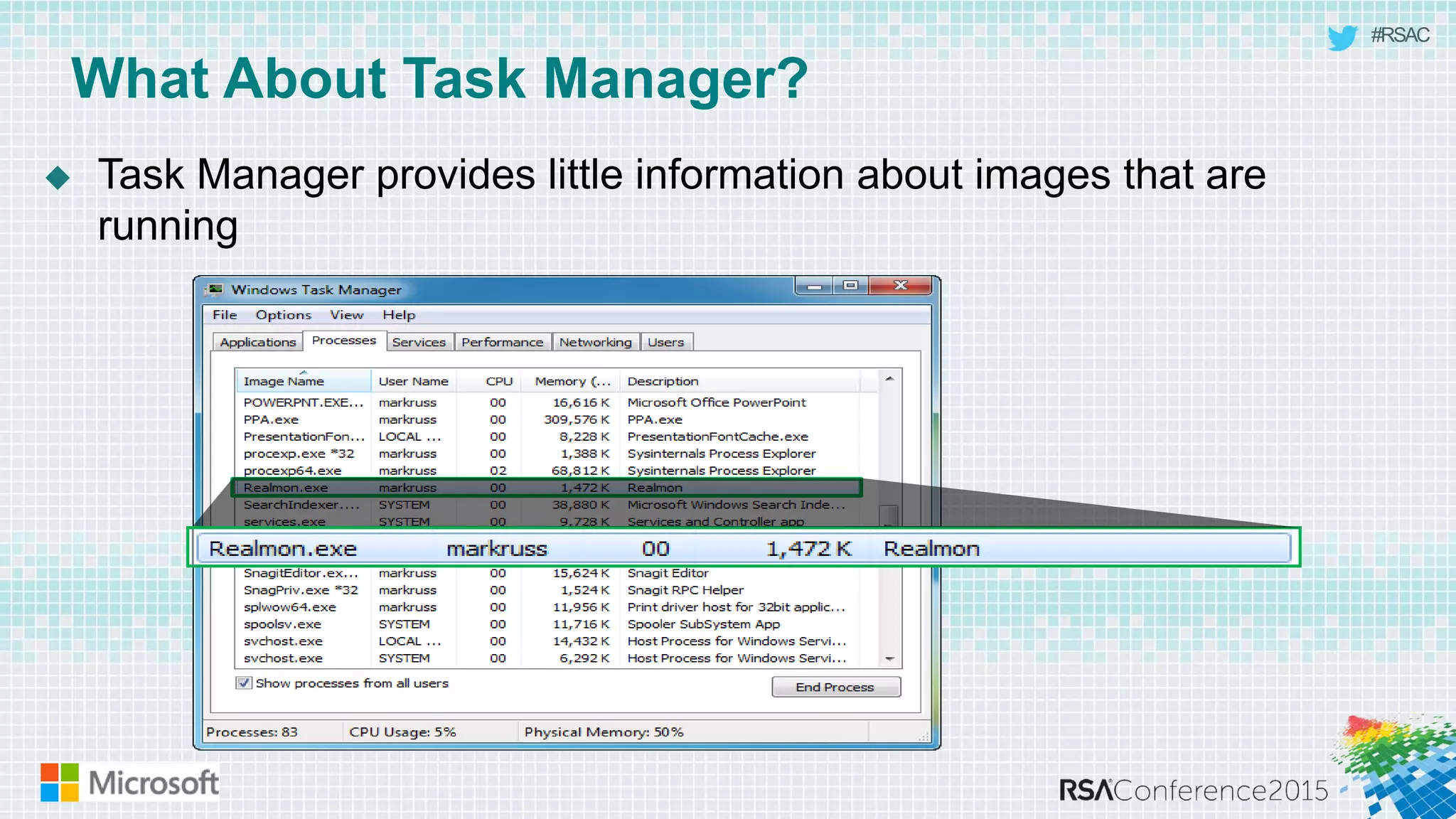
What About Task Manager?
 Task Manager provides little information about images that are
running
#RSAC
Process Explorer
 Process Explorer is “Super Task Manager”
 Has lots of general troubleshooting capabilities:
 DLL versioning problems
 Handle leaks and locked files
 Performance troubleshooting
 Hung processes
 We’re going to focus on its malware cleaning capabilities
#RSAC
The Process View
 The process tree shows parent-child relationships
 Icon, description, and company name are pulled from
image version information
 Most malware doesn’t have version information
 What about malware pretending to be from Microsoft?
 We’ll deal with that shortly…
 Use the Window Finder (in the toolbar) to associate a
window with its owning process
 Use the Search Online menu entry to lookup unknown
processes
 But malware often uses totally random or pseudo-random names
#RSAC
Refresh Highlighting
 Refresh highlighting highlights changes
 Red: process exited
 Green: new process
 Change duration (default 1 second) in Options
 Press space bar to pause and F5 to refresh
 Cause display to scroll to make new processes visible with Show New
Processes option
 We’ll see how to spot short-lived processes later…
#RSAC
Process-type Highlights
 Blue processes are running in the same security context as Process
Explorer
 Pink processes host Windows services
 Purple highlighting indicates an image is “packed”
 Packed can mean compressed or encrypted
 Malware commonly uses packing (e.g. UPX) to make antivirus signature
matching more difficult
 Packing and encryption also hide strings from view
 There are a few other colors, but they’re not important for malware
hunting
#RSAC
Tooltips
 Process tooltips show the full path to the process image
 Malware more often hides behind Svchost, Rundll32, Dllhost and
WMIPrsve
 Tooltip for Rundll32 processes shows hosted DLL
 Dllhost tooltip shows hosted COM server
 WMI provider tooltip shows WMI servers
 Tooltip for service processes shows hosted services
#RSAC
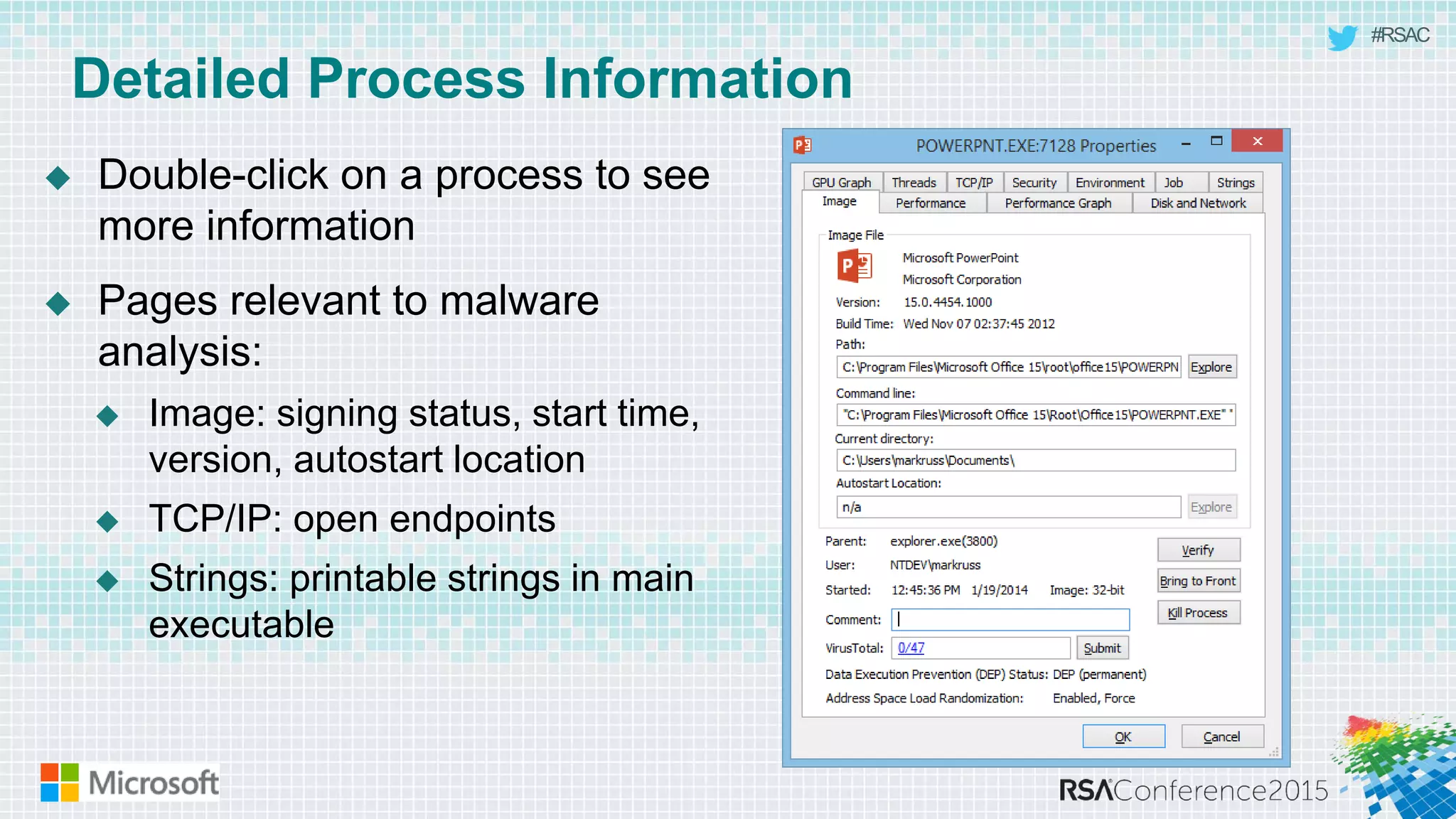
Detailed Process Information
 Double-click on a process to see
more information
 Pages relevant to malware
analysis:
 Image: signing status, start time,
version, autostart location
 TCP/IP: open endpoints
 Strings: printable strings in main
executable
#RSAC
Image Verification
 All (well, most) Microsoft code is digitally signed
 Hash of file is signed with Microsoft’s private key
 Signature is checked by decrypting signed hash with the public key
 You can selectively check for signatures with the Verify button on the
process image tab
 Select the Verify Image Signatures option to check all
 Add the Verified Signer column to see all
 Note that verification will connect to the Internet to check Certificate
Revocation List (CRL) servers
#RSAC
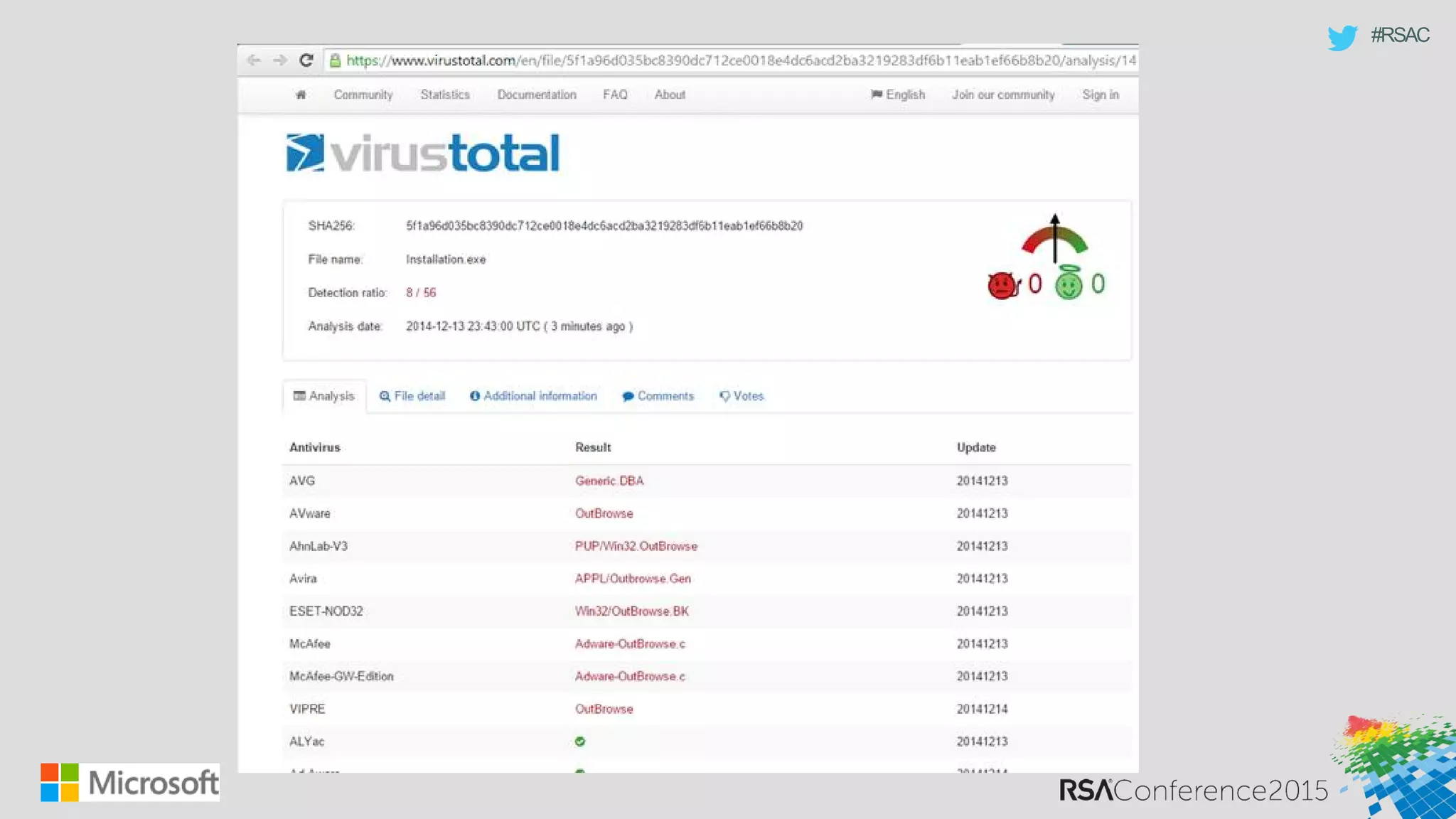
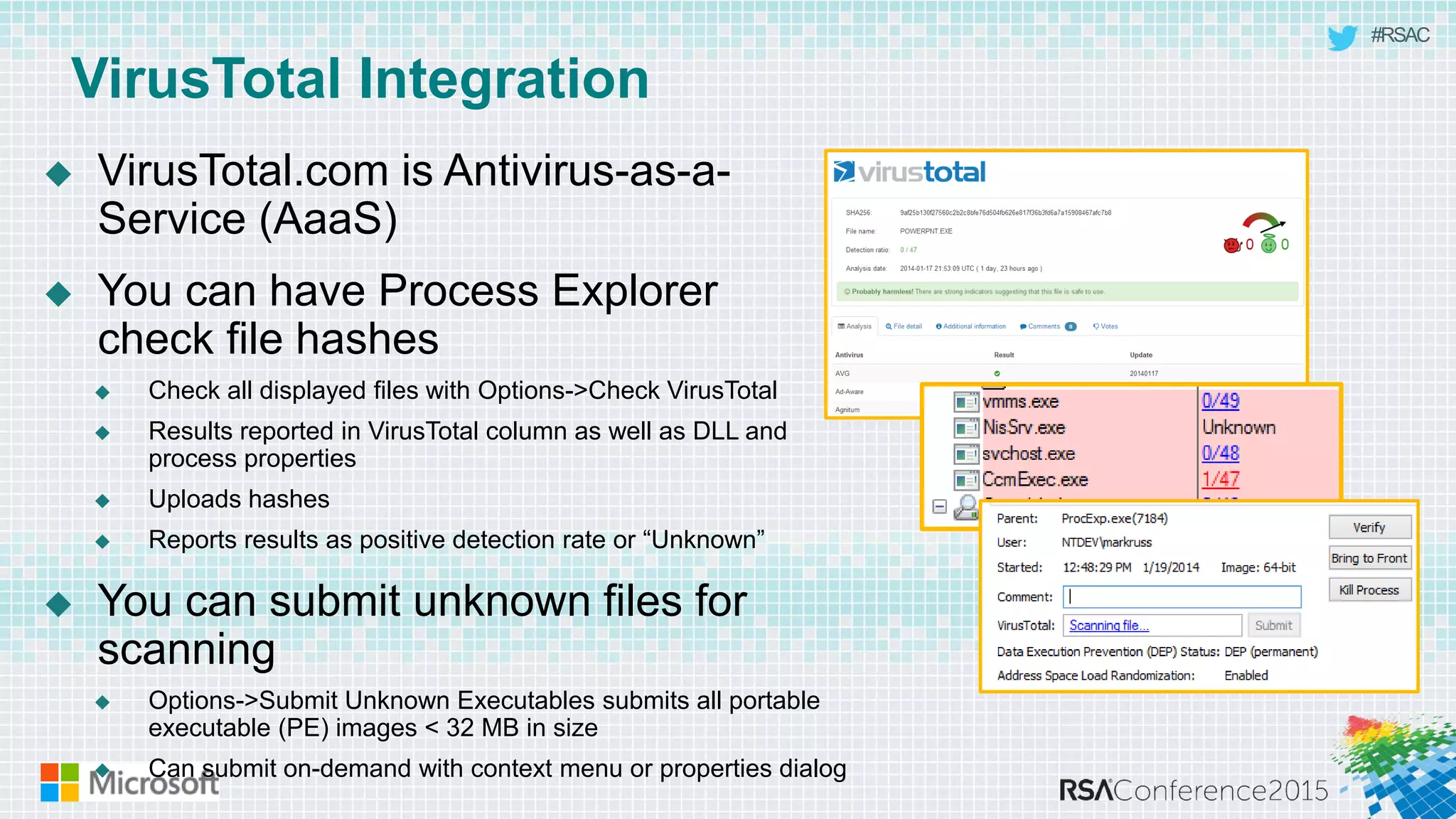
VirusTotal Integration
 VirusTotal.com is Antivirus-as-a-
Service (AaaS)
 You can have Process Explorer
check file hashes
 Check all displayed files with Options->Check VirusTotal
 Results reported in VirusTotal column as well as DLL and
process properties
 Uploads hashes
 Reports results as positive detection rate or “Unknown”
 You can submit unknown files for
scanning
 Options->Submit Unknown Executables submits all portable
executable (PE) images < 32 MB in size
 Can submit on-demand with context menu or properties dialog
#RSAC
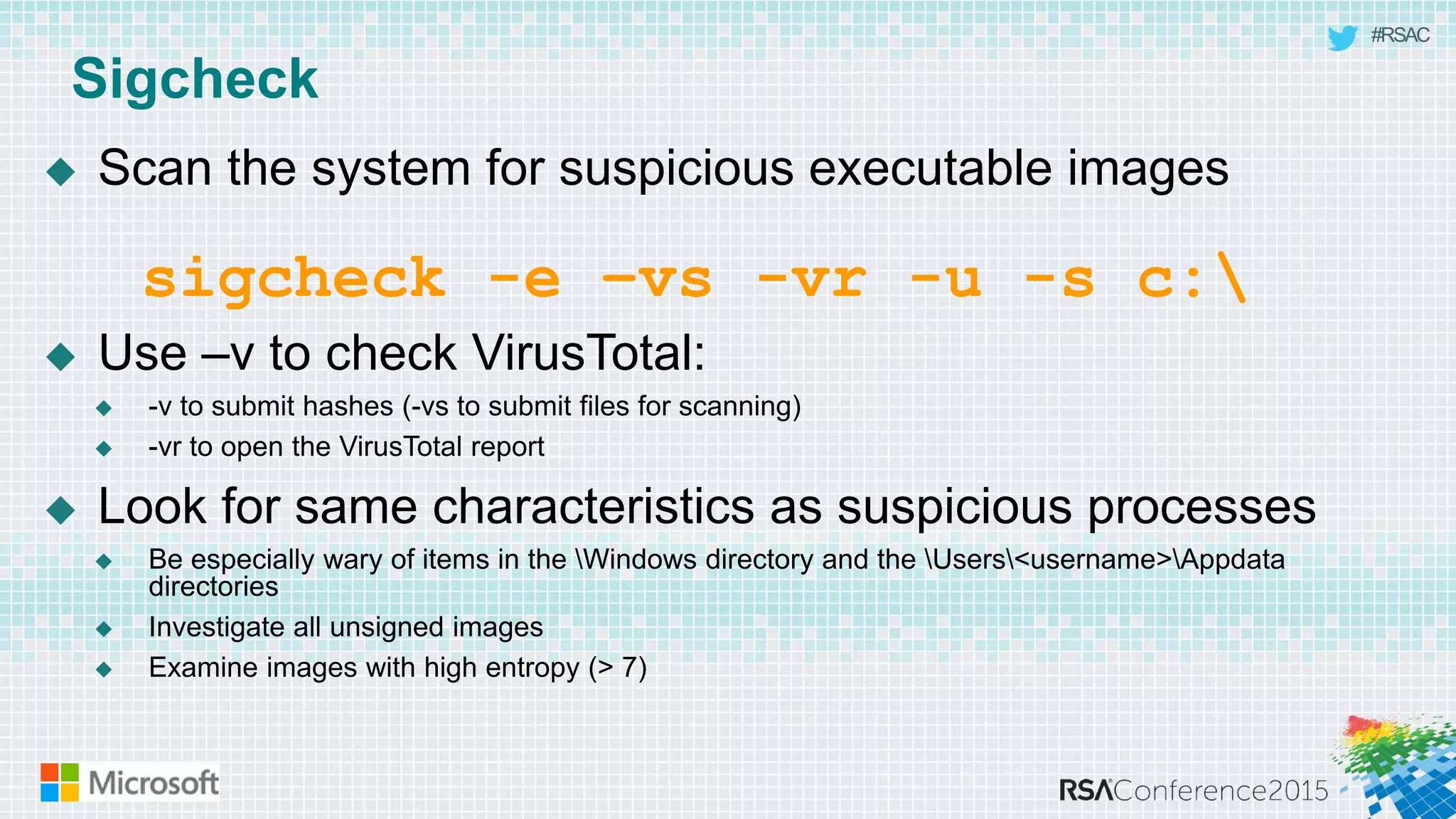
Sigcheck
 Scan the system for suspicious executable images
 Use –v to check VirusTotal:
 -v to submit hashes (-vs to submit files for scanning)
 -vr to open the VirusTotal report
 Look for same characteristics as suspicious processes
 Be especially wary of items in the Windows directory and the Users<username>Appdata
directories
 Investigate all unsigned images
 Examine images with high entropy (> 7)
sigcheck -e –vs -vr -u -s c:
#RSAC
The DLL View
 Malware can hide as a DLL inside a legitimate process
 We’ve already seen this with Rundll32 and Svchost
 Typically loads via an autostart
 Can load through “dll injection”
 Packing highlight shows in DLL view as well
 Open the DLL view by clicking on the DLL icon in the
toolbar
 Shows more than just loaded DLLs
 Includes .EXE and any “memory mapped files”
 Can search for a DLL with the Find dialog
 DLL strings are also viewable on the DLL properties
#RSAC
Terminating Malicious Processes
 Don’t kill the processes
 Malware processes are often restarted by watchdogs
 Instead, suspend them
 Note that this might cause a system hang for Svchost processes
 Record the full path to each malicious EXE and DLL
 After they are all asleep then kill them
 Watch for restarts with new names…
#RSAC
#RSAC
Investigating Autostarts
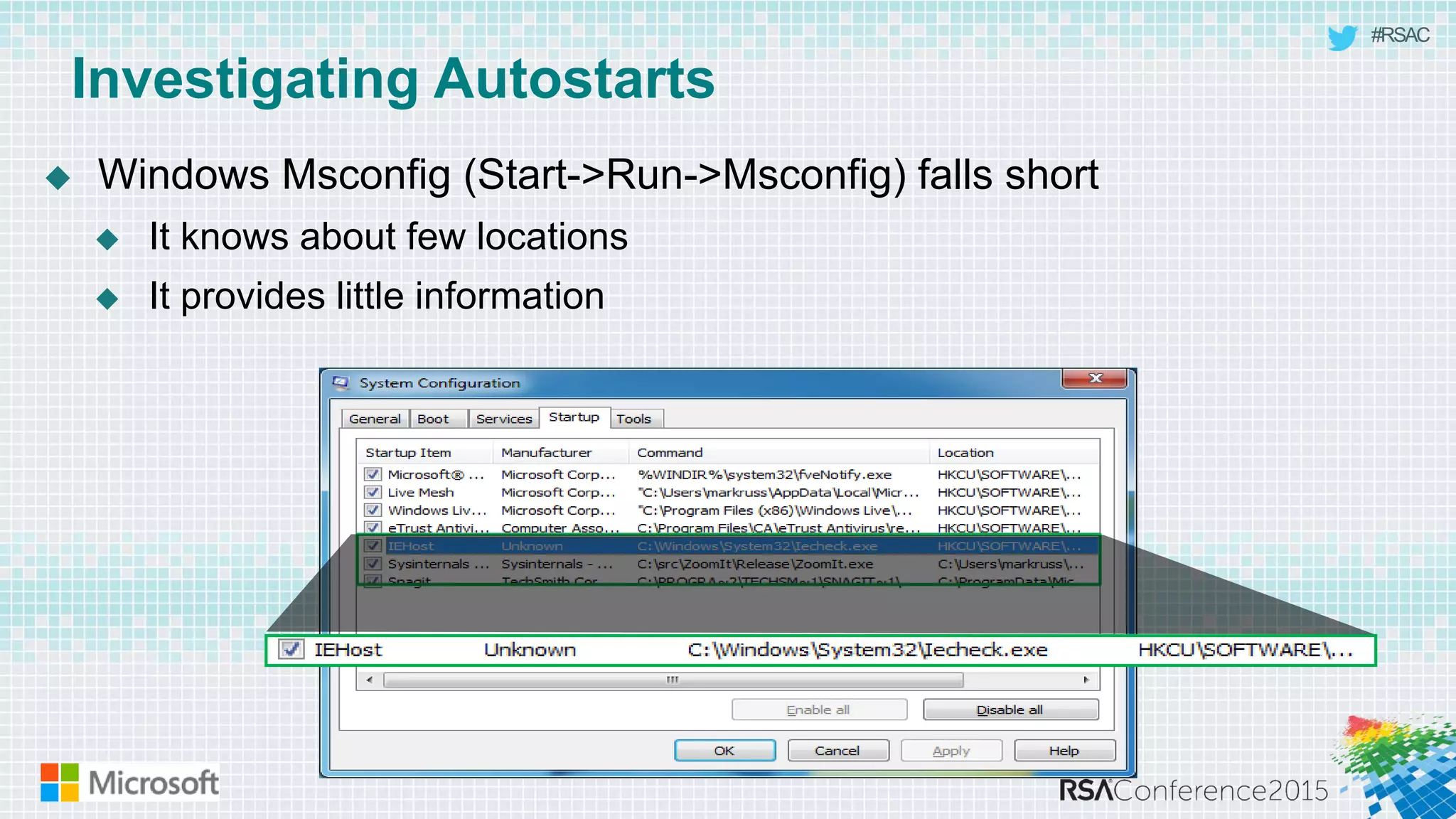
 Windows Msconfig (Start->Run->Msconfig) falls short
 It knows about few locations
 It provides little information
#RSAC
Autoruns
 Shows every place in the system that can be configured to run
something at boot & logon
 Standard Run keys and Startup folders
 Shell, userinit
 Services and drivers
 Tasks
 Winlogon notifications
 Explorer and IE addins (toolbars, Browser Helper Objects, …)
 More and ever growing…
 Each startup category has its own tab and all items display on the
Everything tab
 Startup name, image description, company and path
#RSAC
Identifying Malware Autostarts
 Zoom-in on add-ons (including malware) by selecting these filter
options:
 Verify Code Signatures
 Hide Microsoft Entries
 Select an item to see more in the lower window
 Online search unknown images
 Double-click on an item to look at where its configured in the Registry or
file system
 Has other features:
 Can also show empty locations (informational only)
 Includes compare functionality
 Includes equivalent command-line version, Autorunsc.exe
#RSAC
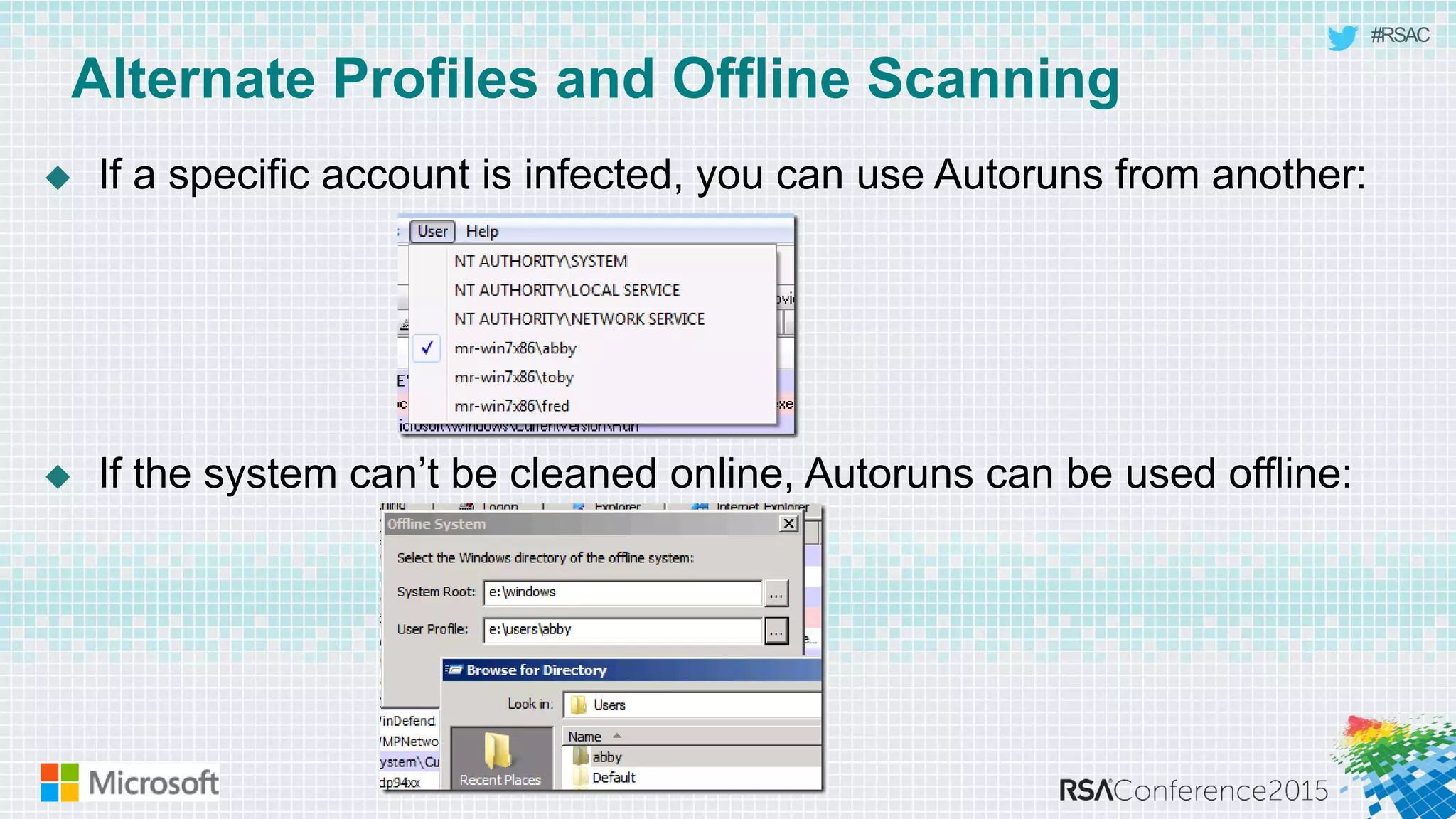
Alternate Profiles and Offline Scanning
 If a specific account is infected, you can use Autoruns from another:
 If the system can’t be cleaned online, Autoruns can be used offline:
#RSAC
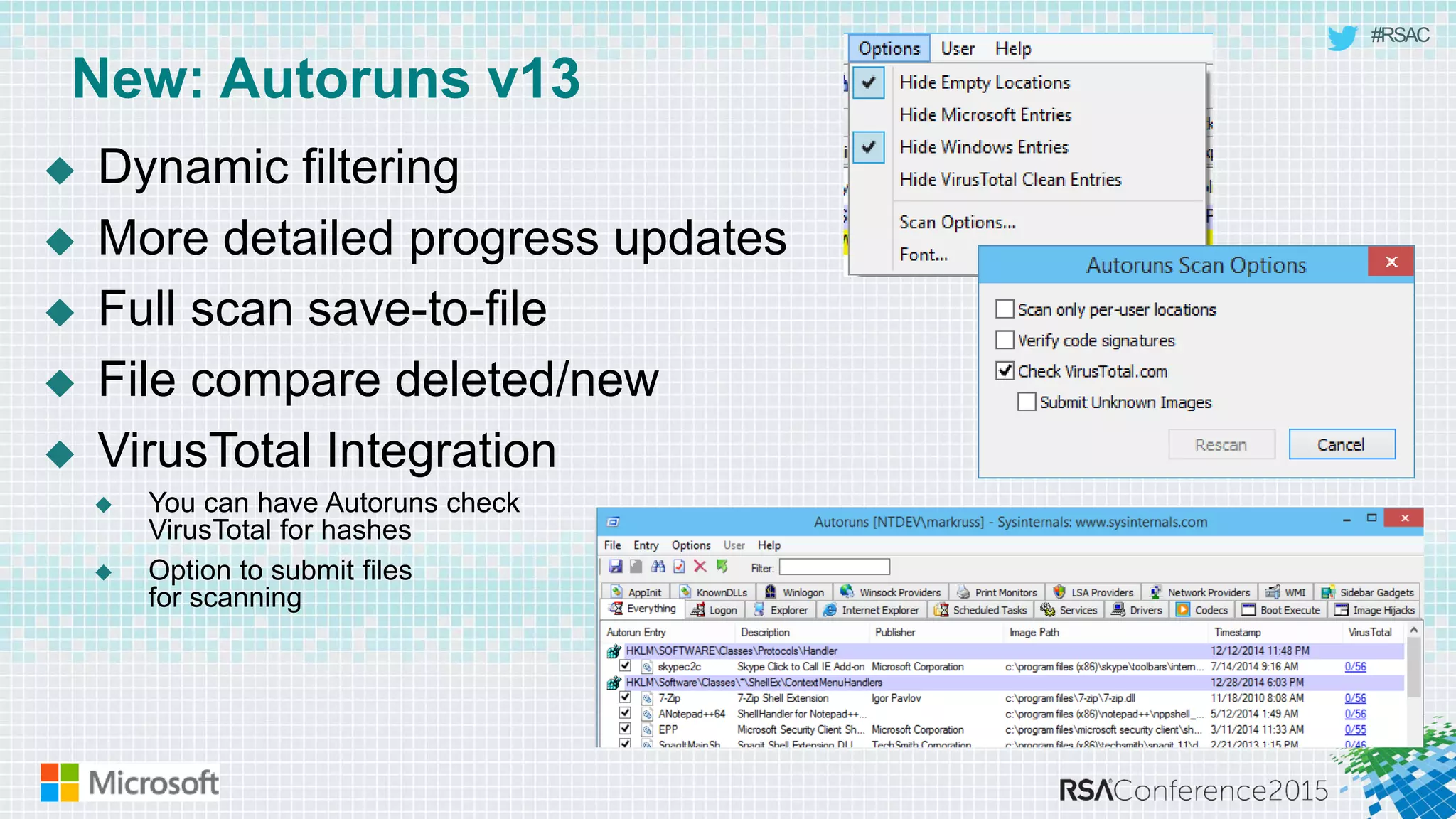
New: Autoruns v13
 Dynamic filtering
 More detailed progress updates
 Full scan save-to-file
 File compare deleted/new
 VirusTotal Integration
 You can have Autoruns check
VirusTotal for hashes
 Option to submit files
for scanning
#RSAC
Deleting Autostarts
 Delete suspicious autostarts
 You can disable them if you’re not sure
 After you’re done do a full refresh
 If they come back, run Process Monitor to see who’s putting them
back
 You might have misidentified a malware process
 It might be a hidden, system, or legitimate process
#RSAC
#RSAC
Tracing Malware
 Tracing activity can reveal the system impact of malware
 Tracing shows initial infection, before cloaking is applied
 Can reveal the internals of “buddy system” and other infection-protection
mechanisms
 Process Monitor makes tracing easy
 A simple filter can identify all system modifications
 Investigating stacks can distinguish legitimate activity from malicious
activity
 It will often show you the cause for error messages
 It many times tells you what is causing sluggish performance
When in doubt, run Process Monitor!
#RSAC
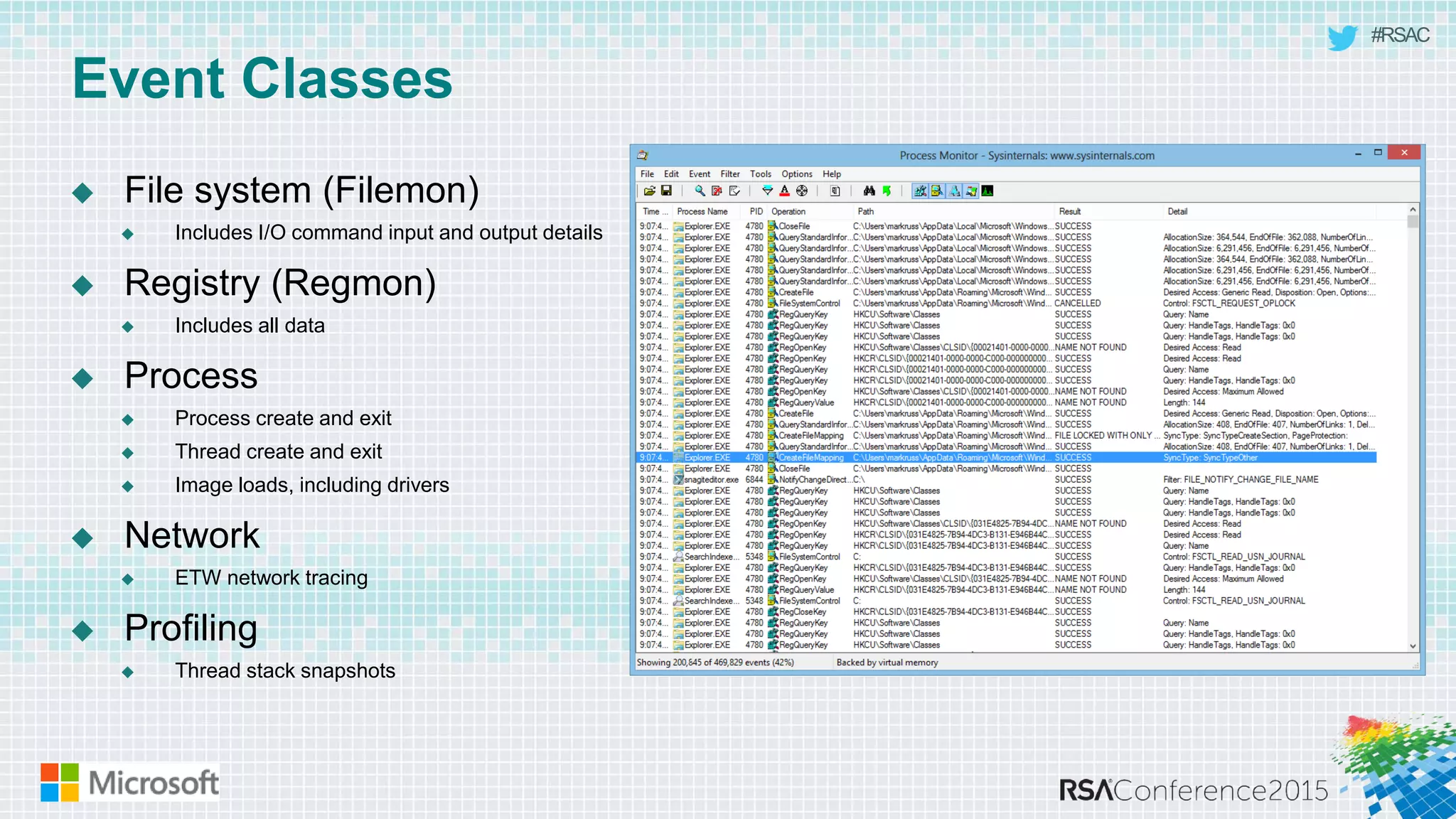
Event Classes
 File system (Filemon)
 Includes I/O command input and output details
 Registry (Regmon)
 Includes all data
 Process
 Process create and exit
 Thread create and exit
 Image loads, including drivers
 Network
 ETW network tracing
 Profiling
 Thread stack snapshots
#RSAC
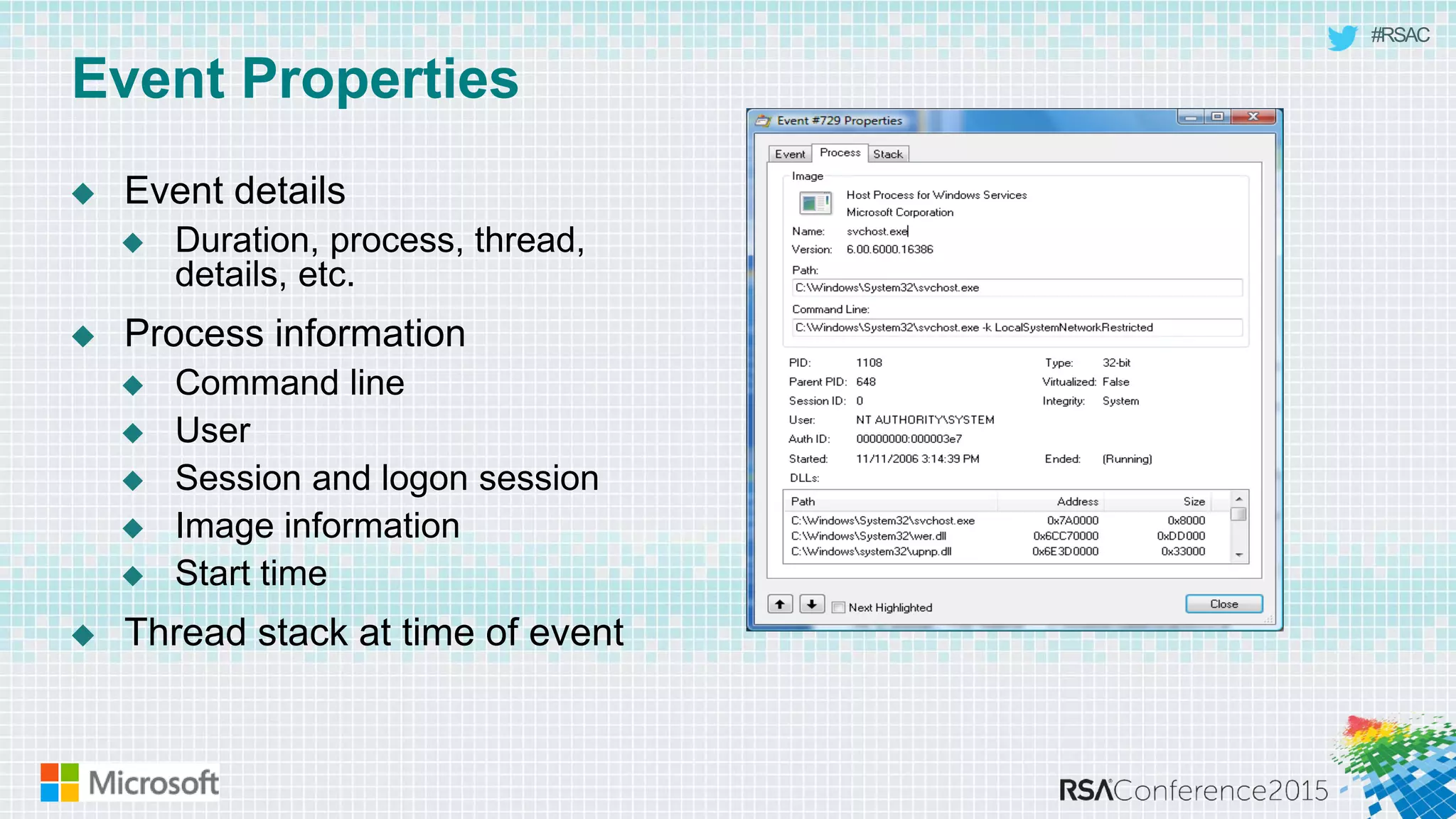
Event Properties
 Event details
 Duration, process, thread,
details, etc.
 Process information
 Command line
 User
 Session and logon session
 Image information
 Start time
 Thread stack at time of event
#RSAC
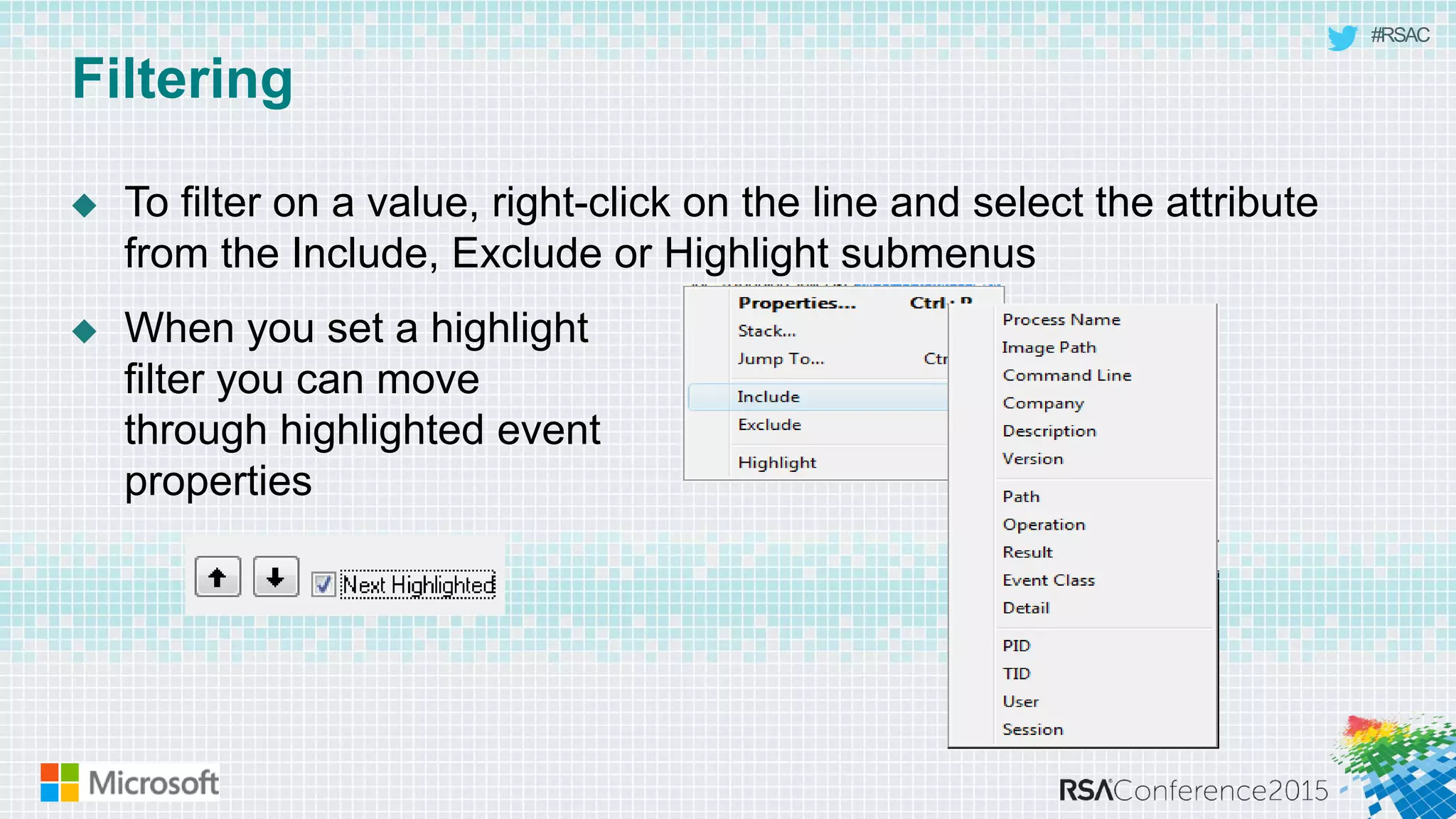
Filtering
 To filter on a value, right-click on the line and select the attribute
from the Include, Exclude or Highlight submenus
 When you set a highlight
filter you can move
through highlighted event
properties
#RSAC
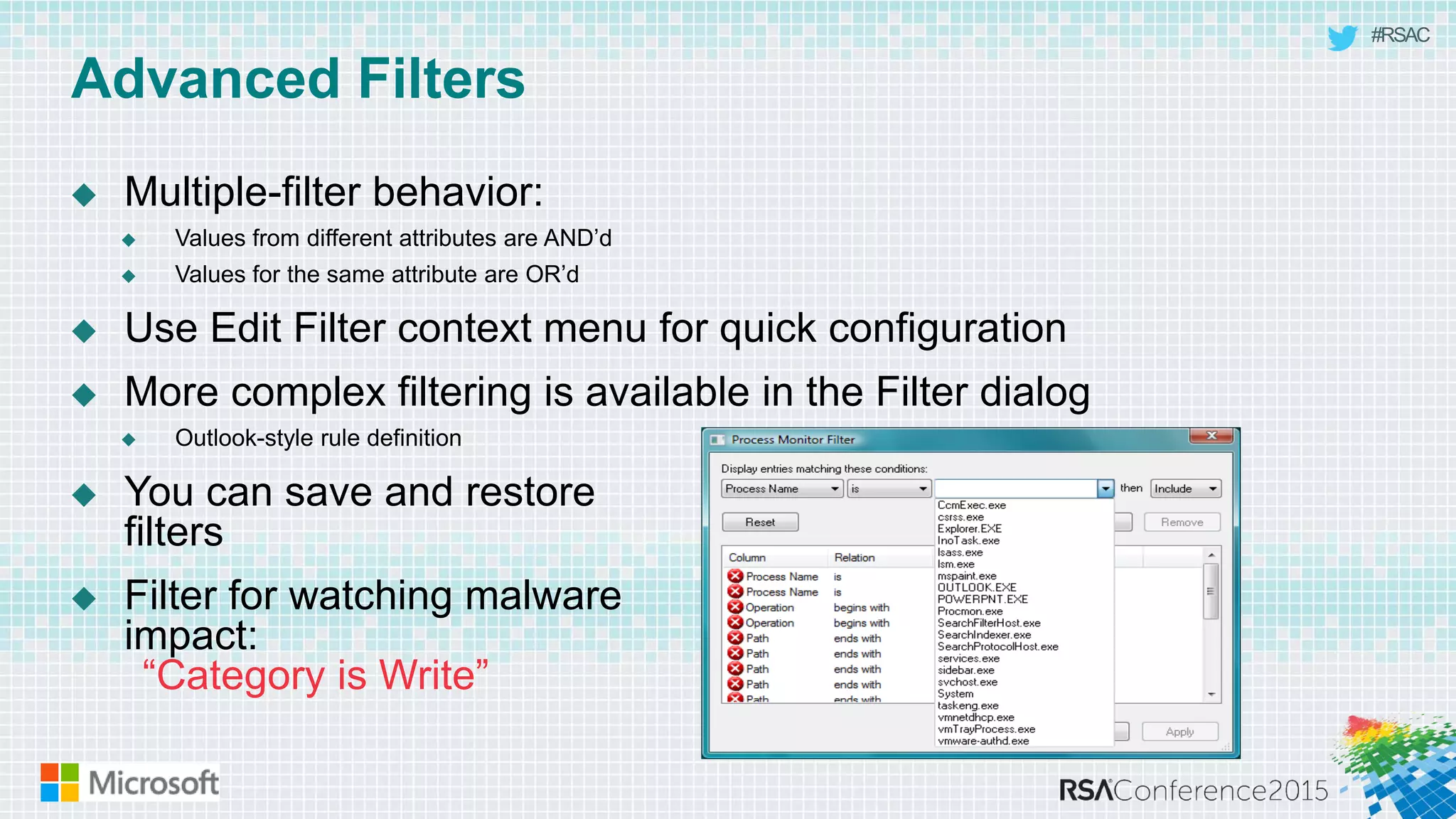
Advanced Filters
 Multiple-filter behavior:
 Values from different attributes are AND’d
 Values for the same attribute are OR’d
 Use Edit Filter context menu for quick configuration
 More complex filtering is available in the Filter dialog
 Outlook-style rule definition
 You can save and restore
filters
 Filter for watching malware
impact:
“Category is Write”
#RSAC
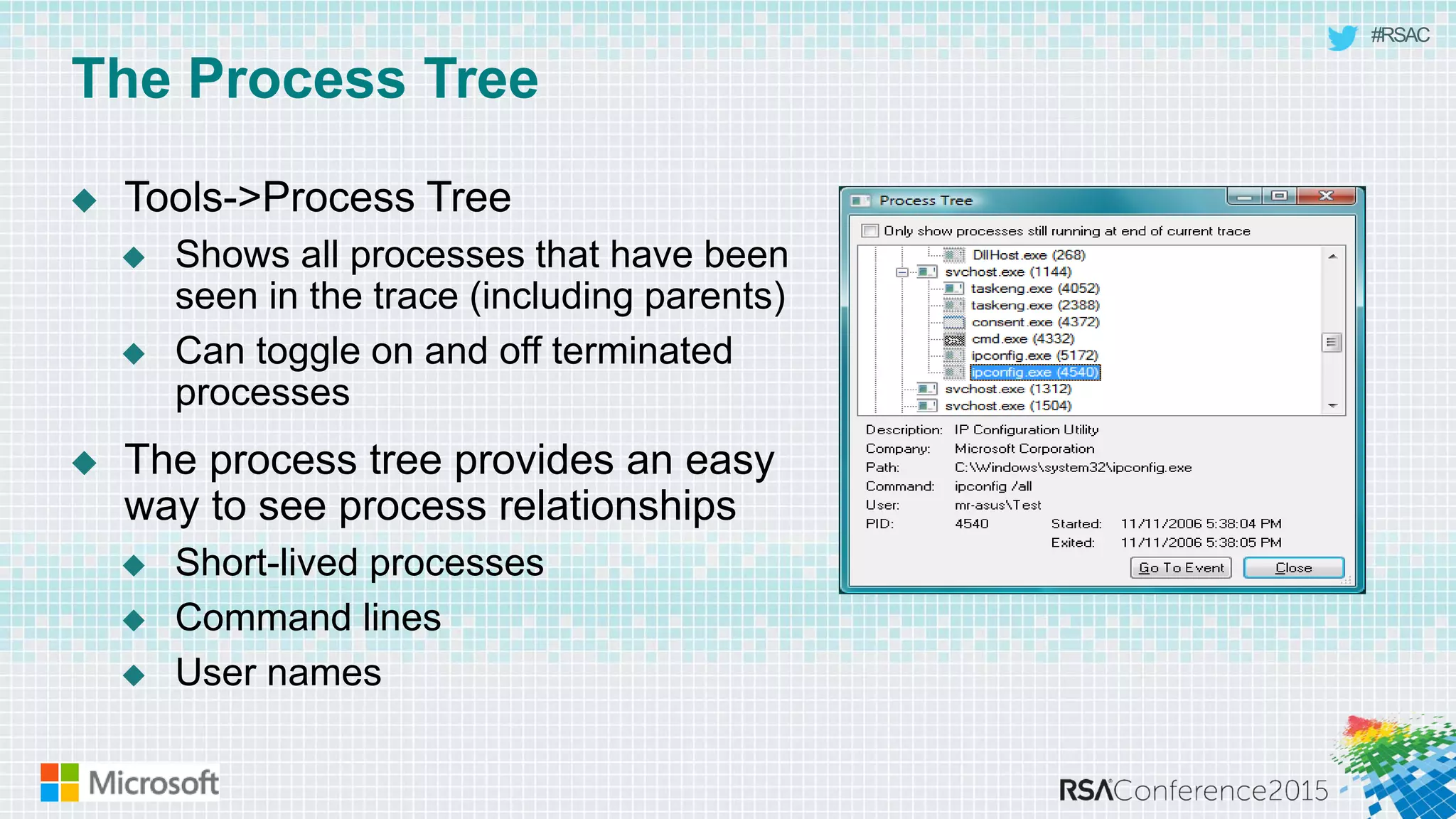
The Process Tree
 Tools->Process Tree
 Shows all processes that have been
seen in the trace (including parents)
 Can toggle on and off terminated
processes
 The process tree provides an easy
way to see process relationships
 Short-lived processes
 Command lines
 User names
#RSAC
#RSAC
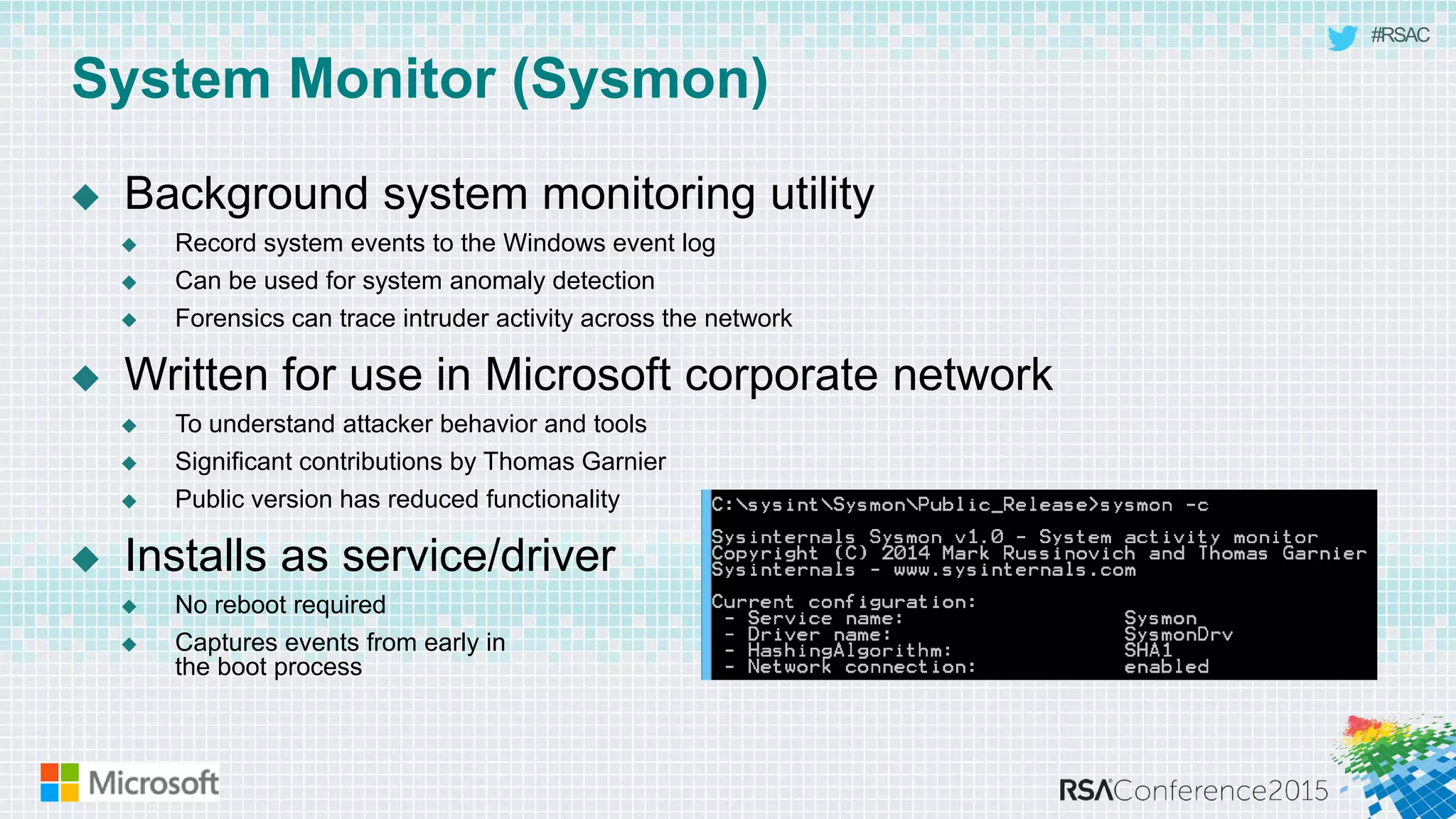
System Monitor (Sysmon)
 Background system monitoring utility
 Record system events to the Windows event log
 Can be used for system anomaly detection
 Forensics can trace intruder activity across the network
 Written for use in Microsoft corporate network
 To understand attacker behavior and tools
 Significant contributions by Thomas Garnier
 Public version has reduced functionality
 Installs as service/driver
 No reboot required
 Captures events from early in
the boot process
#RSAC
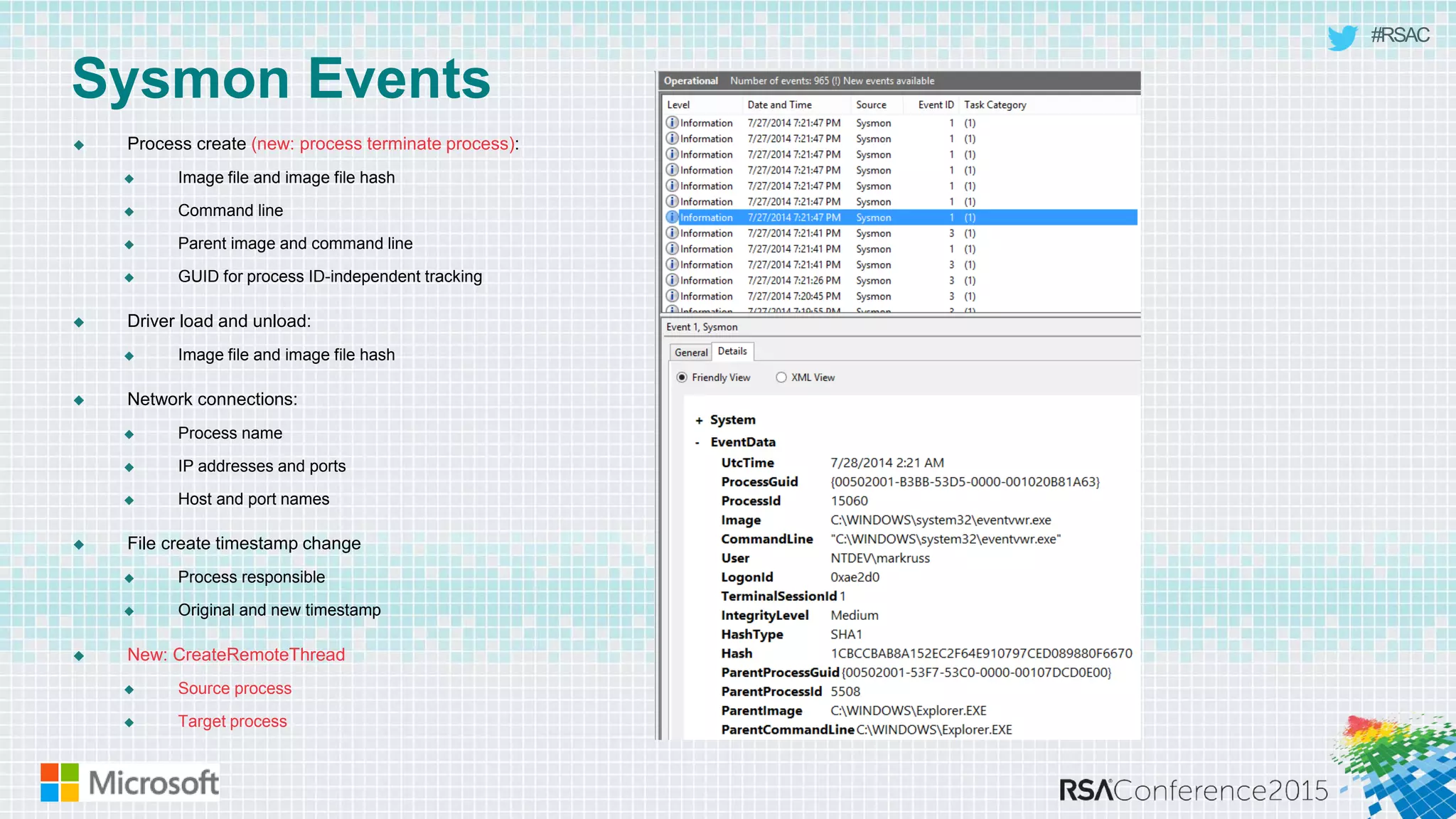
Sysmon Events
 Process create (new: process terminate process):
 Image file and image file hash
 Command line
 Parent image and command line
 GUID for process ID-independent tracking
 Driver load and unload:
 Image file and image file hash
 Network connections:
 Process name
 IP addresses and ports
 Host and port names
 File create timestamp change
 Process responsible
 Original and new timestamp
 New: CreateRemoteThread
 Source process
 Target process
#RSAC
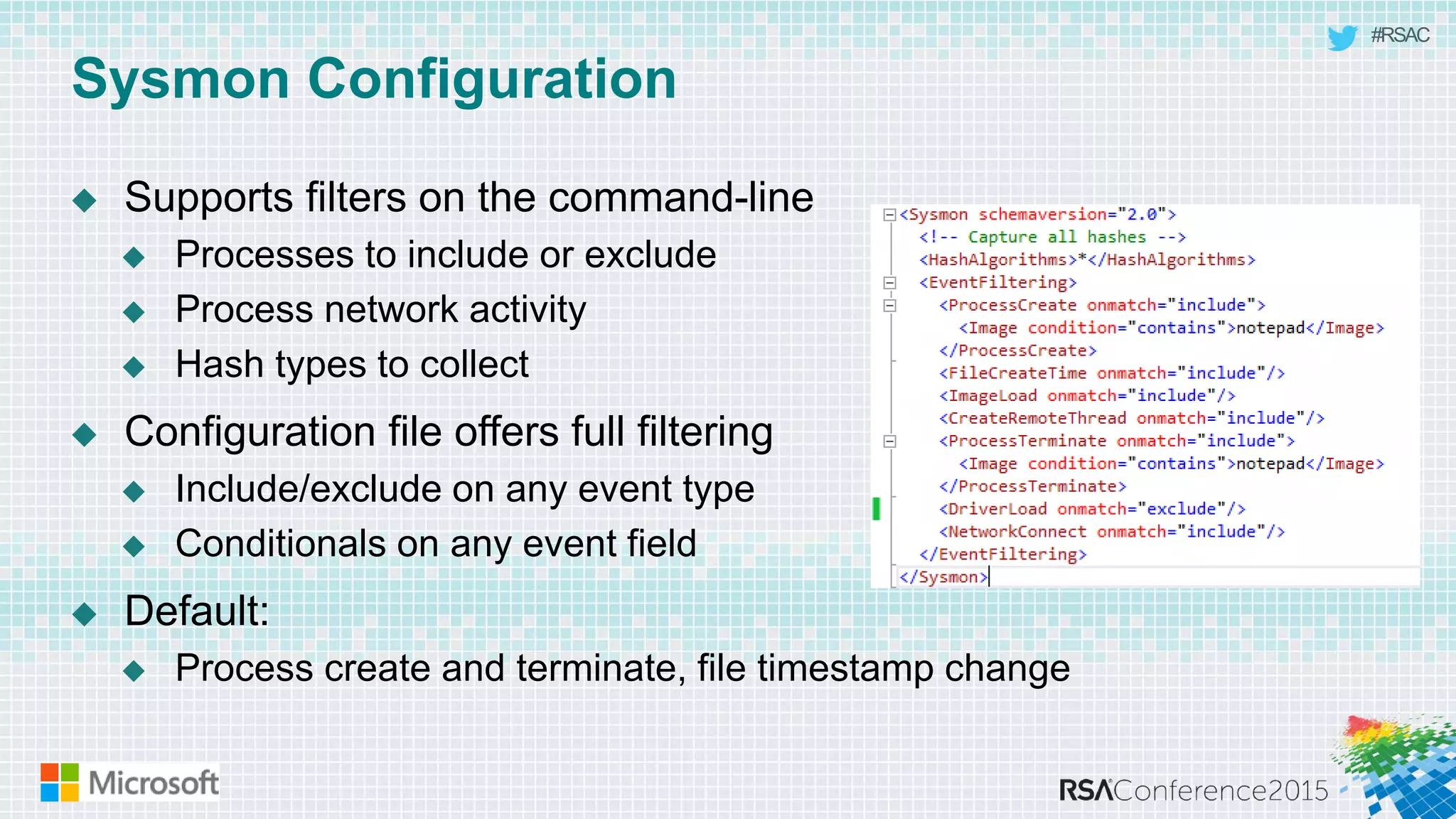
Sysmon Configuration
 Supports filters on the command-line
 Processes to include or exclude
 Process network activity
 Hash types to collect
 Configuration file offers full filtering
 Include/exclude on any event type
 Conditionals on any event field
 Default:
 Process create and terminate, file timestamp change
#RSAC
#RSAC
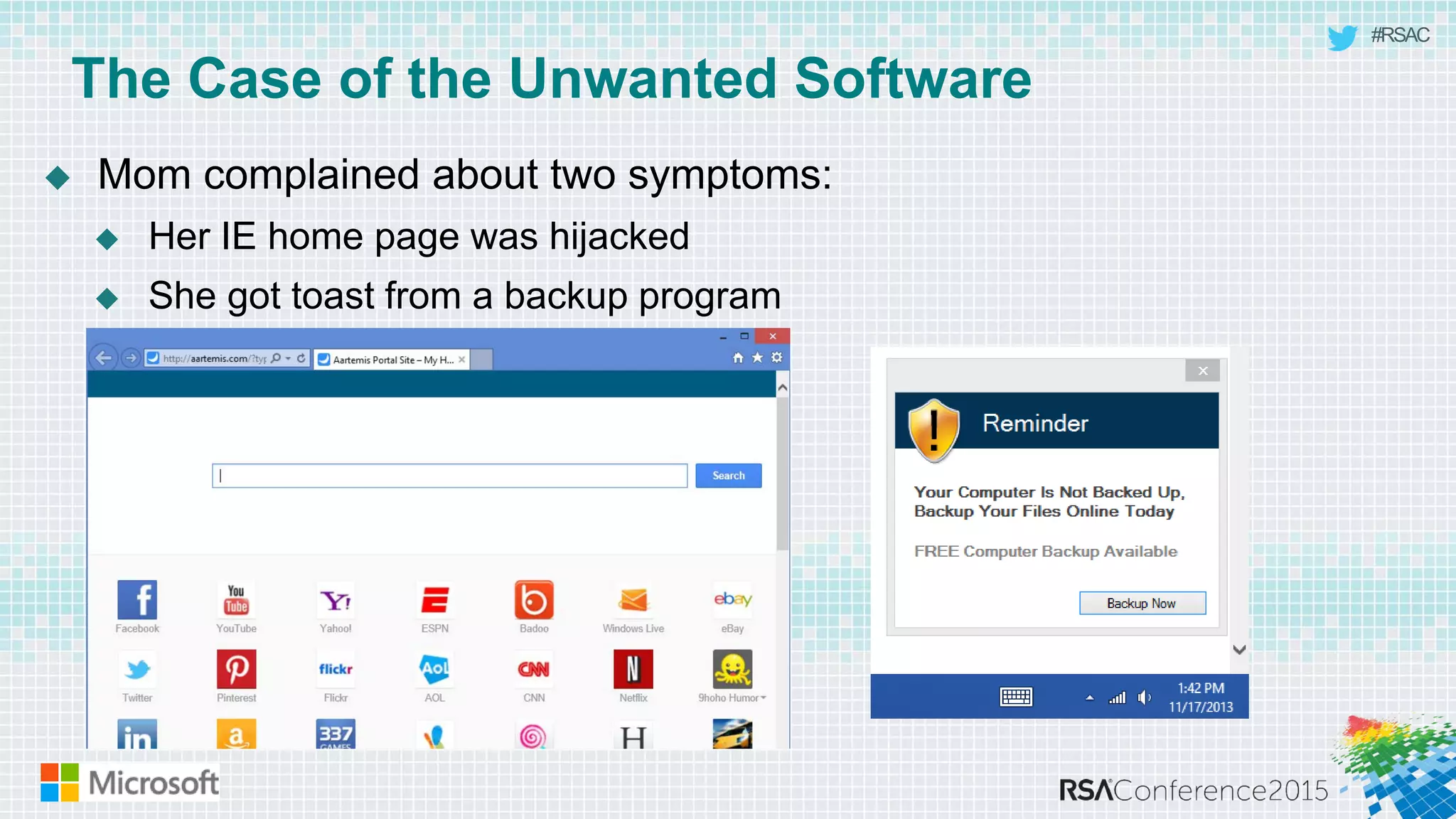
The Case of the Unwanted Software
 Mom complained about two symptoms:
 Her IE home page was hijacked
 She got toast from a backup program
#RSAC
The Case of the Unwanted Software (Cont)
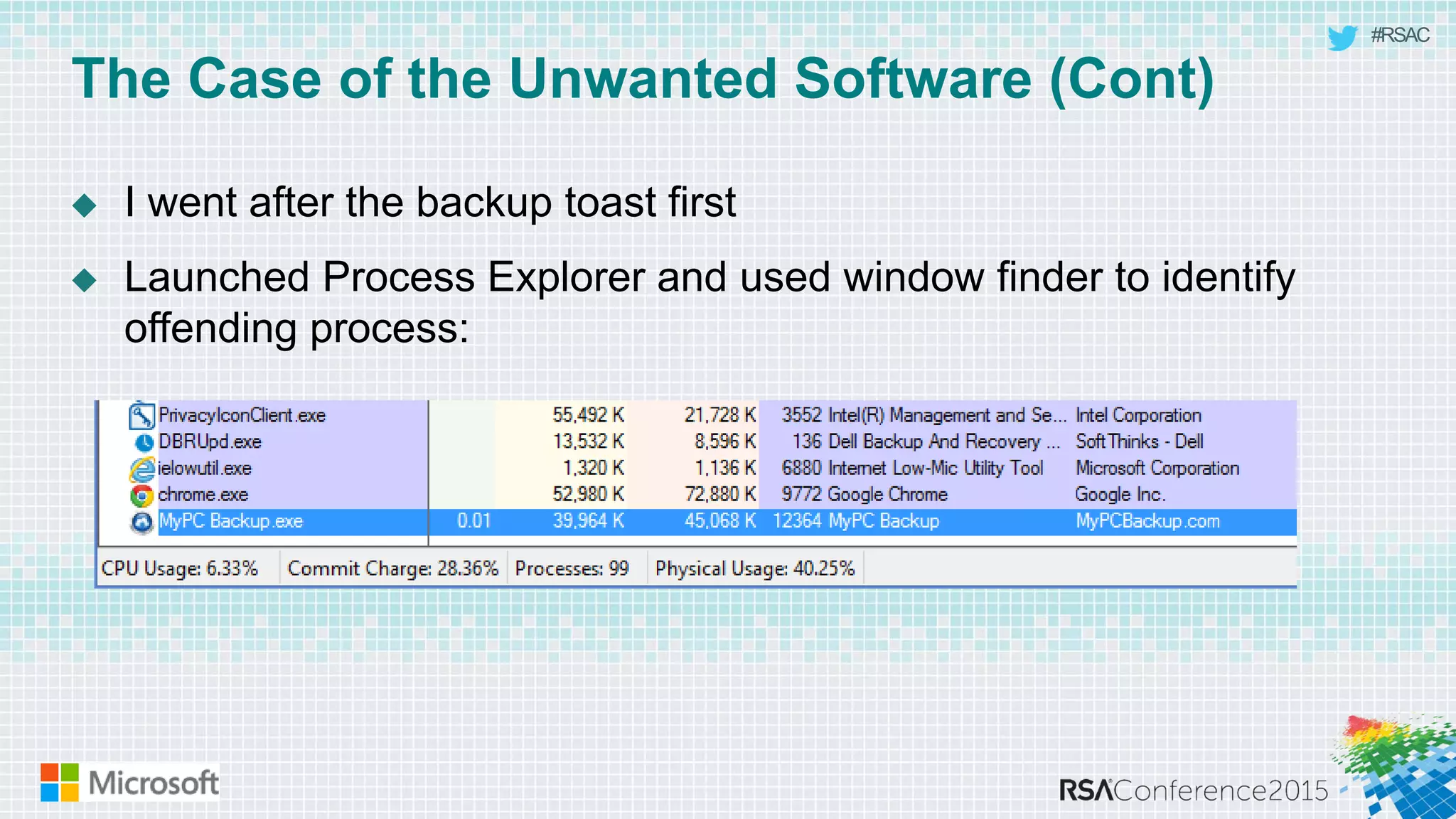
 I went after the backup toast first
 Launched Process Explorer and used window finder to identify
offending process:
#RSAC
The Case of the Unwanted Software (Cont)
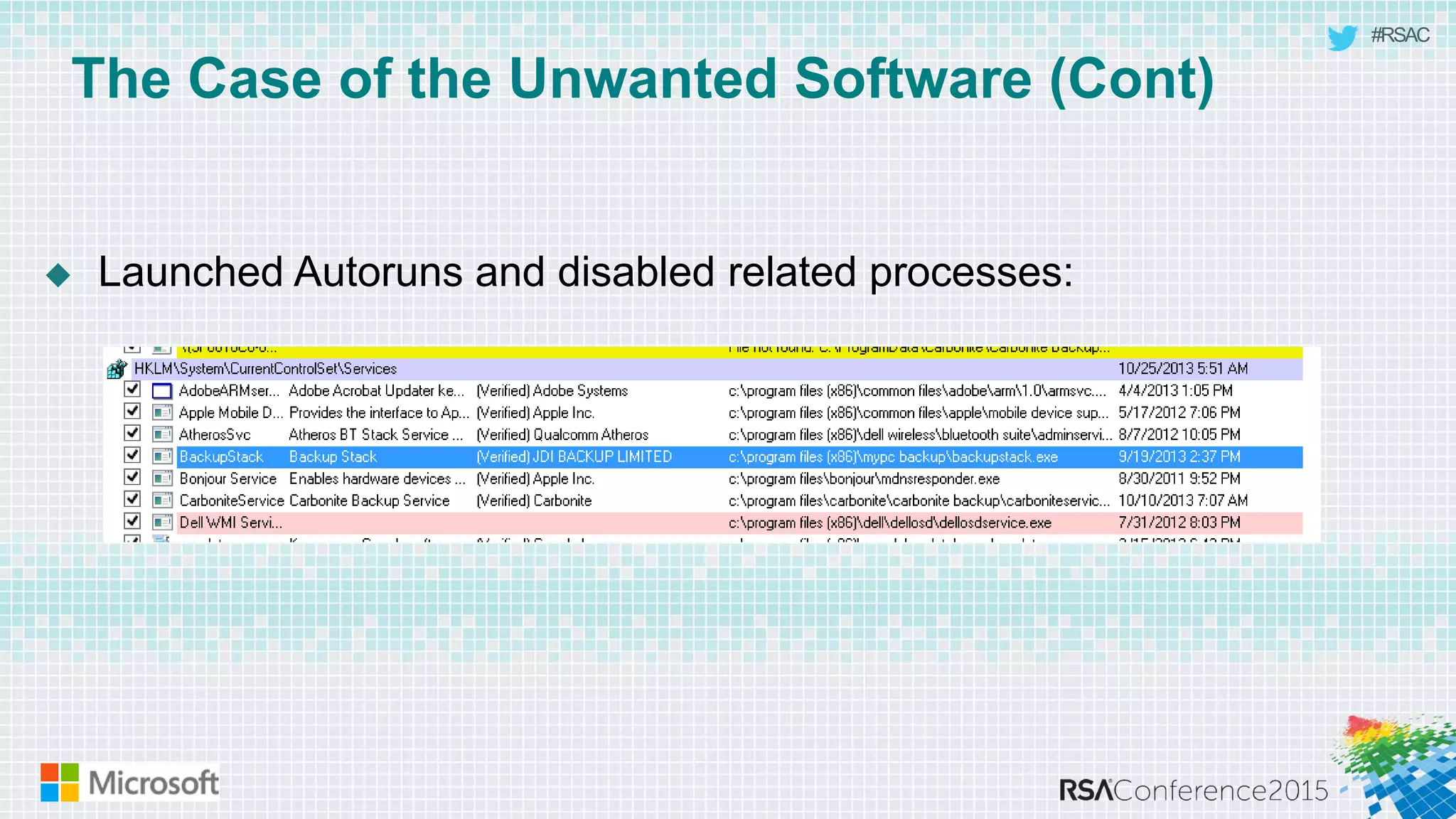
 Launched Autoruns and disabled related processes:
#RSAC
The Case of the Unwanted Software (Cont)
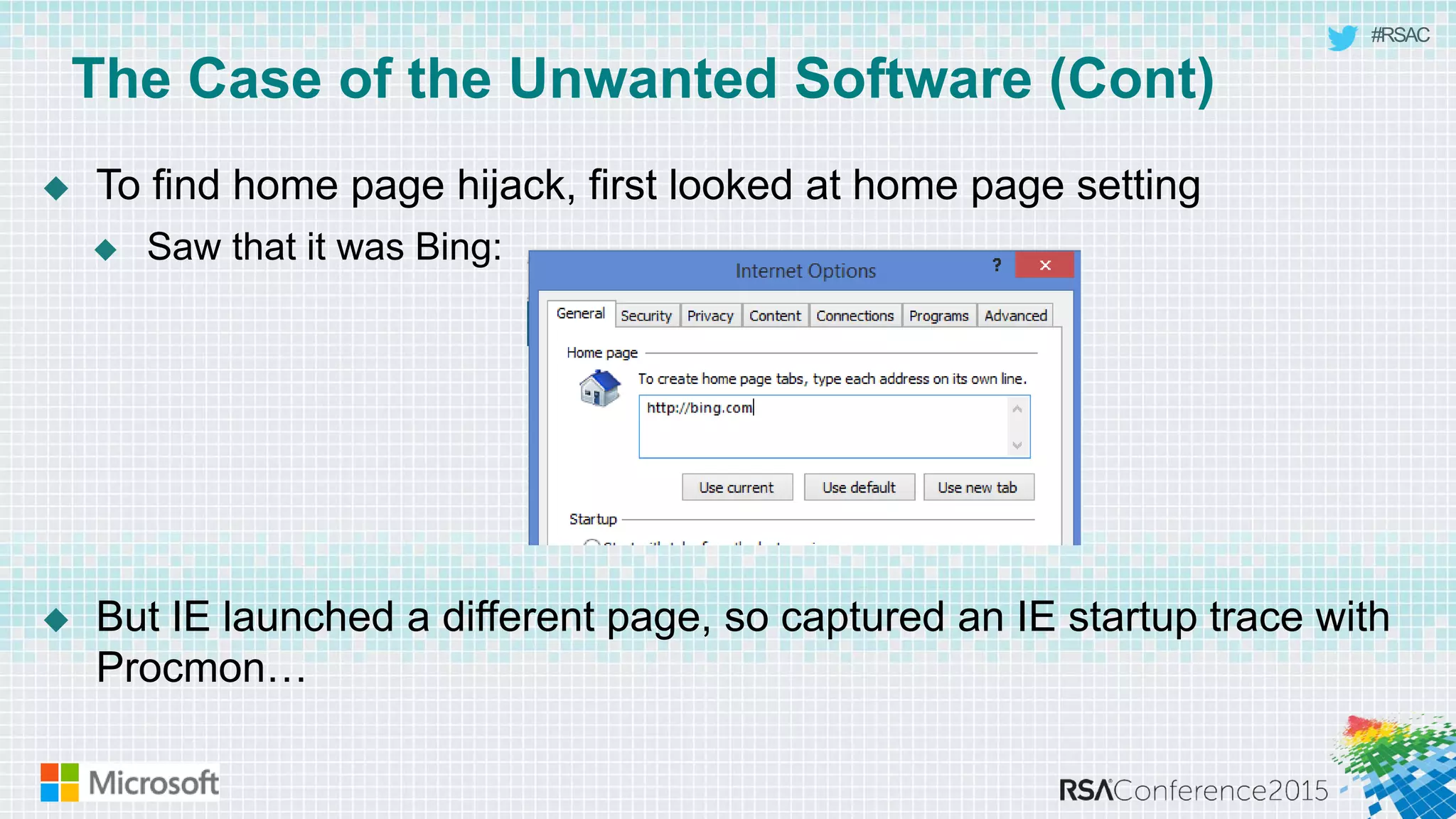
 To find home page hijack, first looked at home page setting
 Saw that it was Bing:
 But IE launched a different page, so captured an IE startup trace with
Procmon…
#RSAC
The Case of the Unwanted Software: Solved
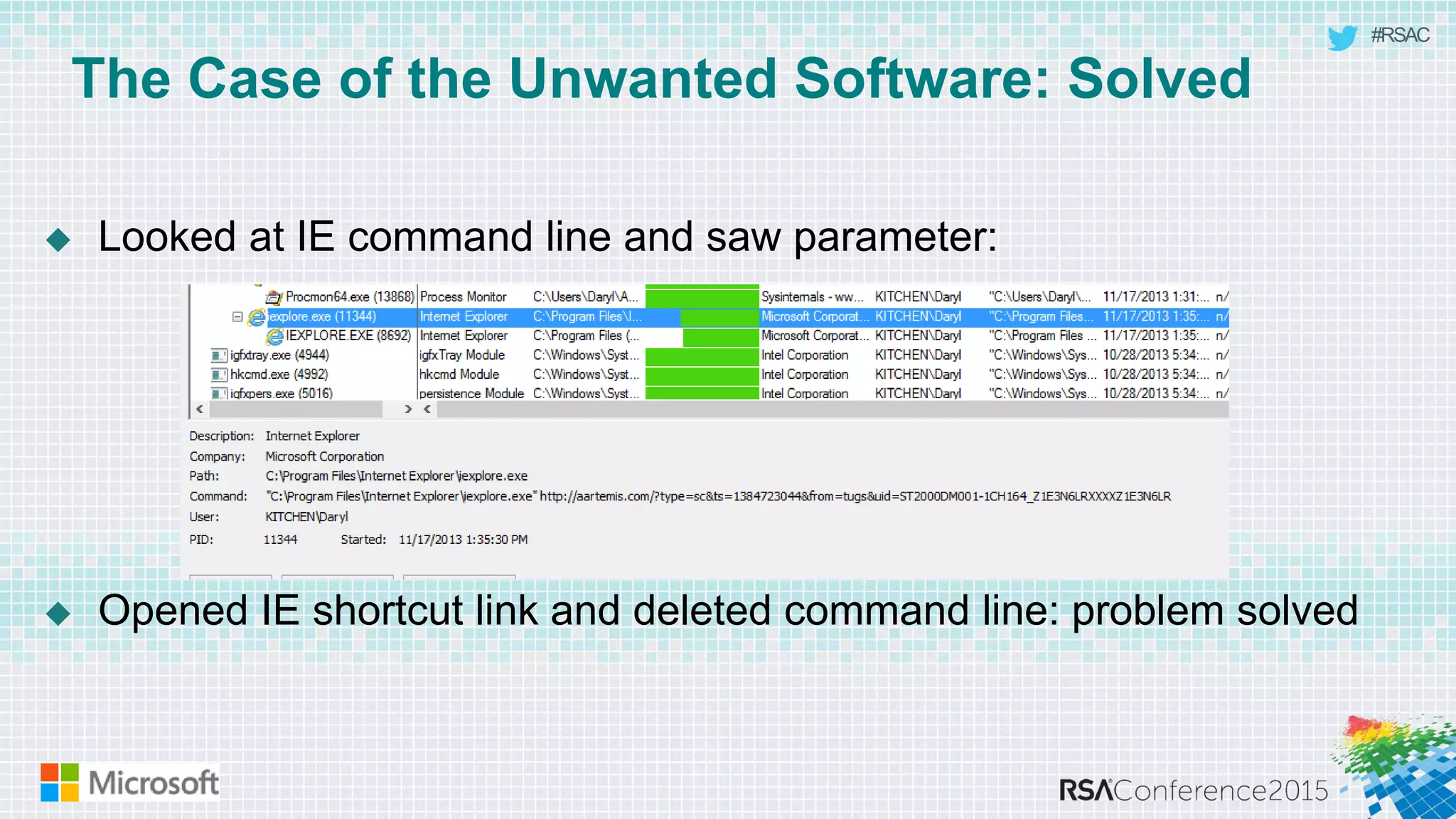
 Looked at IE command line and saw parameter:
 Opened IE shortcut link and deleted command line: problem solved
#RSAC
#RSAC
http://www.microsoft.com/security/portal/threat/encyclopedia/Entry.aspx?Name=Win32/fakerean
#RSAC
#RSAC
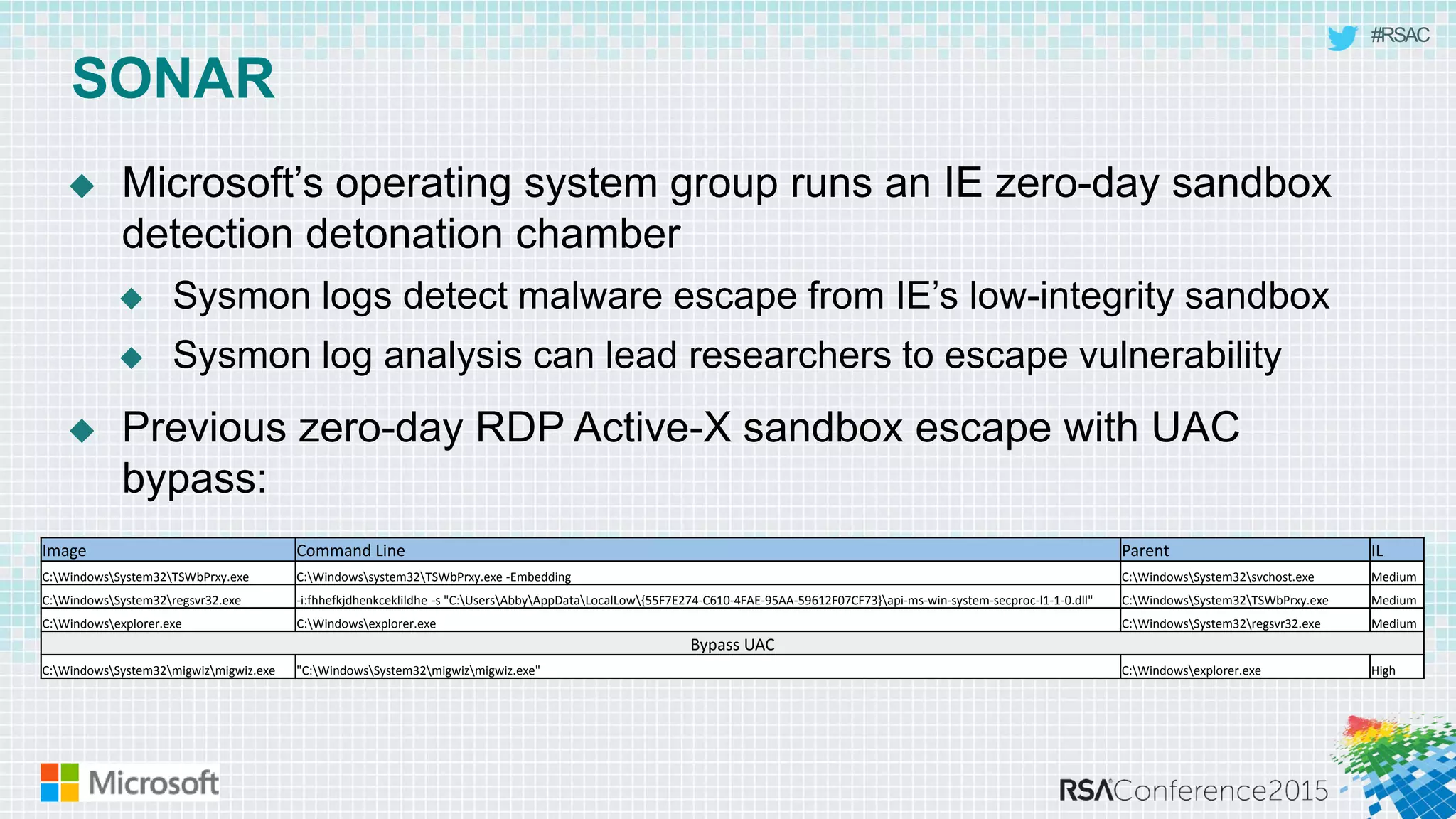
SONAR
 Microsoft’s operating system group runs an IE zero-day sandbox
detection detonation chamber
 Sysmon logs detect malware escape from IE’s low-integrity sandbox
 Sysmon log analysis can lead researchers to escape vulnerability
 Previous zero-day RDP Active-X sandbox escape with UAC
bypass:
Image Command Line Parent IL
C:WindowsSystem32TSWbPrxy.exe C:Windowssystem32TSWbPrxy.exe -Embedding C:WindowsSystem32svchost.exe Medium
C:WindowsSystem32regsvr32.exe -i:fhhefkjdhenkceklildhe -s "C:UsersAbbyAppDataLocalLow{55F7E274-C610-4FAE-95AA-59612F07CF73}api-ms-win-system-secproc-l1-1-0.dll" C:WindowsSystem32TSWbPrxy.exe Medium
C:Windowsexplorer.exe C:Windowsexplorer.exe C:WindowsSystem32regsvr32.exe Medium
Bypass UAC
C:WindowsSystem32migwizmigwiz.exe "C:WindowsSystem32migwizmigwiz.exe" C:Windowsexplorer.exe High
#RSAC
#RSAC
The Future of Malware
 We’ve seen the trends:
 Malware that pretends to be from Microsoft or other legitimate companies
 Malware protected by sophisticated rootkits
 Malware that has stolen certificates
 Cleaning is going to get much, much harder
 Targeted and polymorphic malware won’t get AV/AS signatures
 Malware can directly manipulate Windows structures to cause misdirection
 All standard tools will be directly attacked by malware
 There will be more un-cleanable malware
 You can’t know you’re infected unless you find a symptom
#RSAC
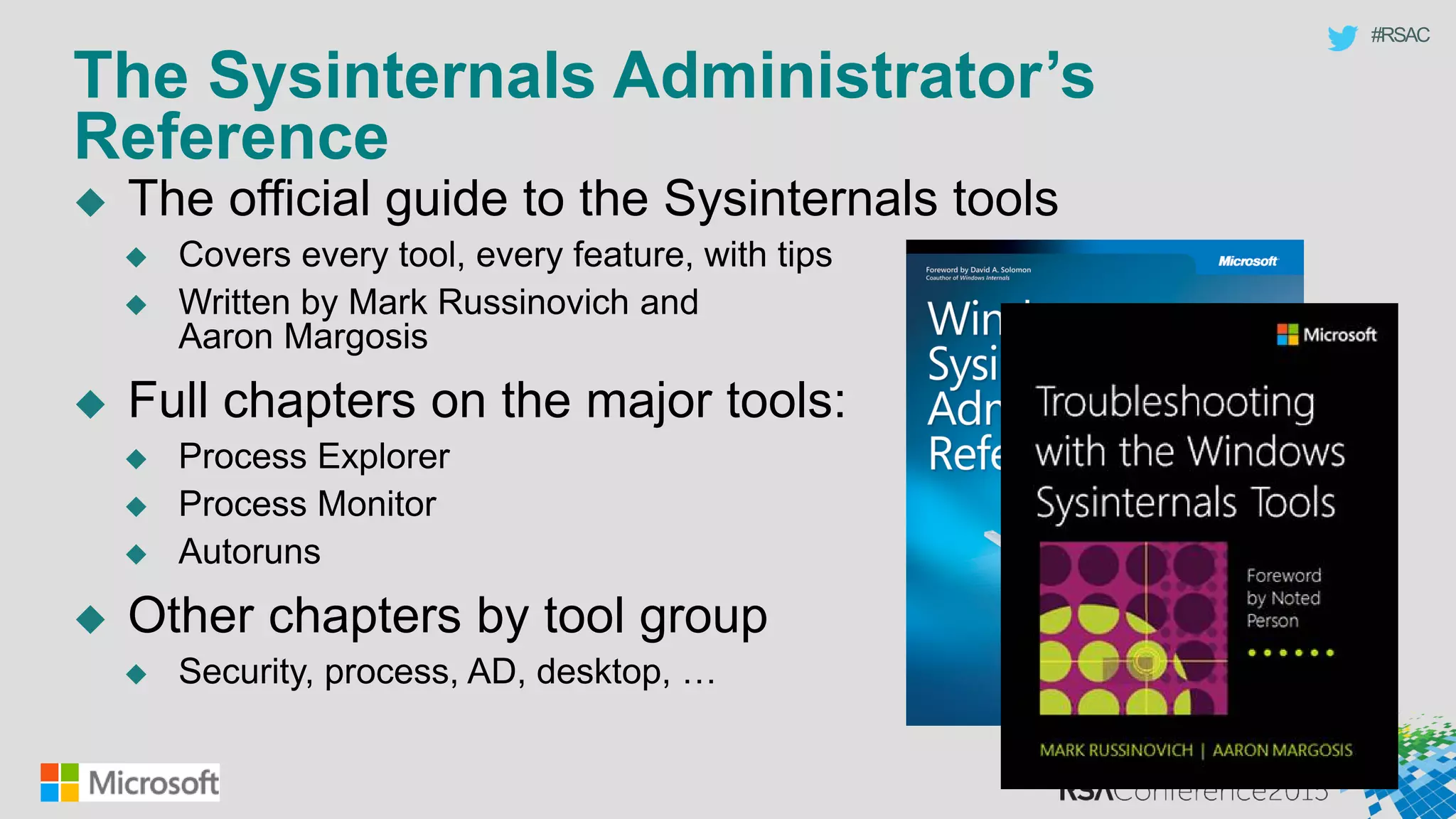
The Sysinternals Administrator’s
Reference
 The official guide to the Sysinternals tools
 Covers every tool, every feature, with tips
 Written by Mark Russinovich and
Aaron Margosis
 Full chapters on the major tools:
 Process Explorer
 Process Monitor
 Autoruns
 Other chapters by tool group
 Security, process, AD, desktop, …
#RSAC
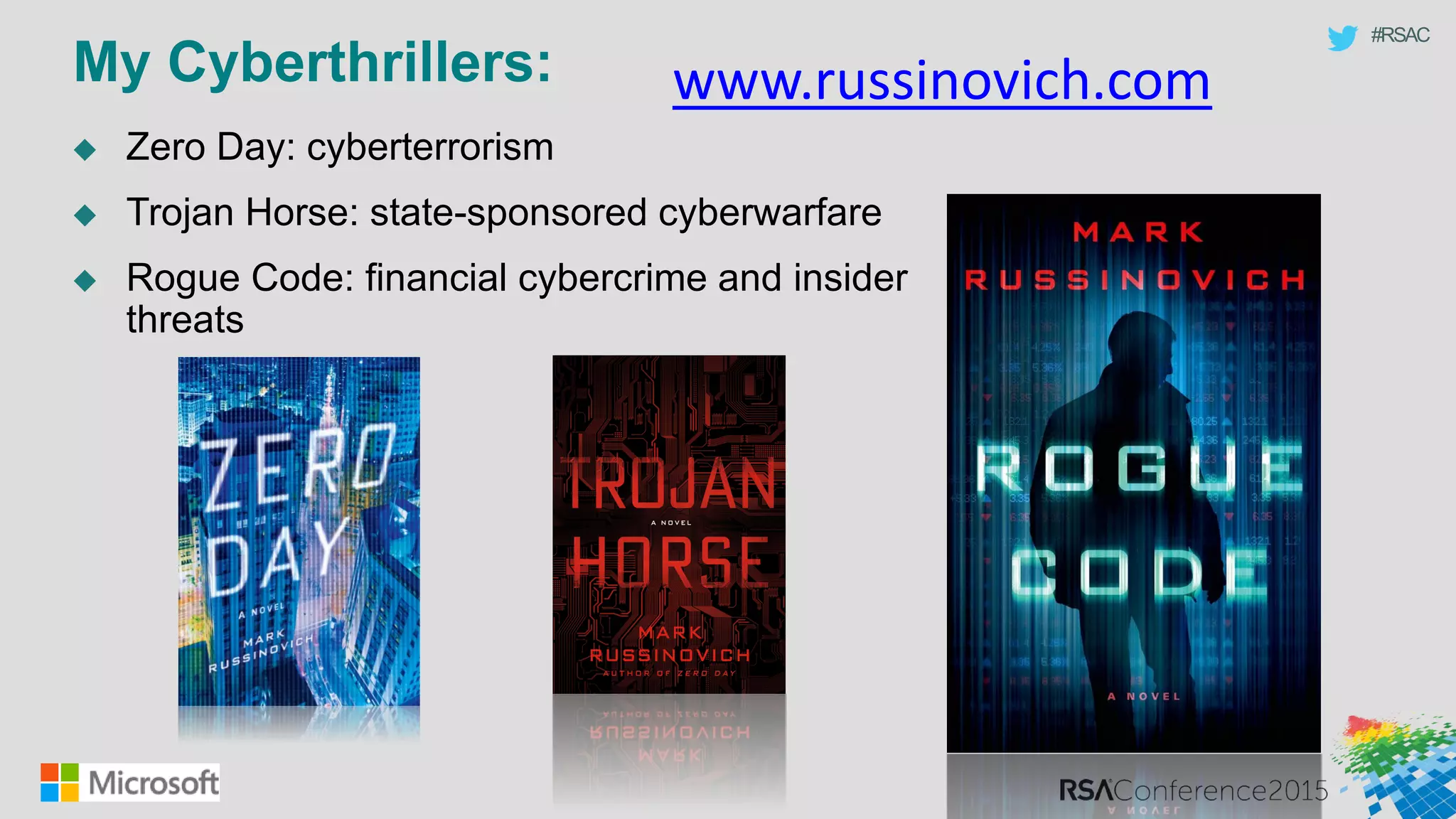
My Cyberthrillers:
 Zero Day: cyberterrorism
 Trojan Horse: state-sponsored cyberwarfare
 Rogue Code: financial cybercrime and insider
threats
www.russinovich.com
#RSAC
@markrussinovich
Rogue Code book giveaway and signing at the Microsoft Boot @ 3:00pm
Book signing at the RSA bookstore @ 1:00pm tomorrow

Malware hunting with the sysinternals tools

  • 1.
    SESSION ID: #RSAC Mark Russinovich MalwareHunting with the Sysinternals Tools CTO, Microsoft Azure Microsoft @markrussinovich HTA-T07R
  • 2.
    #RSAC “When combining theresults from all four AV engines, less than 40% of the binaries were detected.” Source: CAMP: Content-Agnostic Malware Protection Proceedings of 20th Annual Network & Distributed System Security Symposium https://www.cs.jhu.edu/~moheeb/aburajab-ndss-13.pdf
  • 3.
  • 4.
  • 5.
    #RSAC About this Talk Learn about Sysinternals tools and techniques for analyzing and cleaning malware  Professional antimalware analysis requires years of deep training  But even for professionals, Sysinternals tools can prove useful  Analyzing:  Understanding the impact of malware  Can be used to understand malware operation  Generates road map for cleaning infestations  Cleaning:  Removing an infestation of a compromised system  Attempting a clean can also reveal more information about malware’s operation
  • 6.
    #RSAC Malware Cleaning Steps Disconnect from network  Identify malicious processes and drivers  Terminate identified processes  Identify and delete malware autostarts  Delete malware files  Reboot and repeat
  • 7.
  • 8.
    #RSAC What Are YouLooking For?  Investigate processes that…  …have no icon  …have no description or company name  …unsigned Microsoft images  …live in Windows directory or user profile  …are packed  …include strange URLs in their strings  …have open TCP/IP endpoints  …host suspicious DLLs or services
  • 9.
    #RSAC What About TaskManager?  Task Manager provides little information about images that are running
  • 10.
    #RSAC Process Explorer  ProcessExplorer is “Super Task Manager”  Has lots of general troubleshooting capabilities:  DLL versioning problems  Handle leaks and locked files  Performance troubleshooting  Hung processes  We’re going to focus on its malware cleaning capabilities
  • 11.
    #RSAC The Process View The process tree shows parent-child relationships  Icon, description, and company name are pulled from image version information  Most malware doesn’t have version information  What about malware pretending to be from Microsoft?  We’ll deal with that shortly…  Use the Window Finder (in the toolbar) to associate a window with its owning process  Use the Search Online menu entry to lookup unknown processes  But malware often uses totally random or pseudo-random names
  • 12.
    #RSAC Refresh Highlighting  Refreshhighlighting highlights changes  Red: process exited  Green: new process  Change duration (default 1 second) in Options  Press space bar to pause and F5 to refresh  Cause display to scroll to make new processes visible with Show New Processes option  We’ll see how to spot short-lived processes later…
  • 13.
    #RSAC Process-type Highlights  Blueprocesses are running in the same security context as Process Explorer  Pink processes host Windows services  Purple highlighting indicates an image is “packed”  Packed can mean compressed or encrypted  Malware commonly uses packing (e.g. UPX) to make antivirus signature matching more difficult  Packing and encryption also hide strings from view  There are a few other colors, but they’re not important for malware hunting
  • 14.
    #RSAC Tooltips  Process tooltipsshow the full path to the process image  Malware more often hides behind Svchost, Rundll32, Dllhost and WMIPrsve  Tooltip for Rundll32 processes shows hosted DLL  Dllhost tooltip shows hosted COM server  WMI provider tooltip shows WMI servers  Tooltip for service processes shows hosted services
  • 15.
    #RSAC Detailed Process Information Double-click on a process to see more information  Pages relevant to malware analysis:  Image: signing status, start time, version, autostart location  TCP/IP: open endpoints  Strings: printable strings in main executable
  • 16.
    #RSAC Image Verification  All(well, most) Microsoft code is digitally signed  Hash of file is signed with Microsoft’s private key  Signature is checked by decrypting signed hash with the public key  You can selectively check for signatures with the Verify button on the process image tab  Select the Verify Image Signatures option to check all  Add the Verified Signer column to see all  Note that verification will connect to the Internet to check Certificate Revocation List (CRL) servers
  • 17.
    #RSAC VirusTotal Integration  VirusTotal.comis Antivirus-as-a- Service (AaaS)  You can have Process Explorer check file hashes  Check all displayed files with Options->Check VirusTotal  Results reported in VirusTotal column as well as DLL and process properties  Uploads hashes  Reports results as positive detection rate or “Unknown”  You can submit unknown files for scanning  Options->Submit Unknown Executables submits all portable executable (PE) images < 32 MB in size  Can submit on-demand with context menu or properties dialog
  • 18.
    #RSAC Sigcheck  Scan thesystem for suspicious executable images  Use –v to check VirusTotal:  -v to submit hashes (-vs to submit files for scanning)  -vr to open the VirusTotal report  Look for same characteristics as suspicious processes  Be especially wary of items in the Windows directory and the Users<username>Appdata directories  Investigate all unsigned images  Examine images with high entropy (> 7) sigcheck -e –vs -vr -u -s c:
  • 19.
    #RSAC The DLL View Malware can hide as a DLL inside a legitimate process  We’ve already seen this with Rundll32 and Svchost  Typically loads via an autostart  Can load through “dll injection”  Packing highlight shows in DLL view as well  Open the DLL view by clicking on the DLL icon in the toolbar  Shows more than just loaded DLLs  Includes .EXE and any “memory mapped files”  Can search for a DLL with the Find dialog  DLL strings are also viewable on the DLL properties
  • 20.
    #RSAC Terminating Malicious Processes Don’t kill the processes  Malware processes are often restarted by watchdogs  Instead, suspend them  Note that this might cause a system hang for Svchost processes  Record the full path to each malicious EXE and DLL  After they are all asleep then kill them  Watch for restarts with new names…
  • 21.
  • 22.
    #RSAC Investigating Autostarts  WindowsMsconfig (Start->Run->Msconfig) falls short  It knows about few locations  It provides little information
  • 23.
    #RSAC Autoruns  Shows everyplace in the system that can be configured to run something at boot & logon  Standard Run keys and Startup folders  Shell, userinit  Services and drivers  Tasks  Winlogon notifications  Explorer and IE addins (toolbars, Browser Helper Objects, …)  More and ever growing…  Each startup category has its own tab and all items display on the Everything tab  Startup name, image description, company and path
  • 24.
    #RSAC Identifying Malware Autostarts Zoom-in on add-ons (including malware) by selecting these filter options:  Verify Code Signatures  Hide Microsoft Entries  Select an item to see more in the lower window  Online search unknown images  Double-click on an item to look at where its configured in the Registry or file system  Has other features:  Can also show empty locations (informational only)  Includes compare functionality  Includes equivalent command-line version, Autorunsc.exe
  • 25.
    #RSAC Alternate Profiles andOffline Scanning  If a specific account is infected, you can use Autoruns from another:  If the system can’t be cleaned online, Autoruns can be used offline:
  • 26.
    #RSAC New: Autoruns v13 Dynamic filtering  More detailed progress updates  Full scan save-to-file  File compare deleted/new  VirusTotal Integration  You can have Autoruns check VirusTotal for hashes  Option to submit files for scanning
  • 27.
    #RSAC Deleting Autostarts  Deletesuspicious autostarts  You can disable them if you’re not sure  After you’re done do a full refresh  If they come back, run Process Monitor to see who’s putting them back  You might have misidentified a malware process  It might be a hidden, system, or legitimate process
  • 28.
  • 29.
    #RSAC Tracing Malware  Tracingactivity can reveal the system impact of malware  Tracing shows initial infection, before cloaking is applied  Can reveal the internals of “buddy system” and other infection-protection mechanisms  Process Monitor makes tracing easy  A simple filter can identify all system modifications  Investigating stacks can distinguish legitimate activity from malicious activity  It will often show you the cause for error messages  It many times tells you what is causing sluggish performance When in doubt, run Process Monitor!
  • 30.
    #RSAC Event Classes  Filesystem (Filemon)  Includes I/O command input and output details  Registry (Regmon)  Includes all data  Process  Process create and exit  Thread create and exit  Image loads, including drivers  Network  ETW network tracing  Profiling  Thread stack snapshots
  • 31.
    #RSAC Event Properties  Eventdetails  Duration, process, thread, details, etc.  Process information  Command line  User  Session and logon session  Image information  Start time  Thread stack at time of event
  • 32.
    #RSAC Filtering  To filteron a value, right-click on the line and select the attribute from the Include, Exclude or Highlight submenus  When you set a highlight filter you can move through highlighted event properties
  • 33.
    #RSAC Advanced Filters  Multiple-filterbehavior:  Values from different attributes are AND’d  Values for the same attribute are OR’d  Use Edit Filter context menu for quick configuration  More complex filtering is available in the Filter dialog  Outlook-style rule definition  You can save and restore filters  Filter for watching malware impact: “Category is Write”
  • 34.
    #RSAC The Process Tree Tools->Process Tree  Shows all processes that have been seen in the trace (including parents)  Can toggle on and off terminated processes  The process tree provides an easy way to see process relationships  Short-lived processes  Command lines  User names
  • 35.
  • 36.
    #RSAC System Monitor (Sysmon) Background system monitoring utility  Record system events to the Windows event log  Can be used for system anomaly detection  Forensics can trace intruder activity across the network  Written for use in Microsoft corporate network  To understand attacker behavior and tools  Significant contributions by Thomas Garnier  Public version has reduced functionality  Installs as service/driver  No reboot required  Captures events from early in the boot process
  • 37.
    #RSAC Sysmon Events  Processcreate (new: process terminate process):  Image file and image file hash  Command line  Parent image and command line  GUID for process ID-independent tracking  Driver load and unload:  Image file and image file hash  Network connections:  Process name  IP addresses and ports  Host and port names  File create timestamp change  Process responsible  Original and new timestamp  New: CreateRemoteThread  Source process  Target process
  • 38.
    #RSAC Sysmon Configuration  Supportsfilters on the command-line  Processes to include or exclude  Process network activity  Hash types to collect  Configuration file offers full filtering  Include/exclude on any event type  Conditionals on any event field  Default:  Process create and terminate, file timestamp change
  • 39.
  • 40.
    #RSAC The Case ofthe Unwanted Software  Mom complained about two symptoms:  Her IE home page was hijacked  She got toast from a backup program
  • 41.
    #RSAC The Case ofthe Unwanted Software (Cont)  I went after the backup toast first  Launched Process Explorer and used window finder to identify offending process:
  • 42.
    #RSAC The Case ofthe Unwanted Software (Cont)  Launched Autoruns and disabled related processes:
  • 43.
    #RSAC The Case ofthe Unwanted Software (Cont)  To find home page hijack, first looked at home page setting  Saw that it was Bing:  But IE launched a different page, so captured an IE startup trace with Procmon…
  • 44.
    #RSAC The Case ofthe Unwanted Software: Solved  Looked at IE command line and saw parameter:  Opened IE shortcut link and deleted command line: problem solved
  • 45.
  • 46.
  • 47.
  • 48.
    #RSAC SONAR  Microsoft’s operatingsystem group runs an IE zero-day sandbox detection detonation chamber  Sysmon logs detect malware escape from IE’s low-integrity sandbox  Sysmon log analysis can lead researchers to escape vulnerability  Previous zero-day RDP Active-X sandbox escape with UAC bypass: Image Command Line Parent IL C:WindowsSystem32TSWbPrxy.exe C:Windowssystem32TSWbPrxy.exe -Embedding C:WindowsSystem32svchost.exe Medium C:WindowsSystem32regsvr32.exe -i:fhhefkjdhenkceklildhe -s "C:UsersAbbyAppDataLocalLow{55F7E274-C610-4FAE-95AA-59612F07CF73}api-ms-win-system-secproc-l1-1-0.dll" C:WindowsSystem32TSWbPrxy.exe Medium C:Windowsexplorer.exe C:Windowsexplorer.exe C:WindowsSystem32regsvr32.exe Medium Bypass UAC C:WindowsSystem32migwizmigwiz.exe "C:WindowsSystem32migwizmigwiz.exe" C:Windowsexplorer.exe High
  • 49.
  • 50.
    #RSAC The Future ofMalware  We’ve seen the trends:  Malware that pretends to be from Microsoft or other legitimate companies  Malware protected by sophisticated rootkits  Malware that has stolen certificates  Cleaning is going to get much, much harder  Targeted and polymorphic malware won’t get AV/AS signatures  Malware can directly manipulate Windows structures to cause misdirection  All standard tools will be directly attacked by malware  There will be more un-cleanable malware  You can’t know you’re infected unless you find a symptom
  • 51.
    #RSAC The Sysinternals Administrator’s Reference The official guide to the Sysinternals tools  Covers every tool, every feature, with tips  Written by Mark Russinovich and Aaron Margosis  Full chapters on the major tools:  Process Explorer  Process Monitor  Autoruns  Other chapters by tool group  Security, process, AD, desktop, …
  • 52.
    #RSAC My Cyberthrillers:  ZeroDay: cyberterrorism  Trojan Horse: state-sponsored cyberwarfare  Rogue Code: financial cybercrime and insider threats www.russinovich.com
  • 53.
    #RSAC @markrussinovich Rogue Code bookgiveaway and signing at the Microsoft Boot @ 3:00pm Book signing at the RSA bookstore @ 1:00pm tomorrow