NIST 800-92 Log Management Guide in the Real World Dr Anton Chuvakin Chief Logging Evangelist
Goals Get a  refresher on logs  and logging Get familiar with  NIST 800-92  Guide Learn how  log standards  such as NIST help people “in the trenches” Pick a few  tips on organizing  your log management efforts (if you are a manager) Pick a few  logging   tips  (if you are an analyst)
Outline What Logs?   From Log Analysis to Log Management Log Management for Security and Beyond Standards in Logging and Log Management  Brief NIST 800-92 Walkthrough How 800-92 Helps You Examples
Log Data Overview Audit  records Transaction logs Intrusion alerts Connection logs System performance records User activity logs Various alerts and other messages Firewalls/intrusion prevention Routers/switches Intrusion detection Servers, desktops, mainframes Business applications Databases Anti-virus VPNs Proxies What Logs? From Where?
Security Log Analysis: Why Situational  awareness  and   new threat  discovery Unique perspective from combined logs Getting more value out of the network and security  infrastructures Get more that you paid for! Measuring  security (metrics, trends, etc) Tracking  what the users do Incident  response (last, but not least!)
Log Analysis: Why NOT “ Real hackers don’t get logged !”   Why bother? No, really … Too much data (>x0 GB per day) Too hard to do No tools “that do it for you” Or: tools too expensive What logs? We turned them off   
Log Analysis Basics: How Manual ‘ tail’, ‘more’, etc Filtering Positive and negative (“Artificial ignorance”) Summarization  and reports Simple  visualization “… worth a thousand words?” Correlation Rule-based and other
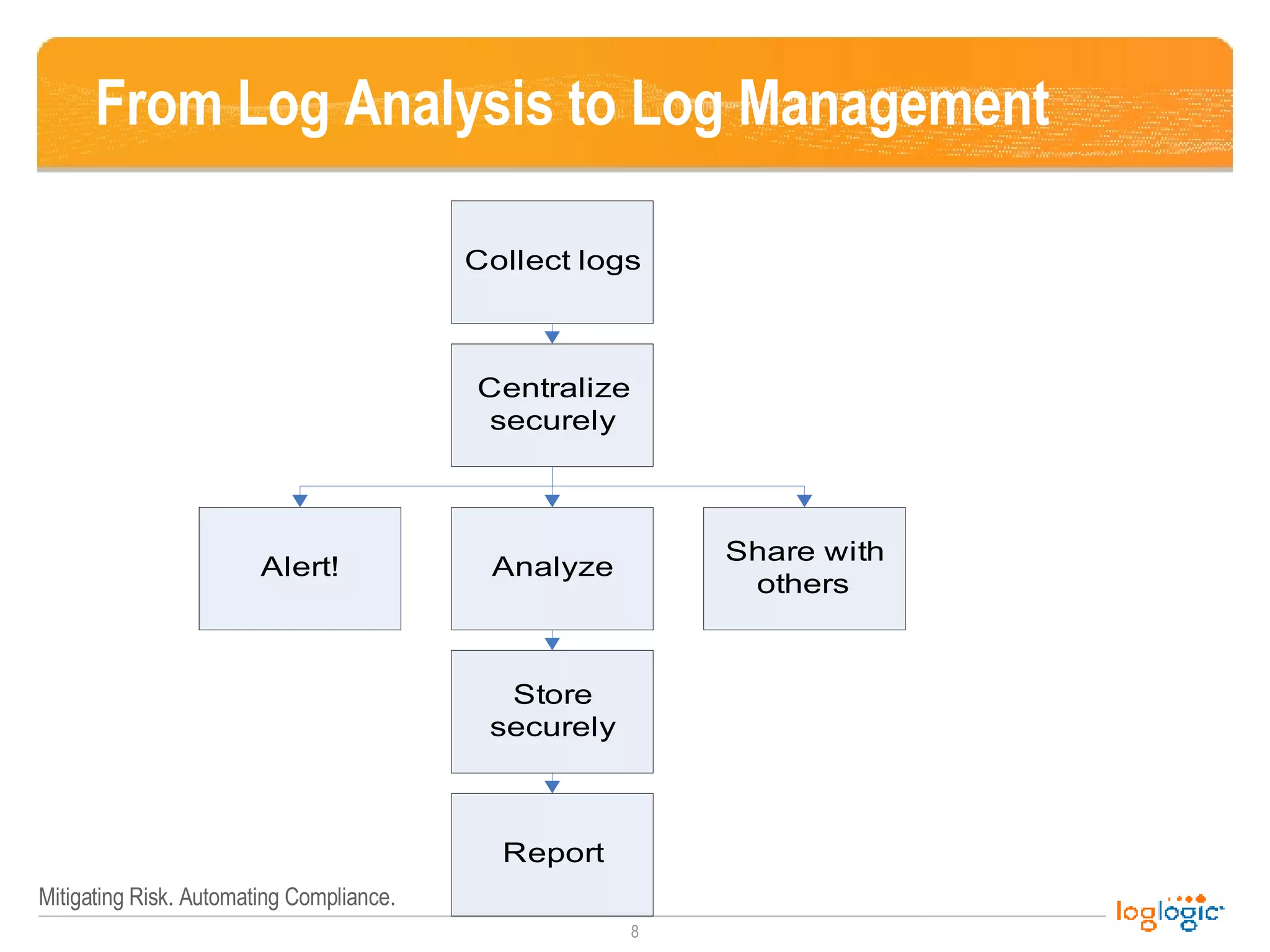
From Log Analysis to Log Management
Why Log Management? Logs Beyond Security  Threat  protection and discovery Regulatory  compliance Internal  policies  and procedure compliance Internal and external  audit  support Incident  response Forensics , “e-discovery” and litigation support IT system and network  troubleshooting IT  performance  management
From Compliance to Logging Standards Log  transmission Syslog (TCP/UDP port 514) Log  format Syslog, “a non-standard standard” IDMEF, a failed standard Log  contents No standard to speak of:  logs = trash can  – people dump what they want (or: don’t want!) there Logging  practices NIST 800-92 (for security only)
Why Logging Standards? Common language  so that people and other systems understand what is in the logs Easier to report  on logs and explain the reports Deeper insight  into future problems as indicated by the log data Easier system  interoperability  (thus, reduced cost and complexity) Common logging practices  simplify audits  and compliance
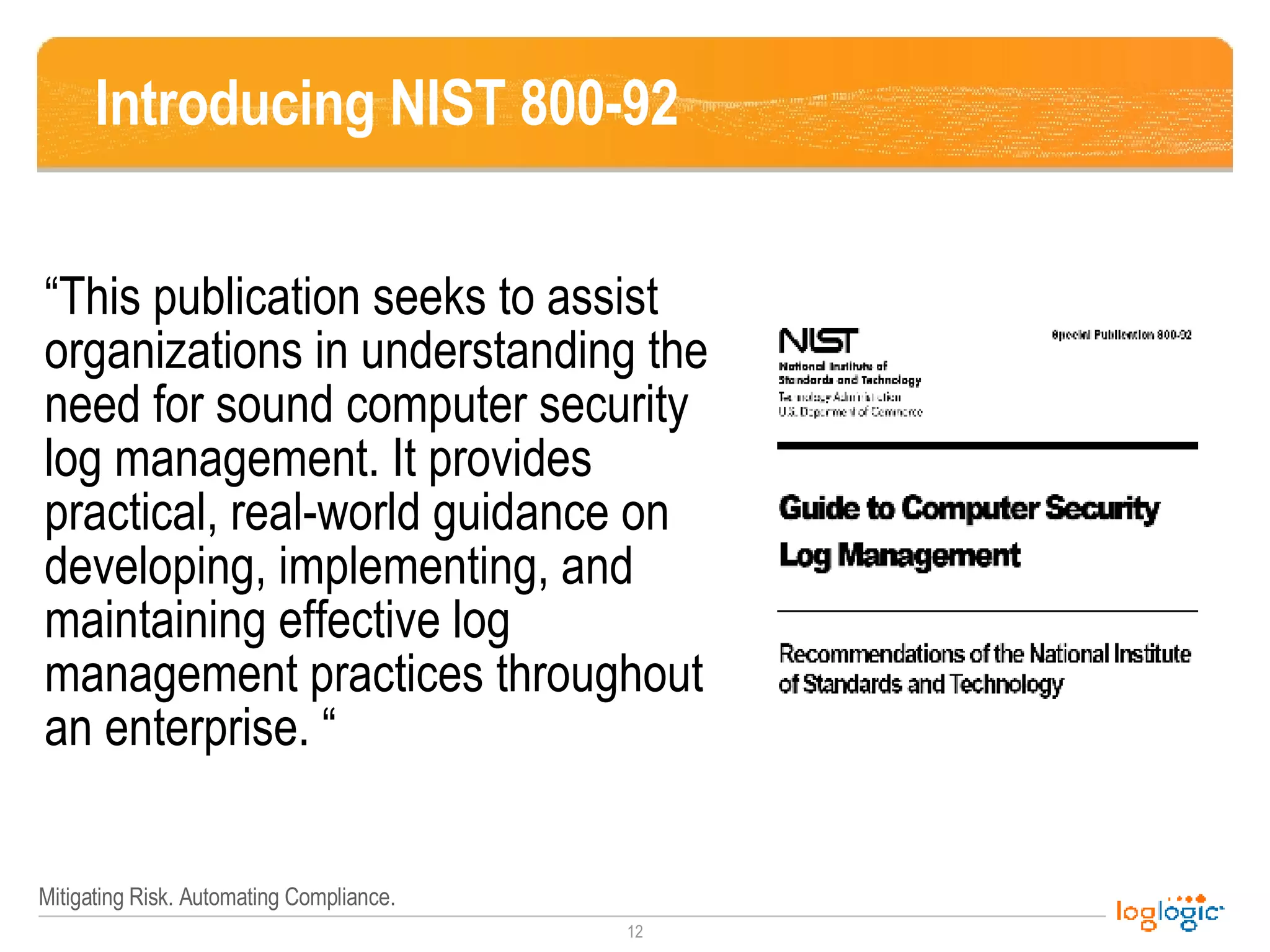
Introducing NIST 800-92 “This publication seeks to assist organizations in understanding the need for sound computer security log management. It provides practical, real-world guidance on developing, implementing, and maintaining effective log management practices throughout an enterprise. “
NIST 800-92 Walkthrough Introduction to Computer Security Log Management  Log Management Infrastructure Log Management Planning Log Management Operational Processes
Computer Security Log Management: Logs “ A log  is a record of the events occurring within an organization’s systems and networks” “Within an organization, many logs contain  records related to computer security ; common examples of these computer security logs are audit logs that track user authentication attempts and security device logs that record possible attacks.” “This guide addresses  only   those logs that typically contain computer security-related information .”
Computer Security Log Management: Process “ Security log management  [is] the process for generating,  transmitting,  storing,  analyzing, and  disposing of computer security log data. ”
Computer Security Log Management: Benefits “ It helps to ensure that  computer security records are   stored  in sufficient detail for an appropriate period of time.  Routine log reviews and analysis  are beneficial for identifying security incidents, policy violations, fraudulent activity, and operational problems […] Logs can also be useful for performing  auditing and forensic analysis , supporting the organization’s internal investigations  Establishing baselines, and identifying  operational trends  and  long-term problems .”
Security Logs vs. Security Logs   Logs from Security Applications  vs. Security Logs from Applications A  key  distinction!
Log Management Challenges “First, there are several potential problems with the initial generation of logs because of their  variety and prevalence.  Second, the  confidentiality, integrity, and availability of generated logs  could be breached inadvertently or intentionally.  Finally, the  people  responsible for performing log analysis are often inadequately prepared and supported.”
Log Management Infrastructure Three Tiers of Log Management Architecture Log   Generation Log Analysis and Storage Log Monitoring
Log Management Infrastructure: Buzzwords Parsing Filtering Aggregation Rotation Archival Compression Reduction Conversion Normalization Integrity Checking Correlation Viewing Reporting Clearing
Log Management Infrastructure: Tools Syslog-based tools SIEM/SIM/SEM Where did the host IDS go?   Log visualization tools General log management tools (e.g.  LogLogic ) Other tools related to logging
Log Management Planning: Roles “ Who is invited to the party?” System and network admins Security admins CIRTs Application developers ISOs and CSOs CIOs Auditors And all software buyers
Log Management Planning: Policies  Policies need to cover “ Log generation  Log transmission  Log storage and disposal Log analysis“
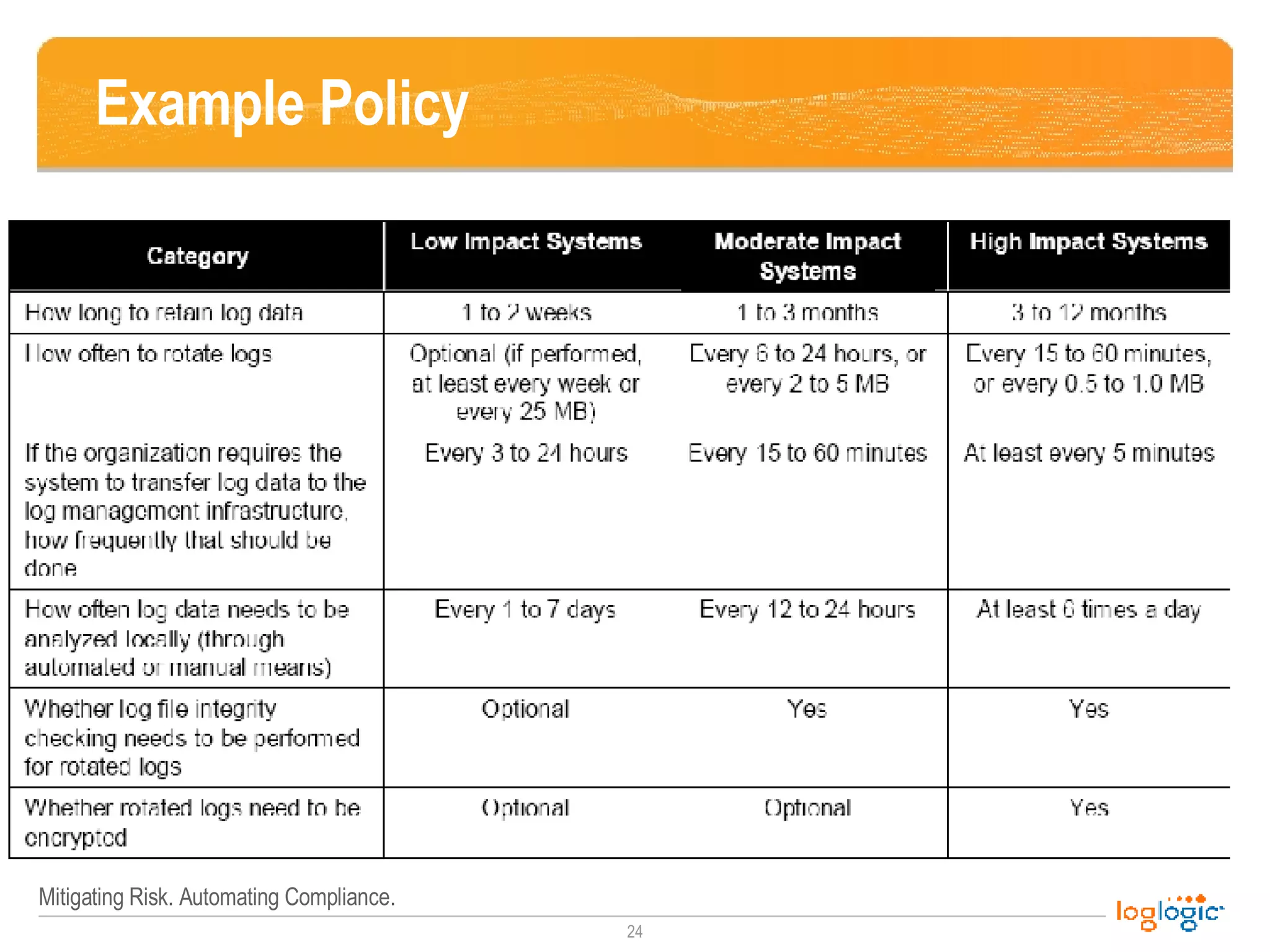
Example Policy
Log Management Operational Processes “ Configure the log sources , including log generation, storage, and security  Perform analysis  of log data  Initiate appropriate  responses  to identified events  Manage the  long-term storage  of log data.”
Log Security Issues “ Limit access  to log files.  Avoid recording  unneeded sensitive data .  Protect archived  log files.  Secure the processes  that generate the log entries.  Configure each log source to behave appropriately when  logging errors  occur.  Implement  secure mechanisms for transporting  log data from the system to the centralized log management servers”
Log Analysis Operational Processes Automation  is key! Review logs =/= read logs More data is good;  context data  is better There might be some log entries that you’d  never understand    Analyze to  prioritize the efforts
Critical Issue:  System-level  vs.  Infrastructure-level Important separation of responsibilities Sysadmin vs. CSO or CIRT Local vs. global Event vs. incident Event response is not the same as incident response Typically, event is system-level while incident infrastructure-level (or organization-level)
Manage Long Term Storage A surprisingly hard problem! “ Choose a  log format  for the data to be archived Archive  the log data Verify the integrity  of the transferred logs Store  the media  securely”
How 800-92 Helps You! Government  (under FISMA mandate) Security Manager Security Analyst Commercial Security Manager Security Analyst
Government: Manager NIST is voluntary guidance, but FISMA is not  (FISMA requires log management): “NIST developed this document in furtherance of its statutory responsibilities under the Federal Information Security Management Act (FISMA) of 2002, Public Law 107-347. “ Planning a log management project?  Don’t start from scratch  – start from NIST 800-92! Log management touches the whole enterprise, and the guide explains how to  involve other teams , not just security
Other: Manager NIST 800-92 might not apply to you directly, but why ignore  good advice ? Planning a log management project?  Don’t start from scratch  – start from NIST 800-92! Compliance drives log management: NIST guide covers a  compliance-friendly way  of doing log management (and it helps justify management decisions)
Government and Other: Technical The guide is mostly about  process , less bits and bytes … Log collection configuration  guidance: how to solve “what to log question” Log analysis  tips, including  prioritization Storage conundrum : not as simple as sounds What to do about  log security ?
Example: NIST 800-92 and PCI Compliance Retail organization log management project driven by PCI DSS Log management in Requirement 10 and beyond NIST guide for tool selection NIST guide for template policies NIST guide for ongoing project success
Take These Home with You!! Find the critical systems  where logging is essential Enable logging! Read the NIST 800-92 guide  (at least the parts needed) – get it on the NIST site  http://csrc.nist.gov/publications/nistpubs/   Involve different teams in  logging initiatives Look at your logs!  You’d be happy you started now and not tomorrow Automate  log management
Thanks for Attending! Dr Anton Chuvakin, GCIA, GCIH, GCFA Chief Logging Evangelist LogLogic, Inc  http://www.chuvakin.org   See  www.info-secure.org   for my papers, books, reviews  and other security resources Also visit my blog at  www.securitywarrior.org

NIST 800-92 Log Management Guide in the Real World

  • 1.
    NIST 800-92 LogManagement Guide in the Real World Dr Anton Chuvakin Chief Logging Evangelist
  • 2.
    Goals Get a refresher on logs and logging Get familiar with NIST 800-92 Guide Learn how log standards such as NIST help people “in the trenches” Pick a few tips on organizing your log management efforts (if you are a manager) Pick a few logging tips (if you are an analyst)
  • 3.
    Outline What Logs?  From Log Analysis to Log Management Log Management for Security and Beyond Standards in Logging and Log Management Brief NIST 800-92 Walkthrough How 800-92 Helps You Examples
  • 4.
    Log Data OverviewAudit records Transaction logs Intrusion alerts Connection logs System performance records User activity logs Various alerts and other messages Firewalls/intrusion prevention Routers/switches Intrusion detection Servers, desktops, mainframes Business applications Databases Anti-virus VPNs Proxies What Logs? From Where?
  • 5.
    Security Log Analysis:Why Situational awareness and new threat discovery Unique perspective from combined logs Getting more value out of the network and security infrastructures Get more that you paid for! Measuring security (metrics, trends, etc) Tracking what the users do Incident response (last, but not least!)
  • 6.
    Log Analysis: WhyNOT “ Real hackers don’t get logged !”  Why bother? No, really … Too much data (>x0 GB per day) Too hard to do No tools “that do it for you” Or: tools too expensive What logs? We turned them off 
  • 7.
    Log Analysis Basics:How Manual ‘ tail’, ‘more’, etc Filtering Positive and negative (“Artificial ignorance”) Summarization and reports Simple visualization “… worth a thousand words?” Correlation Rule-based and other
  • 8.
    From Log Analysisto Log Management
  • 9.
    Why Log Management?Logs Beyond Security Threat protection and discovery Regulatory compliance Internal policies and procedure compliance Internal and external audit support Incident response Forensics , “e-discovery” and litigation support IT system and network troubleshooting IT performance management
  • 10.
    From Compliance toLogging Standards Log transmission Syslog (TCP/UDP port 514) Log format Syslog, “a non-standard standard” IDMEF, a failed standard Log contents No standard to speak of: logs = trash can – people dump what they want (or: don’t want!) there Logging practices NIST 800-92 (for security only)
  • 11.
    Why Logging Standards?Common language so that people and other systems understand what is in the logs Easier to report on logs and explain the reports Deeper insight into future problems as indicated by the log data Easier system interoperability (thus, reduced cost and complexity) Common logging practices simplify audits and compliance
  • 12.
    Introducing NIST 800-92“This publication seeks to assist organizations in understanding the need for sound computer security log management. It provides practical, real-world guidance on developing, implementing, and maintaining effective log management practices throughout an enterprise. “
  • 13.
    NIST 800-92 WalkthroughIntroduction to Computer Security Log Management Log Management Infrastructure Log Management Planning Log Management Operational Processes
  • 14.
    Computer Security LogManagement: Logs “ A log is a record of the events occurring within an organization’s systems and networks” “Within an organization, many logs contain records related to computer security ; common examples of these computer security logs are audit logs that track user authentication attempts and security device logs that record possible attacks.” “This guide addresses only those logs that typically contain computer security-related information .”
  • 15.
    Computer Security LogManagement: Process “ Security log management [is] the process for generating, transmitting, storing, analyzing, and disposing of computer security log data. ”
  • 16.
    Computer Security LogManagement: Benefits “ It helps to ensure that computer security records are stored in sufficient detail for an appropriate period of time. Routine log reviews and analysis are beneficial for identifying security incidents, policy violations, fraudulent activity, and operational problems […] Logs can also be useful for performing auditing and forensic analysis , supporting the organization’s internal investigations Establishing baselines, and identifying operational trends and long-term problems .”
  • 17.
    Security Logs vs.Security Logs  Logs from Security Applications vs. Security Logs from Applications A key distinction!
  • 18.
    Log Management Challenges“First, there are several potential problems with the initial generation of logs because of their variety and prevalence. Second, the confidentiality, integrity, and availability of generated logs could be breached inadvertently or intentionally. Finally, the people responsible for performing log analysis are often inadequately prepared and supported.”
  • 19.
    Log Management InfrastructureThree Tiers of Log Management Architecture Log Generation Log Analysis and Storage Log Monitoring
  • 20.
    Log Management Infrastructure:Buzzwords Parsing Filtering Aggregation Rotation Archival Compression Reduction Conversion Normalization Integrity Checking Correlation Viewing Reporting Clearing
  • 21.
    Log Management Infrastructure:Tools Syslog-based tools SIEM/SIM/SEM Where did the host IDS go?  Log visualization tools General log management tools (e.g. LogLogic ) Other tools related to logging
  • 22.
    Log Management Planning:Roles “ Who is invited to the party?” System and network admins Security admins CIRTs Application developers ISOs and CSOs CIOs Auditors And all software buyers
  • 23.
    Log Management Planning:Policies Policies need to cover “ Log generation Log transmission Log storage and disposal Log analysis“
  • 24.
  • 25.
    Log Management OperationalProcesses “ Configure the log sources , including log generation, storage, and security Perform analysis of log data Initiate appropriate responses to identified events Manage the long-term storage of log data.”
  • 26.
    Log Security Issues“ Limit access to log files. Avoid recording unneeded sensitive data . Protect archived log files. Secure the processes that generate the log entries. Configure each log source to behave appropriately when logging errors occur. Implement secure mechanisms for transporting log data from the system to the centralized log management servers”
  • 27.
    Log Analysis OperationalProcesses Automation is key! Review logs =/= read logs More data is good; context data is better There might be some log entries that you’d never understand  Analyze to prioritize the efforts
  • 28.
    Critical Issue: System-level vs. Infrastructure-level Important separation of responsibilities Sysadmin vs. CSO or CIRT Local vs. global Event vs. incident Event response is not the same as incident response Typically, event is system-level while incident infrastructure-level (or organization-level)
  • 29.
    Manage Long TermStorage A surprisingly hard problem! “ Choose a log format for the data to be archived Archive the log data Verify the integrity of the transferred logs Store the media securely”
  • 30.
    How 800-92 HelpsYou! Government (under FISMA mandate) Security Manager Security Analyst Commercial Security Manager Security Analyst
  • 31.
    Government: Manager NISTis voluntary guidance, but FISMA is not (FISMA requires log management): “NIST developed this document in furtherance of its statutory responsibilities under the Federal Information Security Management Act (FISMA) of 2002, Public Law 107-347. “ Planning a log management project? Don’t start from scratch – start from NIST 800-92! Log management touches the whole enterprise, and the guide explains how to involve other teams , not just security
  • 32.
    Other: Manager NIST800-92 might not apply to you directly, but why ignore good advice ? Planning a log management project? Don’t start from scratch – start from NIST 800-92! Compliance drives log management: NIST guide covers a compliance-friendly way of doing log management (and it helps justify management decisions)
  • 33.
    Government and Other:Technical The guide is mostly about process , less bits and bytes … Log collection configuration guidance: how to solve “what to log question” Log analysis tips, including prioritization Storage conundrum : not as simple as sounds What to do about log security ?
  • 34.
    Example: NIST 800-92and PCI Compliance Retail organization log management project driven by PCI DSS Log management in Requirement 10 and beyond NIST guide for tool selection NIST guide for template policies NIST guide for ongoing project success
  • 35.
    Take These Homewith You!! Find the critical systems where logging is essential Enable logging! Read the NIST 800-92 guide (at least the parts needed) – get it on the NIST site http://csrc.nist.gov/publications/nistpubs/ Involve different teams in logging initiatives Look at your logs! You’d be happy you started now and not tomorrow Automate log management
  • 36.
    Thanks for Attending!Dr Anton Chuvakin, GCIA, GCIH, GCFA Chief Logging Evangelist LogLogic, Inc http://www.chuvakin.org See www.info-secure.org for my papers, books, reviews and other security resources Also visit my blog at www.securitywarrior.org

Editor's Notes

  • #2 This presentation will introduce the first ever standard on log management - NIST 800 - 92 guide. It will then offer a guide walk through to highlight the critical areas of standardization. The majority of the remaining time will be spent on explaining how to use the guide in the real world if you are a security manager or a security pro.