Malnutrition
in Children
of Pakistan
Prof. Imran Iqbal
Prof of Paediatrics (2003-2018)
Prof of Pediatrics Emeritus, CHICH
Multan, Pakistan
In the name of Allah,
the most gracious, the most merciful.
MALNUTRITION
IS A PATHALOGICAL STATE
RESULTING FROM
DEFICIENCY OF
ONE OR MORE
ESSENTIAL NUTRIENTS.
Nutritional status
Nutritional status is determined by balance of
Nutritional Intake and
Nutritional Expenditure
NUTRITIONAL INTAKE NUTRITIONAL EXPENDITURE
NUTRITIONAL STATUS
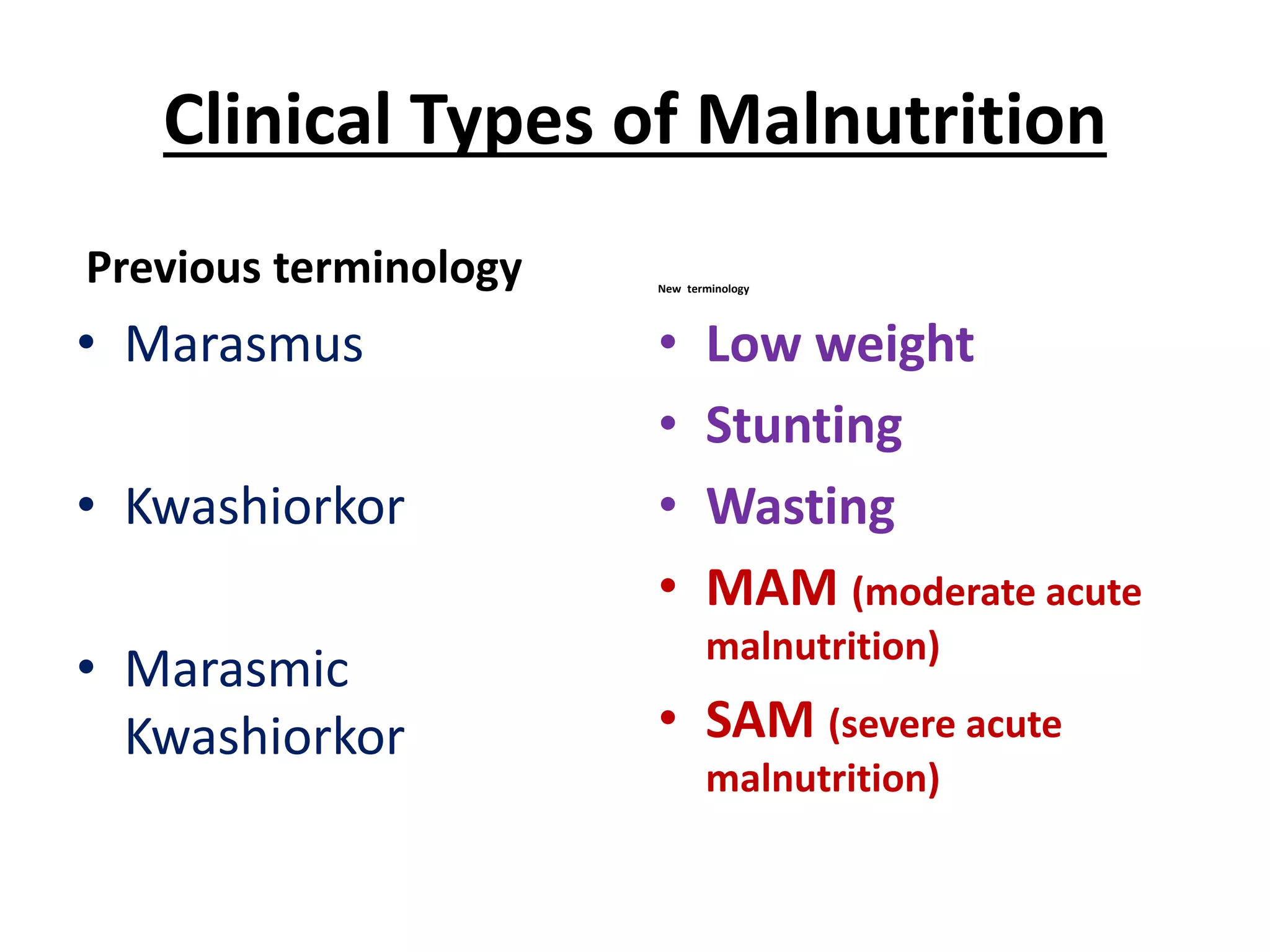
Clinical Types of Malnutrition
Previous terminology
• Marasmus
• Kwashiorkor
• Marasmic
Kwashiorkor
New terminology
• Low weight
• Stunting
• Wasting
• MAM (moderate acute
malnutrition)
• SAM (severe acute
malnutrition)
Clinical types of Malnutrition
• Underweight child – Weight for age
• Wasting – Weight for Height
• Stunting – Ht for age
• Micronutrient deficiency
Malnourished – Weight for age
• Moderate - 2 SD to - 3 SD or 60 - 80%
• Severe < - 3SD or < 60 % Wt for age
Stunting – Height for age
• Mild - 1 SD to - 2 SD or 90 – 95 %
• Moderate - 2 SD to -3 SD or 85 - 90%
• Severe < -3 SD or < 85 % Ht for age
Wasting - Weight for Height
• Mild - 1 SD to - 2 SD or 80 – 90 %
• Moderate - 2 SD to -3 SD or 70 - 80%
• Severe < -3 SD or < 70 % Wt for Ht
SEVERE ACUTE MALNUTRITION
Severe Acute Malnutrition (SAM)
(Presence of any of the following)
• Weight for Height < -3 SD (< 70 %)
• MUAC < 11.5 cm
• Edema
What is the condition of
Children in Pakistan
Prof Imran Iqbal
Statistics for Pakistan
• Under-five mortality rate (2012) = 85
• Infant mortality rate = 62
• Neonatal mortality rate = 49
per 1,000 live births
PAKISTAN
PAKISTAN
Why are the children dying ?
Pneumonia - 11%
Diarrhea - 14%
Other - 11%
Injuries - 2%
In Pakistan 61% of deaths occur during neonatal period. Main
causes being
Infections – 31%
Preterm – 27%
Asphyxia – 24%
Congenital – 10%
Diarrhea – 3%
Tetanus – 2%
Other – 4%
Causes of Death in children < 5
in 2012
• Prematurity 20 %
• Pneumonia 19 %
• Others 18 %
• Asphyxia 13 %
• Diarrhoea 11 %
• Neonatal sepsis 9 %
• Cong anomalies 5 %
• Injuries 5 %
• Measles 1 %
Contribution of undernutrition to
under-five mortality by cause, 2000
0%
20%
40%
60%
80%
100%
Diarrhoea Malaria Pneumonia Measles All-cause
Proportion of deaths associated with undernutrition All Deaths
Sources:
• For cause-specific mortality: EIP/WHO.
• For deaths associated with malnutrition: Caulfield LE, Black RE. Malnutrition and the
global burden of disease: underweight and cause-specific mortality.
RISK OF DEATH IN A CHILD IN
RELATION TO NUTRITIONAL STATUS
• NORMAL = 1
• MILD MALNUTRITION = 2
• MODERATE MALNUTRITION = 4
• SEVERE MALNUTRITION = 8
0
1
2
3
4
5
6
7
8
Norm Mild Mod Severe
Normal
Mild
Moderate
Severe
Health Indicators in Pakistan
• Low birth wt =25 – 33 %
• Exclusive Mother Feeding = 25 %
• Mod and Severe Malnutrition = 40 %
How Many children are
Malnourished ?
PAKISTAN - NNS 2011
Malnutrition
in Pakistan
Stunted 41 %
Wasted 14%
Underweight 31%
Anemia in children = 62%
Iron deficiency in children = 44%
Vitamin A deficiency = 53 %
KeratomalaciaBitot spot
Zinc deficiency = 39%
Vitamin D deficiency = 67%
Rickets
Iodine deficiency = 30 %
Congenital Hypothyroidism
What are the
causes of Malnutrition
in children ?
Breast Feeding = 63 %
Introduction of semisolids = 51 %
Inadequate diet = 93 %
Current ARI = 22 %
Diarrhea in last 2 weeks = 34%
Nutritional Status and
Mother Education
Micronutrient
Deficiency in
Mothers
Micronutrient Deficiency in Mothers
• Anemia = 51 %
• Iron Deficiency = 37 %
• Vitamin A deficiency = 44 %
• Vitamin D deficiency = 68 %
• Zinc deficiency = 47 %
Why Malnutrition ?
Causes of Malnutrition
• Primary causes – inadequate feeding
• Secondary causes -- diseases
 Repeated infections
 Genetic causes - syndromes
 Chronic diseases – CLD, CKD
 Celiac disease
 Diabetes mellitus
 Metabolic disorders
Determinants of Malnutrition
• Poor maternal health
• Lactation failure
• Restriction of food during illness
• Unequal distribution of food
• Unhealthy feeding habits
• Repeated infections
• Overcrowding
• Unhygienic environment
• Poor literacy rate
• Poverty (30% of population lives below poverty line)
How malnutrition occours in the community
Nutrition Causal Framework
Adapted from Unicef
Outcome Under-Nutrition
Immediate
Causes
Inadequate
Dietary Intake
Disease
Underlying
Health /
Nutrition
Causes
Inadequate
Care for Mothers
and Children
Insufficient
Access to Food
Lack of health services
unhealthy environment
The Impact of Malnutrition
Malnutrition-Infection Cycle
Inadequate dietary
intake
Weight loss
Growth faltering
Lowered immunity
Mucosal damage
Disease
Appetite loss
Nutrient loss
Mal-absorption
Altered metabolism
MALNUTRITION and INFECTION
- Immunoglobulins ↓
- T-CELL FUNCTION ↓
- POLYs FUNCTION ↓
- Complement levels ↓
- Transferrin levels ↓
- Macrophage function ↓
- Intestinal commensel flora-altered
↓
INFECTIONS
INDEQUATE DIET /DISEASE CYCLE
INFECTIONS
LOW
IMMUNITY
MALNUTRITION
INADEQUATE
DIETARY
INTAKE
Main cause of Malnutrition
LOW INTAKE (underfeeding)
+
RECURRENT INFECTIONS
Pathophysiology
Reductive adaptation
• Smaller size
• Thinness
• Smaller organs
• Reduced immunity
Physiological Effects of
Malnutrition
• Cardiovascular
• GI
• GU
• Immune
• Liver
• Endocrine
• Cellular function
• Circulatory/Temperature regulation
• Skin, muscles, glands
Cardiovascular System
Effects:
• ↓ cardiac output and stroke volume
• ↓ blood pressure
• ↓ renal perfusion
Concerns:
• An increase in blood volume can produce acute heart
failure
• A further decrease in blood volume will compromise
tissue perfusion
Management:
• If dehydrated, give ReSoMal or F-75
• Do not give IV fluids unless child is in shock
• If blood transfusion is necessary, restrict to 10 ml/kg
and give a diuretic
Gastrointestinal System
Effects:
• ↓ production of gastric acid
• ↓ intestinal motility
• ↓ production of digestive enzymes secondary
to pancreatic atrophy
• ↓ secretion of digestive enzymes secondary to
small intestinal mucosa atrophy
• ↓ absorption of nutrients when large amounts
of food ingested
Management:
• Give small, frequent feeds
Genitourinary System
Effects:
• ↓ glomerular filtration
• ↓ ability for renal excretion of acid or water load
• ↓ sodium excretion
• ↓ urinary phosphate output
• ↑ incidence of UTI
Concerns:
• A large protein load may not be well tolerated by the
kidneys
• Further protein deprivation will lead to continued
tissue breakdown
Management:
• Caloric intake should be targeted at 80-100 kcal/kg/day
• Restrict sodium intake
Immune System
Effects:
• ↓ cell-mediated immunity
• ↓ secretion of IgA
• ↓ levels of complement components
• ↓ efficacy of phagocytes
Concerns:
• Typical signs of infection (↑ WBC count, fever) are
often absent
• Hypoglycemia and hypothermia are signs of severe
infection
Management:
• Treat all inpatients with broad-spectrum antibiotics
• Protect against infection
Liver
Effects:
• ↓ synthesis of all proteins
• ↓ gluconeogenesis
Concerns:
• Risk of hypoglycemia is high, particularly with
infection
Management:
• Protein intake should be 1-2 g/kg/day
• Ensure sufficient carbohydrate intake
• Do not give iron supplements
Endocrine System
Effects:
• ↓ insulin levels, leading to glucose intolerance
• ↓ levels of IGF-1
• ↑ levels of growth hormone
• ↑ levels of cortisol
Management:
• Do not give steroids
Cellular Function
Effects:
• ↓ synthesis of proteins
• ↓ activity of sodium pump
• ↑ permeability of cell membranes
Concerns:
• This leads to an increase in intracellular sodium and a
decrease in intracellular potassium and magnesium
Management:
• Restrict sodium intake
• Give potassium and magnesium to all children
Circulatory System and
Temperature Regulation
Effects:
• Heat generation as well as heat loss are impaired
• ↓ energy expenditure and basic metabolic rate
Concerns:
• Child becomes hypothermic in cold environment and
hyperthermic in hot environment
Management:
• Keep child dry and warm
• Room temperature should be at 25-30 °C
• If child has fever, cool with tepid water
Skin, Muscles, Glands
Effects:
• Skin and subcutaneous fat are atrophied
• Atrophy of sweat, tear, and salivary glands
• Respiratory muscles are fatigued easily
Concerns:
• Typical signs of dehydration (sunken eyes, abdominal
skin pinch) are unreliable due to the loss of
subcutaneous fat.
• No of stools, vomits, thirst, pulse, urine output can be
used
Management:
• Rehydrate with ReSoMal when necessary
Management of Malnutrition
• Adequate calories
• Micronutrients
• Growth monitoring
• Follow-up
PRINCIPLES of Management
Assessment
- Severity and type of malnutrition
- Any complications
- Associated deficiencies
- Epidemiological factors
Hospital treatment
- Severe and complicated malnutrition
Home treatment
- Severe malnutrition--uncomplicated cases
- Moderate malnutrition
Community-based Management of Acute Malnutrition (CMAM)
• Inpatient care or Stabilization Centre
(SC) to treat severe acute malnutrition
with
• Medical complications
• Anorexia
• Severe edema
• Severe wasting and edema
Time frame for the management of
a child with severe malnutrition
Stabilization Rehabilitation
Days 1-2 Days 3-7 Weeks 2-6
1. Hypoglycaemia
2. Hypothermia
3. Dehydration
4. Electrolytes
5. Infection
6. Micronutrients no iron with iron
7. Initiate feeding
8. Catch up growth
9. Sensory stimulation
10. Prepare for follow-up
Source: WHO
ReSoMal
(Rehydration Solution for Malnutrition)
• Sodium Chloride 1.75 gm
• Sodium Citrate 1.45 gm
• Potassium Chloride 2.54 gm
• Potassium Citrate 0.65 gm
• Magnesium Chloride 0.61 gm
• Zinc Acetate 0.0656 gm
• Copper Sulphate 0.0112 gm
• Glucose 10 gm
• Sucrose 25 gm
Recipe for F-75 and F-100
Alternatives Ingredient Amount for F-75 Amount for F-100
Dried whole Milk Dried whole milk
sugar
vegetable oil Mineral
mix* water to
make 1000ml
35 g
100 g
20 g
20 ml
1000 ml**
110 g
50 g
30 g
20 ml
1000 ml**
Fresh cow’s Milk Fresh Cow’s milk, or
full cream (whole)
long life milk
sugar
vegetable oil Mineral
mix* water to
make 1000 ml
300 ml
100 g
20 g
20 ml
1000 ml**
880 ml
75 g
20 g
20 ml
1000 ml**
RECOVERY
• WEIGHT GAIN should be 10 gm / kg /
day
• Child is considered to be recovered
when 90 % of expected weight for
length has been achieved
Hifsa’s journey from malnutrition to health
Prevention
of
Malnutrition
Prof Imran Iqbal
PREVENTION is
BETTER than CURE
Main cause of Malnutrition
LOW INTAKE (underfeeding)
+
RECURRENT INFECTIONS
FEEDING PRACTICES
LEADING TO MALNUTRITION
1. BOTTLE FEEDING
- DILUTED MILK
- UNHYGENIC PREPARATION
2. DELAYED WEANING
- INADEQUATE CALORIES
- IRON DEFICIENCY
3. FOOD RESTRICTIONS
- IN A NORMAL CHILD
- DURING DISEASE
PREVENTION OF
MALNUTRITION
1. Nutrition education
2. Adequate feeding and diet
3. Growth monitoring
4. Protection against
infections
Nutrition education
• Health care providers
• Parents
• Caregivers
Adequate feeding and diet
• Breast feeding for 2 Yrs.
• Weaning at 4 months
• Adequate diet
• Feeding during illness
During an illness
Prevent malnutrition by:
• Frequent small feeds
• Extra food after the child recovers
Strategies to prevent
Infections
• Vaccination
• Handwashing
• Avoid
overcrowding
• Unpolluted air
• Breastfeeding
• Nutrition
• Micronutrients
• Safe water
• Clean food
31% of all child deaths can be prevented
through nutrition related interventions
Intervention Deaths (x 103) % deaths
Oral Rehydration Therapy* 1477 15
Breastfeeding 1301 13
Zinc (prophylaxis &
treatment*)
810 9
Insecticide-treated bednets 691 7
Complementary feeding 587 6
Antibiotics for sepsis* 583 6
Antibiotics for pneumonia* 577 6
Clean delivery 411 4
Vitamin A 233 3
What can I do ?
Give at least 1 - 5
Preventive Health care
message to
Parents of each child whom
I see in my
OPD, Ward, Clinic
?
Thankyou

Malnutrition in children 2019

  • 1.
    Malnutrition in Children of Pakistan Prof.Imran Iqbal Prof of Paediatrics (2003-2018) Prof of Pediatrics Emeritus, CHICH Multan, Pakistan
  • 2.
    In the nameof Allah, the most gracious, the most merciful.
  • 4.
    MALNUTRITION IS A PATHALOGICALSTATE RESULTING FROM DEFICIENCY OF ONE OR MORE ESSENTIAL NUTRIENTS.
  • 5.
    Nutritional status Nutritional statusis determined by balance of Nutritional Intake and Nutritional Expenditure NUTRITIONAL INTAKE NUTRITIONAL EXPENDITURE NUTRITIONAL STATUS
  • 6.
    Clinical Types ofMalnutrition Previous terminology • Marasmus • Kwashiorkor • Marasmic Kwashiorkor New terminology • Low weight • Stunting • Wasting • MAM (moderate acute malnutrition) • SAM (severe acute malnutrition)
  • 7.
    Clinical types ofMalnutrition • Underweight child – Weight for age • Wasting – Weight for Height • Stunting – Ht for age • Micronutrient deficiency
  • 11.
    Malnourished – Weightfor age • Moderate - 2 SD to - 3 SD or 60 - 80% • Severe < - 3SD or < 60 % Wt for age
  • 12.
    Stunting – Heightfor age • Mild - 1 SD to - 2 SD or 90 – 95 % • Moderate - 2 SD to -3 SD or 85 - 90% • Severe < -3 SD or < 85 % Ht for age
  • 13.
    Wasting - Weightfor Height • Mild - 1 SD to - 2 SD or 80 – 90 % • Moderate - 2 SD to -3 SD or 70 - 80% • Severe < -3 SD or < 70 % Wt for Ht
  • 14.
  • 16.
    Severe Acute Malnutrition(SAM) (Presence of any of the following) • Weight for Height < -3 SD (< 70 %) • MUAC < 11.5 cm • Edema
  • 17.
    What is thecondition of Children in Pakistan Prof Imran Iqbal
  • 18.
    Statistics for Pakistan •Under-five mortality rate (2012) = 85 • Infant mortality rate = 62 • Neonatal mortality rate = 49 per 1,000 live births
  • 19.
  • 20.
  • 21.
    Why are thechildren dying ?
  • 22.
    Pneumonia - 11% Diarrhea- 14% Other - 11% Injuries - 2%
  • 23.
    In Pakistan 61%of deaths occur during neonatal period. Main causes being Infections – 31% Preterm – 27% Asphyxia – 24% Congenital – 10% Diarrhea – 3% Tetanus – 2% Other – 4%
  • 24.
    Causes of Deathin children < 5 in 2012 • Prematurity 20 % • Pneumonia 19 % • Others 18 % • Asphyxia 13 % • Diarrhoea 11 % • Neonatal sepsis 9 % • Cong anomalies 5 % • Injuries 5 % • Measles 1 %
  • 25.
    Contribution of undernutritionto under-five mortality by cause, 2000 0% 20% 40% 60% 80% 100% Diarrhoea Malaria Pneumonia Measles All-cause Proportion of deaths associated with undernutrition All Deaths Sources: • For cause-specific mortality: EIP/WHO. • For deaths associated with malnutrition: Caulfield LE, Black RE. Malnutrition and the global burden of disease: underweight and cause-specific mortality.
  • 27.
    RISK OF DEATHIN A CHILD IN RELATION TO NUTRITIONAL STATUS • NORMAL = 1 • MILD MALNUTRITION = 2 • MODERATE MALNUTRITION = 4 • SEVERE MALNUTRITION = 8 0 1 2 3 4 5 6 7 8 Norm Mild Mod Severe Normal Mild Moderate Severe
  • 28.
  • 29.
    • Low birthwt =25 – 33 % • Exclusive Mother Feeding = 25 % • Mod and Severe Malnutrition = 40 %
  • 30.
    How Many childrenare Malnourished ?
  • 31.
  • 32.
    Malnutrition in Pakistan Stunted 41% Wasted 14% Underweight 31%
  • 33.
  • 34.
    Iron deficiency inchildren = 44%
  • 35.
  • 36.
    Vitamin A deficiency= 53 % KeratomalaciaBitot spot
  • 37.
  • 38.
  • 39.
  • 40.
  • 41.
  • 42.
    What are the causesof Malnutrition in children ?
  • 43.
  • 44.
  • 45.
  • 46.
  • 47.
    Diarrhea in last2 weeks = 34%
  • 48.
  • 49.
  • 50.
    Micronutrient Deficiency inMothers • Anemia = 51 % • Iron Deficiency = 37 % • Vitamin A deficiency = 44 % • Vitamin D deficiency = 68 % • Zinc deficiency = 47 %
  • 51.
  • 52.
    Causes of Malnutrition •Primary causes – inadequate feeding • Secondary causes -- diseases  Repeated infections  Genetic causes - syndromes  Chronic diseases – CLD, CKD  Celiac disease  Diabetes mellitus  Metabolic disorders
  • 53.
    Determinants of Malnutrition •Poor maternal health • Lactation failure • Restriction of food during illness • Unequal distribution of food • Unhealthy feeding habits • Repeated infections • Overcrowding • Unhygienic environment • Poor literacy rate • Poverty (30% of population lives below poverty line)
  • 54.
    How malnutrition occoursin the community
  • 55.
    Nutrition Causal Framework Adaptedfrom Unicef Outcome Under-Nutrition Immediate Causes Inadequate Dietary Intake Disease Underlying Health / Nutrition Causes Inadequate Care for Mothers and Children Insufficient Access to Food Lack of health services unhealthy environment
  • 56.
    The Impact ofMalnutrition Malnutrition-Infection Cycle Inadequate dietary intake Weight loss Growth faltering Lowered immunity Mucosal damage Disease Appetite loss Nutrient loss Mal-absorption Altered metabolism
  • 57.
    MALNUTRITION and INFECTION -Immunoglobulins ↓ - T-CELL FUNCTION ↓ - POLYs FUNCTION ↓ - Complement levels ↓ - Transferrin levels ↓ - Macrophage function ↓ - Intestinal commensel flora-altered ↓ INFECTIONS
  • 58.
    INDEQUATE DIET /DISEASECYCLE INFECTIONS LOW IMMUNITY MALNUTRITION INADEQUATE DIETARY INTAKE
  • 59.
    Main cause ofMalnutrition LOW INTAKE (underfeeding) + RECURRENT INFECTIONS
  • 60.
  • 61.
    Reductive adaptation • Smallersize • Thinness • Smaller organs • Reduced immunity
  • 62.
    Physiological Effects of Malnutrition •Cardiovascular • GI • GU • Immune • Liver • Endocrine • Cellular function • Circulatory/Temperature regulation • Skin, muscles, glands
  • 63.
    Cardiovascular System Effects: • ↓cardiac output and stroke volume • ↓ blood pressure • ↓ renal perfusion Concerns: • An increase in blood volume can produce acute heart failure • A further decrease in blood volume will compromise tissue perfusion Management: • If dehydrated, give ReSoMal or F-75 • Do not give IV fluids unless child is in shock • If blood transfusion is necessary, restrict to 10 ml/kg and give a diuretic
  • 64.
    Gastrointestinal System Effects: • ↓production of gastric acid • ↓ intestinal motility • ↓ production of digestive enzymes secondary to pancreatic atrophy • ↓ secretion of digestive enzymes secondary to small intestinal mucosa atrophy • ↓ absorption of nutrients when large amounts of food ingested Management: • Give small, frequent feeds
  • 65.
    Genitourinary System Effects: • ↓glomerular filtration • ↓ ability for renal excretion of acid or water load • ↓ sodium excretion • ↓ urinary phosphate output • ↑ incidence of UTI Concerns: • A large protein load may not be well tolerated by the kidneys • Further protein deprivation will lead to continued tissue breakdown Management: • Caloric intake should be targeted at 80-100 kcal/kg/day • Restrict sodium intake
  • 66.
    Immune System Effects: • ↓cell-mediated immunity • ↓ secretion of IgA • ↓ levels of complement components • ↓ efficacy of phagocytes Concerns: • Typical signs of infection (↑ WBC count, fever) are often absent • Hypoglycemia and hypothermia are signs of severe infection Management: • Treat all inpatients with broad-spectrum antibiotics • Protect against infection
  • 67.
    Liver Effects: • ↓ synthesisof all proteins • ↓ gluconeogenesis Concerns: • Risk of hypoglycemia is high, particularly with infection Management: • Protein intake should be 1-2 g/kg/day • Ensure sufficient carbohydrate intake • Do not give iron supplements
  • 68.
    Endocrine System Effects: • ↓insulin levels, leading to glucose intolerance • ↓ levels of IGF-1 • ↑ levels of growth hormone • ↑ levels of cortisol Management: • Do not give steroids
  • 69.
    Cellular Function Effects: • ↓synthesis of proteins • ↓ activity of sodium pump • ↑ permeability of cell membranes Concerns: • This leads to an increase in intracellular sodium and a decrease in intracellular potassium and magnesium Management: • Restrict sodium intake • Give potassium and magnesium to all children
  • 70.
    Circulatory System and TemperatureRegulation Effects: • Heat generation as well as heat loss are impaired • ↓ energy expenditure and basic metabolic rate Concerns: • Child becomes hypothermic in cold environment and hyperthermic in hot environment Management: • Keep child dry and warm • Room temperature should be at 25-30 °C • If child has fever, cool with tepid water
  • 71.
    Skin, Muscles, Glands Effects: •Skin and subcutaneous fat are atrophied • Atrophy of sweat, tear, and salivary glands • Respiratory muscles are fatigued easily Concerns: • Typical signs of dehydration (sunken eyes, abdominal skin pinch) are unreliable due to the loss of subcutaneous fat. • No of stools, vomits, thirst, pulse, urine output can be used Management: • Rehydrate with ReSoMal when necessary
  • 72.
  • 73.
    Management of Malnutrition •Adequate calories • Micronutrients • Growth monitoring • Follow-up
  • 74.
    PRINCIPLES of Management Assessment -Severity and type of malnutrition - Any complications - Associated deficiencies - Epidemiological factors Hospital treatment - Severe and complicated malnutrition Home treatment - Severe malnutrition--uncomplicated cases - Moderate malnutrition
  • 75.
    Community-based Management ofAcute Malnutrition (CMAM) • Inpatient care or Stabilization Centre (SC) to treat severe acute malnutrition with • Medical complications • Anorexia • Severe edema • Severe wasting and edema
  • 76.
    Time frame forthe management of a child with severe malnutrition Stabilization Rehabilitation Days 1-2 Days 3-7 Weeks 2-6 1. Hypoglycaemia 2. Hypothermia 3. Dehydration 4. Electrolytes 5. Infection 6. Micronutrients no iron with iron 7. Initiate feeding 8. Catch up growth 9. Sensory stimulation 10. Prepare for follow-up Source: WHO
  • 77.
    ReSoMal (Rehydration Solution forMalnutrition) • Sodium Chloride 1.75 gm • Sodium Citrate 1.45 gm • Potassium Chloride 2.54 gm • Potassium Citrate 0.65 gm • Magnesium Chloride 0.61 gm • Zinc Acetate 0.0656 gm • Copper Sulphate 0.0112 gm • Glucose 10 gm • Sucrose 25 gm
  • 78.
    Recipe for F-75and F-100 Alternatives Ingredient Amount for F-75 Amount for F-100 Dried whole Milk Dried whole milk sugar vegetable oil Mineral mix* water to make 1000ml 35 g 100 g 20 g 20 ml 1000 ml** 110 g 50 g 30 g 20 ml 1000 ml** Fresh cow’s Milk Fresh Cow’s milk, or full cream (whole) long life milk sugar vegetable oil Mineral mix* water to make 1000 ml 300 ml 100 g 20 g 20 ml 1000 ml** 880 ml 75 g 20 g 20 ml 1000 ml**
  • 79.
    RECOVERY • WEIGHT GAINshould be 10 gm / kg / day • Child is considered to be recovered when 90 % of expected weight for length has been achieved
  • 81.
    Hifsa’s journey frommalnutrition to health
  • 82.
  • 83.
  • 84.
    Main cause ofMalnutrition LOW INTAKE (underfeeding) + RECURRENT INFECTIONS
  • 85.
    FEEDING PRACTICES LEADING TOMALNUTRITION 1. BOTTLE FEEDING - DILUTED MILK - UNHYGENIC PREPARATION 2. DELAYED WEANING - INADEQUATE CALORIES - IRON DEFICIENCY 3. FOOD RESTRICTIONS - IN A NORMAL CHILD - DURING DISEASE
  • 86.
    PREVENTION OF MALNUTRITION 1. Nutritioneducation 2. Adequate feeding and diet 3. Growth monitoring 4. Protection against infections
  • 87.
    Nutrition education • Healthcare providers • Parents • Caregivers
  • 88.
    Adequate feeding anddiet • Breast feeding for 2 Yrs. • Weaning at 4 months • Adequate diet • Feeding during illness
  • 89.
    During an illness Preventmalnutrition by: • Frequent small feeds • Extra food after the child recovers
  • 91.
    Strategies to prevent Infections •Vaccination • Handwashing • Avoid overcrowding • Unpolluted air • Breastfeeding • Nutrition • Micronutrients • Safe water • Clean food
  • 93.
    31% of allchild deaths can be prevented through nutrition related interventions Intervention Deaths (x 103) % deaths Oral Rehydration Therapy* 1477 15 Breastfeeding 1301 13 Zinc (prophylaxis & treatment*) 810 9 Insecticide-treated bednets 691 7 Complementary feeding 587 6 Antibiotics for sepsis* 583 6 Antibiotics for pneumonia* 577 6 Clean delivery 411 4 Vitamin A 233 3
  • 94.
    What can Ido ? Give at least 1 - 5 Preventive Health care message to Parents of each child whom I see in my OPD, Ward, Clinic
  • 95.
  • 96.