
Malnutrition
Case
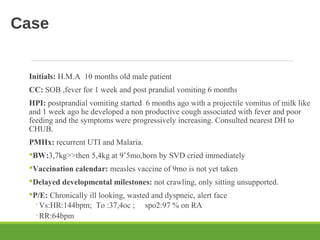
Initials: H.M.A 10 months old male patient
CC: SOB ,fever for 1 week and post prandial vomiting 6 months
HPI: postprandial vomiting started 6 months ago with a projectile vomitus of milk like
and 1 week ago he developed a non productive cough associated with fever and poor
feeding and the symptoms were progressively increasing. Consulted nearest DH to
CHUB.
PMHx: recurrent UTI and Malaria.
BW:3,7kg>>then 5,4kg at 9’5mo,born by SVD cried immediately
Vaccination calendar: measles vaccine of 9mo is not yet taken
Delayed developmental milestones: not crawling, only sitting unsupported.
P/E: Chronically ill looking, wasted and dyspneic, alert face
◦Vs:HR:144bpm; To :37,4oc ; spo2:97 % on RA
◦RR:64bpm
CASE CONT’
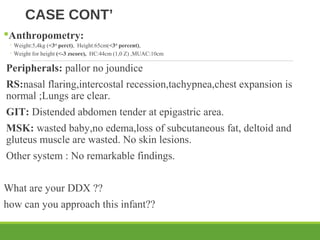
Anthropometry:
◦ Weight:5,4kg (<3rd
perct), Height:65cm(<3rd
percent),
◦ Weight for height (<-3 zscore), HC:44cm (1,0 Z) ,MUAC:10cm
Peripherals: pallor no joundice
RS:nasal flaring,intercostal recession,tachypnea,chest expansion is
normal ;Lungs are clear.
GIT: Distended abdomen tender at epigastric area.
MSK: wasted baby,no edema,loss of subcutaneous fat, deltoid and
gluteus muscle are wasted. No skin lesions.
Other system : No remarkable findings.
What are your DDX ??
how can you approach this infant??
INTRODUCTION
Malnutrition is a condition of having the inappropriate level
of a micro and/or macro- nutrient.
It includes both:
◦Undernutrition
◦Over nutrition
Epidemiology
Malnutrition is a significant factor in approximately one third
of the nearly 8 million deaths per year in children who are
under 5 years of age worldwide.
Severe acute malnutrition affects nearly 20 million preschool-
age children, mostly from Africa and south-east Asia
Rwanda,38% of < 5 children are stunted and only 2.8 % are
wasted.
WHO REPORT 2017 , RDHS 2015
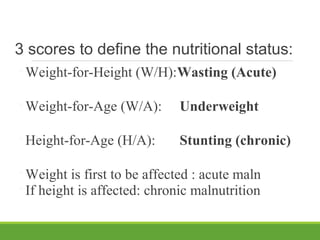
3 scores to define the nutritional status:
◦Weight-for-Height (W/H):Wasting (Acute)
◦Weight-for-Age (W/A): Underweight
◦Height-for-Age (H/A): Stunting (chronic)
◦Weight is first to be affected : acute maln
◦If height is affected: chronic malnutrition
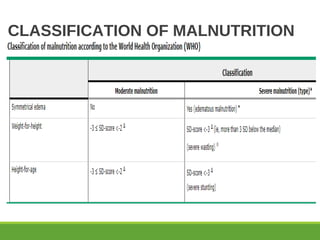
CLASSIFICATION OF MALNUTRITION
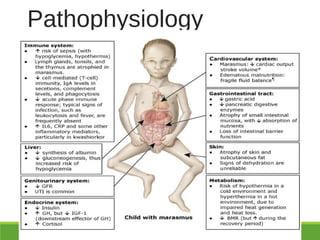
Pathophysiology
SEVERE ACUTE MALNUTRITION
SAM
Defined by one of the
following:
Severe wasting
(W/H < -3SD)
Bipedal edema
MUAC<11.5 cm under 5
year of age
SAM has 3 types
Marasmus
Kwashiorkor
Marasmic-Kwashiorkor
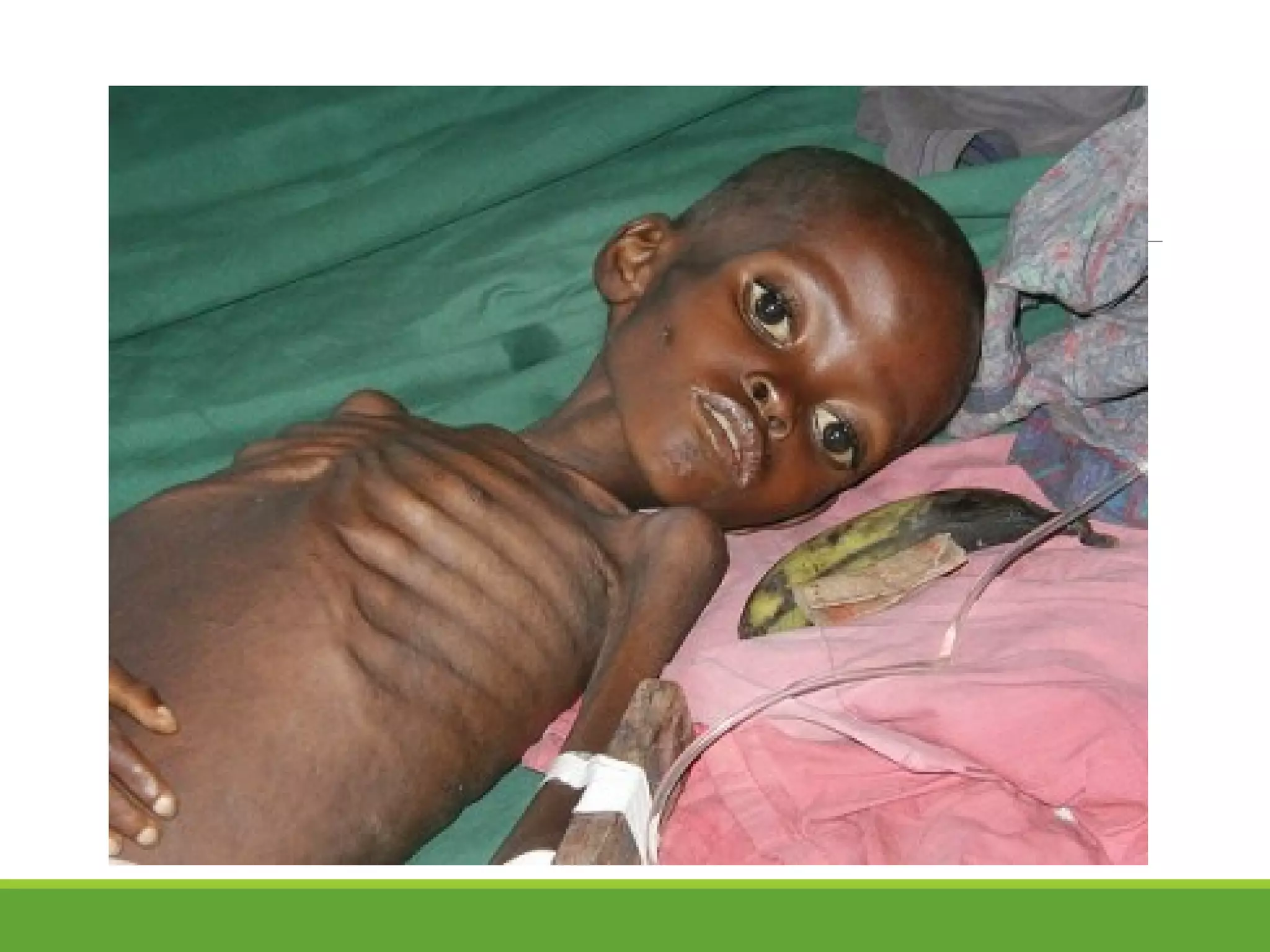
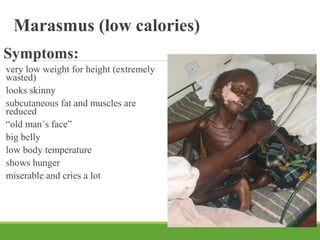
Marasmus (low calories)
Symptoms:
very low weight for height (extremely
wasted)
looks skinny
subcutaneous fat and muscles are
reduced
“old man´s face”
big belly
low body temperature
shows hunger
miserable and cries a lot
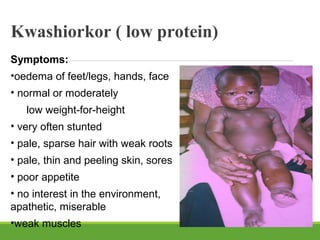
Kwashiorkor ( low protein)
Symptoms:
•oedema of feet/legs, hands, face
• normal or moderately
low weight-for-height
• very often stunted
• pale, sparse hair with weak roots
• pale, thin and peeling skin, sores
• poor appetite
• no interest in the environment,
apathetic, miserable
•weak muscles
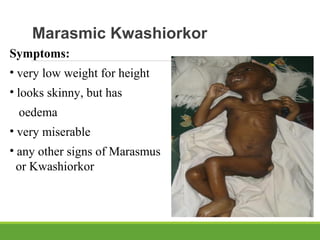
Marasmic Kwashiorkor
Symptoms:
• very low weight for height
• looks skinny, but has
oedema
• very miserable
• any other signs of Marasmus
or Kwashiorkor
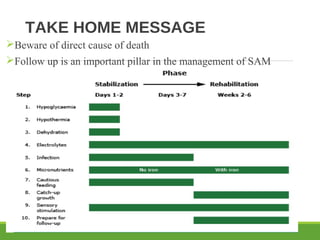
10 steps in SAM Treatment
Treat/Prevent Hypoglycemia
Treat/Prevent Hypothermia
Treat/Prevent Dehydration
Correct electrolytes imbalances
Treat/Prevent Infection
Correct micronutrient deficiencies
Initiate feeding
Catch-up growth
Sensory stimulation
Follow-up
1. Hypoglycaemia
Diagnosis:
Blood glucose < 3 mmol/l (< 54 mg/dl)
If not possible to measure assume hypoglycaemia
Child is weak, drowsy, very often also hypothermic.
Treatment:
• Give the first feed of Starter Formula (F-75) orally or by
nasogasric tube,
• If not available immediately, give 5ml/ kg of 10%
Dextrose.
• Feed 2-hourly at least for the first day
2. Hypothermia
Diagnosis:
axillary temperature < 35 °C
rectal temperature < 35.5 °C
cold hands, cold feet
Treatment:
• Warm blanket or incandescent light directed on,but not touching the
child‘ s body.If not available put the child on the mothers bare breast
or abdomen.
•ensure that the child is clothed (including the head) and covered,
especially at night and keep the child dry
• Feed the child immediately start with F75
3. Dehydration (Also check for Anemia)
Deyhdration tends to be overdiagnosed in children with severe
malnutrition!
Diagnosis:- sunken eyes and fontanelle
- standing skin-fold
- dry mouth, skin
Treatment:
Correct dehydration according to the severity (follow protocal)
If Hb < 5g/dl transfuse PRBCs 10ml/kg in 3hrs+ Lasix 1mg/kg
- Don‘t use Standard-ORS for malnourished children, has too high
sodium and too low potassium content (Electrolyte imbalances)!
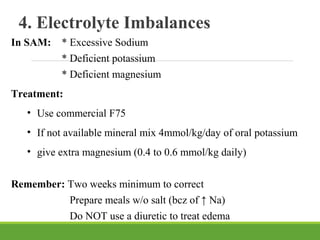
4. Electrolyte Imbalances
In SAM: * Excessive Sodium
* Deficient potassium
* Deficient magnesium
Treatment:
• Use commercial F75
• If not available mineral mix 4mmol/kg/day of oral potassium
• give extra magnesium (0.4 to 0.6 mmol/kg daily)
Remember: Two weeks minimum to correct
Prepare meals w/o salt (bcz of ↑ Na)
Do NOT use a diuretic to treat edema
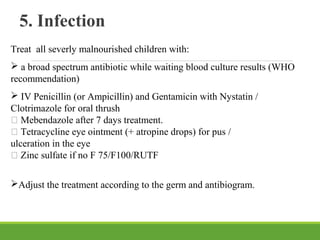
5. Infection
Treat all severly malnourished children with:
 a broad spectrum antibiotic while waiting blood culture results (WHO
recommendation)
 IV Penicillin (or Ampicillin) and Gentamicin with Nystatin /
Clotrimazole for oral thrush
 Mebendazole after 7 days treatment.
 Tetracycline eye ointment (+ atropine drops) for pus /
ulceration in the eye
 Zinc sulfate if no F 75/F100/RUTF
Adjust the treatment according to the germ and antibiogram.
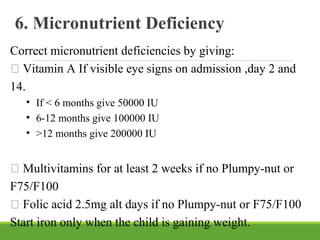
6. Micronutrient Deficiency
Correct micronutrient deficiencies by giving:
 Vitamin A If visible eye signs on admission ,day 2 and
14.
• If < 6 months give 50000 IU
• 6-12 months give 100000 IU
• >12 months give 200000 IU
 Multivitamins for at least 2 weeks if no Plumpy-nut or
F75/F100
 Folic acid 2.5mg alt days if no Plumpy-nut or F75/F100
Start iron only when the child is gaining weight.
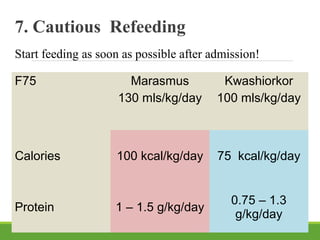
7. Cautious Refeeding
Start feeding as soon as possible after admission!
F75 Marasmus
130 mls/kg/day
Kwashiorkor
100 mls/kg/day
Calories 100 kcal/kg/day 75 kcal/kg/day
Protein 1 – 1.5 g/kg/day
0.75 – 1.3
g/kg/day
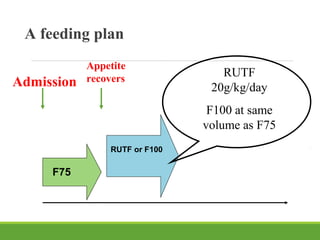
A feeding plan
Admission
F75
Appetite
recovers
RUTF or F100
RUTF
20g/kg/day
F100 at same
volume as F75
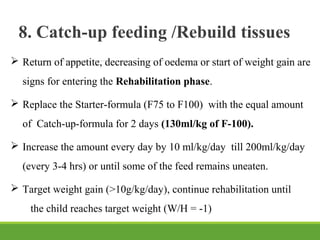
8. Catch-up feeding /Rebuild tissues
 Return of appetite, decreasing of oedema or start of weight gain are
signs for entering the Rehabilitation phase.
 Replace the Starter-formula (F75 to F100) with the equal amount
of Catch-up-formula for 2 days (130ml/kg of F-100).
 Increase the amount every day by 10 ml/kg/day till 200ml/kg/day
(every 3-4 hrs) or until some of the feed remains uneaten.
 Target weight gain (>10g/kg/day), continue rehabilitation until
the child reaches target weight (W/H = -1)
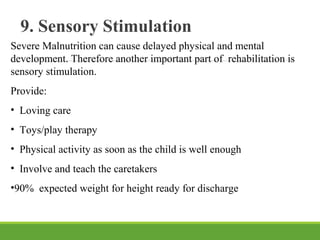
9. Sensory Stimulation
Severe Malnutrition can cause delayed physical and mental
development. Therefore another important part of rehabilitation is
sensory stimulation.
Provide:
• Loving care
• Toys/play therapy
• Physical activity as soon as the child is well enough
• Involve and teach the caretakers
•90% expected weight for height ready for discharge
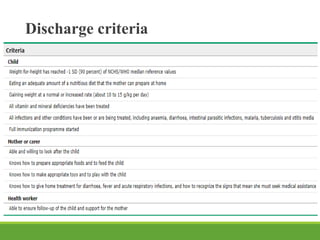
Discharge criteria
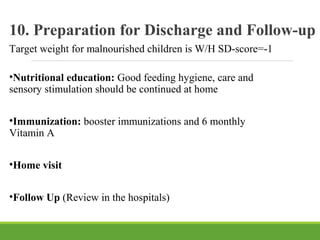
10. Preparation for Discharge and Follow-up
Target weight for malnourished children is W/H SD-score=-1
•Nutritional education: Good feeding hygiene, care and
sensory stimulation should be continued at home
•Immunization: booster immunizations and 6 monthly
Vitamin A
•Home visit
•Follow Up (Review in the hospitals)
TAKE HOME MESSAGE
Beware of direct cause of death
Follow up is an important pillar in the management of SAM
References
WHO Guidelines for SAM Management 2016
Basic pediatric protocols ,2014 (Rwanda)
Rwanda demographic and health survey 2015
National Institute of Statistics Rwanda, Ministry of Health
Rwanda report 2016
National nutritional protocal
Uptodate ,2018
03/19/19

Malnutrition

  • 2.
  • 3.
    Case Initials: H.M.A 10months old male patient CC: SOB ,fever for 1 week and post prandial vomiting 6 months HPI: postprandial vomiting started 6 months ago with a projectile vomitus of milk like and 1 week ago he developed a non productive cough associated with fever and poor feeding and the symptoms were progressively increasing. Consulted nearest DH to CHUB. PMHx: recurrent UTI and Malaria. BW:3,7kg>>then 5,4kg at 9’5mo,born by SVD cried immediately Vaccination calendar: measles vaccine of 9mo is not yet taken Delayed developmental milestones: not crawling, only sitting unsupported. P/E: Chronically ill looking, wasted and dyspneic, alert face ◦Vs:HR:144bpm; To :37,4oc ; spo2:97 % on RA ◦RR:64bpm
  • 4.
    CASE CONT’ Anthropometry: ◦ Weight:5,4kg(<3rd perct), Height:65cm(<3rd percent), ◦ Weight for height (<-3 zscore), HC:44cm (1,0 Z) ,MUAC:10cm Peripherals: pallor no joundice RS:nasal flaring,intercostal recession,tachypnea,chest expansion is normal ;Lungs are clear. GIT: Distended abdomen tender at epigastric area. MSK: wasted baby,no edema,loss of subcutaneous fat, deltoid and gluteus muscle are wasted. No skin lesions. Other system : No remarkable findings. What are your DDX ?? how can you approach this infant??
  • 5.
    INTRODUCTION Malnutrition is acondition of having the inappropriate level of a micro and/or macro- nutrient. It includes both: ◦Undernutrition ◦Over nutrition
  • 6.
    Epidemiology Malnutrition is asignificant factor in approximately one third of the nearly 8 million deaths per year in children who are under 5 years of age worldwide. Severe acute malnutrition affects nearly 20 million preschool- age children, mostly from Africa and south-east Asia Rwanda,38% of < 5 children are stunted and only 2.8 % are wasted. WHO REPORT 2017 , RDHS 2015
  • 7.
    3 scores todefine the nutritional status: ◦Weight-for-Height (W/H):Wasting (Acute) ◦Weight-for-Age (W/A): Underweight ◦Height-for-Age (H/A): Stunting (chronic) ◦Weight is first to be affected : acute maln ◦If height is affected: chronic malnutrition
  • 8.
  • 9.
  • 10.
    SEVERE ACUTE MALNUTRITION SAM Definedby one of the following: Severe wasting (W/H < -3SD) Bipedal edema MUAC<11.5 cm under 5 year of age SAM has 3 types Marasmus Kwashiorkor Marasmic-Kwashiorkor
  • 11.
    Marasmus (low calories) Symptoms: verylow weight for height (extremely wasted) looks skinny subcutaneous fat and muscles are reduced “old man´s face” big belly low body temperature shows hunger miserable and cries a lot
  • 12.
    Kwashiorkor ( lowprotein) Symptoms: •oedema of feet/legs, hands, face • normal or moderately low weight-for-height • very often stunted • pale, sparse hair with weak roots • pale, thin and peeling skin, sores • poor appetite • no interest in the environment, apathetic, miserable •weak muscles
  • 13.
    Marasmic Kwashiorkor Symptoms: • verylow weight for height • looks skinny, but has oedema • very miserable • any other signs of Marasmus or Kwashiorkor
  • 14.
    10 steps inSAM Treatment Treat/Prevent Hypoglycemia Treat/Prevent Hypothermia Treat/Prevent Dehydration Correct electrolytes imbalances Treat/Prevent Infection Correct micronutrient deficiencies Initiate feeding Catch-up growth Sensory stimulation Follow-up
  • 15.
    1. Hypoglycaemia Diagnosis: Blood glucose< 3 mmol/l (< 54 mg/dl) If not possible to measure assume hypoglycaemia Child is weak, drowsy, very often also hypothermic. Treatment: • Give the first feed of Starter Formula (F-75) orally or by nasogasric tube, • If not available immediately, give 5ml/ kg of 10% Dextrose. • Feed 2-hourly at least for the first day
  • 16.
    2. Hypothermia Diagnosis: axillary temperature< 35 °C rectal temperature < 35.5 °C cold hands, cold feet Treatment: • Warm blanket or incandescent light directed on,but not touching the child‘ s body.If not available put the child on the mothers bare breast or abdomen. •ensure that the child is clothed (including the head) and covered, especially at night and keep the child dry • Feed the child immediately start with F75
  • 17.
    3. Dehydration (Alsocheck for Anemia) Deyhdration tends to be overdiagnosed in children with severe malnutrition! Diagnosis:- sunken eyes and fontanelle - standing skin-fold - dry mouth, skin Treatment: Correct dehydration according to the severity (follow protocal) If Hb < 5g/dl transfuse PRBCs 10ml/kg in 3hrs+ Lasix 1mg/kg - Don‘t use Standard-ORS for malnourished children, has too high sodium and too low potassium content (Electrolyte imbalances)!
  • 18.
    4. Electrolyte Imbalances InSAM: * Excessive Sodium * Deficient potassium * Deficient magnesium Treatment: • Use commercial F75 • If not available mineral mix 4mmol/kg/day of oral potassium • give extra magnesium (0.4 to 0.6 mmol/kg daily) Remember: Two weeks minimum to correct Prepare meals w/o salt (bcz of ↑ Na) Do NOT use a diuretic to treat edema
  • 19.
    5. Infection Treat allseverly malnourished children with:  a broad spectrum antibiotic while waiting blood culture results (WHO recommendation)  IV Penicillin (or Ampicillin) and Gentamicin with Nystatin / Clotrimazole for oral thrush  Mebendazole after 7 days treatment.  Tetracycline eye ointment (+ atropine drops) for pus / ulceration in the eye  Zinc sulfate if no F 75/F100/RUTF Adjust the treatment according to the germ and antibiogram.
  • 20.
    6. Micronutrient Deficiency Correctmicronutrient deficiencies by giving:  Vitamin A If visible eye signs on admission ,day 2 and 14. • If < 6 months give 50000 IU • 6-12 months give 100000 IU • >12 months give 200000 IU  Multivitamins for at least 2 weeks if no Plumpy-nut or F75/F100  Folic acid 2.5mg alt days if no Plumpy-nut or F75/F100 Start iron only when the child is gaining weight.
  • 21.
    7. Cautious Refeeding Startfeeding as soon as possible after admission! F75 Marasmus 130 mls/kg/day Kwashiorkor 100 mls/kg/day Calories 100 kcal/kg/day 75 kcal/kg/day Protein 1 – 1.5 g/kg/day 0.75 – 1.3 g/kg/day
  • 22.
    A feeding plan Admission F75 Appetite recovers RUTFor F100 RUTF 20g/kg/day F100 at same volume as F75
  • 23.
    8. Catch-up feeding/Rebuild tissues  Return of appetite, decreasing of oedema or start of weight gain are signs for entering the Rehabilitation phase.  Replace the Starter-formula (F75 to F100) with the equal amount of Catch-up-formula for 2 days (130ml/kg of F-100).  Increase the amount every day by 10 ml/kg/day till 200ml/kg/day (every 3-4 hrs) or until some of the feed remains uneaten.  Target weight gain (>10g/kg/day), continue rehabilitation until the child reaches target weight (W/H = -1)
  • 24.
    9. Sensory Stimulation SevereMalnutrition can cause delayed physical and mental development. Therefore another important part of rehabilitation is sensory stimulation. Provide: • Loving care • Toys/play therapy • Physical activity as soon as the child is well enough • Involve and teach the caretakers •90% expected weight for height ready for discharge
  • 25.
  • 26.
    10. Preparation forDischarge and Follow-up Target weight for malnourished children is W/H SD-score=-1 •Nutritional education: Good feeding hygiene, care and sensory stimulation should be continued at home •Immunization: booster immunizations and 6 monthly Vitamin A •Home visit •Follow Up (Review in the hospitals)
  • 27.
    TAKE HOME MESSAGE Bewareof direct cause of death Follow up is an important pillar in the management of SAM
  • 28.
    References WHO Guidelines forSAM Management 2016 Basic pediatric protocols ,2014 (Rwanda) Rwanda demographic and health survey 2015 National Institute of Statistics Rwanda, Ministry of Health Rwanda report 2016 National nutritional protocal Uptodate ,2018
  • 29.

Editor's Notes

  • #9 SD score &amp;lt; -3 : severe SD score between -3 and -2 : moderate SD score between -2 and -1 : mild
  • #15 3 Phases: -Initial phase (Deal w/ life threatening conditions like Hypoglycemia, Hypothermia),no fasting -Rehabilitation phase -Follow-up
  • #18 -Don‘t use the IV-route for rehydration except in cases of shock ! - Don‘t use Standard-ORS for malnourished children, has too high sodium and too low potassium content (Electrolyte imbalances)!
  • #20 The usual signs of infection such as fever are often absent in children with SAM, yet multiple infections are common.
  • #21 A multivitamin supplement Folic acid (5 mg on day 1, then 1 mg/day) Zinc (2 mg Zn/kg/day) (included in CMV) Copper (0,3 mg Cu/kg/day) (included in CMV) once gaining weight, ferrous sulphate (3 mg Fe/kg/day) High dose of Vitamin A orally according to the age. If &amp;lt; 6 months give 50000 IU 6-12 months give 100000 IU &amp;gt;12 months give 200000 IU Do not give IRON because it can be dangerous in early stage as the transferrin level is low.
  • #22 Frequent small feeds low in lactose High in energy :100 kcal/kg/day Protein: 1-1,5 g/kg/day Liquid: 130 ml/kg/day If the child is breastfed, continue with this, but take care that the scheduled amounts of starter formula is given. Usually from Day 1 – 7
  • #23 At the return of appetite initially the feed is changed but the total volume of feed remains the same, 130mls/kg/day. The recovery formula is more energy and protein dense so although the volumes have not changed the calorie and protein intake have increased considerably. The child should receive this volume of F100 for 2-3 days and their progress monitored. Remember the child can and should breast feed as often as it can as well.
  • #24 Do not give huge amounts too fast, because this can cause heart failure! Check for early signs of heart failure like rapid pulse and fast breathing. If these signs occur, reduce the volume to 100 ml/kg/day for 24 hours then increase more slowly ! Assess progress: If the weight gain is poor (&amp;lt; 5 g/kg/day), the child requires a full reassessment moderate (5-10 g/kg/day), check whether the intake targets are being met, or if infection has been overseen good (&amp;gt;10g/kg/day), continue rehabilitation until the child reaches target weight (W/H = -1)