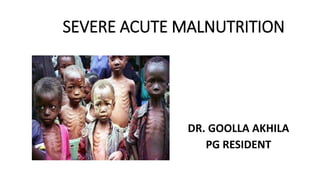
SEVERE ACUTE MALNUTRITION
DR. GOOLLA AKHILA
PG RESIDENT
• BALANCED DIET:
Defined as nutritionally adequate & appropriate intake of food
items that provide all the nutrients in required amounts & proper
proportions to ensure normal growth, development, disease free
optimum health among children and adolescents.
• CARBOHYDRATES-55-60% ( 4kcal/g)
• FATS-30-35% ( 9kcal/g)
• PROTEINS-10-15% ( 4kcal/g)
• MALNUTRITION
Refers to deficiencies, excesses or imbalances in a person’s intake of energy
and or nutrients ( WHO).
• The term malnutrition is used to denote
UNDERNUTRITION
OVERNUTRITION
SELECTIVE NUTRITIONAL DEFICIENCIES
• Undernutrition occurs due to
-inadequate intake
-poor absorption
-excessive loss of nutrients
• Overnutrition includes overweight and obesity.
• PEM
It is defined as range of pathological conditions arising from coincidental lack
of proteins and calories in varying proportions in infants and young children.
-commonly associated with infections.
- one of the major causes of death in children below 5years of age.
CAUSES OF PEM:
• Primary causes: due to lack of adequate intake of food
Poverty
Traditional habits
Social and cultural factors
Congenital defects like cleft lip and cleft palate
IUGR and Maternal malnutrition predisposes the child to undernutrition
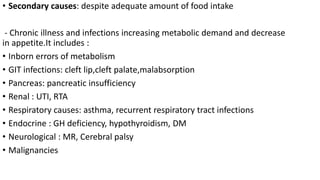
• Secondary causes: despite adequate amount of food intake
- Chronic illness and infections increasing metabolic demand and decrease
in appetite.It includes :
• Inborn errors of metabolism
• GIT infections: cleft lip,cleft palate,malabsorption
• Pancreas: pancreatic insufficiency
• Renal : UTI, RTA
• Respiratory causes: asthma, recurrent respiratory tract infections
• Endocrine : GH deficiency, hypothyroidism, DM
• Neurological : MR, Cerebral palsy
• Malignancies
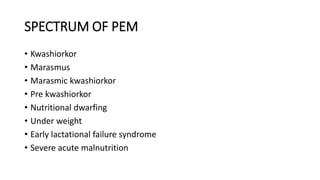
SPECTRUM OF PEM
• Kwashiorkor
• Marasmus
• Marasmic kwashiorkor
• Pre kwashiorkor
• Nutritional dwarfing
• Under weight
• Early lactational failure syndrome
• Severe acute malnutrition
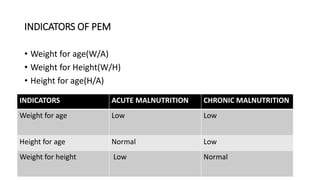
INDICATORS OF PEM
• Weight for age(W/A)
• Weight for Height(W/H)
• Height for age(H/A)
INDICATORS ACUTE MALNUTRITION CHRONIC MALNUTRITION
Weight for age Low Low
Height for age Normal Low
Weight for height Low Normal
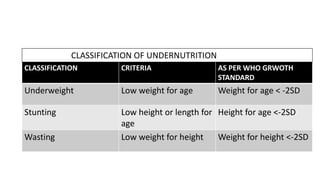
CLASSIFICATION CRITERIA AS PER WHO GRWOTH
STANDARD
Underweight Low weight for age Weight for age < -2SD
Stunting Low height or length for
age
Height for age <-2SD
Wasting Low weight for height Weight for height <-2SD
CLASSIFICATION OF UNDERNUTRITION
CLINICAL SYNDROMES OF UNDERNUTRITION
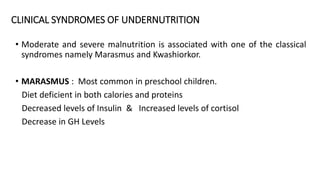
• Moderate and severe malnutrition is associated with one of the classical
syndromes namely Marasmus and Kwashiorkor.
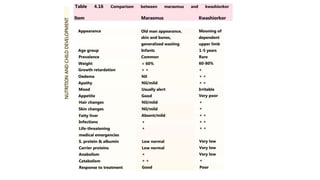
• MARASMUS : Most common in preschool children.
Diet deficient in both calories and proteins
Decreased levels of Insulin & Increased levels of cortisol
Decrease in GH Levels
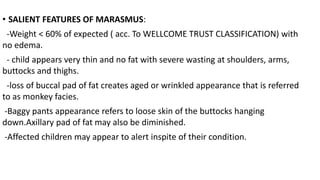
• SALIENT FEATURES OF MARASMUS:
-Weight < 60% of expected ( acc. To WELLCOME TRUST CLASSIFICATION) with
no edema.
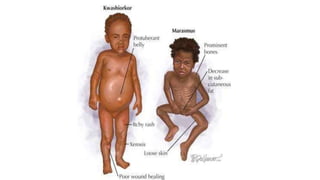
- child appears very thin and no fat with severe wasting at shoulders, arms,
buttocks and thighs.
-loss of buccal pad of fat creates aged or wrinkled appearance that is referred
to as monkey facies.
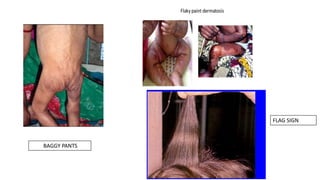
-Baggy pants appearance refers to loose skin of the buttocks hanging
down.Axillary pad of fat may also be diminished.
-Affected children may appear to alert inspite of their condition.
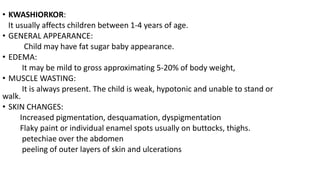
• KWASHIORKOR:
It usually affects children between 1-4 years of age.
• GENERAL APPEARANCE:
Child may have fat sugar baby appearance.
• EDEMA:
It may be mild to gross approximating 5-20% of body weight,
• MUSCLE WASTING:
It is always present. The child is weak, hypotonic and unable to stand or
walk.
• SKIN CHANGES:
Increased pigmentation, desquamation, dyspigmentation
Flaky paint or individual enamel spots usually on buttocks, thighs.
petechiae over the abdomen
peeling of outer layers of skin and ulcerations
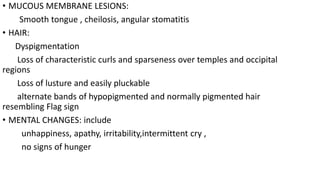
• MUCOUS MEMBRANE LESIONS:
Smooth tongue , cheilosis, angular stomatitis
• HAIR:
Dyspigmentation
Loss of characteristic curls and sparseness over temples and occipital
regions
Loss of lusture and easily pluckable
alternate bands of hypopigmented and normally pigmented hair
resembling Flag sign
• MENTAL CHANGES: include
unhappiness, apathy, irritability,intermittent cry ,
no signs of hunger
• GIT: Anorexia,Abdominal distension
• stools may be watery or bulky or semisolid with low Ph and unabsorbed
sugars,
• NUTRITIONAL ANEMIA
• CVS: Bradycardia, prolonged capillary refilling time, decreased cardiac
output and hypotension
• RENAL : There is aminoaciduria and inefficient excretion of acid load
FLAG SIGN
BAGGY PANTS
IDENTIFICATION OF SEVERE ACUTE MALNUTRITION
Criteria for identifying SAM in children < 6 months of age:
• Weight for height less than -3SD
• Edema of both feet
Criteria for identifying SAM in children > 6months of age:
• Weight for height less than -3SD on WHO Growth Standard
• Oedema of both feet
• Mid upper arm circumference < 11.5cms
PATHOLOGICAL CHANGES SEEN IN SAM
• Liver -Reduced glucose production causing HYPOGLYCEMIA
-Reduced ability to synthesize albumin,transferrin,transport
proteins
• Kidneys - Reduced excretion of sodium and excess fluids causing
FLUID OVERLOAD
• Cardiovascular system-Reduced myocardial mass,atrophy,patchy
necrosis of myocardium
• Respiratory system- Atrophy of intercostal muscles
• Reduced thermogenesis
• GIT-Mucosal atrophy,reduced gastrointestinal enzyme secretions
Delayed mucosal repair
Atrophy of intestinal villi(malabsorption)
• Endocrine system-
Decrease in- Thyriod hormone Increase in Cortisol levels
Insulin
Growth hormone
• Immunological system-Cell mediated immunity is reduced
Impaired T and B lymphocytes function
Decreased Lymphocyte count
• Micronutrient deficiency- Reduced free radical deactivation leading to
cell damage
CRITERIA FOR IDENTIFYING CHILDREN WITH SAM FOR
TREATMENT
• Early detection of children with SAM will ensure that these children
will be identified before they develop medical complications.
• MUAC is the simple measure for detection of SAM.
• MUAC in children from 6months to 59 months and look for bilateral
pitting edema.
• MUAC is less than 11.5 cms or any degree of bilateral pedal edema
immediately child is referred for full assessment and further medical
management.
SCREENING OF SAM
• Active screening of children by AWW,ASHA through house to house visit and measuring of
MUAC using tape and look for bilateral pitting pedal edema.
• Passive screening during growth monitoring,village health nutrition days using MUAC and b/l
pitting pedal edema
If features of SAM present look for complications
-severe edema +++
-poor appetite (failed appetite test)
-medical complications-severe anemia
pneumomia
diarrhoea
dehydration
cerebral palsy, TB, HIV, Heart disease
-one or more IMCI danger signs
SUPERVISED HOME MANAGEMENT OR OUTPATIENT
MANAGEMENT OF UNCOMPLICATED SAM
• Counselling about breast feeding,supplementary
feeding,immunization and hygiene.
• Community health care workers or peer counselors are involved to
support the family.
• Theraputic food adhering to WHO and UNICEF specifications to be
provided like RUFTs( ready to use therapeutic food).
• 2-3 hourly feeds with plenty of water.
• Periodic monitoring of growth and medical condition
• Child should be monitored by health care workers for signs of under
nutrition(weight,height,MUAC,edema etc., every week.
MANAGEMENT OF COMPLICATED SAM IN HOSPITAL
• All children with complicated SAM should be admitted to a
Nutritional Rehabilitation Centre(NRCs) or health facility.
• Children with severe malnutrition has a complex backdrop with
dietary, infective, social, economic factors.
• History of events leading to child’s admission should be obtained.
• Socio economic history and family circumstances should be explored
to understand the underlying and basic causes.
Initial assessment of severely malnourished
child
• History & Examination
Recent intake of foods and fluids including breast feeding
Usual diet before the illness
Duration and frequency of diarrhea and vomiting
Loss of appetite
Bowel and bladder habits
Known or suspected HIV & TB contact
Immunization history
History of measles infection in the past
Developmental history
• On examination
Anthropometry
Edema
Anemia
Signs of dehydration and shock
Eye signs of vitamin A deficiency
Localizing signs of infections
Skin changes of kwashiorkar
Fever,Hypothermia(<35.5*c)
Signs of dehydration and shock
Severe anemia
Extensive skin lesions,mouth ulcers and eye lesions
Localizing signs of infections
PRINCIPLES OF HOSPITAL MANAGEMENT OF SAM
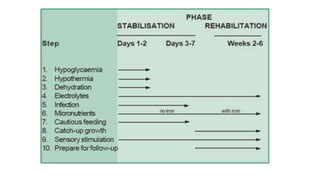
• The general treatment includes 10 steps in two phases
• STABILIZATION PHASE-
It focuses on restoring homeostasis and treating medical
complications.It usually takes 2-7 days.
• REHABILITATION PHASE-
It focuses on rebuilding wasted tissues and may take 2-6 weeks
MANAGEMENT OF SAM
HYPOGLYCEMIA –
• Blood glucose levels < 54mg/dl or 3mmol/l
• Hypoglycemia, Hypothermia, Infections occur together in
malnourished children.
TREATMENT-
• Asymptomatic hypoglycemia-
50ml of 10% glucose or sucrose solution followed by first feed with F 75 every
2hourly day and night.
• Symptomatic hypoglycemia- 10% D IV 5ml/kg
follow with 50ml of 10%D or sucrose solution by nasogastric tube
Feed with F 75 every 2hourly day and night
Start with appropriate antibiotics
PREVENTION- feed 2 hourly and prevent hypothermia
HYPOTHERMIA- Rectal temperature < 35.5 degree C or 95.5 degree F
Axillary temperature <35 degree C or 95 degree F
TREATMENT-
• Cloth the child with warm clothes; head covered with cap
• Provide heat using headwarmer,skin contact or heat convector
• Avoid rapid rewarming as this may lead to disequilibrium
• Feed the child immediately
• Start appropriate antibiotis
DEHYDRATION- Difficult to assess the dehydration status in severely
malnourished child.
• Assume that all the children with watery diarrhea have some dehydration
TREATMENT-
• Use reduced osmolrity ORS solution with potassium supplements for
rehydration and maintainence.
• Initiate feeding within 2-3 hours of starting rehydration:use F75 formula on
alternate hours.
• Be alert with signs of dehydration
PREVENTION-
Give reduced osmolarity ORS at 5-10ml/kg after each watery stool
If breastfed continue breastfeeding
ELECTROLYTES-
• Supplemental potassium at 3-4mEq/kg/day for 1-2 weeks
• 50% of MgSO4 0.1-0.2ml/kg/dose in 2 divided doses for 1-3 days
• Sodium is restricted to 2-3meq/kg/day
• INFECTIONS-majority caused by gram negative bacteria.
TREATMENT-
• Give broad spectrum antibiotics, penicillins or ampicillin with aminoglycosides
• If no improvement occurs with in 48 hours change to IV Cefotaxime or
Ceftriaxone.
PREVENTION-
Follow hand hygiene
MICRONUTRIENTS-
• On day1 give oral Vitamin A.
• Folic acid 1mg/day
• Zinc 2mg/kg/day
• Iron 3mg/kg/day once child starts gaining weight after first week
INITIATE FEEDING-small and frequent feeds
• Oral or nasogastric feeds
• Continue breast feeding
• Start with F75 feeds every 2hourly
• In persistent diarrhea give cereal based low lactose F75 diet as starter diet
• If diarrhea continues on low lactose diet give F75 lactose free diet
CATCH UP GROWTH-
• Return of appetite within one week signals Rehabilitation phase
• Increase volume offered at each feed and decrease the frequency of feeds
• Continue breast feeding
• Make gradual transition from F75- F100 diet
• Increase calories from 150-200kcal/day and proteins to 4-6g/kg/day
• Add complementary feeds as soon as possible
SENSORY STIMULATION- A cheerful stimulating environment
• structural play therapy for 15-30min
• physical activity as soon as the child is healthy
• Tender loving care
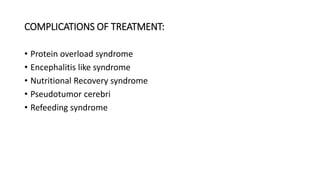
COMPLICATIONS OF TREATMENT:
• Protein overload syndrome
• Encephalitis like syndrome
• Nutritional Recovery syndrome
• Pseudotumor cerebri
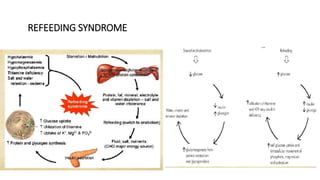
• Refeeding syndrome
REFEEDING SYNDROME
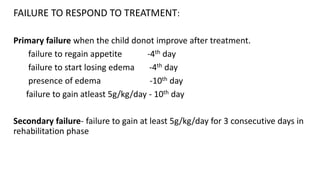
FAILURE TO RESPOND TO TREATMENT:
Primary failure when the child donot improve after treatment.
failure to regain appetite -4th day
failure to start losing edema -4th day
presence of edema -10th day
failure to gain atleast 5g/kg/day - 10th day
Secondary failure- failure to gain at least 5g/kg/day for 3 consecutive days in
rehabilitation phase
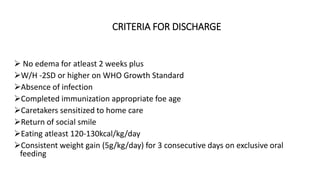
CRITERIA FOR DISCHARGE
 No edema for atleast 2 weeks plus
W/H -2SD or higher on WHO Growth Standard
Absence of infection
Completed immunization appropriate foe age
Caretakers sensitized to home care
Return of social smile
Eating atleast 120-130kcal/kg/day
Consistent weight gain (5g/kg/day) for 3 consecutive days on exclusive oral
feeding
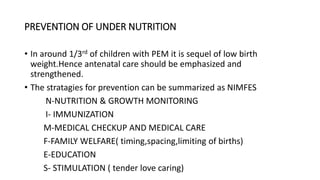
PREVENTION OF UNDER NUTRITION
• In around 1/3rd of children with PEM it is sequel of low birth
weight.Hence antenatal care should be emphasized and
strengthened.
• The stratagies for prevention can be summarized as NIMFES
N-NUTRITION & GROWTH MONITORING
I- IMMUNIZATION
M-MEDICAL CHECKUP AND MEDICAL CARE
F-FAMILY WELFARE( timing,spacing,limiting of births)
E-EDUCATION
S- STIMULATION ( tender love caring)
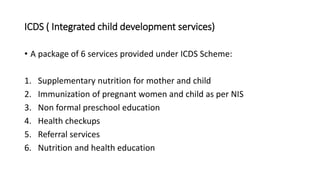
ICDS ( Integrated child development services)
• A package of 6 services provided under ICDS Scheme:
1. Supplementary nutrition for mother and child
2. Immunization of pregnant women and child as per NIS
3. Non formal preschool education
4. Health checkups
5. Referral services
6. Nutrition and health education
THANK YOU

Severe acute malnutrition presentation ppt

  • 1.
    SEVERE ACUTE MALNUTRITION DR.GOOLLA AKHILA PG RESIDENT
  • 2.
    • BALANCED DIET: Definedas nutritionally adequate & appropriate intake of food items that provide all the nutrients in required amounts & proper proportions to ensure normal growth, development, disease free optimum health among children and adolescents. • CARBOHYDRATES-55-60% ( 4kcal/g) • FATS-30-35% ( 9kcal/g) • PROTEINS-10-15% ( 4kcal/g)
  • 3.
    • MALNUTRITION Refers todeficiencies, excesses or imbalances in a person’s intake of energy and or nutrients ( WHO). • The term malnutrition is used to denote UNDERNUTRITION OVERNUTRITION SELECTIVE NUTRITIONAL DEFICIENCIES • Undernutrition occurs due to -inadequate intake -poor absorption -excessive loss of nutrients • Overnutrition includes overweight and obesity.
  • 4.
    • PEM It isdefined as range of pathological conditions arising from coincidental lack of proteins and calories in varying proportions in infants and young children. -commonly associated with infections. - one of the major causes of death in children below 5years of age. CAUSES OF PEM: • Primary causes: due to lack of adequate intake of food Poverty Traditional habits Social and cultural factors Congenital defects like cleft lip and cleft palate IUGR and Maternal malnutrition predisposes the child to undernutrition
  • 5.
    • Secondary causes:despite adequate amount of food intake - Chronic illness and infections increasing metabolic demand and decrease in appetite.It includes : • Inborn errors of metabolism • GIT infections: cleft lip,cleft palate,malabsorption • Pancreas: pancreatic insufficiency • Renal : UTI, RTA • Respiratory causes: asthma, recurrent respiratory tract infections • Endocrine : GH deficiency, hypothyroidism, DM • Neurological : MR, Cerebral palsy • Malignancies
  • 6.
    SPECTRUM OF PEM •Kwashiorkor • Marasmus • Marasmic kwashiorkor • Pre kwashiorkor • Nutritional dwarfing • Under weight • Early lactational failure syndrome • Severe acute malnutrition
  • 7.
    INDICATORS OF PEM •Weight for age(W/A) • Weight for Height(W/H) • Height for age(H/A) INDICATORS ACUTE MALNUTRITION CHRONIC MALNUTRITION Weight for age Low Low Height for age Normal Low Weight for height Low Normal
  • 8.
    CLASSIFICATION CRITERIA ASPER WHO GRWOTH STANDARD Underweight Low weight for age Weight for age < -2SD Stunting Low height or length for age Height for age <-2SD Wasting Low weight for height Weight for height <-2SD CLASSIFICATION OF UNDERNUTRITION
  • 9.
    CLINICAL SYNDROMES OFUNDERNUTRITION • Moderate and severe malnutrition is associated with one of the classical syndromes namely Marasmus and Kwashiorkor. • MARASMUS : Most common in preschool children. Diet deficient in both calories and proteins Decreased levels of Insulin & Increased levels of cortisol Decrease in GH Levels
  • 10.
    • SALIENT FEATURESOF MARASMUS: -Weight < 60% of expected ( acc. To WELLCOME TRUST CLASSIFICATION) with no edema. - child appears very thin and no fat with severe wasting at shoulders, arms, buttocks and thighs. -loss of buccal pad of fat creates aged or wrinkled appearance that is referred to as monkey facies. -Baggy pants appearance refers to loose skin of the buttocks hanging down.Axillary pad of fat may also be diminished. -Affected children may appear to alert inspite of their condition.
  • 11.
    • KWASHIORKOR: It usuallyaffects children between 1-4 years of age. • GENERAL APPEARANCE: Child may have fat sugar baby appearance. • EDEMA: It may be mild to gross approximating 5-20% of body weight, • MUSCLE WASTING: It is always present. The child is weak, hypotonic and unable to stand or walk. • SKIN CHANGES: Increased pigmentation, desquamation, dyspigmentation Flaky paint or individual enamel spots usually on buttocks, thighs. petechiae over the abdomen peeling of outer layers of skin and ulcerations
  • 12.
    • MUCOUS MEMBRANELESIONS: Smooth tongue , cheilosis, angular stomatitis • HAIR: Dyspigmentation Loss of characteristic curls and sparseness over temples and occipital regions Loss of lusture and easily pluckable alternate bands of hypopigmented and normally pigmented hair resembling Flag sign • MENTAL CHANGES: include unhappiness, apathy, irritability,intermittent cry , no signs of hunger
  • 13.
    • GIT: Anorexia,Abdominaldistension • stools may be watery or bulky or semisolid with low Ph and unabsorbed sugars, • NUTRITIONAL ANEMIA • CVS: Bradycardia, prolonged capillary refilling time, decreased cardiac output and hypotension • RENAL : There is aminoaciduria and inefficient excretion of acid load
  • 16.
  • 17.
    IDENTIFICATION OF SEVEREACUTE MALNUTRITION Criteria for identifying SAM in children < 6 months of age: • Weight for height less than -3SD • Edema of both feet Criteria for identifying SAM in children > 6months of age: • Weight for height less than -3SD on WHO Growth Standard • Oedema of both feet • Mid upper arm circumference < 11.5cms
  • 18.
    PATHOLOGICAL CHANGES SEENIN SAM • Liver -Reduced glucose production causing HYPOGLYCEMIA -Reduced ability to synthesize albumin,transferrin,transport proteins • Kidneys - Reduced excretion of sodium and excess fluids causing FLUID OVERLOAD • Cardiovascular system-Reduced myocardial mass,atrophy,patchy necrosis of myocardium • Respiratory system- Atrophy of intercostal muscles • Reduced thermogenesis
  • 19.
    • GIT-Mucosal atrophy,reducedgastrointestinal enzyme secretions Delayed mucosal repair Atrophy of intestinal villi(malabsorption) • Endocrine system- Decrease in- Thyriod hormone Increase in Cortisol levels Insulin Growth hormone • Immunological system-Cell mediated immunity is reduced Impaired T and B lymphocytes function Decreased Lymphocyte count • Micronutrient deficiency- Reduced free radical deactivation leading to cell damage
  • 20.
    CRITERIA FOR IDENTIFYINGCHILDREN WITH SAM FOR TREATMENT • Early detection of children with SAM will ensure that these children will be identified before they develop medical complications. • MUAC is the simple measure for detection of SAM. • MUAC in children from 6months to 59 months and look for bilateral pitting edema. • MUAC is less than 11.5 cms or any degree of bilateral pedal edema immediately child is referred for full assessment and further medical management.
  • 21.
    SCREENING OF SAM •Active screening of children by AWW,ASHA through house to house visit and measuring of MUAC using tape and look for bilateral pitting pedal edema. • Passive screening during growth monitoring,village health nutrition days using MUAC and b/l pitting pedal edema If features of SAM present look for complications -severe edema +++ -poor appetite (failed appetite test) -medical complications-severe anemia pneumomia diarrhoea dehydration cerebral palsy, TB, HIV, Heart disease -one or more IMCI danger signs
  • 22.
    SUPERVISED HOME MANAGEMENTOR OUTPATIENT MANAGEMENT OF UNCOMPLICATED SAM • Counselling about breast feeding,supplementary feeding,immunization and hygiene. • Community health care workers or peer counselors are involved to support the family. • Theraputic food adhering to WHO and UNICEF specifications to be provided like RUFTs( ready to use therapeutic food). • 2-3 hourly feeds with plenty of water. • Periodic monitoring of growth and medical condition • Child should be monitored by health care workers for signs of under nutrition(weight,height,MUAC,edema etc., every week.
  • 23.
    MANAGEMENT OF COMPLICATEDSAM IN HOSPITAL • All children with complicated SAM should be admitted to a Nutritional Rehabilitation Centre(NRCs) or health facility. • Children with severe malnutrition has a complex backdrop with dietary, infective, social, economic factors. • History of events leading to child’s admission should be obtained. • Socio economic history and family circumstances should be explored to understand the underlying and basic causes.
  • 24.
    Initial assessment ofseverely malnourished child • History & Examination Recent intake of foods and fluids including breast feeding Usual diet before the illness Duration and frequency of diarrhea and vomiting Loss of appetite Bowel and bladder habits Known or suspected HIV & TB contact Immunization history History of measles infection in the past Developmental history
  • 25.
    • On examination Anthropometry Edema Anemia Signsof dehydration and shock Eye signs of vitamin A deficiency Localizing signs of infections Skin changes of kwashiorkar Fever,Hypothermia(<35.5*c) Signs of dehydration and shock Severe anemia Extensive skin lesions,mouth ulcers and eye lesions Localizing signs of infections
  • 26.
    PRINCIPLES OF HOSPITALMANAGEMENT OF SAM • The general treatment includes 10 steps in two phases • STABILIZATION PHASE- It focuses on restoring homeostasis and treating medical complications.It usually takes 2-7 days. • REHABILITATION PHASE- It focuses on rebuilding wasted tissues and may take 2-6 weeks
  • 28.
    MANAGEMENT OF SAM HYPOGLYCEMIA– • Blood glucose levels < 54mg/dl or 3mmol/l • Hypoglycemia, Hypothermia, Infections occur together in malnourished children. TREATMENT- • Asymptomatic hypoglycemia- 50ml of 10% glucose or sucrose solution followed by first feed with F 75 every 2hourly day and night. • Symptomatic hypoglycemia- 10% D IV 5ml/kg follow with 50ml of 10%D or sucrose solution by nasogastric tube Feed with F 75 every 2hourly day and night Start with appropriate antibiotics PREVENTION- feed 2 hourly and prevent hypothermia
  • 29.
    HYPOTHERMIA- Rectal temperature< 35.5 degree C or 95.5 degree F Axillary temperature <35 degree C or 95 degree F TREATMENT- • Cloth the child with warm clothes; head covered with cap • Provide heat using headwarmer,skin contact or heat convector • Avoid rapid rewarming as this may lead to disequilibrium • Feed the child immediately • Start appropriate antibiotis
  • 30.
    DEHYDRATION- Difficult toassess the dehydration status in severely malnourished child. • Assume that all the children with watery diarrhea have some dehydration TREATMENT- • Use reduced osmolrity ORS solution with potassium supplements for rehydration and maintainence. • Initiate feeding within 2-3 hours of starting rehydration:use F75 formula on alternate hours. • Be alert with signs of dehydration PREVENTION- Give reduced osmolarity ORS at 5-10ml/kg after each watery stool If breastfed continue breastfeeding
  • 31.
    ELECTROLYTES- • Supplemental potassiumat 3-4mEq/kg/day for 1-2 weeks • 50% of MgSO4 0.1-0.2ml/kg/dose in 2 divided doses for 1-3 days • Sodium is restricted to 2-3meq/kg/day • INFECTIONS-majority caused by gram negative bacteria. TREATMENT- • Give broad spectrum antibiotics, penicillins or ampicillin with aminoglycosides • If no improvement occurs with in 48 hours change to IV Cefotaxime or Ceftriaxone. PREVENTION- Follow hand hygiene
  • 32.
    MICRONUTRIENTS- • On day1give oral Vitamin A. • Folic acid 1mg/day • Zinc 2mg/kg/day • Iron 3mg/kg/day once child starts gaining weight after first week INITIATE FEEDING-small and frequent feeds • Oral or nasogastric feeds • Continue breast feeding • Start with F75 feeds every 2hourly • In persistent diarrhea give cereal based low lactose F75 diet as starter diet • If diarrhea continues on low lactose diet give F75 lactose free diet
  • 33.
    CATCH UP GROWTH- •Return of appetite within one week signals Rehabilitation phase • Increase volume offered at each feed and decrease the frequency of feeds • Continue breast feeding • Make gradual transition from F75- F100 diet • Increase calories from 150-200kcal/day and proteins to 4-6g/kg/day • Add complementary feeds as soon as possible SENSORY STIMULATION- A cheerful stimulating environment • structural play therapy for 15-30min • physical activity as soon as the child is healthy • Tender loving care
  • 34.
    COMPLICATIONS OF TREATMENT: •Protein overload syndrome • Encephalitis like syndrome • Nutritional Recovery syndrome • Pseudotumor cerebri • Refeeding syndrome
  • 35.
  • 36.
    FAILURE TO RESPONDTO TREATMENT: Primary failure when the child donot improve after treatment. failure to regain appetite -4th day failure to start losing edema -4th day presence of edema -10th day failure to gain atleast 5g/kg/day - 10th day Secondary failure- failure to gain at least 5g/kg/day for 3 consecutive days in rehabilitation phase
  • 37.
    CRITERIA FOR DISCHARGE No edema for atleast 2 weeks plus W/H -2SD or higher on WHO Growth Standard Absence of infection Completed immunization appropriate foe age Caretakers sensitized to home care Return of social smile Eating atleast 120-130kcal/kg/day Consistent weight gain (5g/kg/day) for 3 consecutive days on exclusive oral feeding
  • 38.
    PREVENTION OF UNDERNUTRITION • In around 1/3rd of children with PEM it is sequel of low birth weight.Hence antenatal care should be emphasized and strengthened. • The stratagies for prevention can be summarized as NIMFES N-NUTRITION & GROWTH MONITORING I- IMMUNIZATION M-MEDICAL CHECKUP AND MEDICAL CARE F-FAMILY WELFARE( timing,spacing,limiting of births) E-EDUCATION S- STIMULATION ( tender love caring)
  • 39.
    ICDS ( Integratedchild development services) • A package of 6 services provided under ICDS Scheme: 1. Supplementary nutrition for mother and child 2. Immunization of pregnant women and child as per NIS 3. Non formal preschool education 4. Health checkups 5. Referral services 6. Nutrition and health education
  • 40.