Concept of Primary Health
care
DR MALIMU -MUHAS/KIU
Learning objectives:
At the end of the session the participants will be able to:
1. Define what is primary health care (PHC)
2. Describe the Elements, principles and strategy of PHC
3. Outline the factors that contributed to evolvement of PHC
4. Describe the indicators for evaluating PHC
Find out the current status of PHC in Tanzania
6. .Describe the linkage between PHC and HFA 2020
Definition of PHC
“Is essential care that is based on scientifically sound and
socially acceptable methods and technology that is made
universally accessible to individuals and families in the
community through their full participation and at a cost they can
afford at every stage of development and spirit of self reliance”.
Differentiate
 Primary Health Care
 Primary Medical Care
Context- Primary health care
Elements
1. Education on prevailing health problems and methods of
preventing and controlling them
2. Provision of food supplies and promotion of proper nutrition
3. Adequate supply of safe water and provision of basic
sanitation
4. Maternal and child health care, including family planning
5. Immunization against the major infections diseases
6. Prevention and control of locally endemic and epidemic
diseases
7. Appropriate treatment of common disease and injuries
8. Provision of essential drugs and supplies
Tanzania add:
9. Provision of Mental Health
10. Provision of Oral Health
Factors that contributed to evolvement of PHC
in Tanzania
1. Policy of socialism and Self reliance, emphasizes
rural development; equity in distribution of basic
human needs (BHN)
2. Pattern of diseases are preventable
3. Increase in health infrastructures not synchronous
with population increase
:. PHC for every village instead of a dispensary for each
village
Factors which contributed to evolvement of PHC at
At Global level
1. Failure of the trickle down theory of economic
development
2. Maurice King's ideology of accessibility of
facilities
3. Success of barefoot doctors in China, Cuba,
and Tanzania
4. Pressure from Donors
5. Population growth not synchronizing with
increase in basic services
Strategies for implementation of
PHC
1. Training and use community members as health
workers
2. Community participation in planning and
implementing health programmes
3. Inter-sectoral coordination, particularly between
agriculture, education, housing, sanitation and water
supplies
4. Collaboration between health organizations,
particularly governmental and NGO , traditional and
private practitioners.
5. Decentralization of MOH planning and the
strengthening of district health system
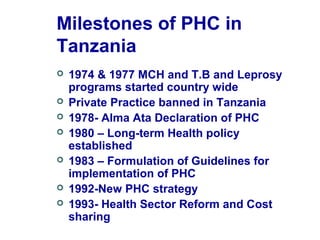
Milestones of PHC in
Tanzania
 1967- Started with Arusha
Declaration emphasizing rural
development and distribution of
basic human Needs (BHN)
 1972 – Villagization &
Decentralization policy
 1974- Mtu ni Afya Campaign
 1977- Universal Primary education
(UPE)
Milestones of PHC in
Tanzania
 1974 & 1977 MCH and T.B and Leprosy
programs started country wide
 Private Practice banned in Tanzania
 1978- Alma Ata Declaration of PHC
 1980 – Long-term Health policy
established
 1983 – Formulation of Guidelines for
implementation of PHC
 1992-New PHC strategy
 1993- Health Sector Reform and Cost
sharing
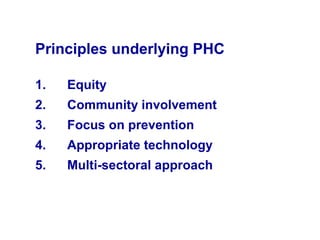
Principles underlying PHC
1. Equity
2. Community involvement
3. Focus on prevention
4. Appropriate technology
5. Multi-sectoral approach
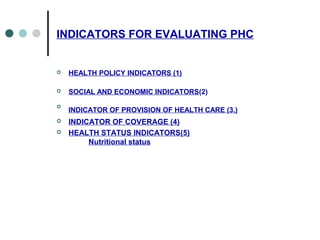
INDICATORS FOR EVALUATING PHC
 HEALTH POLICY INDICATORS (1)
 SOCIAL AND ECONOMIC INDICATORS(2)

INDICATOR OF PROVISION OF HEALTH CARE (3.)
 INDICATOR OF COVERAGE (4)
 HEALTH STATUS INDICATORS(5)
Nutritional status
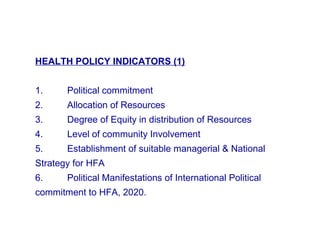
HEALTH POLICY INDICATORS (1)
1. Political commitment
2. Allocation of Resources
3. Degree of Equity in distribution of Resources
4. Level of community Involvement
5. Establishment of suitable managerial & National
Strategy for HFA
6. Political Manifestations of International Political
commitment to HFA, 2020.
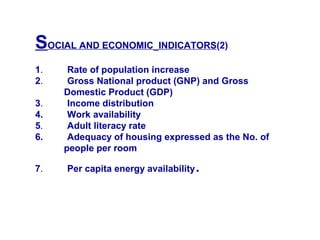
SOCIAL AND ECONOMIC INDICATORS(2)
1. Rate of population increase
2. Gross National product (GNP) and Gross
Domestic Product (GDP)
3. Income distribution
4. Work availability
5. Adult literacy rate
6. Adequacy of housing expressed as the No. of
people per room
7. Per capita energy availability.
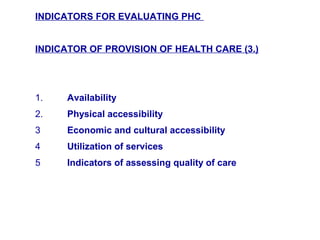
INDICATORS FOR EVALUATING PHC
INDICATOR OF PROVISION OF HEALTH CARE (3.)
1. Availability
2. Physical accessibility
3 Economic and cultural accessibility
4 Utilization of services
5 Indicators of assessing quality of care
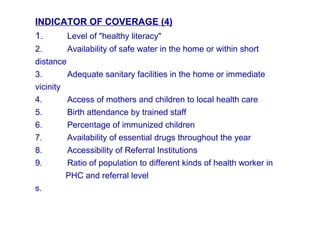
INDICATOR OF COVERAGE (4)
1. Level of "healthy literacy"
2. Availability of safe water in the home or within short
distance
3. Adequate sanitary facilities in the home or immediate
vicinity
4. Access of mothers and children to local health care
5. Birth attendance by trained staff
6. Percentage of immunized children
7. Availability of essential drugs throughout the year
8. Accessibility of Referral Institutions
9. Ratio of population to different kinds of health worker in
PHC and referral level
s.
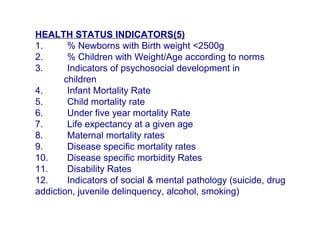
HEALTH STATUS INDICATORS(5)
1. % Newborns with Birth weight <2500g
2. % Children with Weight/Age according to norms
3. Indicators of psychosocial development in
children
4. Infant Mortality Rate
5. Child mortality rate
6. Under five year mortality Rate
7. Life expectancy at a given age
8. Maternal mortality rates
9. Disease specific mortality rates
10. Disease specific morbidity Rates
11. Disability Rates
12. Indicators of social & mental pathology (suicide, drug
addiction, juvenile delinquency, alcohol, smoking)
 What is the Current status of PHC Indicators in
Tanzania 2010?
 Ref; DHS/2010 and other MOHSW documents.
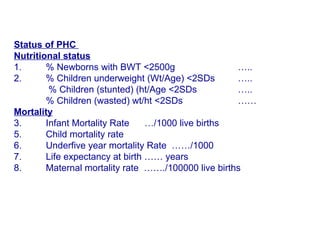
Status of PHC
Nutritional status
1. % Newborns with BWT <2500g …..
2. % Children underweight (Wt/Age) <2SDs …..
% Children (stunted) (ht/Age <2SDs …..
% Children (wasted) wt/ht <2SDs ……
Mortality
3. Infant Mortality Rate …/1000 live births
5. Child mortality rate
6. Underfive year mortality Rate ……/1000
7. Life expectancy at birth …… years
8. Maternal mortality rate ……./100000 live births
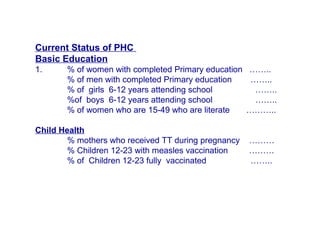
Current Status of PHC
Basic Education
1. % of women with completed Primary education ……..
% of men with completed Primary education ……..
% of girls 6-12 years attending school ……..
%of boys 6-12 years attending school ……..
% of women who are 15-49 who are literate ………..
Child Health
% mothers who received TT during pregnancy ………
% Children 12-23 with measles vaccination ………
% of Children 12-23 fully vaccinated ……..
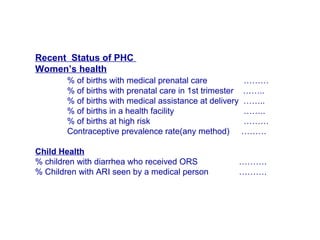
Recent Status of PHC
Women’s health
% of births with medical prenatal care ………
% of births with prenatal care in 1st trimester ……..
% of births with medical assistance at delivery ……..
% of births in a health facility ……..
% of births at high risk ………
Contraceptive prevalence rate(any method) ………
Child Health
% children with diarrhea who received ORS ……….
% Children with ARI seen by a medical person ……….
What is the linkage between PHC
and Health for All 2020?
 Began in 1977 when WHA passed
resolution No. 30.43 of HFA by 2000
 Endorsed at the Alma Ata Conference
of 1978 that PHC will be the strategy
for attainment of HFA 2000,
 In 1995 WHO reviewed HFA
achievements and passed Resolution
No. 48.16 for renewed policy of HFA
2020
What is Health for All
2020?
 HFA is a social goal
 Health is a human right
 Emphasizes equity in health
 Health is part and parcel of socio-economic
development
 Individuals, families and communities must
take a leading role in changing their life
style and behavior so as to be in a good
state of health ultimately contribute towards
Socioeconomic development
EPIDEMOLOGY
 The END
 Thank you
 What are Non communicable disease
 Causes
 Prevention and control

Malimu primary health care.

  • 1.
    Concept of PrimaryHealth care DR MALIMU -MUHAS/KIU
  • 2.
    Learning objectives: At theend of the session the participants will be able to: 1. Define what is primary health care (PHC) 2. Describe the Elements, principles and strategy of PHC 3. Outline the factors that contributed to evolvement of PHC 4. Describe the indicators for evaluating PHC Find out the current status of PHC in Tanzania 6. .Describe the linkage between PHC and HFA 2020
  • 3.
    Definition of PHC “Isessential care that is based on scientifically sound and socially acceptable methods and technology that is made universally accessible to individuals and families in the community through their full participation and at a cost they can afford at every stage of development and spirit of self reliance”.
  • 4.
    Differentiate  Primary HealthCare  Primary Medical Care
  • 5.
    Context- Primary healthcare Elements 1. Education on prevailing health problems and methods of preventing and controlling them 2. Provision of food supplies and promotion of proper nutrition 3. Adequate supply of safe water and provision of basic sanitation 4. Maternal and child health care, including family planning 5. Immunization against the major infections diseases 6. Prevention and control of locally endemic and epidemic diseases 7. Appropriate treatment of common disease and injuries 8. Provision of essential drugs and supplies Tanzania add: 9. Provision of Mental Health 10. Provision of Oral Health
  • 6.
    Factors that contributedto evolvement of PHC in Tanzania 1. Policy of socialism and Self reliance, emphasizes rural development; equity in distribution of basic human needs (BHN) 2. Pattern of diseases are preventable 3. Increase in health infrastructures not synchronous with population increase :. PHC for every village instead of a dispensary for each village
  • 7.
    Factors which contributedto evolvement of PHC at At Global level 1. Failure of the trickle down theory of economic development 2. Maurice King's ideology of accessibility of facilities 3. Success of barefoot doctors in China, Cuba, and Tanzania 4. Pressure from Donors 5. Population growth not synchronizing with increase in basic services
  • 8.
    Strategies for implementationof PHC 1. Training and use community members as health workers 2. Community participation in planning and implementing health programmes 3. Inter-sectoral coordination, particularly between agriculture, education, housing, sanitation and water supplies 4. Collaboration between health organizations, particularly governmental and NGO , traditional and private practitioners. 5. Decentralization of MOH planning and the strengthening of district health system
  • 9.
    Milestones of PHCin Tanzania  1967- Started with Arusha Declaration emphasizing rural development and distribution of basic human Needs (BHN)  1972 – Villagization & Decentralization policy  1974- Mtu ni Afya Campaign  1977- Universal Primary education (UPE)
  • 10.
    Milestones of PHCin Tanzania  1974 & 1977 MCH and T.B and Leprosy programs started country wide  Private Practice banned in Tanzania  1978- Alma Ata Declaration of PHC  1980 – Long-term Health policy established  1983 – Formulation of Guidelines for implementation of PHC  1992-New PHC strategy  1993- Health Sector Reform and Cost sharing
  • 11.
    Principles underlying PHC 1.Equity 2. Community involvement 3. Focus on prevention 4. Appropriate technology 5. Multi-sectoral approach
  • 12.
    INDICATORS FOR EVALUATINGPHC  HEALTH POLICY INDICATORS (1)  SOCIAL AND ECONOMIC INDICATORS(2)  INDICATOR OF PROVISION OF HEALTH CARE (3.)  INDICATOR OF COVERAGE (4)  HEALTH STATUS INDICATORS(5) Nutritional status
  • 13.
    HEALTH POLICY INDICATORS(1) 1. Political commitment 2. Allocation of Resources 3. Degree of Equity in distribution of Resources 4. Level of community Involvement 5. Establishment of suitable managerial & National Strategy for HFA 6. Political Manifestations of International Political commitment to HFA, 2020.
  • 14.
    SOCIAL AND ECONOMICINDICATORS(2) 1. Rate of population increase 2. Gross National product (GNP) and Gross Domestic Product (GDP) 3. Income distribution 4. Work availability 5. Adult literacy rate 6. Adequacy of housing expressed as the No. of people per room 7. Per capita energy availability.
  • 15.
    INDICATORS FOR EVALUATINGPHC INDICATOR OF PROVISION OF HEALTH CARE (3.) 1. Availability 2. Physical accessibility 3 Economic and cultural accessibility 4 Utilization of services 5 Indicators of assessing quality of care
  • 16.
    INDICATOR OF COVERAGE(4) 1. Level of "healthy literacy" 2. Availability of safe water in the home or within short distance 3. Adequate sanitary facilities in the home or immediate vicinity 4. Access of mothers and children to local health care 5. Birth attendance by trained staff 6. Percentage of immunized children 7. Availability of essential drugs throughout the year 8. Accessibility of Referral Institutions 9. Ratio of population to different kinds of health worker in PHC and referral level s.
  • 17.
    HEALTH STATUS INDICATORS(5) 1.% Newborns with Birth weight <2500g 2. % Children with Weight/Age according to norms 3. Indicators of psychosocial development in children 4. Infant Mortality Rate 5. Child mortality rate 6. Under five year mortality Rate 7. Life expectancy at a given age 8. Maternal mortality rates 9. Disease specific mortality rates 10. Disease specific morbidity Rates 11. Disability Rates 12. Indicators of social & mental pathology (suicide, drug addiction, juvenile delinquency, alcohol, smoking)
  • 18.
     What isthe Current status of PHC Indicators in Tanzania 2010?  Ref; DHS/2010 and other MOHSW documents.
  • 19.
    Status of PHC Nutritionalstatus 1. % Newborns with BWT <2500g ….. 2. % Children underweight (Wt/Age) <2SDs ….. % Children (stunted) (ht/Age <2SDs ….. % Children (wasted) wt/ht <2SDs …… Mortality 3. Infant Mortality Rate …/1000 live births 5. Child mortality rate 6. Underfive year mortality Rate ……/1000 7. Life expectancy at birth …… years 8. Maternal mortality rate ……./100000 live births
  • 20.
    Current Status ofPHC Basic Education 1. % of women with completed Primary education …….. % of men with completed Primary education …….. % of girls 6-12 years attending school …….. %of boys 6-12 years attending school …….. % of women who are 15-49 who are literate ……….. Child Health % mothers who received TT during pregnancy ……… % Children 12-23 with measles vaccination ……… % of Children 12-23 fully vaccinated ……..
  • 21.
    Recent Status ofPHC Women’s health % of births with medical prenatal care ……… % of births with prenatal care in 1st trimester …….. % of births with medical assistance at delivery …….. % of births in a health facility …….. % of births at high risk ……… Contraceptive prevalence rate(any method) ……… Child Health % children with diarrhea who received ORS ………. % Children with ARI seen by a medical person ……….
  • 22.
    What is thelinkage between PHC and Health for All 2020?  Began in 1977 when WHA passed resolution No. 30.43 of HFA by 2000  Endorsed at the Alma Ata Conference of 1978 that PHC will be the strategy for attainment of HFA 2000,  In 1995 WHO reviewed HFA achievements and passed Resolution No. 48.16 for renewed policy of HFA 2020
  • 23.
    What is Healthfor All 2020?  HFA is a social goal  Health is a human right  Emphasizes equity in health  Health is part and parcel of socio-economic development  Individuals, families and communities must take a leading role in changing their life style and behavior so as to be in a good state of health ultimately contribute towards Socioeconomic development
  • 24.
  • 25.
     What areNon communicable disease  Causes  Prevention and control