Unit Three
Primary Health Care (PHC)
By: Nejib Sufian(BSc, MA, MPHN)
1
Objectives
• To describe the historical development of PHC
• Definition of PHC
• To discuss on Principles and components of
PHC
• To identify possible problems in implementing
PHC
2
PHC Historical Development
• The World Health Organization (WHO),
established in 1948.
• Major objective: The attainment by all people of the
highest possible level of health.
• Due to political and socio economic factors the
various health care approaches implemented in
different countries between 1948 and 1978 did not
enable WHO to meet the stated objectives.
3
PHC Historical Development…
Strategies used by WHO
- In the 1950s the vertical health service strategy which
included:
- mass campaigns and
- specialized disease control programs for selected
communicable diseases, such as control of malaria,
tuberculosis and venereal diseases.
- But it was found to be expensive and unsuccessful.
4
PHC Historical Development…
• Later In the mid 1950s the concept/strategy of Basic
Health Service came into practice.
• This approach gave more attention to rural areas
through construction of health centers and health
stations providing both preventive and curative care.
• In the early 1970s integration of the specialized disease
control programs with the basic health services was
emphasized.
5
PHC Historical Development…
• All these approaches were disease oriented based on
high cost health institutions requiring advanced
technology to solve the health needs of the people,
and thus ultimately failed to reach the desired goal.
• Specially in developing countries where their
health problems required emphasising on health
promotion and preventive care, the strategies
applied did not make much impact on the health
status of the population.
6
PHC Historical Development…
The evaluation of these strategies during 1950s and 1970s showed the
following:
• The health status of millions of people in the world at that time
and even today is unacceptable.
• the health status of the majority of people in disadvantaged
areas of most countries of the world remained low.
• The organised limited health institutions failed to meet the
demands of those most in need of health services.
• The health services often created in isolation neglecting other
sectors such as education, agriculture, water, communication etc.
• Health institutions stressed curative services with lacking
priority to preventive, promotive and rehabilitative care. 7
PHC Historical Development…
These situations called for WHO and UNICEF in the early 70s
to seriously and critically re-evaluate and re-examine existing
policies, approaches and options in health.
Thus, the magnitude of health problems and inadequate
distribution of health resources called for a new approach and the
Concept of PHC.
In 1977 the WHO set a goal of providing “Health for All by the
year 2000” which aims at achieving a level of health that enables
every citizen of the world to lead a socially and economically
productive life.
The strategy to meet this goal was later defined in the 1978
WHO/UNICEF joints meeting at Alma-Ata USSR.
In this meeting it was declared that the PHC strategy become a
core policy to meet the goal of “Health for all by the Year 2000”.8
Primary health care
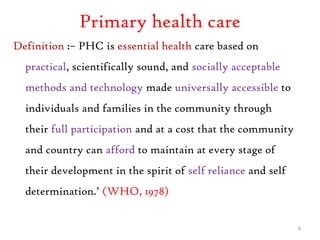
Definition :– PHC is essential health care based on
practical, scientifically sound, and socially acceptable
methods and technology made universally accessible to
individuals and families in the community through
their full participation and at a cost that the community
and country can afford to maintain at every stage of
their development in the spirit of self reliance and self
determination.’ (WHO, 1978)
9
PHC Definition…
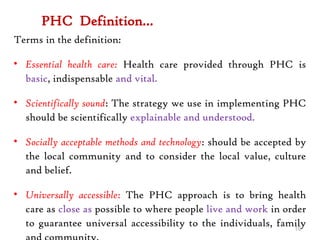
Terms in the definition:
• Essential health care: Health care provided through PHC is
basic, indispensable and vital.
• Scientifically sound: The strategy we use in implementing PHC
should be scientifically explainable and understood.
• Socially acceptable methods and technology: should be accepted by
the local community and to consider the local value, culture
and belief.
• Universally accessible: The PHC approach is to bring health
care as close as possible to where people live and work in order
to guarantee universal accessibility to the individuals, family
10
PHC Definition…
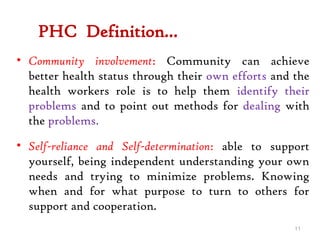
• Community involvement: Community can achieve
better health status through their own efforts and the
health workers role is to help them identify their
problems and to point out methods for dealing with
the problems.
• Self-reliance and Self-determination: able to support
yourself, being independent understanding your own
needs and trying to minimize problems. Knowing
when and for what purpose to turn to others for
support and cooperation.
11
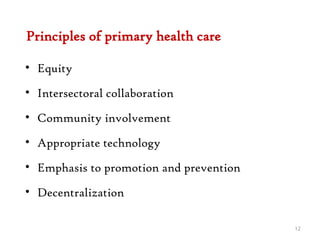
Principles of primary health care
• Equity
• Intersectoral collaboration
• Community involvement
• Appropriate technology
• Emphasis to promotion and prevention
• Decentralization
12
I. Equity
• Providing equal health care to all groups of people
according to their needs.
• giving highest priority to those with greatest health
needs
• Services should be physically, socially, and financially
accessible to everyone
13
II. Intersectoral collaboration
• It means a joint concern and responsibility of
different sectors
• Which sector must be collaborated?
Important to:-
• Save resources (effective use of resources)
• Identify community needs together
14
III. Community involvement
The communities should be actively involved in:
• The assessment of the situation
• Definition/identification of the problems
• Setting of priorities
• Planning, implementation, monitoring and
evaluation and management of development
programs
15
IV. Appropriate Technology
Methods- procedures - techniques, equipments
used are;
• Scientifically valid
• Adapted to/based on local needs
• Acceptable by the professionals
• Acceptable by the community
16
Criteria of Appropriateness
• Effective:-must work and fulfill its purpose
• Culturally acceptable and valuable:- must fit into the
hands, minds and lives of its users
• Affordable:-affordable cost by the major/ whole
community
• Environmentally accountable:- should be
environmentally harmless
• Measurable:-needs proper and continuing evaluation if
17
V. Emphasis on health promotion and prevention
• Promotive: addresses basic causes of ill health at the
level of society.
• Preventive: reduces the incidence of disease by
addressing the immediate and underlying causes (risks)
at the individual level.
• Curative: reduces the prevalence of disease by stopping
the progression of disease among the sick.
• Rehabilitative: reduces the long-term effects or
complications of a health problem.
18
VI. Decentralization
• Bringing decision making away from the national or
central level and closer to the communities served &
to field level providers of services
• It reflects Community participation
19
PHC COMPONENTS
20
PHC COMPONENTS…
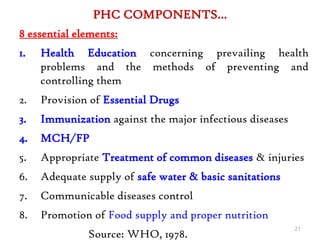
8 essential elements:
1. Health Education concerning prevailing health
problems and the methods of preventing and
controlling them
2. Provision of Essential Drugs
3. Immunization against the major infectious diseases
4. MCH/FP
5. Appropriate Treatment of common diseases & injuries
6. Adequate supply of safe water & basic sanitations
7. Communicable diseases control
8. Promotion of Food supply and proper nutrition
Source: WHO, 1978.
21
PHC COMPONENTS…
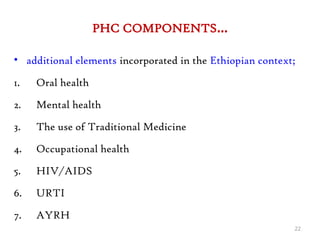
• additional elements incorporated in the Ethiopian context;
1. Oral health
2. Mental health
3. The use of Traditional Medicine
4. Occupational health
5. HIV/AIDS
6. URTI
7. AYRH
22
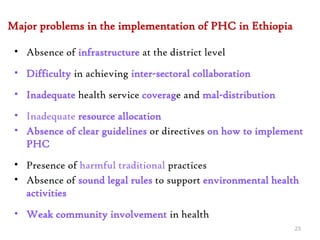
Major problems in the implementation of PHC in Ethiopia
• Absence of infrastructure at the district level
• Difficulty in achieving inter-sectoral collaboration
• Inadequate health service coverage and mal-distribution
• Inadequate resource allocation
• Absence of clear guidelines or directives on how to implement
PHC
• Presence of harmful traditional practices
• Absence of sound legal rules to support environmental health
activities
• Weak community involvement in health
23
Thank you!
24