PRIMARY HEALTH
CARE
HEALTH FOR ALL
ATTAINMENT OF A LEVEL OF
HEALTH THAT WILL ENABLE
EVERY INDIVIDUAL LEAD A
SOCIALLY AND
ECONOMICALLY PRODUCTIVE
LIFE
Levels of Care
 Primary health care
 Secondary health care
 Tertiary health care
CONTD.
Primary health care
 The “first” level of contact between the
individual and the health system.
 Essential health care (PHC) is provided.
 A majority of prevailing health problems
can be satisfactorily managed.
 The closest to the people.
 Provided by the primary health centers.
CONTD.
Secondary health care
 More complex problems are dealt with.
 Comprises curative services
 Provided by the district hospitals
 The 1st referral level
Tertiary health care
 Offers super-specialist care
 Provided by regional/central level institution.
 Provide training programs
Primary health care (PHC) became a core
policy for the World Health Organization with
the Alma-Ata Declaration in 1978 and the
‘Health-for-All by the Year 2000’ Program.
The commitment to global improvements in
health, especially for the most disadvantaged
populations, was renewed in 1998 by the World
Health Assembly. This led to the ‘Health-for-All
for the twenty-first Century’ policy and program,
within which the commitment to PHC
development is restated.
WHAT IS PRIMARY HEALTH CARE
 PRIMARY HEATLH CARE IS
ESSENTIAL HEALTH CARE MADE
UNIVERSALLY ACCESSIBLE TO
INDIVIDUALS AND ACCEPTABLE
TO THEM, THROUGH FULL
PARTICIPATION AND AT A COST
THE COMMUNITY AND COUNTRY
CAN AFFORD
Contd.
 Primary Health Care is different in each
community depending upon:
 Needs of the residents;
 Availability of health care providers;
 The communities geographic location; &
 Proximity to other health care services in
the area.
ELEMENTS OF PRIMARY
HEATH CARE
 Education concerning prevailing health
problems and the methods of preventing an
controlling them
 Promotion of food supply and proper nutrition
 An adequate supply of safe water and basic
sanitation
 Maternal and child health care including FP
Contd.
 Immunization against major infections
diseases
 Prevention and control local endemic
diseases
 Appropriate treatment of common
diseases
 Provision of essential drugs
PRINCIPLES OF PRIMARY
HEALTH CARE
 EQUITABLE DISTRIBUTION
 COMMUNITY PARTICIPATION
 INTERSECTORAL COORDINATION
 APROPRIATE TECHNOLOGY
 DECENTRALISATION
GOALS TO BE ACHIEVED BY
2000
 REDUCTION OF IMR
 RAISE THE EXPECTATION OF LIFE
 REDUCE THE CDR
 REDUCE THE CBR
 ACHIEVE A NET REPRODUCTION RATE
OF ONE
 TO PROVIDE POTABABLE WATER TO
ENTIRE RURAL POPULATION
The Basic Requirements for Sound
PHC (the 8 A’s and the 3 C’s)
 Appropriateness
 Availability
 Adequacy
 Accessibility
 Acceptability
 Affordability
 Assessability
 Accountability
 Completeness
 Comprehensiveness
 Continuity
Strategies of PHC
1.Reducing excess mortality of poor marginalized
populations:
PHC must ensure access to health services for the most
disadvantaged populations, and focus on interventions
which will directly impact on the major causes of
mortality, morbidity and disability for those populations.
2. Reducing the leading risk factors to human health:
PHC, through its preventative and health promotion
roles, must address those known risk factors, which are
the major determinants of health outcomes for local
populations.
Strategies contd.
3. Developing Sustainable Health Systems:
PHC as a component of health systems must
develop in ways, which are financially sustainable,
supported by political leaders, and supported by the
populations served.
4. Developing an enabling policy and institutional
environment:
PHC policy must be integrated with other policy
domains, and play its part in the pursuit of wider
social, economic, environmental and development
policy.
Evaluation of HFA : 1979-2006
 Reasons for slow progress:
 Insufficient political commitment
 Failure to achieve equity in acess to all PHC
components
 The continuing low status of women
 Slow socio- economic development
 Difficulty in achieving inter sectoral action for
Health
 Unbalanced distribution of resources
Reasons for slow progress
(contd.)
 Widespread inequity of health promotion efforts
 Weak health information systems and lack of
baseline data
 Pollution, poor food safety, and lack of water supply
and sanitation
 Rapid demographic and epidemiological changes
 Inappropriate use and allocation of resources for
high cost technology
 Natural and man made disasters
Obstacles to the implementation
of the PHC strategy
 Misinterpretation of the PHC concept
 Misconception that PHC is a 2nd rate health
care for the poor.
 Selective PHC strategies
 Lack of political will
 Centralized planning and management
The Challenges of changing World
 Unequal growth, unequal outcomes
 Adapting to new health challenges
 Trends that undermine the health systems’
response
 Changing values and rising expectations
 PHC reforms: driven by demand
EXTENDED ELEMENTS OF PHC
 Expanded options of immunization
 Reproductive health needs
 Provision of essential technologies for
health
 Prevention and control of non
communicable diseases
 Food safety and provision of selected food
supplements.
FIVE COMMON SHORT COMINGS
OF HEALTH CARE DELIVERY
 INVERSE CARE
 IMPOVERISHING CARE
 FRAGMENTED AND FRAGMENTING CARE
 UNSAFE CARE
 MISDIRECTED CARE
HOW EXPERIENCE HAS SHIFTED
THE PHC MOVEMENT
 Extended access to a
basic package of health
interventions
 Concentration on MCH
 Focus on small number
of selected diseases
 Transformation and
regulation of existing
health systems aiming
for universal access
 Dealing with the health
of everyone
 A comprehensive
response to peoples’s
expectations
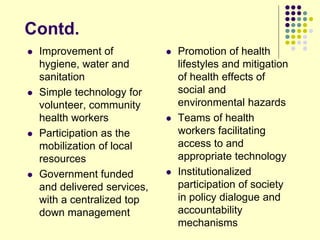
Contd.
 Improvement of
hygiene, water and
sanitation
 Simple technology for
volunteer, community
health workers
 Participation as the
mobilization of local
resources
 Government funded
and delivered services,
with a centralized top
down management
 Promotion of health
lifestyles and mitigation
of health effects of
social and
environmental hazards
 Teams of health
workers facilitating
access to and
appropriate technology
 Institutionalized
participation of society
in policy dialogue and
accountability
mechanisms
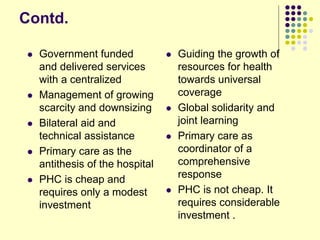
Contd.
 Government funded
and delivered services
with a centralized
 Management of growing
scarcity and downsizing
 Bilateral aid and
technical assistance
 Primary care as the
antithesis of the hospital
 PHC is cheap and
requires only a modest
investment
 Guiding the growth of
resources for health
towards universal
coverage
 Global solidarity and
joint learning
 Primary care as
coordinator of a
comprehensive
response
 PHC is not cheap. It
requires considerable
investment .
FOUR SETS OF PHC REFORMS
 UNIVERSAL COVERAGE
REFORMS
 SERVICE DELIVERY REFORMS
 PUBLIC POLICY REFORMS
 LEADERSHIP REFORMS