FAMILY HEALTH BY: drlcb PRIMARY HEALTH CARE 2
PHC WHO define PHC as essential health care made universally accessible to individual and families in the community  by means
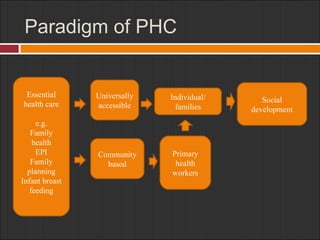
Paradigm of PHC Essential health care e.g. Family health EPI Family planning Infant breast feeding Individual/ families Universally accessible Community based Primary health workers Social development
Essential Health Care Program 1. Family Health 2. Prevention and control of non-communicable disease 3. prevention and control of communicable disease 4. Environmental   Health and sanitation 5. Other priority health programs
Family Health program 1. Maternal health program 2. Family planning program 3. Child health program 4. Expanded program of immunization 5. Nutrition program 6. Oral health program 7. Other health program
Family health The DOH- Family health office- is responsible for the creation, implementation and evaluation of health family programs The summary of its objective is to improve the survival, health and well being of each members of the family as well as the reduction of morbidity and mortality rates in the family and community.
Maternal Health Program Philippine statistics reveal 25% maternal deaths due to hypertension 20.3% Postpartum hemorrhage 9% Pregnancy related diseases Objective: To improve the survival, health and well being of mothers and unborn child
Maternal Health Services 1. Antenatal Registration- pregnant women can avail the free prenatal services at their respective health center. 2. Tetanus Toxoid Immunization-A series of 2 doses of tetanus toxiod vaccination must be received by a pregnant women one month before delivery and 3 booster doses after childbirth 3. Micronutrient Supplementation- Vitamin A  and Iron supplement for the prevention of anemia
4. treatment of diseases and other conditions- These is for the women who is diagnosed as under the high risk pregnancy 5. Clean and Safe delivery- ensuring an aseptic areas for labor and delivery
The Family Planning Program In 2003, there are about 84 million Filipinos to grow annually at 2.36 percent and expected to double in 29 years. The total fertility rate is at 3.5 children/ women The use of contraceptive increases gradually from 15.4%  (1996) to 48.9% (2003) 44% of women got pregnant with their first child  at the age of 20-24.
The objectives: To help couples and individuals achieve their desired family size within the context of responsible parenthood and to improve their reproductive health to attain sustainable growth.
Family planning Method Female Sterilization 1. Tubal Ligation- It involves the cutting or blocking the 2 fallopian tubes. Advantages: Permanent method of contraception No repeated clinic visits Does not interfere with sex- result to increase enjoyment No known side effects
Male Sterilization 1. Vasectomy- The vas deferens is blocked or cut, to prevent the passage of sperm Advantages: Very effective  3 month after the procedure Permanent, safe, simple and easy to perform Does not interfere with sex
Use of Pill- These pill contains hormone: estrogen and progesterone, this is taken daily to prevent conception. Advantages: Safe, convenient and easy to use Make menstrual cycle occur regularly Reduces gynecological symptoms like painful menstruation and reduce the risk of ovarian and endometrial cancers
Disadvantage: It has side effects like; nausea, dizziness, breast tenderness, blurring of vision It suppress lactation Requires regular supply
Use of Condom- It’s a thin sheath of latex rubber made to fit on a man’s erected penis, it prevent the passage of sperm into the internal vagina Advantages: Safe and no hormonal effects; 98% effective It protect individual in sexually transmitted diseases Disadvantages: Allergies to rubber latex Decrease in sensation, interrupts the sexual act
Injectibles- It contains synthetic hormone, progestin which suppresses ovulation, it thickens the cervical mucus thus making it difficult for sperm to pass through  Advantages: Reversible and no daily intake No sexual inference
Lactating amenorrhea method or LAM- A temporary postpartum method of postponing pregnancy based on the physiological infertility experienced by breast feeding mothers. Advantages: Available to all postpartum lactating mothers
Mucus/Billing/Ovulation Method- Abstaining from sexual intercourse during fertile (wet) days Advantages: Can be use by healthy women, no known diseases Disadvantages: Not reliable
Basal Body temperature- BBT is use to identify the fertile and infertile period of a woman’s cycle by daily taking and recording the rise and fall in body temperature during and after ovulation Advantage: Very effective Disadvantage: Couples abstinence during fertile period
Sympto-Thermal Method- It’s the combination of BBT and Billings method. Combination of observation made on cervical mucus and BBT Effectiveness 80%
Child Health Program Which includes the newborn, infants and children Programs for children Infant and young child feeding Newborn screening Expanded program on Immunization Management of Childhood diseases Micronutrient supplementation Dental health
Early child development Child Health injuries Overall objective To reduce morbidity and mortality rate among children from 0-9 years old.
Infant & young child feeding Importance of breast feeding-  Exclusive breast feeding is giving only breast milk to infants, This is recommended up to 6 months and can be extended up to 2 years. Benefits for the infants A complete food for the infants Strengthen immune system thus preventing infections Increases IQ points
Benefit for the mothers Reduces excessive blood loss after birth Natural method of delaying pregnancies Reduces the risk of ovarian and breast cancers
Laws that protects infant and young child feeding Milk code (EO 51) – products covered by milk code consist of breast milk substitute, e.g. infant formula, other milk products, bottlefed complementary foods Rooming-In Breastfeeding Act of 1992- requires both public and private institution to promote rooming-in, it encourage and support the practice of breastfeeding
Food fortification Law or An act establishing the Philippine Food fortification Program and for other purpose- Food fortification law- Republic Act 8976 Food fortification law is vital in the promotion of optimal health and to compensate for the loss of nutrients during processing and storage of food.
Infant screening tests or  Neonatal screening tests Newborn screening  is a process of testing newborn babies from treatable genetic, endocrinologic, metabolic and hematologic diseases The test is mandated in the RA 9288 otherwise known as Newborn screening program of 2004
Disorders screened  1. CH -(congenital hypothyroidism)- 1: 4000 ratio 2. CAH – (Congenital adrenal hyperplasia)  3. GAL – (Galactosemia)  4. PKU – (Phenylketonuria)  5. G6PD – ( glucose-6-phosphate dehydrogenase)
How the test is performed: Blood tests: A health care professional will prick the babys heel to obtain a few drops of blood. The blood is sent to a lab for analysis. Hearing test: An audiologist will place a tiny earpiece or microphone in the infant� ' s ear or stick electrodes on the baby� ' s head.
How to prepare for the test: There is no preparation necessary for newborn screening tests. The tests are performed when the baby is between 24 hours and 7 days old, typically before the baby goes home from the hospital. How the test will feel: The baby will most likely cry when his or her heel is pricked to obtain the small blood sample. The hearing test should not cause the baby to feel pain, cry, or respond
EPI Our commitment to Universal Child Immunization has lead to the mandate of laws regarding EPI. Accelerated EPI coverage started in 1986 and in 1992 Hepatitis B immunization has been integrated into EPI manual of operation. In early 1990 there is a declined  of numerous cases of the immunizable disease such as: Polio disease, Measles and neonatal tetanus
Routine schedule of Immunization Every Wednesday is designated as immunization day in all parts of the country.  A fully immunized child- receives one dose of BCG, 3 doses of OPV, DPT, HB and one dose measles vaccine before the child’s 1 st  birthday
Schedule of immunization Vaccine Minimum age at 1st dose Number of doses Minimum interval between doses Reason BCG Birth or anytime after birth 1 BCG protects the infant from possibility of TB meningitis & other TB infections DPT 6 weeks 3 4 weeks Reduce the chance of pertussis OPV 6 weeks 3 4 weeks Protection against polio disease
Vaccine Minimum age at 1st dose Number of doses Minimum interval between doses Reason Hepatitis B At birth 3 6 weeks interval from 1 st  dose to 2 nd  dose; 8 weeks interval from 2 nd  to 3 rd  dose Reduces the chance of being infected and becoming a carrier Measles 9 months Prevents deaths, malnutrition and protection from measles
EPI vaccines and its characteristics Type/Form of vaccine Storage Temperature Most Sensitive to heat Oral Polio (live attenuated ) -15°C to -25°C ( at the freezer) Measles ( Freeze dried) -15°C to -25°C ( at the freezer)
Type/Form of vaccine Storage Temperature Least sensitive to heat DPT/Hep B “ D” toxoid is a weakened toxin “ P” killed bacteria “ T” toxoid is a weakened toxin +2 °C to + 8°C ( in the body of refrigerator) Hepatitis B +2 °C to + 8°C ( in the body of refrigerator) BCG (freeze dried) +2 °C to + 8°C ( in the body of refrigerator) Tetanus toxoid +2 °C to + 8°C ( in the body of refrigerator)
Administration of the vaccine Vaccine Dose Route of Administration Site of Administration BCG 0.05 ml Intradermal Right deltoid region DPT 0.5 ml Intramuscular Upper outer portion of the thigh OPV 2 drops or depending on the manufacturer instruction Oral Mouth Measles 0.5 ml Subcutaneous Outer part of the arm Hepa B 0.5 ml Intramuscular Upper outer portion of the thigh Tetanus toxoid 0.5 ml Intramuscular Deltoid region
Nutritional program Common nutritional deficiencies in the Philippines according to DOH Vitamin A Iron Iodine Goal of Nutrition program- is to improve quality of life of every Filipinos through better nutrition, improved health and increase productivity.
Programs and projects 1. Micronutrient supplementation- 2x a year distribution of vitamin A capsules through the “Araw ng Sangkap Pinoy”-  (ASAP) also known as GP- garantisadong pambata
2. Food Fortification- 3. Essential Maternal and child health service package 4. Nutrition information 5. Home, school and community food production 6. Food assistance 7. Livelihood assistance
The End

Primary Health Care 2

  • 1.
    FAMILY HEALTH BY:drlcb PRIMARY HEALTH CARE 2
  • 2.
    PHC WHO definePHC as essential health care made universally accessible to individual and families in the community by means
  • 3.
    Paradigm of PHCEssential health care e.g. Family health EPI Family planning Infant breast feeding Individual/ families Universally accessible Community based Primary health workers Social development
  • 4.
    Essential Health CareProgram 1. Family Health 2. Prevention and control of non-communicable disease 3. prevention and control of communicable disease 4. Environmental Health and sanitation 5. Other priority health programs
  • 5.
    Family Health program1. Maternal health program 2. Family planning program 3. Child health program 4. Expanded program of immunization 5. Nutrition program 6. Oral health program 7. Other health program
  • 6.
    Family health TheDOH- Family health office- is responsible for the creation, implementation and evaluation of health family programs The summary of its objective is to improve the survival, health and well being of each members of the family as well as the reduction of morbidity and mortality rates in the family and community.
  • 7.
    Maternal Health ProgramPhilippine statistics reveal 25% maternal deaths due to hypertension 20.3% Postpartum hemorrhage 9% Pregnancy related diseases Objective: To improve the survival, health and well being of mothers and unborn child
  • 8.
    Maternal Health Services1. Antenatal Registration- pregnant women can avail the free prenatal services at their respective health center. 2. Tetanus Toxoid Immunization-A series of 2 doses of tetanus toxiod vaccination must be received by a pregnant women one month before delivery and 3 booster doses after childbirth 3. Micronutrient Supplementation- Vitamin A and Iron supplement for the prevention of anemia
  • 9.
    4. treatment ofdiseases and other conditions- These is for the women who is diagnosed as under the high risk pregnancy 5. Clean and Safe delivery- ensuring an aseptic areas for labor and delivery
  • 10.
    The Family PlanningProgram In 2003, there are about 84 million Filipinos to grow annually at 2.36 percent and expected to double in 29 years. The total fertility rate is at 3.5 children/ women The use of contraceptive increases gradually from 15.4% (1996) to 48.9% (2003) 44% of women got pregnant with their first child at the age of 20-24.
  • 11.
    The objectives: Tohelp couples and individuals achieve their desired family size within the context of responsible parenthood and to improve their reproductive health to attain sustainable growth.
  • 12.
    Family planning MethodFemale Sterilization 1. Tubal Ligation- It involves the cutting or blocking the 2 fallopian tubes. Advantages: Permanent method of contraception No repeated clinic visits Does not interfere with sex- result to increase enjoyment No known side effects
  • 13.
    Male Sterilization 1.Vasectomy- The vas deferens is blocked or cut, to prevent the passage of sperm Advantages: Very effective 3 month after the procedure Permanent, safe, simple and easy to perform Does not interfere with sex
  • 14.
    Use of Pill-These pill contains hormone: estrogen and progesterone, this is taken daily to prevent conception. Advantages: Safe, convenient and easy to use Make menstrual cycle occur regularly Reduces gynecological symptoms like painful menstruation and reduce the risk of ovarian and endometrial cancers
  • 15.
    Disadvantage: It hasside effects like; nausea, dizziness, breast tenderness, blurring of vision It suppress lactation Requires regular supply
  • 16.
    Use of Condom-It’s a thin sheath of latex rubber made to fit on a man’s erected penis, it prevent the passage of sperm into the internal vagina Advantages: Safe and no hormonal effects; 98% effective It protect individual in sexually transmitted diseases Disadvantages: Allergies to rubber latex Decrease in sensation, interrupts the sexual act
  • 17.
    Injectibles- It containssynthetic hormone, progestin which suppresses ovulation, it thickens the cervical mucus thus making it difficult for sperm to pass through Advantages: Reversible and no daily intake No sexual inference
  • 18.
    Lactating amenorrhea methodor LAM- A temporary postpartum method of postponing pregnancy based on the physiological infertility experienced by breast feeding mothers. Advantages: Available to all postpartum lactating mothers
  • 19.
    Mucus/Billing/Ovulation Method- Abstainingfrom sexual intercourse during fertile (wet) days Advantages: Can be use by healthy women, no known diseases Disadvantages: Not reliable
  • 20.
    Basal Body temperature-BBT is use to identify the fertile and infertile period of a woman’s cycle by daily taking and recording the rise and fall in body temperature during and after ovulation Advantage: Very effective Disadvantage: Couples abstinence during fertile period
  • 21.
    Sympto-Thermal Method- It’sthe combination of BBT and Billings method. Combination of observation made on cervical mucus and BBT Effectiveness 80%
  • 22.
    Child Health ProgramWhich includes the newborn, infants and children Programs for children Infant and young child feeding Newborn screening Expanded program on Immunization Management of Childhood diseases Micronutrient supplementation Dental health
  • 23.
    Early child developmentChild Health injuries Overall objective To reduce morbidity and mortality rate among children from 0-9 years old.
  • 24.
    Infant & youngchild feeding Importance of breast feeding- Exclusive breast feeding is giving only breast milk to infants, This is recommended up to 6 months and can be extended up to 2 years. Benefits for the infants A complete food for the infants Strengthen immune system thus preventing infections Increases IQ points
  • 25.
    Benefit for themothers Reduces excessive blood loss after birth Natural method of delaying pregnancies Reduces the risk of ovarian and breast cancers
  • 26.
    Laws that protectsinfant and young child feeding Milk code (EO 51) – products covered by milk code consist of breast milk substitute, e.g. infant formula, other milk products, bottlefed complementary foods Rooming-In Breastfeeding Act of 1992- requires both public and private institution to promote rooming-in, it encourage and support the practice of breastfeeding
  • 27.
    Food fortification Lawor An act establishing the Philippine Food fortification Program and for other purpose- Food fortification law- Republic Act 8976 Food fortification law is vital in the promotion of optimal health and to compensate for the loss of nutrients during processing and storage of food.
  • 28.
    Infant screening testsor Neonatal screening tests Newborn screening is a process of testing newborn babies from treatable genetic, endocrinologic, metabolic and hematologic diseases The test is mandated in the RA 9288 otherwise known as Newborn screening program of 2004
  • 29.
    Disorders screened 1. CH -(congenital hypothyroidism)- 1: 4000 ratio 2. CAH – (Congenital adrenal hyperplasia) 3. GAL – (Galactosemia) 4. PKU – (Phenylketonuria) 5. G6PD – ( glucose-6-phosphate dehydrogenase)
  • 30.
    How the testis performed: Blood tests: A health care professional will prick the babys heel to obtain a few drops of blood. The blood is sent to a lab for analysis. Hearing test: An audiologist will place a tiny earpiece or microphone in the infant� ' s ear or stick electrodes on the baby� ' s head.
  • 31.
    How to preparefor the test: There is no preparation necessary for newborn screening tests. The tests are performed when the baby is between 24 hours and 7 days old, typically before the baby goes home from the hospital. How the test will feel: The baby will most likely cry when his or her heel is pricked to obtain the small blood sample. The hearing test should not cause the baby to feel pain, cry, or respond
  • 32.
    EPI Our commitmentto Universal Child Immunization has lead to the mandate of laws regarding EPI. Accelerated EPI coverage started in 1986 and in 1992 Hepatitis B immunization has been integrated into EPI manual of operation. In early 1990 there is a declined of numerous cases of the immunizable disease such as: Polio disease, Measles and neonatal tetanus
  • 33.
    Routine schedule ofImmunization Every Wednesday is designated as immunization day in all parts of the country. A fully immunized child- receives one dose of BCG, 3 doses of OPV, DPT, HB and one dose measles vaccine before the child’s 1 st birthday
  • 34.
    Schedule of immunizationVaccine Minimum age at 1st dose Number of doses Minimum interval between doses Reason BCG Birth or anytime after birth 1 BCG protects the infant from possibility of TB meningitis & other TB infections DPT 6 weeks 3 4 weeks Reduce the chance of pertussis OPV 6 weeks 3 4 weeks Protection against polio disease
  • 35.
    Vaccine Minimum ageat 1st dose Number of doses Minimum interval between doses Reason Hepatitis B At birth 3 6 weeks interval from 1 st dose to 2 nd dose; 8 weeks interval from 2 nd to 3 rd dose Reduces the chance of being infected and becoming a carrier Measles 9 months Prevents deaths, malnutrition and protection from measles
  • 36.
    EPI vaccines andits characteristics Type/Form of vaccine Storage Temperature Most Sensitive to heat Oral Polio (live attenuated ) -15°C to -25°C ( at the freezer) Measles ( Freeze dried) -15°C to -25°C ( at the freezer)
  • 37.
    Type/Form of vaccineStorage Temperature Least sensitive to heat DPT/Hep B “ D” toxoid is a weakened toxin “ P” killed bacteria “ T” toxoid is a weakened toxin +2 °C to + 8°C ( in the body of refrigerator) Hepatitis B +2 °C to + 8°C ( in the body of refrigerator) BCG (freeze dried) +2 °C to + 8°C ( in the body of refrigerator) Tetanus toxoid +2 °C to + 8°C ( in the body of refrigerator)
  • 38.
    Administration of thevaccine Vaccine Dose Route of Administration Site of Administration BCG 0.05 ml Intradermal Right deltoid region DPT 0.5 ml Intramuscular Upper outer portion of the thigh OPV 2 drops or depending on the manufacturer instruction Oral Mouth Measles 0.5 ml Subcutaneous Outer part of the arm Hepa B 0.5 ml Intramuscular Upper outer portion of the thigh Tetanus toxoid 0.5 ml Intramuscular Deltoid region
  • 39.
    Nutritional program Commonnutritional deficiencies in the Philippines according to DOH Vitamin A Iron Iodine Goal of Nutrition program- is to improve quality of life of every Filipinos through better nutrition, improved health and increase productivity.
  • 40.
    Programs and projects1. Micronutrient supplementation- 2x a year distribution of vitamin A capsules through the “Araw ng Sangkap Pinoy”- (ASAP) also known as GP- garantisadong pambata
  • 41.
    2. Food Fortification-3. Essential Maternal and child health service package 4. Nutrition information 5. Home, school and community food production 6. Food assistance 7. Livelihood assistance
  • 42.