

Case study: Internationalization
         of South African Higher
                        Education
IAU
4th Global Meeting
12 April 2011

Prof Duma Malaza


THE VOICE OF HIGHER EDUCATION LEADERSHIP
Guiding Question

•How much impact can
organizations like HESA have
on internationalization policies?
•What strategies are employed
to raise the profile of
internationalization?
All the right noises
National HE policy formation
•Education White Paper 3 (1997)
•National Plan for Higher Education
(2001)
Policy documents of government
Departments
•Trade and Industry
•Science and Technology
•International Cooperation


  However, national equity imperatives meant that
      transformation was HE’s first priority
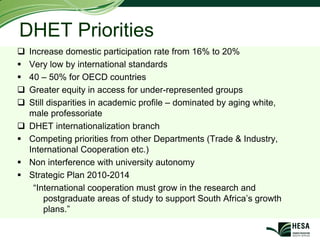
DHET Priorities
 Increase domestic participation rate from 16% to 20%
 Very low by international standards
 40 – 50% for OECD countries
 Greater equity in access for under-represented groups
 Still disparities in academic profile – dominated by aging white,
 male professoriate
 DHET internationalization branch
 Competing priorities from other Departments (Trade & Industry,
 International Cooperation etc.)
 Non interference with university autonomy
 Strategic Plan 2010-2014
  “International cooperation must grow in the research and
      postgraduate areas of study to support South Africa’s growth
      plans.”
External policy
                           •   Work towards standardisation of university
Main international             admission requirements.
policy document            •   Develop mechanisms for the transfer of
comes from the                 credit within universities in the region.
                               Reserve space for 5% of student
SADC Protocol                  admissions for SADC students.
(1997)                         Encourage student and staff mobility.
                               Ensure, within 10 years, that SADC
                               students and home students have the same
                               rights as far as accommodation and fees
                               are concerned.


           South African is the only
           SADC country to achieve
           these
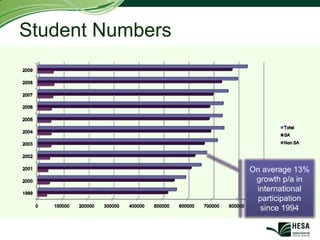
Student Numbers


                  On average 13%
                   growth p/a in
                   international
                   participation
                    since 1994
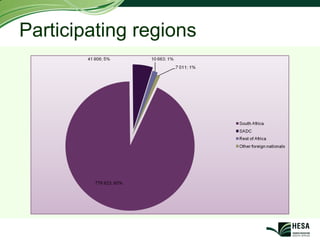
Participating regions
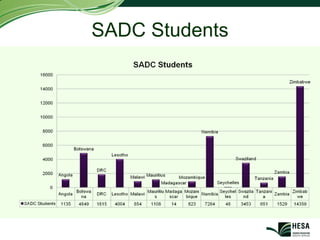
SADC Students
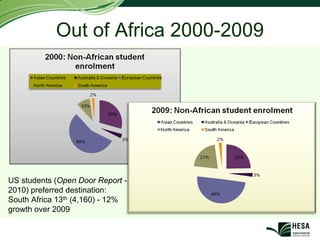
Out of Africa 2000-2009


US students (Open Door Report -
2010) preferred destination:
South Africa 13th (4,160) - 12%
growth over 2009
PROMOTING THE
       INTERNATIONAL AGENDA

                     HESA STRATEGIES


THE VOICE OF HIGHER EDUCATION LEADERSHIP
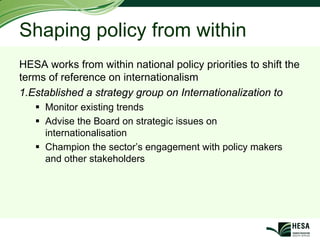
Shaping policy from within
HESA works from within national policy priorities to shift the
terms of reference on internationalism
1.Established a strategy group on Internationalization to
     Monitor existing trends
     Advise the Board on strategic issues on
     internationalisation
     Champion the sector’s engagement with policy makers
     and other stakeholders
Shaping policy from within
2. Work in alignment with Government’s developmental
   focus areas. Promote international collaborations aimed
   at
     Creation of decent work and sustainable livelihoods
     Education
     Health
     Rural development, food security and land reform
     The fight against crime and corruption
3. Leverage off existing government multilaterals
     Support the mobility of academics via the India-Brazil-South
     Africa partnership
     Strong strategic role and coordination the South Africa-Japan
     Universities partnership – aimed at developing scarce and
     critical skills
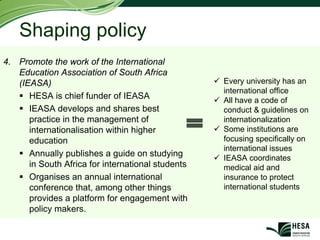
Shaping policy
4. Promote the work of the International
   Education Association of South Africa
   (IEASA)                                         Every university has an
                                                   international office
      HESA is chief funder of IEASA                All have a code of
      IEASA develops and shares best               conduct & guidelines on
      practice in the management of                internationalization
      internationalisation within higher           Some institutions are
      education                                    focusing specifically on
                                                   international issues
      Annually publishes a guide on studying       IEASA coordinates
      in South Africa for international students   medical aid and
      Organises an annual international            insurance to protect
      conference that, among other things          international students
      provides a platform for engagement with
      policy makers.
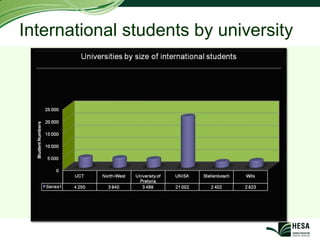
International students by university
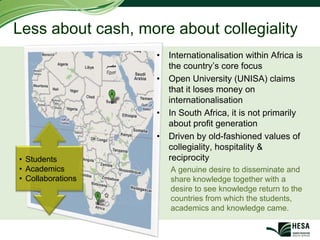
Less about cash, more about collegiality
                    •   Internationalisation within Africa is
                        the country’s core focus
                    •   Open University (UNISA) claims
                        that it loses money on
                        internationalisation
                    •   In South Africa, it is not primarily
                        about profit generation
                    •   Driven by old-fashioned values of
                        collegiality, hospitality &
• Students              reciprocity
• Academics             A genuine desire to disseminate and
• Collaborations        share knowledge together with a
                        desire to see knowledge return to the
                        countries from which the students,
                        academics and knowledge came.

GMA IV_Malaza

  • 1.
    Case study: Internationalization of South African Higher Education IAU 4th Global Meeting 12 April 2011 Prof Duma Malaza THE VOICE OF HIGHER EDUCATION LEADERSHIP
  • 2.
    Guiding Question •How muchimpact can organizations like HESA have on internationalization policies? •What strategies are employed to raise the profile of internationalization?
  • 3.
    All the rightnoises National HE policy formation •Education White Paper 3 (1997) •National Plan for Higher Education (2001) Policy documents of government Departments •Trade and Industry •Science and Technology •International Cooperation However, national equity imperatives meant that transformation was HE’s first priority
  • 4.
    DHET Priorities Increasedomestic participation rate from 16% to 20% Very low by international standards 40 – 50% for OECD countries Greater equity in access for under-represented groups Still disparities in academic profile – dominated by aging white, male professoriate DHET internationalization branch Competing priorities from other Departments (Trade & Industry, International Cooperation etc.) Non interference with university autonomy Strategic Plan 2010-2014 “International cooperation must grow in the research and postgraduate areas of study to support South Africa’s growth plans.”
  • 5.
    External policy • Work towards standardisation of university Main international admission requirements. policy document • Develop mechanisms for the transfer of comes from the credit within universities in the region. Reserve space for 5% of student SADC Protocol admissions for SADC students. (1997) Encourage student and staff mobility. Ensure, within 10 years, that SADC students and home students have the same rights as far as accommodation and fees are concerned. South African is the only SADC country to achieve these
  • 6.
    Student Numbers On average 13% growth p/a in international participation since 1994
  • 7.
  • 8.
  • 9.
    Out of Africa2000-2009 US students (Open Door Report - 2010) preferred destination: South Africa 13th (4,160) - 12% growth over 2009
  • 10.
    PROMOTING THE INTERNATIONAL AGENDA HESA STRATEGIES THE VOICE OF HIGHER EDUCATION LEADERSHIP
  • 11.
    Shaping policy fromwithin HESA works from within national policy priorities to shift the terms of reference on internationalism 1.Established a strategy group on Internationalization to Monitor existing trends Advise the Board on strategic issues on internationalisation Champion the sector’s engagement with policy makers and other stakeholders
  • 12.
    Shaping policy fromwithin 2. Work in alignment with Government’s developmental focus areas. Promote international collaborations aimed at Creation of decent work and sustainable livelihoods Education Health Rural development, food security and land reform The fight against crime and corruption 3. Leverage off existing government multilaterals Support the mobility of academics via the India-Brazil-South Africa partnership Strong strategic role and coordination the South Africa-Japan Universities partnership – aimed at developing scarce and critical skills
  • 13.
    Shaping policy 4. Promotethe work of the International Education Association of South Africa (IEASA) Every university has an international office HESA is chief funder of IEASA All have a code of IEASA develops and shares best conduct & guidelines on practice in the management of internationalization internationalisation within higher Some institutions are education focusing specifically on international issues Annually publishes a guide on studying IEASA coordinates in South Africa for international students medical aid and Organises an annual international insurance to protect conference that, among other things international students provides a platform for engagement with policy makers.
  • 14.
  • 15.
    Less about cash,more about collegiality • Internationalisation within Africa is the country’s core focus • Open University (UNISA) claims that it loses money on internationalisation • In South Africa, it is not primarily about profit generation • Driven by old-fashioned values of collegiality, hospitality & • Students reciprocity • Academics A genuine desire to disseminate and • Collaborations share knowledge together with a desire to see knowledge return to the countries from which the students, academics and knowledge came.