AMPEI

ASOCIACIÓN MEXICANA PARA LA
  EDUCACIÓN INTERNACIONAL
Asociación Mexicana para la Educación Internacional
                     Origins

 AMPEI is the most important association of professionals in
 international education and cooperation in Mexico. It was founded in
 1992 due to the initiative and support of:


      International educators from various Mexican universities.

      Officials from the Mexican Ministry of Education (SEP).

      The Mexican Rectors’ Conference (ANUIES: Asociación Nacional
      de Universidades e Instituciones de Educación Superior).

      Institute of International Education (IIE).
Asociación Mexicana para la Educación Internacional
                     Mission


AMPEI aims to promote the inclusion of an
international dimension in Mexican educational
institutions so that they may educate and graduate
persons and professionals who are able to live
fulfilling lives and perform effectively in today’s
multicultural global society and contribute to
understanding, respect, and tolerance among
nations and cultures.
Asociación Mexicana para la Educación Internacional
                    Members


AMPEI has currently over 150
members, mainly international
educators employed at Mexican
institutions of higher education,
but also independent service
providers, among others.
Asociación Mexicana para la Educación Internacional
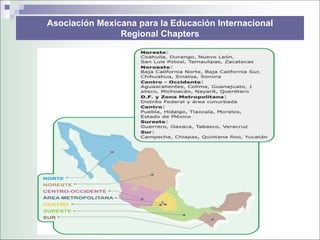
                Regional Chapters
Asociación Mexicana para la Educación Internacional
                        Leadership


Board of Directors (13):

  President, Vice-President, Secretary, Treasurer, two
  members-at-large and the seven regional chairs.


International Advisory Board (13):

  Seven internationally recognized experts in
  international education and the six former presidents
  of AMPEI.
Asociación Mexicana para la Educación Internacional
                        Activities


Publication of the journal Educación Global.

Participation in conferences and boards of other international education
associations, such as AIEA, AIEC, APAIE, CONAHEC, EAIE, NAFSA,
among others.

Organization of workshops and other professional development activities.

Surveys and opinion polls related to international education in Mexico.

Diffusion of information through listserve and website (www.ampei.org.mx)

Promotion of Mexican higher education.

Organization of annual conference.
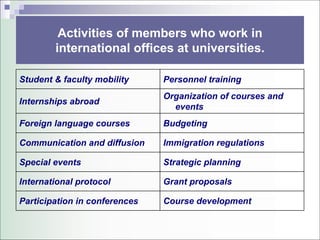
Activities of members who work in
        international offices at universities.

Student & faculty mobility     Personnel training
                               Organization of courses and
Internships abroad
                                 events
Foreign language courses       Budgeting

Communication and diffusion    Immigration regulations

Special events                 Strategic planning

International protocol         Grant proposals

Participation in conferences   Course development
Asociación Mexicana para la Educación Internacional
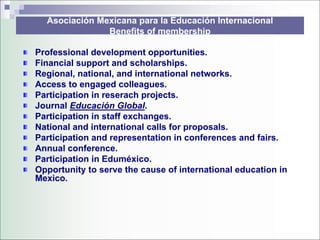
               Benefits of membership

Professional development opportunities.
Financial support and scholarships.
Regional, national, and international networks.
Access to engaged colleagues.
Participation in reserach projects.
Journal Educación Global.
Participation in staff exchanges.
National and international calls for proposals.
Participation and representation in conferences and fairs.
Annual conference.
Participation in Eduméxico.
Opportunity to serve the cause of international education in
Mexico.
Asociación Mexicana para la Educación Internacional
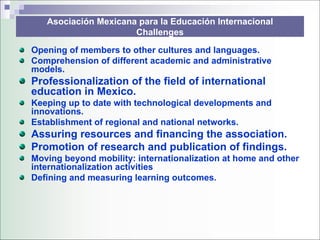
                      Challenges

Opening of members to other cultures and languages.
Comprehension of different academic and administrative
models.
Professionalization of the field of international
education in Mexico.
Keeping up to date with technological developments and
innovations.
Establishment of regional and national networks.
Assuring resources and financing the association.
Promotion of research and publication of findings.
Moving beyond mobility: internationalization at home and other
internationalization activities
Defining and measuring learning outcomes.
AMPEI
THANK YOU!


   THANK YOU!
¡MUCHAS GRACIAS!
International Student Mobility
         to and from
        Latin America


                 Thomas Buntru
       Director of International Programs
           Universidad de Monterrey
International Student Mobility
                  to and from Latin America

1.   Low Mobility

2.   Uneven Mobility

3.   Limiting Factors

4.   Motivating Factors

5.   The Future

6.   Sources
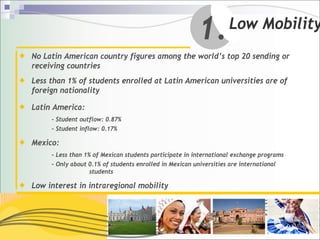
1.         Low Mobility
No Latin American country figures among the world’s top 20 sending or
receiving countries
Less than 1% of students enrolled at Latin American universities are of
foreign nationality

Latin America:
     - Student outflow: 0.87%
     - Student inflow: 0.17%

Mexico:
     - Less than 1% of Mexican students participate in international exchange programs
     - Only about 0.1% of students enrolled in Mexican universities are international
                  students

Low interest in intraregional mobility
2.        Uneven Mobility

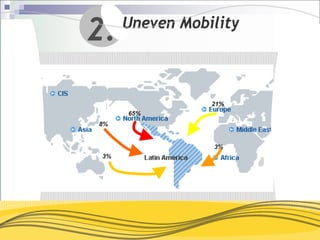
Student mobility is mainly to and from North America and Europe

86% of all incoming international students are from Canada and
the USA (65%) and from Europe (21%); 8% come from Asia, 3% from
Oceania, and 3% from Africa.

The most popular countries for outgoing students are the United
States and Spain.

There is a marked difference in study abroad participation rates
among students from private and public universities; private
universities with high tuition levels have the highest mobility.
2.      Uneven Mobility


• Mapa de Fischer p. 31
                          21%
             65%
       8%


                          3%
        3%
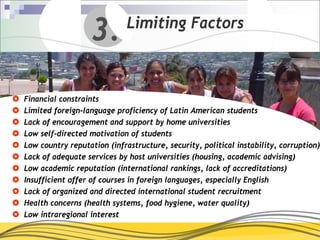
3.        Limiting Factors


Financial constraints
Limited foreign-language proficiency of Latin American students
Lack of encouragement and support by home universities
Low self-directed motivation of students
Low country reputation (infrastructure, security, political instability, corruption)
Lack of adequate services by host universities (housing, academic advising)
Low academic reputation (international rankings, lack of accreditations)
Insufficient offer of courses in foreign languages, especially English
Lack of organized and directed international student recruitment
Health concerns (health systems, food hygiene, water quality)
Low intraregional interest
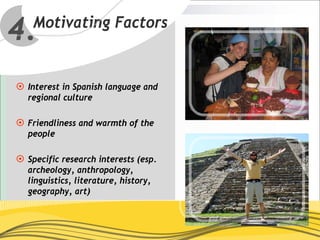
4.Motivating Factors


 Interest in Spanish language and
 regional culture

 Friendliness and warmth of the
 people

 Specific research interests (esp.
 archeology, anthropology,
 linguistics, literature, history,
 geography, art)
5.      The Future: Cautious Optimism

Growing awareness of the importance of
internationalization in general and student
mobility programs in particular

Growing concern with quality assurance in
higher education

Growing importance of Spanish as an
international language

Affordable tuition fees and low cost of living

Professionalization of the field

Lobbying by international education
associations (AMPEI, FAUBAI)

Regional integration (NAFTA , Mercosur)
6.     Sources

o Asociación Nacional de Universidades e Instituciones de Educación Superior. (2006).
    Consolidación y avance de la educación superior en México: Elementos de diagnóstico
    y propuesta. Mexico City, Mexico. ANUIES.
o   Center for World-Class Universities. (2009). Academic Ranking of World Class
    Universities. Shanghai, China. Shanghai Jiao Tong University. Internet:
    http://www.arwu.org/ARWU2009
o   Fischer, T. (2007). Not Far Away: A barrier analysis on the international dimension of
    higher education in Latin America from an institutional perspective” Unpublished
    master’s thesis.
o   Institute of International Education. (2010). Atlas of Student Mobility. New York City,
    USA. Institute of International Education. Internet: http://atlas.iienetwork.org
o   Instituto de Estadística de la UNESCO (2006). Compendio Mundial de la Educación
    2006: Comparación de las estadísticas de educación en el mundo. Montreal, Canada.
    UNESCO.
o   Organisation for Economic Cooperation and Development. 2006. Education at a
    Glance: OECD Indicators 2006. Paris, France. OECD Publishing.
Thank you!
 ¡Gracias!
GMA IV_Buntru

GMA IV_Buntru

  • 1.
    AMPEI ASOCIACIÓN MEXICANA PARALA EDUCACIÓN INTERNACIONAL
  • 2.
    Asociación Mexicana parala Educación Internacional Origins AMPEI is the most important association of professionals in international education and cooperation in Mexico. It was founded in 1992 due to the initiative and support of: International educators from various Mexican universities. Officials from the Mexican Ministry of Education (SEP). The Mexican Rectors’ Conference (ANUIES: Asociación Nacional de Universidades e Instituciones de Educación Superior). Institute of International Education (IIE).
  • 3.
    Asociación Mexicana parala Educación Internacional Mission AMPEI aims to promote the inclusion of an international dimension in Mexican educational institutions so that they may educate and graduate persons and professionals who are able to live fulfilling lives and perform effectively in today’s multicultural global society and contribute to understanding, respect, and tolerance among nations and cultures.
  • 4.
    Asociación Mexicana parala Educación Internacional Members AMPEI has currently over 150 members, mainly international educators employed at Mexican institutions of higher education, but also independent service providers, among others.
  • 5.
    Asociación Mexicana parala Educación Internacional Regional Chapters
  • 6.
    Asociación Mexicana parala Educación Internacional Leadership Board of Directors (13): President, Vice-President, Secretary, Treasurer, two members-at-large and the seven regional chairs. International Advisory Board (13): Seven internationally recognized experts in international education and the six former presidents of AMPEI.
  • 7.
    Asociación Mexicana parala Educación Internacional Activities Publication of the journal Educación Global. Participation in conferences and boards of other international education associations, such as AIEA, AIEC, APAIE, CONAHEC, EAIE, NAFSA, among others. Organization of workshops and other professional development activities. Surveys and opinion polls related to international education in Mexico. Diffusion of information through listserve and website (www.ampei.org.mx) Promotion of Mexican higher education. Organization of annual conference.
  • 8.
    Activities of memberswho work in international offices at universities. Student & faculty mobility Personnel training Organization of courses and Internships abroad events Foreign language courses Budgeting Communication and diffusion Immigration regulations Special events Strategic planning International protocol Grant proposals Participation in conferences Course development
  • 9.
    Asociación Mexicana parala Educación Internacional Benefits of membership Professional development opportunities. Financial support and scholarships. Regional, national, and international networks. Access to engaged colleagues. Participation in reserach projects. Journal Educación Global. Participation in staff exchanges. National and international calls for proposals. Participation and representation in conferences and fairs. Annual conference. Participation in Eduméxico. Opportunity to serve the cause of international education in Mexico.
  • 10.
    Asociación Mexicana parala Educación Internacional Challenges Opening of members to other cultures and languages. Comprehension of different academic and administrative models. Professionalization of the field of international education in Mexico. Keeping up to date with technological developments and innovations. Establishment of regional and national networks. Assuring resources and financing the association. Promotion of research and publication of findings. Moving beyond mobility: internationalization at home and other internationalization activities Defining and measuring learning outcomes.
  • 11.
    AMPEI THANK YOU! THANK YOU! ¡MUCHAS GRACIAS!
  • 12.
    International Student Mobility to and from Latin America Thomas Buntru Director of International Programs Universidad de Monterrey
  • 13.
    International Student Mobility to and from Latin America 1. Low Mobility 2. Uneven Mobility 3. Limiting Factors 4. Motivating Factors 5. The Future 6. Sources
  • 14.
    1. Low Mobility No Latin American country figures among the world’s top 20 sending or receiving countries Less than 1% of students enrolled at Latin American universities are of foreign nationality Latin America: - Student outflow: 0.87% - Student inflow: 0.17% Mexico: - Less than 1% of Mexican students participate in international exchange programs - Only about 0.1% of students enrolled in Mexican universities are international students Low interest in intraregional mobility
  • 15.
    2. Uneven Mobility Student mobility is mainly to and from North America and Europe 86% of all incoming international students are from Canada and the USA (65%) and from Europe (21%); 8% come from Asia, 3% from Oceania, and 3% from Africa. The most popular countries for outgoing students are the United States and Spain. There is a marked difference in study abroad participation rates among students from private and public universities; private universities with high tuition levels have the highest mobility.
  • 16.
    2. Uneven Mobility • Mapa de Fischer p. 31 21% 65% 8% 3% 3%
  • 17.
    3. Limiting Factors Financial constraints Limited foreign-language proficiency of Latin American students Lack of encouragement and support by home universities Low self-directed motivation of students Low country reputation (infrastructure, security, political instability, corruption) Lack of adequate services by host universities (housing, academic advising) Low academic reputation (international rankings, lack of accreditations) Insufficient offer of courses in foreign languages, especially English Lack of organized and directed international student recruitment Health concerns (health systems, food hygiene, water quality) Low intraregional interest
  • 18.
    4.Motivating Factors Interestin Spanish language and regional culture Friendliness and warmth of the people Specific research interests (esp. archeology, anthropology, linguistics, literature, history, geography, art)
  • 19.
    5. The Future: Cautious Optimism Growing awareness of the importance of internationalization in general and student mobility programs in particular Growing concern with quality assurance in higher education Growing importance of Spanish as an international language Affordable tuition fees and low cost of living Professionalization of the field Lobbying by international education associations (AMPEI, FAUBAI) Regional integration (NAFTA , Mercosur)
  • 20.
    6. Sources o Asociación Nacional de Universidades e Instituciones de Educación Superior. (2006). Consolidación y avance de la educación superior en México: Elementos de diagnóstico y propuesta. Mexico City, Mexico. ANUIES. o Center for World-Class Universities. (2009). Academic Ranking of World Class Universities. Shanghai, China. Shanghai Jiao Tong University. Internet: http://www.arwu.org/ARWU2009 o Fischer, T. (2007). Not Far Away: A barrier analysis on the international dimension of higher education in Latin America from an institutional perspective” Unpublished master’s thesis. o Institute of International Education. (2010). Atlas of Student Mobility. New York City, USA. Institute of International Education. Internet: http://atlas.iienetwork.org o Instituto de Estadística de la UNESCO (2006). Compendio Mundial de la Educación 2006: Comparación de las estadísticas de educación en el mundo. Montreal, Canada. UNESCO. o Organisation for Economic Cooperation and Development. 2006. Education at a Glance: OECD Indicators 2006. Paris, France. OECD Publishing.
  • 21.