NATIONAL FRAMEWORK AND
OPERATIONAL GUIDELINES FOR
MALARIA ELIMINATION
Dr. Devendra kumar
History of malaria control in India
Year Milestone
Before 1940 No organized National Malaria Control Programme
Prior to 1953 Estimated malaria cases in India: 75 million; estimated
deaths due to malaria: 1 million
1953 Launching of National Malaria Control Programme
1958 Launching of National Malaria Eradication Programme
1965 Cases reduced to 0.1 million
History of malaria control in India
Year Milestone
Early 1970’s Resurgence of malaria
1971 Urban Malaria Scheme launched
1976 Malaria cases - 6.46 million highest in post DDT era
1977 Modified Plan of Operations (MPO) implemented
1997 World Bank assisted Enhanced Malaria Control Project
(EMCP) started
History of malaria control in India
Year Milestone
2002 Integration of malaria control progamme into the
National Vector Borne Disease Control Programme
2005 RDT (monovalent) introduced in the programme
2005 Intensified Malaria Control Project (IMCP)
2006 ACT introduced in areas showing chloroquine
resistance in falciparum
2009 LLIN introduced, oral artemisinin monotherapy banned
in the country
2013 RDT (bi-valent) introduced in the programme,
Epidemiological profile & Current trends of
malaria in India
• Two major malaria parasites: Plasmodium Falciparum
Plasmodium Vivax
• Six primary vectors: Anopheles Culicifacies
An. Stephensi
An. Dirus
An. Fluviatilis
An. Minimus
An. Epiroticus
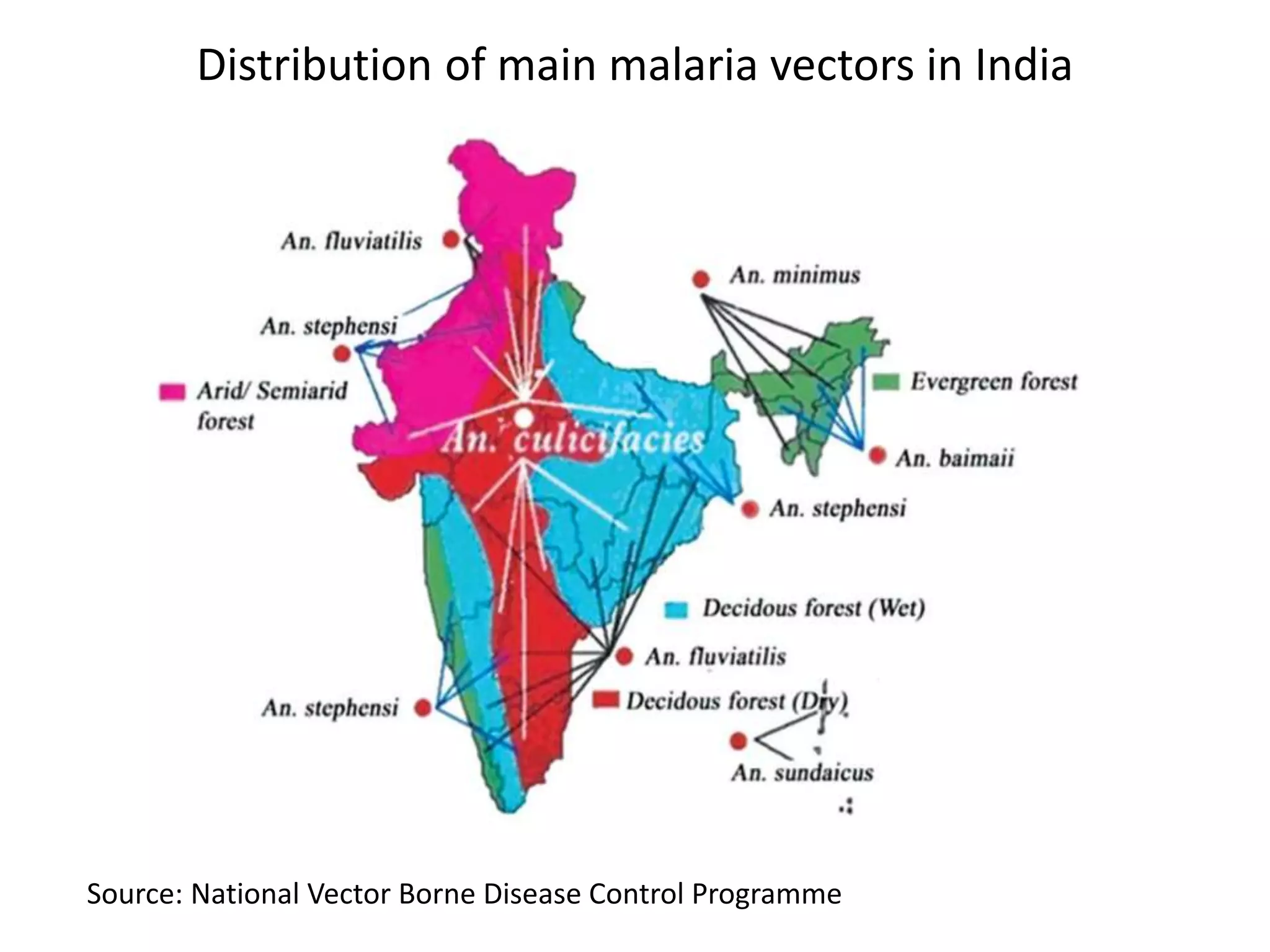
Distribution of main malaria vectors in India
Source: National Vector Borne Disease Control Programme
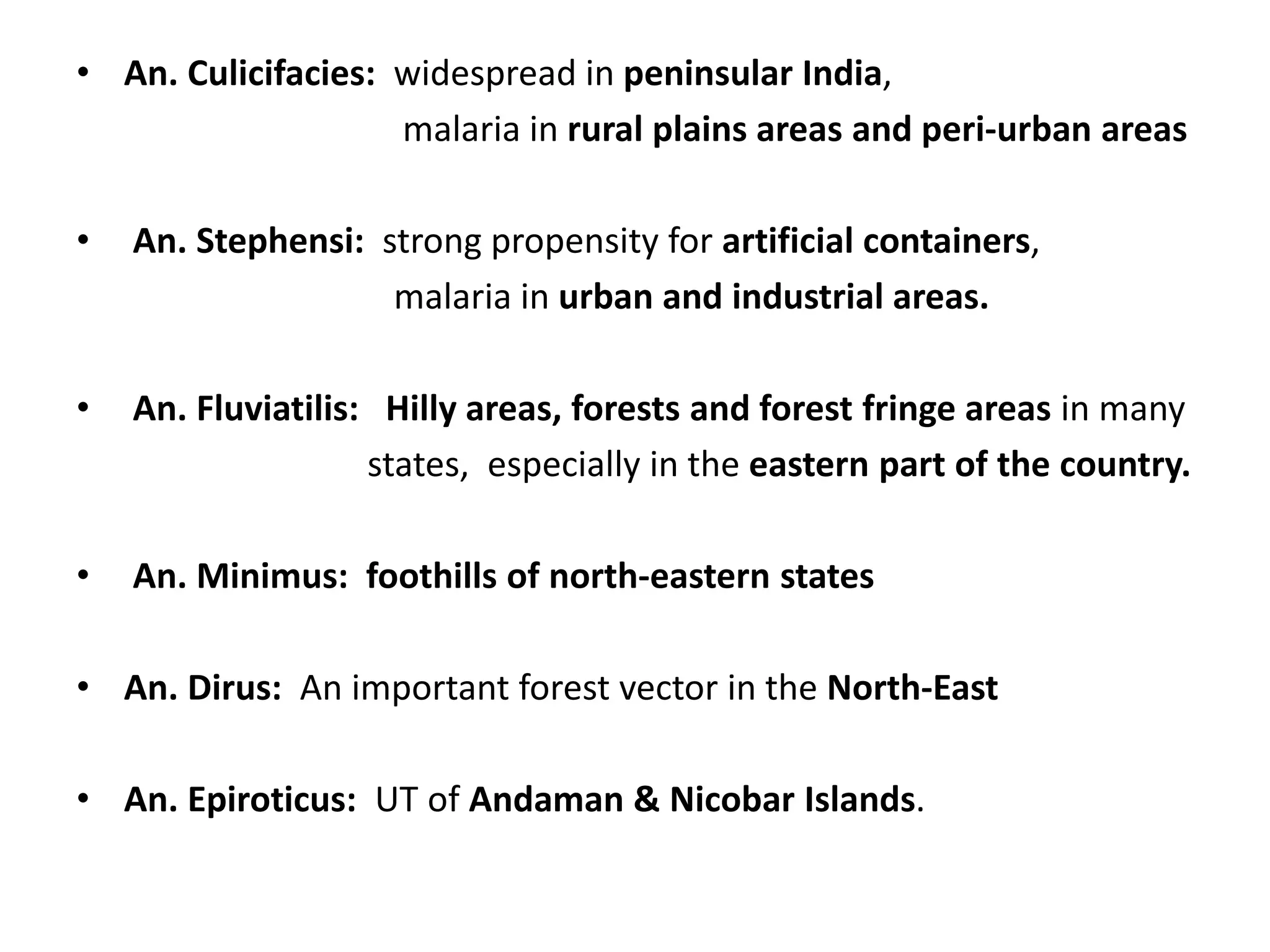
• An. Culicifacies: widespread in peninsular India,
malaria in rural plains areas and peri-urban areas
• An. Stephensi: strong propensity for artificial containers,
malaria in urban and industrial areas.
• An. Fluviatilis: Hilly areas, forests and forest fringe areas in many
states, especially in the eastern part of the country.
• An. Minimus: foothills of north-eastern states
• An. Dirus: An important forest vector in the North-East
• An. Epiroticus: UT of Andaman & Nicobar Islands.
Trend of total malaria cases, Pf and Pv cases and
deaths (2000–2014)
Source: National Vector Borne Disease Control Programme
National Framework for Malaria elimination in
India (2016-2030)
• In line with the WHO Global Technical Strategy for
Malaria 2016–2030 (GTS), the goals of the NFME
in India 2016-2030 are:
 Eliminate malaria (zero indigenous cases) throughout
the entire country by 2030
 Maintain malaria–free status in areas where malaria
transmission has been interrupted and prevent re-
introduction of malaria.
OBJECTIVES
 Eliminate malaria from all 26 low (Category 1) and
moderate (Category 2) transmission states/union territories
(UTs) by 2022
 Reduce the incidence of malaria to less than 1 case per 1000
population per year in all states and UTs and their districts by
2024
 Interrupt indigenous transmission of malaria throughout the
entire country, including all high transmission states and
union territories (UTs) (Category 3) by 2027
 Prevent the re-establishment of local transmission of malaria
in areas where it has been eliminated and maintain national
malaria-free status by 2030 and beyond.
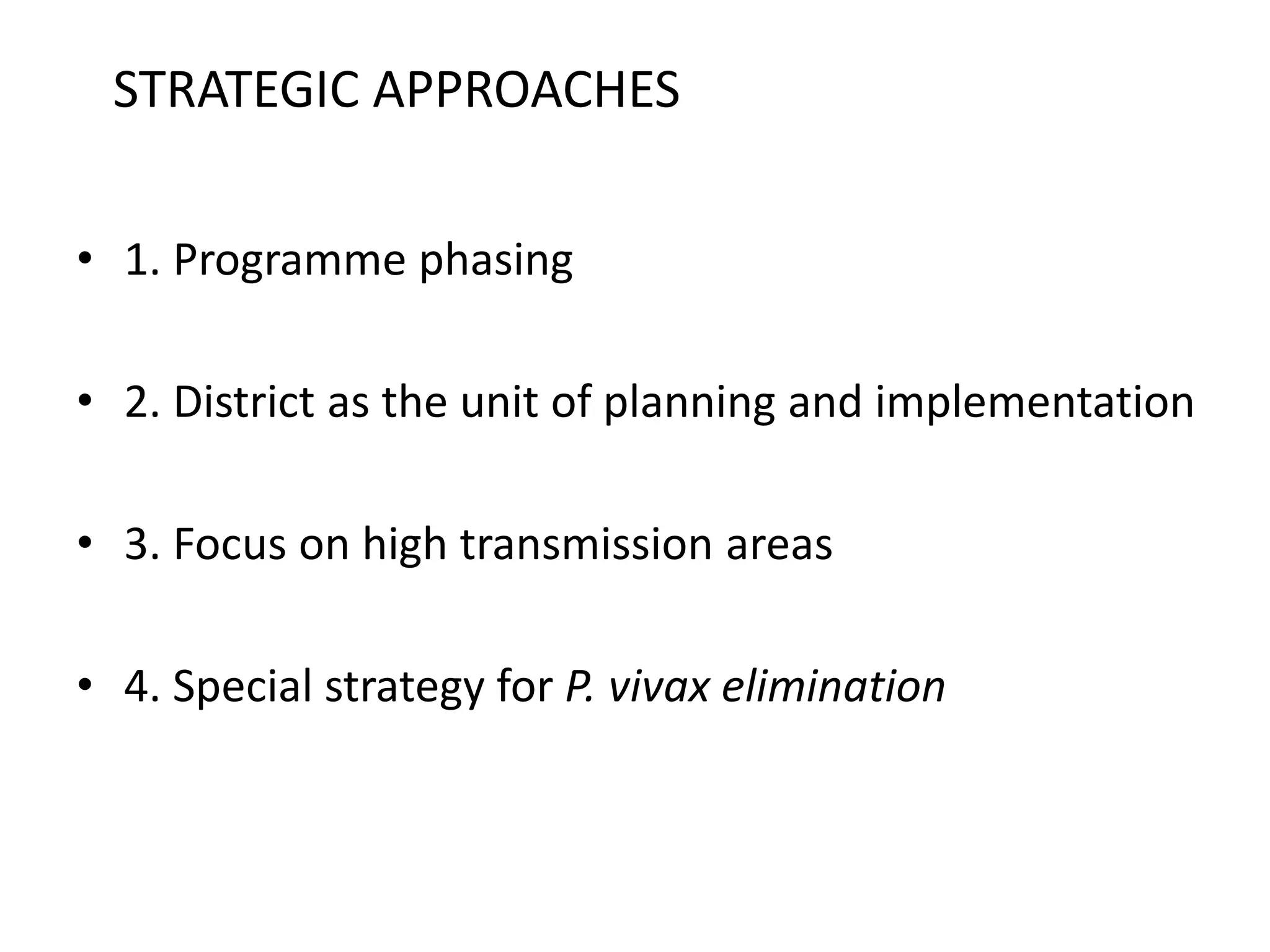
STRATEGIC APPROACHES
• 1. Programme phasing
• 2. District as the unit of planning and implementation
• 3. Focus on high transmission areas
• 4. Special strategy for P. vivax elimination
MILESTONES AND TARGETS
• By end of 2016:
 All states/UTs have included malaria elimination in their
broader health policies and planning frameworks.
• By 2020:
 Transmission of malaria interrupted and zero indigenous cases
and deaths due to malaria attained in all 15 states/UTs under
Category 1 (elimination phase) in 2014 (base year).
 All 11 states/UTs under Category 2 (pre-elimination phase) in
2014 enter into Category 1 (elimination phase).
Contd..
 Five states/UTs under Category 3 (intensified control phase) in
2014 enter into Category 2 (pre-elimination phase).
 Five states/UTs under Category 3 (intensified control phase) in
2014 reduce malaria transmission but continue to remain in
Category 3.
 An estimated reduction in malaria of 15–20% at the national
level compared with 2014.
 Additionally, progressive states with strong health systems
such as Gujarat, Maharashtra and Karnataka may implement
accelerated malaria elimination programmes.
• By 2022
 Transmission of malaria interrupted and zero indigenous cases
and deaths due to malaria attained in all 26 states/UTs that
were under Categories 1 and 2 in 2014.
 Five states/UTs which were under Category 3 (intensified
control phase) in 2014 enter into elimination phase.
 Five states/UTs which were under Category 3 (intensified
control phase) in 2014 enter into pre-elimination phase.
 An estimated reduction in malaria of 30–35% at the national
level compared with 2014.
• By 2024
 All states/UTs and their respective districts reduce API to less
than 1 case per 1000 population at risk and sustain zero
deaths due to malaria
 Transmission of malaria interrupted and zero indigenous cases
and deaths due to malaria attained in all 31 states/UTs.
 Five states/UTs which were under Category 3 (intensified
control phase) in 2014 enter into elimination phase.
• By 2027
 The indigenous transmission of malaria in India interrupted.
• By 2030
 The re-establishment of local transmission prevented in
areas where malaria has been eliminated.
 The malaria-free status maintained throughout the nation.
KEY INTERVENTIONS
• Specific objectives and key interventions in intensified control phase
Specific Objectives Key Interventions
•Achieve universal
Coverage
•Efficient system
•Reduce malaria
specific
morbidity and
mortality.
•Massive scaling up
•Screening
•Classification
• Strengthening
•High risk groups
Specific Objectives Key Interventions
•Contain and
prevent
possible outbreaks of
Malaria
• Emphasize
reducing
malaria morbidity
and mortality in high
transmission pockets
• One-stop centres or mobile clinics on fixed days
in tribal or conflict affected
•Timely referral and treatment of severe malaria
•Strengthening all district and sub district
hospitals in malaria endemic areas
•Establishment of a robust supply chain
management system.
• Equipping all health institutions
Specific objectives and key interventions in elimination phase
Specific Objectives Key Interventions
• Interrupt
transmission of
malaria.
• Immediately
notify each
detected case.
• Detect any
possible
continuation of
malaria
transmission
• Determine the
underlying
causes of residual
•In elimination areas, all efforts will be directed at
interrupting local transmission in all active foci of malaria.
• Mandatory notification of each case
• Investigation and classification of all foci of malaria.
• A strict total coverage of all active foci by effective
vector control measures.
• Early detection and treatment of all cases of malaria
Specific Objectives Key Interventions
•Ensure epidemic
preparedness
• Prevent re
establishment
of local transmission
of malaria.
• Ascertain
elimination of
malaria.
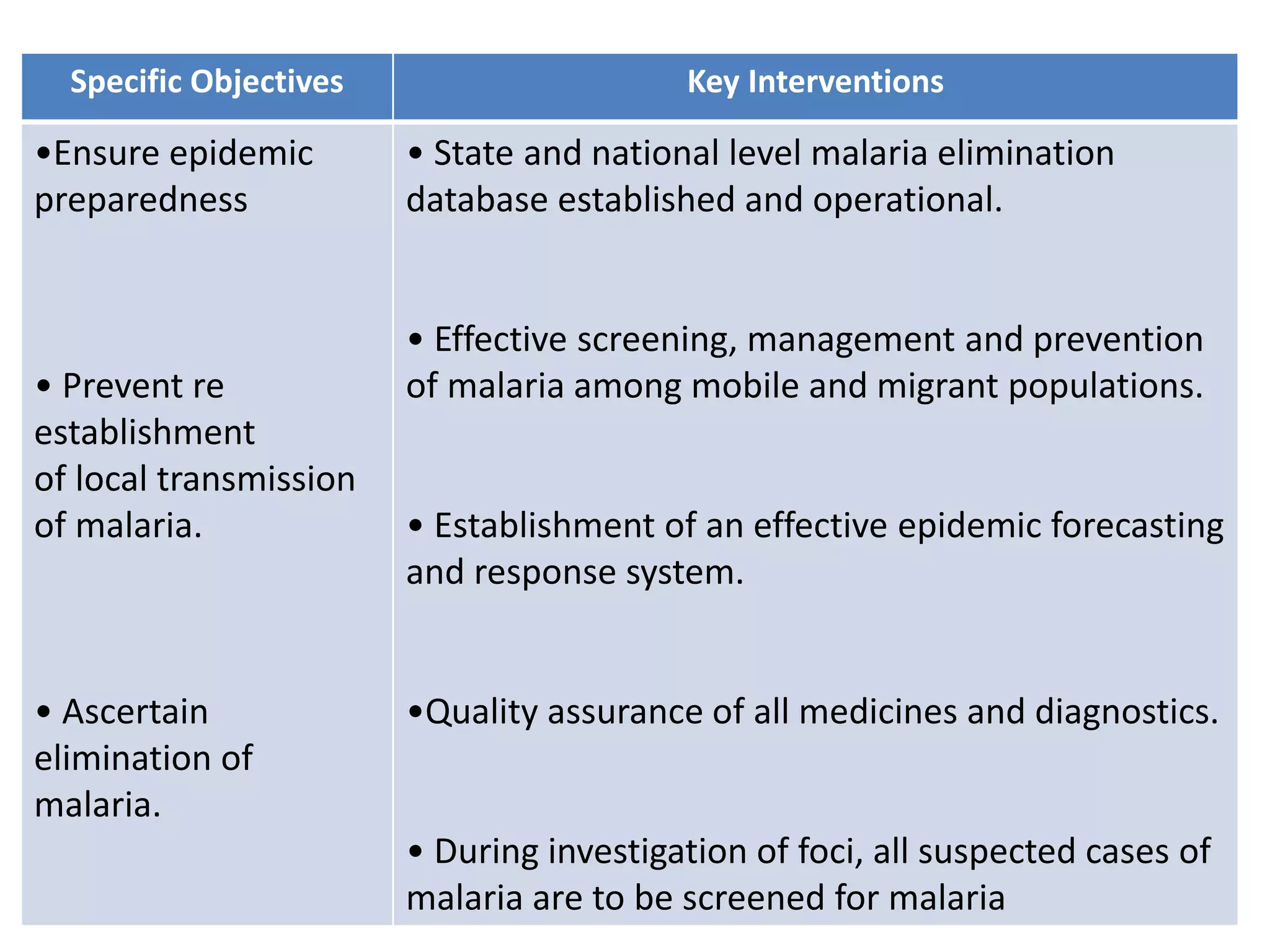
• State and national level malaria elimination
database established and operational.
• Effective screening, management and prevention
of malaria among mobile and migrant populations.
• Establishment of an effective epidemic forecasting
and response system.
•Quality assurance of all medicines and diagnostics.
• During investigation of foci, all suspected cases of
malaria are to be screened for malaria
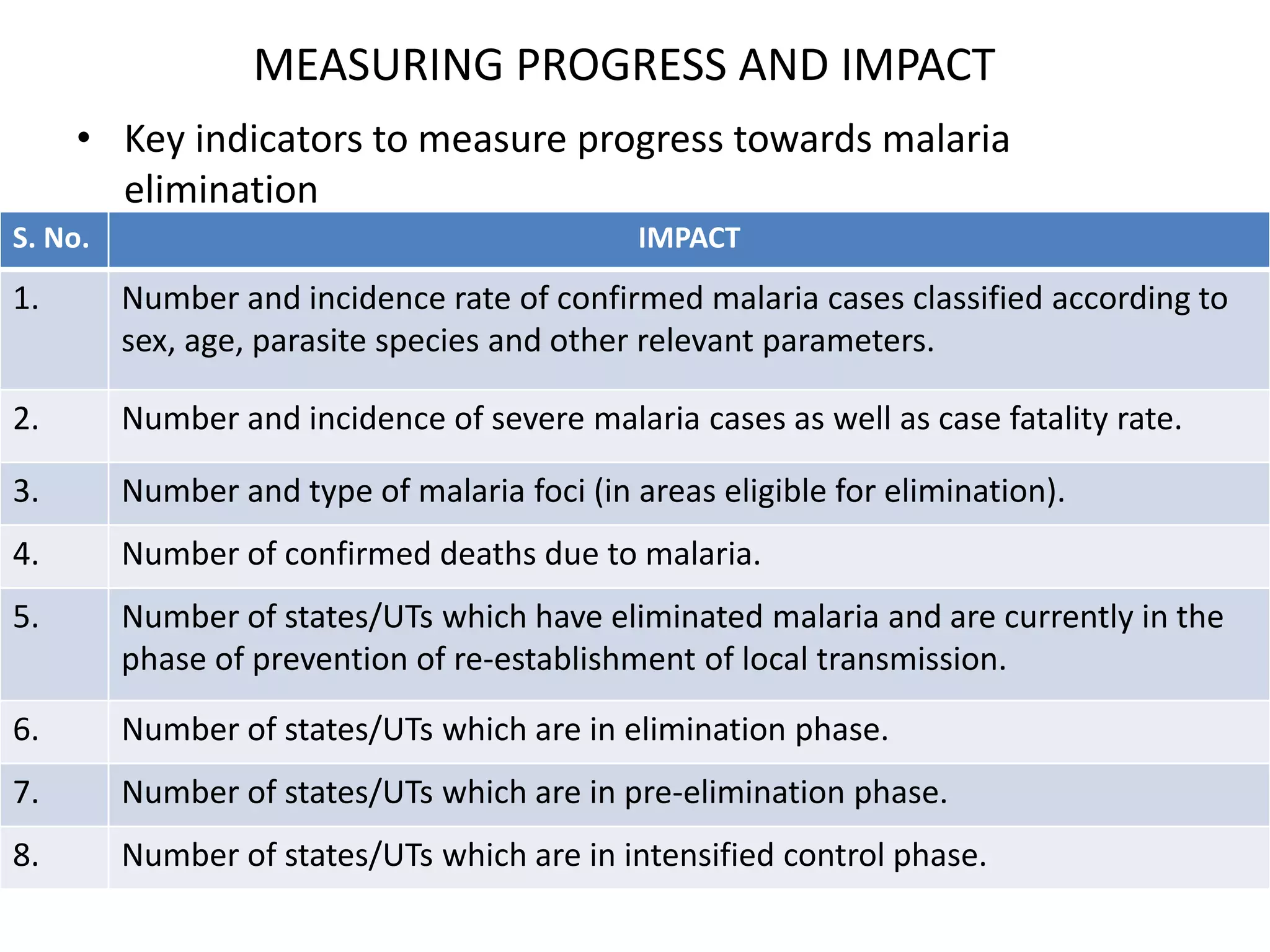
MEASURING PROGRESS AND IMPACT
• Key indicators to measure progress towards malaria
elimination
S. No. IMPACT
1. Number and incidence rate of confirmed malaria cases classified according to
sex, age, parasite species and other relevant parameters.
2. Number and incidence of severe malaria cases as well as case fatality rate.
3. Number and type of malaria foci (in areas eligible for elimination).
4. Number of confirmed deaths due to malaria.
5. Number of states/UTs which have eliminated malaria and are currently in the
phase of prevention of re-establishment of local transmission.
6. Number of states/UTs which are in elimination phase.
7. Number of states/UTs which are in pre-elimination phase.
8. Number of states/UTs which are in intensified control phase.
Contd...
S.No. OUTCOME
10. Proportion of population at risk who slept under an insecticide-treated
net/LLIN the previous night.
11. Proportion of population at risk protected by indoor residual spraying within
the past 12 months.
12. Proportion of patients with confirmed malaria who received anti-malarial
treatment as per national policy.
13. Proportion of cases investigated and classified (in areas eligible for
elimination).
14. Proportion of foci investigated and classified (in areas eligible for
elimination).
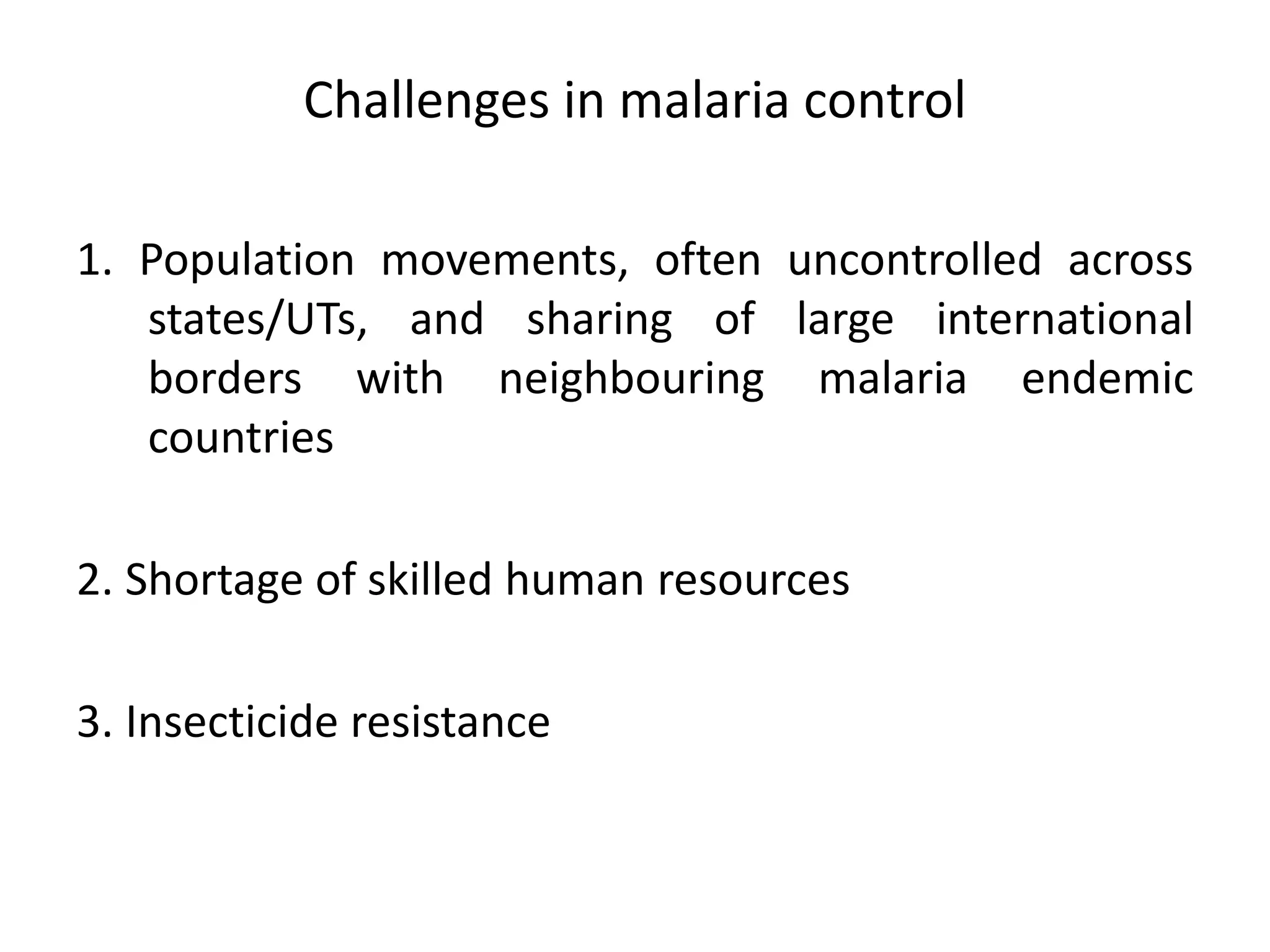
Challenges in malaria control
1. Population movements, often uncontrolled across
states/UTs, and sharing of large international
borders with neighbouring malaria endemic
countries
2. Shortage of skilled human resources
3. Insecticide resistance

Malaria elimination

  • 1.
    NATIONAL FRAMEWORK AND OPERATIONALGUIDELINES FOR MALARIA ELIMINATION Dr. Devendra kumar
  • 2.
    History of malariacontrol in India Year Milestone Before 1940 No organized National Malaria Control Programme Prior to 1953 Estimated malaria cases in India: 75 million; estimated deaths due to malaria: 1 million 1953 Launching of National Malaria Control Programme 1958 Launching of National Malaria Eradication Programme 1965 Cases reduced to 0.1 million
  • 3.
    History of malariacontrol in India Year Milestone Early 1970’s Resurgence of malaria 1971 Urban Malaria Scheme launched 1976 Malaria cases - 6.46 million highest in post DDT era 1977 Modified Plan of Operations (MPO) implemented 1997 World Bank assisted Enhanced Malaria Control Project (EMCP) started
  • 4.
    History of malariacontrol in India Year Milestone 2002 Integration of malaria control progamme into the National Vector Borne Disease Control Programme 2005 RDT (monovalent) introduced in the programme 2005 Intensified Malaria Control Project (IMCP) 2006 ACT introduced in areas showing chloroquine resistance in falciparum 2009 LLIN introduced, oral artemisinin monotherapy banned in the country 2013 RDT (bi-valent) introduced in the programme,
  • 5.
    Epidemiological profile &Current trends of malaria in India • Two major malaria parasites: Plasmodium Falciparum Plasmodium Vivax • Six primary vectors: Anopheles Culicifacies An. Stephensi An. Dirus An. Fluviatilis An. Minimus An. Epiroticus
  • 6.
    Distribution of mainmalaria vectors in India Source: National Vector Borne Disease Control Programme
  • 7.
    • An. Culicifacies:widespread in peninsular India, malaria in rural plains areas and peri-urban areas • An. Stephensi: strong propensity for artificial containers, malaria in urban and industrial areas. • An. Fluviatilis: Hilly areas, forests and forest fringe areas in many states, especially in the eastern part of the country. • An. Minimus: foothills of north-eastern states • An. Dirus: An important forest vector in the North-East • An. Epiroticus: UT of Andaman & Nicobar Islands.
  • 8.
    Trend of totalmalaria cases, Pf and Pv cases and deaths (2000–2014) Source: National Vector Borne Disease Control Programme
  • 9.
    National Framework forMalaria elimination in India (2016-2030) • In line with the WHO Global Technical Strategy for Malaria 2016–2030 (GTS), the goals of the NFME in India 2016-2030 are:  Eliminate malaria (zero indigenous cases) throughout the entire country by 2030  Maintain malaria–free status in areas where malaria transmission has been interrupted and prevent re- introduction of malaria.
  • 10.
    OBJECTIVES  Eliminate malariafrom all 26 low (Category 1) and moderate (Category 2) transmission states/union territories (UTs) by 2022  Reduce the incidence of malaria to less than 1 case per 1000 population per year in all states and UTs and their districts by 2024  Interrupt indigenous transmission of malaria throughout the entire country, including all high transmission states and union territories (UTs) (Category 3) by 2027  Prevent the re-establishment of local transmission of malaria in areas where it has been eliminated and maintain national malaria-free status by 2030 and beyond.
  • 11.
    STRATEGIC APPROACHES • 1.Programme phasing • 2. District as the unit of planning and implementation • 3. Focus on high transmission areas • 4. Special strategy for P. vivax elimination
  • 12.
    MILESTONES AND TARGETS •By end of 2016:  All states/UTs have included malaria elimination in their broader health policies and planning frameworks. • By 2020:  Transmission of malaria interrupted and zero indigenous cases and deaths due to malaria attained in all 15 states/UTs under Category 1 (elimination phase) in 2014 (base year).  All 11 states/UTs under Category 2 (pre-elimination phase) in 2014 enter into Category 1 (elimination phase).
  • 13.
    Contd..  Five states/UTsunder Category 3 (intensified control phase) in 2014 enter into Category 2 (pre-elimination phase).  Five states/UTs under Category 3 (intensified control phase) in 2014 reduce malaria transmission but continue to remain in Category 3.  An estimated reduction in malaria of 15–20% at the national level compared with 2014.  Additionally, progressive states with strong health systems such as Gujarat, Maharashtra and Karnataka may implement accelerated malaria elimination programmes.
  • 14.
    • By 2022 Transmission of malaria interrupted and zero indigenous cases and deaths due to malaria attained in all 26 states/UTs that were under Categories 1 and 2 in 2014.  Five states/UTs which were under Category 3 (intensified control phase) in 2014 enter into elimination phase.  Five states/UTs which were under Category 3 (intensified control phase) in 2014 enter into pre-elimination phase.  An estimated reduction in malaria of 30–35% at the national level compared with 2014.
  • 15.
    • By 2024 All states/UTs and their respective districts reduce API to less than 1 case per 1000 population at risk and sustain zero deaths due to malaria  Transmission of malaria interrupted and zero indigenous cases and deaths due to malaria attained in all 31 states/UTs.  Five states/UTs which were under Category 3 (intensified control phase) in 2014 enter into elimination phase.
  • 16.
    • By 2027 The indigenous transmission of malaria in India interrupted. • By 2030  The re-establishment of local transmission prevented in areas where malaria has been eliminated.  The malaria-free status maintained throughout the nation.
  • 17.
    KEY INTERVENTIONS • Specificobjectives and key interventions in intensified control phase Specific Objectives Key Interventions •Achieve universal Coverage •Efficient system •Reduce malaria specific morbidity and mortality. •Massive scaling up •Screening •Classification • Strengthening •High risk groups
  • 18.
    Specific Objectives KeyInterventions •Contain and prevent possible outbreaks of Malaria • Emphasize reducing malaria morbidity and mortality in high transmission pockets • One-stop centres or mobile clinics on fixed days in tribal or conflict affected •Timely referral and treatment of severe malaria •Strengthening all district and sub district hospitals in malaria endemic areas •Establishment of a robust supply chain management system. • Equipping all health institutions
  • 19.
    Specific objectives andkey interventions in elimination phase Specific Objectives Key Interventions • Interrupt transmission of malaria. • Immediately notify each detected case. • Detect any possible continuation of malaria transmission • Determine the underlying causes of residual •In elimination areas, all efforts will be directed at interrupting local transmission in all active foci of malaria. • Mandatory notification of each case • Investigation and classification of all foci of malaria. • A strict total coverage of all active foci by effective vector control measures. • Early detection and treatment of all cases of malaria
  • 20.
    Specific Objectives KeyInterventions •Ensure epidemic preparedness • Prevent re establishment of local transmission of malaria. • Ascertain elimination of malaria. • State and national level malaria elimination database established and operational. • Effective screening, management and prevention of malaria among mobile and migrant populations. • Establishment of an effective epidemic forecasting and response system. •Quality assurance of all medicines and diagnostics. • During investigation of foci, all suspected cases of malaria are to be screened for malaria
  • 21.
    MEASURING PROGRESS ANDIMPACT • Key indicators to measure progress towards malaria elimination S. No. IMPACT 1. Number and incidence rate of confirmed malaria cases classified according to sex, age, parasite species and other relevant parameters. 2. Number and incidence of severe malaria cases as well as case fatality rate. 3. Number and type of malaria foci (in areas eligible for elimination). 4. Number of confirmed deaths due to malaria. 5. Number of states/UTs which have eliminated malaria and are currently in the phase of prevention of re-establishment of local transmission. 6. Number of states/UTs which are in elimination phase. 7. Number of states/UTs which are in pre-elimination phase. 8. Number of states/UTs which are in intensified control phase.
  • 22.
    Contd... S.No. OUTCOME 10. Proportionof population at risk who slept under an insecticide-treated net/LLIN the previous night. 11. Proportion of population at risk protected by indoor residual spraying within the past 12 months. 12. Proportion of patients with confirmed malaria who received anti-malarial treatment as per national policy. 13. Proportion of cases investigated and classified (in areas eligible for elimination). 14. Proportion of foci investigated and classified (in areas eligible for elimination).
  • 23.
    Challenges in malariacontrol 1. Population movements, often uncontrolled across states/UTs, and sharing of large international borders with neighbouring malaria endemic countries 2. Shortage of skilled human resources 3. Insecticide resistance