SOWING
PROSPERITY :
BOOSTING
AGRICULTURE
PRODUCTION
AMIT SIHAG 9627965015
SHUBHAM AGARWAL 7275349139
ANUJ KUMAR AGARAWAL 9530492612
SAURABH KUMAR GUPTA 8410610839
SIDDHARTH GUPTA 8126833043(TEAM CO-ORDINATOR)
EMAIL ID: siddharth869@gmail.com
PROBLEMS
Lack of Agricultural
education and awareness
Obsolete machinery &
farming technology
Inadequate irrigation
facilities
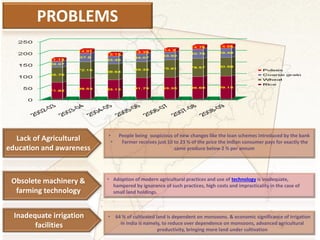
• People being suspicious of new changes like the loan schemes introduced by the bank
• Farmer receives just 10 to 23 % of the price the Indian consumer pays for exactly the
same produce below 2 % per annum
• Adoption of modern agricultural practices and use of technology is inadequate,
hampered by ignorance of such practices, high costs and impracticality in the case of
small land holdings.
• 64 % of cultivated land is dependent on monsoons. & economic significance of irrigation
in India is namely, to reduce over dependence on monsoons, advanced agricultural
productivity, bringing more land under cultivation
Unstable policies of
government
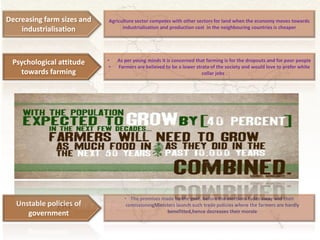
• The promises made by the govt. before the elections fades away wid their
comissioningMinisters launch such trade policies where the farmers are hardly
benefitted,hence decreases their morale
Psychological attitude
towards farming
Agriculture sector competes with other sectors for land when the economy moves towards
industrialisation and production cost in the neighbouring countries is cheaper
Decreasing farm sizes and
industrialisation
• As per young minds it is concerned that farming is for the dropouts and for poor people
• Farmers are believed to be a lower strata of the society and would love to prefer white
collar jobs .
Encourage private
sector investment:
introduced several incentives
example, by encouraging the
production of quality and safe
product
onnecting geographically
dispersed people and enhance
two-way communication.
Farmer knowledge:
Establish national network
for demonstration &
training like Central training
institutes, Satellite training
institutes, Farm Schools
Develop , E-farming --
deliver expert advice &
training via rural knowledge
centres
Reorient Agricultral
Colleges to focus on
Production
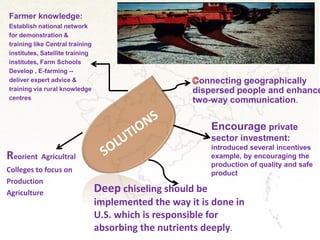
Agriculture Deep chiseling should be
implemented the way it is done in
U.S. which is responsible for
absorbing the nutrients deeply.
Doubling or tripling
productivity per unit
area : can reduce the
cost per unit of
agricultural produce to
enhance farm incomes
and promote
international
competitiveness.
Doubling or tripling
farmer income by
balancing plant
nutrients in the soil to
optimize plant intake
of applied fertilisers,
safeguarding the
environment and
reducing soil
degradation.
Doubling or tripling water
use efficiency and reducing
salinization of irrigated
lands through land
preparation techniques that
harvest rainwater on
millions of acre while
reducing waste of irrigated
water.
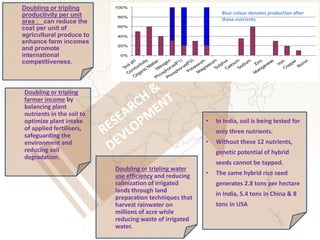
• In India, soil is being tested for
only three nutrients.
• Without these 12 nutrients,
genetic potential of hybrid
seeds cannot be tapped.
• The same hybrid rice seed
generates 2.8 tons per hectare
in India, 5.4 tons in China & 8
tons in USA
0%
20%
40%
60%
80%
100%
S
oilpH
C
onductivity
O
rganic
M
atterN
itrogen
P
hosphorus(P
1)
P
hosphorus(P
2)
P
otassium
M
agnesiumS
ulphurC
alciumS
odium
Zinc
M
anganese
IronC
opper
B
oron
Blue colour denotes production after
these nutrients
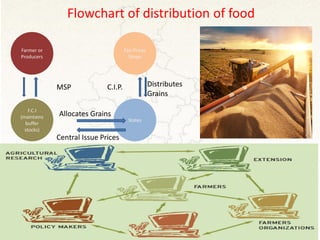
Farmer or
Producers
F.C.I
(maintains
buffer
stocks)
States
Fair Prices
Shops
MSP C.I.P. Distributes
Grains
Allocates Grains
Central Issue Prices
Flowchart of distribution of food
• Strong linkage between research and field implementation &Easy
access of agricultural information
• These reduction in percentage of the workforce obviously that
employment in the agriculture sector contracted due to the increased use
of labour-saving technologies, thus causing labour shortage as local
labour force moved into economic sector for higher wages
• the beginning of mechanization in the sector and improved farm
management
• increaseS job opportunities and created alternative sources of income.
However, the total employment in the agricultural sector declined over
the years while those in manufacturing increased.
• Meets the Future Food Demands like Increase efficiency ,Produce more
food with same resources ,Conserve more natural, Produce a product
that is more affordable around the globe, Improve the lives of farmers
Profitability
IMAPCT OF PROPOSED SOLUTIONS
Challenges
2.Using electrical machines with advanced
technology instead of manpower and the
work is out with the to carried concern of
the old residents of the village who have the
knowledge of the soil affecting factors and
the land usage pattern.
1.Expensive equipments will be
imported which is a major issue
because it invoves buying of
equipments as per the dealer’s
choice along with paying different
kind of taxes
3.money must be invested by the
government in the field of
biotechnology by decreasing the
amount of investment done in the
production of artificial fertilisers and
pesticides and must replace them by
organic chemicals like in Europe
R&D is mandatory .
5.average age of living of the
farmers have reduced to 55 years
and concsecutively the suicides
have increased and hence we need
to put a strict measure by opening
small organisations consisting of
people from all the villages in india
4.Education no doubt is the backbone for a
developing country like us having thousands
of natural resources to be harnessed for a
better living where these days youth have
started refraining themselves from joining
agricultural institutes and stepping into R&D,
therefore NGO’s along with the industrialists
of our nation.
6.We must talk to IMF, World bank and
countries to libeaalise our agricultural
import and to give us subudies & provide
marketing assistance to our farmers.
REFERENCES
agroworld123

agroworld123

  • 1.
    SOWING PROSPERITY : BOOSTING AGRICULTURE PRODUCTION AMIT SIHAG9627965015 SHUBHAM AGARWAL 7275349139 ANUJ KUMAR AGARAWAL 9530492612 SAURABH KUMAR GUPTA 8410610839 SIDDHARTH GUPTA 8126833043(TEAM CO-ORDINATOR) EMAIL ID: siddharth869@gmail.com
  • 2.
    PROBLEMS Lack of Agricultural educationand awareness Obsolete machinery & farming technology Inadequate irrigation facilities • People being suspicious of new changes like the loan schemes introduced by the bank • Farmer receives just 10 to 23 % of the price the Indian consumer pays for exactly the same produce below 2 % per annum • Adoption of modern agricultural practices and use of technology is inadequate, hampered by ignorance of such practices, high costs and impracticality in the case of small land holdings. • 64 % of cultivated land is dependent on monsoons. & economic significance of irrigation in India is namely, to reduce over dependence on monsoons, advanced agricultural productivity, bringing more land under cultivation
  • 3.
    Unstable policies of government •The promises made by the govt. before the elections fades away wid their comissioningMinisters launch such trade policies where the farmers are hardly benefitted,hence decreases their morale Psychological attitude towards farming Agriculture sector competes with other sectors for land when the economy moves towards industrialisation and production cost in the neighbouring countries is cheaper Decreasing farm sizes and industrialisation • As per young minds it is concerned that farming is for the dropouts and for poor people • Farmers are believed to be a lower strata of the society and would love to prefer white collar jobs .
  • 4.
    Encourage private sector investment: introducedseveral incentives example, by encouraging the production of quality and safe product onnecting geographically dispersed people and enhance two-way communication. Farmer knowledge: Establish national network for demonstration & training like Central training institutes, Satellite training institutes, Farm Schools Develop , E-farming -- deliver expert advice & training via rural knowledge centres Reorient Agricultral Colleges to focus on Production Agriculture Deep chiseling should be implemented the way it is done in U.S. which is responsible for absorbing the nutrients deeply.
  • 5.
    Doubling or tripling productivityper unit area : can reduce the cost per unit of agricultural produce to enhance farm incomes and promote international competitiveness. Doubling or tripling farmer income by balancing plant nutrients in the soil to optimize plant intake of applied fertilisers, safeguarding the environment and reducing soil degradation. Doubling or tripling water use efficiency and reducing salinization of irrigated lands through land preparation techniques that harvest rainwater on millions of acre while reducing waste of irrigated water. • In India, soil is being tested for only three nutrients. • Without these 12 nutrients, genetic potential of hybrid seeds cannot be tapped. • The same hybrid rice seed generates 2.8 tons per hectare in India, 5.4 tons in China & 8 tons in USA 0% 20% 40% 60% 80% 100% S oilpH C onductivity O rganic M atterN itrogen P hosphorus(P 1) P hosphorus(P 2) P otassium M agnesiumS ulphurC alciumS odium Zinc M anganese IronC opper B oron Blue colour denotes production after these nutrients
  • 6.
    Farmer or Producers F.C.I (maintains buffer stocks) States Fair Prices Shops MSPC.I.P. Distributes Grains Allocates Grains Central Issue Prices Flowchart of distribution of food
  • 8.
    • Strong linkagebetween research and field implementation &Easy access of agricultural information • These reduction in percentage of the workforce obviously that employment in the agriculture sector contracted due to the increased use of labour-saving technologies, thus causing labour shortage as local labour force moved into economic sector for higher wages • the beginning of mechanization in the sector and improved farm management • increaseS job opportunities and created alternative sources of income. However, the total employment in the agricultural sector declined over the years while those in manufacturing increased. • Meets the Future Food Demands like Increase efficiency ,Produce more food with same resources ,Conserve more natural, Produce a product that is more affordable around the globe, Improve the lives of farmers Profitability IMAPCT OF PROPOSED SOLUTIONS
  • 9.
    Challenges 2.Using electrical machineswith advanced technology instead of manpower and the work is out with the to carried concern of the old residents of the village who have the knowledge of the soil affecting factors and the land usage pattern. 1.Expensive equipments will be imported which is a major issue because it invoves buying of equipments as per the dealer’s choice along with paying different kind of taxes 3.money must be invested by the government in the field of biotechnology by decreasing the amount of investment done in the production of artificial fertilisers and pesticides and must replace them by organic chemicals like in Europe R&D is mandatory . 5.average age of living of the farmers have reduced to 55 years and concsecutively the suicides have increased and hence we need to put a strict measure by opening small organisations consisting of people from all the villages in india 4.Education no doubt is the backbone for a developing country like us having thousands of natural resources to be harnessed for a better living where these days youth have started refraining themselves from joining agricultural institutes and stepping into R&D, therefore NGO’s along with the industrialists of our nation. 6.We must talk to IMF, World bank and countries to libeaalise our agricultural import and to give us subudies & provide marketing assistance to our farmers.
  • 10.