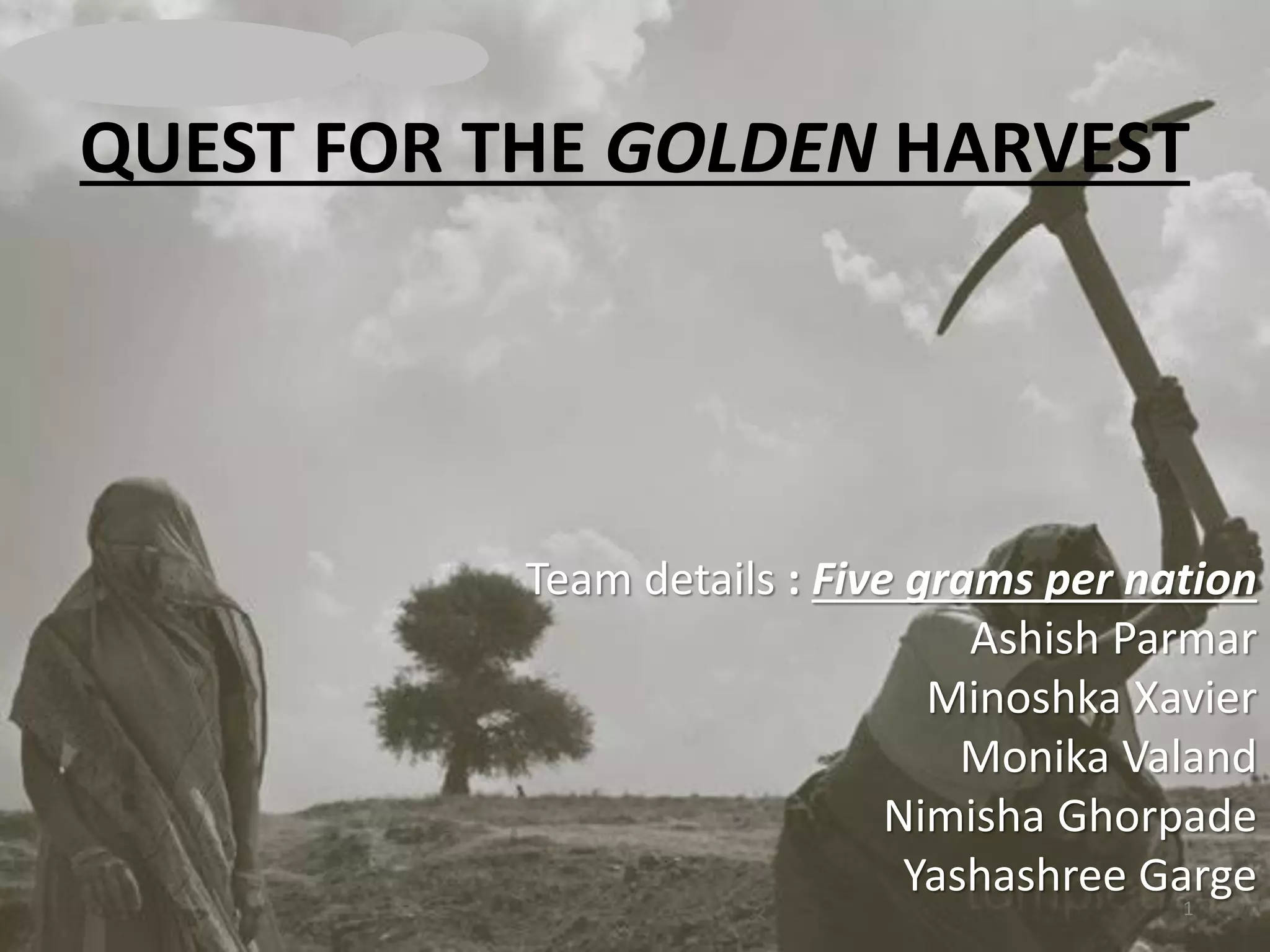
QUEST FOR THE GOLDEN HARVEST
Team details : Five grams per nation
Ashish Parmar
Minoshka Xavier
Monika Valand
Nimisha Ghorpade
Yashashree Garge
1
•India is termed as “Bhumivargaha” i.e. gifted land in Sanskrit.
• Yet agricultures contribution is 17.4% (2012)1 in the
total GDP.
Resource management Farmer Empowerment Balanced Economy
PROBLEMS •Fragmented land practices and
reduction in land productivity
•Lack of water availability and
unsustainable water exploitation
practices
•Maximum no. of unemployed
agricultural graduates.
•Stunted awareness among farmers on
recent developments in the field of
agriculture.
•Loopholes in economic structure where
producer’s prices and consumer prices
•Inadequate MSP and Market availability
to marginal and FTI farmers.
REASON •60-70 % of Indian farmers have <1 ha
per holding land ,
•Total area under degradation is 105.48
mha(32.7%) .
•70% of the irrigation water is wasted.
•An estimated 29.4 million ha of Indian
soil is experiencing a decline in fertility
•55 crore farmers.
•90-95% are illiterate , technologically
unaided and practice unsound methods
of cultivation .
•More than 50% of rural population is
opting out of agriculture.
•Imbalanced price factors
•investment in infrastructure;
•inputs including credit and technology
• domestic and international trade
reforms
•Diversification
•marketing and rural non-farm sector.
WHY? Risk and failures in implementing
policies in improvising the production.
Major baseline deficit in building a
sustainable agricultural network and
model
Average income and profit
discrimination in policies and decline in
the net GDP
2
Sustainable agriculture by
integrated co-operative and corporate system
Integrated
C&C System
What is it?
Advantages
•Agricultural management system (AMS) based on a corporate model
of hierarchy where at each level micro co-operative network is formed
between the involved stakeholders.
•Equity and economic reforms policy specific to guild of stakeholders at
the grassroots level of farmers to the consumer base.
•“ Seed to sell “ concept.
•Reduced mediation and ambiguity.
•Enhanced per capita production and average income
•Increased employment
•Transparent networks of PDS
Integrated management practices
•Resource management -Scientific methodologies and Co-operative
agrarian system.
•Farmer empowerment – concerted awareness and technical- social
skill set development.
•Balanced economy – providing entrepreneurship to farmers and
transparent universal PDS.
3
Integrated Corporate model Cooperative
Systems.
Resource
management
• Channelizing
resources-
adoption of crop
specificity.
• Micro seed bank-
community and
land reform agro
cooperative.
• Agro scientific
workshop &
community centre.
Farmer
empowerment
• Innovation
schemes-
agricultural setup
• Portals & help
lines; booklets and
placards in local
language
• Concept based
workshops for
farmers and youth
volunteer network
Balanced economy
• Marketing and
distribution
interstate and intra
state
• Quarterly
subsidiary system
& sharing of
resources
• Setup of markets
and consumption
units.
CENTRAL
STATE AND
DISTRICT
GRASS ROOT
“FARM BASED”
4
Elucidating the concepts
Community
shareholder
Agro
entrepreneur-
ship
Righteous
market
strategies
Key-steps
Conquering
Barriers
• Land use pattern
• Soil fertility
• Watershed
Management
• Seed cultures
• Issuing health
cards
• Sharing of profits
• Judicious use of
resources like
water and energy
• Easier to conduct
Agro-Audits
• Makes farmers
independent
• More inflow of
liquid cash for
better
agricultural
technology
• Developing a link
between ‘farm to
fork’
• Sequestering
middlemen and
private traders
5
Agro branding. Micro Scale C&C
Cooperative patency Royalty on every
product
Indigenous
techniques.
Scientific
methodologies
Target based production
and sales
Providing Agro credits for
consumers by using agro
credit cards.
Common irrigation
techniques- drip , pot,
trickling etc.
Creating a database that is
also available in the local
language and making
farmers scientifically sound.
Quarterly sales programs Extending SHG programs. Vayalagam concept–
maintains the use of village
water tank.
Providing in-house expertise.
Appointing Sales
representatives-rural
entrepreneurship
Merchandising Redirecting cannel to ground
water recharge by using rain
harvesting techniques.
Agricultural hotspots-
maximum cultivation in a
particular area, thus acting
as a climate change mitigate.
Direct approach forming
urban rural consumption
units.
Globalizing the agro brand
on a national portal.
Cluster farming- land sharing
reforms for vegetation.
Green laboratories- quarterly
testing for local agricultural
parameters e.g. Seed, soil
,water.
Agricultural labor boosting
round the year.
Eco labeled products will get
leverages.
Companion cropping (Mixed
cropping) system & grassland
cultivation on farm
boundaries and
barren/waste lands.
Drop box concept- sharing
innovative agricultural
progressive ideas on the
world wide web.
6
Leveraging financial aid.
•Leveraging existing government infrastructure.
•Financial human resources, requirement and statistics
•Incentives for cluster farming
•Land reclamation- through grassland and weed cultivation.
•Amends in APMC act that doesn’t not allow market member and producers direct
interaction with their consumers.
•C&C concept should help in bringing domestic market reforms.
•Reduction of fertilizer subsidies and mass production of organic fertilizers.
•Low investment in crop maintenances.
•Land convergence will transform marginal farmers in to higher stake holders.
•Reduction in crop loss due to banning of chemical pesticides
•Proposed sources for funding
7
Impact
Criteria
ScalabilitySustainability
Monitoring
Impact:
•Increases storage facilities.
•Improves quality of transport.
Criteria:
•Maintains the productivity and the yield.
•Better living for farmers and their family.
Scalability:
• From local to central i.e. from community to national
level implementation.
•Interaction between farmers on a national level.
Sustainability:
• Reduces the use of pesticides by using methods of
organic farming.
•Cluster farming act as carbon sinks, thus giving rise to
“agro villages” , thus being environmentally sound.
Monitoring:
•Steady growth in GDP will be observed on quarterly
bases
•Implementation of feedback obtained from drop box
from various areas.
8
•Socio- economic and political challenges.
•Land ceiling act and land acquisition act bars the progress of small and marginal
farmers. Risk and failed strategies in crop insurance policies.
•Blocked liquidity between FPO and private producers and the direct buyers.
•Discrepancy in loan waivers and heavy pricing in procuring of seeds an fertilizers.
•Traders and middlemen exploit the SMFs .
•At all India level, the share of formal source varies from 22.6% to 58% for small and
marginal farmers while it varies from 65 to 68% for medium to large farmers.
•The policies of huge subsidies and protection policies by developed countries have
negative effects on small holding farmers in developing countries.
Challenges
9
•Modern techniques to glamorize the agro industries.
•Economic liberalization and decentralization aiding farmers with technological skills.
•Network for distance learning so as rural enterprises can become internationally
compatible.
• The rural youth is targeted though technical education innovative employment and
entrepreneurship.
•Increasing demand supply ratio reaching out to rural and urban markets.
•Reduction of heavy prices and inflation .
•Wastage of excessive production and storage issues can be managed.
•Over grazing forest grazing can be minimized through grassland cultivation.
•Exploiting IPR, MSPs ,NFSM, RKVY, and FCI and other agricultural programmers can be
integrated under this concept.
Mitigations
10
Present v/s future
• Increasing average income of
agricultural stakeholders and SMF’s
will be targeted through Integrated
C&C practices.
• Capitalizing on the agricultural
scientific advances and overcoming
mediation and fiscal deficit can be
the agenda for the next five year plan
providing such a holistic perspective.
• Agricultural employment at the moment
is 72% according to WB database
• The current share of agriculture in GDP
growth is 4.8% in the 1st quarter of 2012-
2013
• Net income of SMF which form 84 % of
total farmers, their average income is
only Rs. 1818/per month from all source.
where as their total expenditure is
coming to about Rs. 2678 per month.
11
References
• 1 world data bank
• India: Issues and Priorities for Agriculture-http://www.worldbank.org
• Guidelines for National Agriculture Development Programme (NADP)
Rashtriya Krishi Vikas Yojana (RKVY) Department of Agriculture &
Cooperation Ministry of Agriculture Government of India
• The state of small scale farming in the developing world-
http://www.ifad.org
• Small Farmers in India: Challenges and Opportunities - S.Mahendra Dev,
Indira Gandhi Institute of Development Research, Mumbai,June 2012
• DIVERSIFICATION OF SMALL FARMS IN INDIA : PROBLEMS AND PROSPECTS
(Theme Paper) by Dr. T. Haque,National Centre for Agricultural Economics
and Policy Research, New Delhi
• Images: Corbis.com
12

5gramspernation

  • 1.
    QUEST FOR THEGOLDEN HARVEST Team details : Five grams per nation Ashish Parmar Minoshka Xavier Monika Valand Nimisha Ghorpade Yashashree Garge 1
  • 2.
    •India is termedas “Bhumivargaha” i.e. gifted land in Sanskrit. • Yet agricultures contribution is 17.4% (2012)1 in the total GDP. Resource management Farmer Empowerment Balanced Economy PROBLEMS •Fragmented land practices and reduction in land productivity •Lack of water availability and unsustainable water exploitation practices •Maximum no. of unemployed agricultural graduates. •Stunted awareness among farmers on recent developments in the field of agriculture. •Loopholes in economic structure where producer’s prices and consumer prices •Inadequate MSP and Market availability to marginal and FTI farmers. REASON •60-70 % of Indian farmers have <1 ha per holding land , •Total area under degradation is 105.48 mha(32.7%) . •70% of the irrigation water is wasted. •An estimated 29.4 million ha of Indian soil is experiencing a decline in fertility •55 crore farmers. •90-95% are illiterate , technologically unaided and practice unsound methods of cultivation . •More than 50% of rural population is opting out of agriculture. •Imbalanced price factors •investment in infrastructure; •inputs including credit and technology • domestic and international trade reforms •Diversification •marketing and rural non-farm sector. WHY? Risk and failures in implementing policies in improvising the production. Major baseline deficit in building a sustainable agricultural network and model Average income and profit discrimination in policies and decline in the net GDP 2
  • 3.
    Sustainable agriculture by integratedco-operative and corporate system Integrated C&C System What is it? Advantages •Agricultural management system (AMS) based on a corporate model of hierarchy where at each level micro co-operative network is formed between the involved stakeholders. •Equity and economic reforms policy specific to guild of stakeholders at the grassroots level of farmers to the consumer base. •“ Seed to sell “ concept. •Reduced mediation and ambiguity. •Enhanced per capita production and average income •Increased employment •Transparent networks of PDS Integrated management practices •Resource management -Scientific methodologies and Co-operative agrarian system. •Farmer empowerment – concerted awareness and technical- social skill set development. •Balanced economy – providing entrepreneurship to farmers and transparent universal PDS. 3
  • 4.
    Integrated Corporate modelCooperative Systems. Resource management • Channelizing resources- adoption of crop specificity. • Micro seed bank- community and land reform agro cooperative. • Agro scientific workshop & community centre. Farmer empowerment • Innovation schemes- agricultural setup • Portals & help lines; booklets and placards in local language • Concept based workshops for farmers and youth volunteer network Balanced economy • Marketing and distribution interstate and intra state • Quarterly subsidiary system & sharing of resources • Setup of markets and consumption units. CENTRAL STATE AND DISTRICT GRASS ROOT “FARM BASED” 4
  • 5.
    Elucidating the concepts Community shareholder Agro entrepreneur- ship Righteous market strategies Key-steps Conquering Barriers •Land use pattern • Soil fertility • Watershed Management • Seed cultures • Issuing health cards • Sharing of profits • Judicious use of resources like water and energy • Easier to conduct Agro-Audits • Makes farmers independent • More inflow of liquid cash for better agricultural technology • Developing a link between ‘farm to fork’ • Sequestering middlemen and private traders 5
  • 6.
    Agro branding. MicroScale C&C Cooperative patency Royalty on every product Indigenous techniques. Scientific methodologies Target based production and sales Providing Agro credits for consumers by using agro credit cards. Common irrigation techniques- drip , pot, trickling etc. Creating a database that is also available in the local language and making farmers scientifically sound. Quarterly sales programs Extending SHG programs. Vayalagam concept– maintains the use of village water tank. Providing in-house expertise. Appointing Sales representatives-rural entrepreneurship Merchandising Redirecting cannel to ground water recharge by using rain harvesting techniques. Agricultural hotspots- maximum cultivation in a particular area, thus acting as a climate change mitigate. Direct approach forming urban rural consumption units. Globalizing the agro brand on a national portal. Cluster farming- land sharing reforms for vegetation. Green laboratories- quarterly testing for local agricultural parameters e.g. Seed, soil ,water. Agricultural labor boosting round the year. Eco labeled products will get leverages. Companion cropping (Mixed cropping) system & grassland cultivation on farm boundaries and barren/waste lands. Drop box concept- sharing innovative agricultural progressive ideas on the world wide web. 6
  • 7.
    Leveraging financial aid. •Leveragingexisting government infrastructure. •Financial human resources, requirement and statistics •Incentives for cluster farming •Land reclamation- through grassland and weed cultivation. •Amends in APMC act that doesn’t not allow market member and producers direct interaction with their consumers. •C&C concept should help in bringing domestic market reforms. •Reduction of fertilizer subsidies and mass production of organic fertilizers. •Low investment in crop maintenances. •Land convergence will transform marginal farmers in to higher stake holders. •Reduction in crop loss due to banning of chemical pesticides •Proposed sources for funding 7
  • 8.
    Impact Criteria ScalabilitySustainability Monitoring Impact: •Increases storage facilities. •Improvesquality of transport. Criteria: •Maintains the productivity and the yield. •Better living for farmers and their family. Scalability: • From local to central i.e. from community to national level implementation. •Interaction between farmers on a national level. Sustainability: • Reduces the use of pesticides by using methods of organic farming. •Cluster farming act as carbon sinks, thus giving rise to “agro villages” , thus being environmentally sound. Monitoring: •Steady growth in GDP will be observed on quarterly bases •Implementation of feedback obtained from drop box from various areas. 8
  • 9.
    •Socio- economic andpolitical challenges. •Land ceiling act and land acquisition act bars the progress of small and marginal farmers. Risk and failed strategies in crop insurance policies. •Blocked liquidity between FPO and private producers and the direct buyers. •Discrepancy in loan waivers and heavy pricing in procuring of seeds an fertilizers. •Traders and middlemen exploit the SMFs . •At all India level, the share of formal source varies from 22.6% to 58% for small and marginal farmers while it varies from 65 to 68% for medium to large farmers. •The policies of huge subsidies and protection policies by developed countries have negative effects on small holding farmers in developing countries. Challenges 9
  • 10.
    •Modern techniques toglamorize the agro industries. •Economic liberalization and decentralization aiding farmers with technological skills. •Network for distance learning so as rural enterprises can become internationally compatible. • The rural youth is targeted though technical education innovative employment and entrepreneurship. •Increasing demand supply ratio reaching out to rural and urban markets. •Reduction of heavy prices and inflation . •Wastage of excessive production and storage issues can be managed. •Over grazing forest grazing can be minimized through grassland cultivation. •Exploiting IPR, MSPs ,NFSM, RKVY, and FCI and other agricultural programmers can be integrated under this concept. Mitigations 10
  • 11.
    Present v/s future •Increasing average income of agricultural stakeholders and SMF’s will be targeted through Integrated C&C practices. • Capitalizing on the agricultural scientific advances and overcoming mediation and fiscal deficit can be the agenda for the next five year plan providing such a holistic perspective. • Agricultural employment at the moment is 72% according to WB database • The current share of agriculture in GDP growth is 4.8% in the 1st quarter of 2012- 2013 • Net income of SMF which form 84 % of total farmers, their average income is only Rs. 1818/per month from all source. where as their total expenditure is coming to about Rs. 2678 per month. 11
  • 12.
    References • 1 worlddata bank • India: Issues and Priorities for Agriculture-http://www.worldbank.org • Guidelines for National Agriculture Development Programme (NADP) Rashtriya Krishi Vikas Yojana (RKVY) Department of Agriculture & Cooperation Ministry of Agriculture Government of India • The state of small scale farming in the developing world- http://www.ifad.org • Small Farmers in India: Challenges and Opportunities - S.Mahendra Dev, Indira Gandhi Institute of Development Research, Mumbai,June 2012 • DIVERSIFICATION OF SMALL FARMS IN INDIA : PROBLEMS AND PROSPECTS (Theme Paper) by Dr. T. Haque,National Centre for Agricultural Economics and Policy Research, New Delhi • Images: Corbis.com 12