MAKING CREATIVITY
“WORK”
THE WAY IT ALREADY WILL
Creativity is a competency. And now it is deemed indispensable.
It has officially been promoted from “recreation” to “work”.
For organizations that assess themselves as not being creative enough, the
sense of urgency to “become” creative most often translates into action as
“getting” something they don’t “have”.
Business is good about committing to plans. Yet reports about satisfaction
with this pursuit are highly mixed.
Most organizations say that it is more difficult than they expected, and
many have stopped what they were doing about it, without a planned
successor.
Of those who continued pursuit, only a small percentage say that they are
happily successful, while less than half say that they have confidence in
continuing despite lack of success to date.
So, the overall situation is that even while half or more still have intent,
most of them are unsure of what to do and unimpressed with previous
results. Most, in other words, still say they do not “have” enough creativity.
Reasons for the shortfalls will vary, but in a business perspective it is not
hard to see that “getting creativity” has three main efforts.
It needs to be developed, implemented, and leveraged for benefit.
Because of that shared perspective, there is some opportunity for different
business organizations to compare notes, in apples-to-apples fashion.
But why not take notes from non-business areas that have already figured it
out?
The obvious cases are the Arts and Sports – behaviors, and industries,
where creativity does not “have” performance but instead “is” performance.
Those areas have characteristics in common that amount to the creative
state so desired by business.
The real question is whether business has the will-power to adopt them.
The important observations to make usually look like these Top Lessons from
Art and Sport:
Development tells individuals that discovering their abilities is desirable and
practical.
Implementation says that the organization intends for them to improve that
way.
Leverage decides what expectations are normal to value.
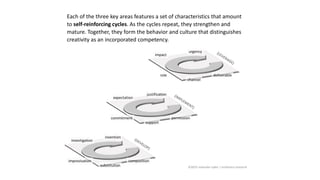
Each of the three key areas features a set of characteristics that amount
to self-reinforcing cycles. As the cycles repeat, they strengthen and
mature. Together, they form the behavior and culture that distinguishes
creativity as an incorporated competency.
©2015 malcolm ryder / archestra research
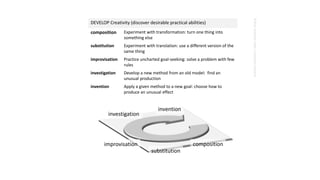
composition
substitution
improvisation
investigation
invention
DEVELOP Creativity (discover desirable practical abilities)
composition Experiment with transformation: turn one thing into
something else
substitution Experiment with translation: use a different version of the
same thing
improvisation Practice uncharted goal-seeking: solve a problem with few
rules
investigation Develop a new method from an old model: find an
unusual production
invention Apply a given method to a new goal: choose how to
produce an unusual effect
©2015malcolmryder/archestraresearch
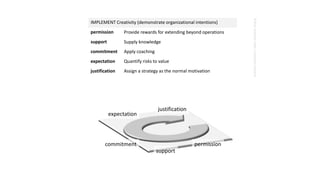
permission
support
commitment
expectation
justification
IMPLEMENT Creativity (demonstrate organizational intentions)
permission Provide rewards for extending beyond operations
support Supply knowledge
commitment Apply coaching
expectation Quantify risks to value
justification Assign a strategy as the normal motivation
©2015malcolmryder/archestraresearch
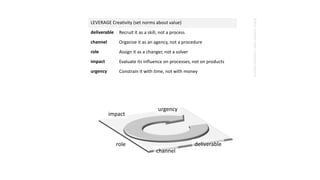
deliverable
channel
role
impact
urgency
LEVERAGE Creativity (set norms about value)
deliverable Recruit it as a skill, not a process
channel Organize it as an agency, not a procedure
role Assign it as a changer, not a solver
impact Evaluate its influence on processes, not on products
urgency Constrain it with time, not with money
©2015malcolmryder/archestraresearch
There are many competencies that can be critical to the business
differentiation that helps create or sustain security and advantage in a
market.
Creativity is one of those competencies, but the organization must learn to
logically recognize competencies as resourceful behavior.
The ultimate importance of understanding creativity is in dispelling the key
inhibitors that the organization brings to it: ambiguity, uncertainty and
frustration.
Cultivating creative behavior means making it systemic and self-
regenerating; cultivating benefit from creativity means understanding when
the behavior is most likely to create a desired opportunity.
Whether defined by a stakeholder or by a provider, an increase in
opportunity is the target principal “product” of creativity.
©2015 Malcolm Ryder / Archestra Research
mryder@malcolmryder.com

The Top Three Things Business Can Learn From Arts and Sports about Creativity

  • 1.
  • 2.
    Creativity is acompetency. And now it is deemed indispensable. It has officially been promoted from “recreation” to “work”. For organizations that assess themselves as not being creative enough, the sense of urgency to “become” creative most often translates into action as “getting” something they don’t “have”. Business is good about committing to plans. Yet reports about satisfaction with this pursuit are highly mixed. Most organizations say that it is more difficult than they expected, and many have stopped what they were doing about it, without a planned successor.
  • 3.
    Of those whocontinued pursuit, only a small percentage say that they are happily successful, while less than half say that they have confidence in continuing despite lack of success to date. So, the overall situation is that even while half or more still have intent, most of them are unsure of what to do and unimpressed with previous results. Most, in other words, still say they do not “have” enough creativity. Reasons for the shortfalls will vary, but in a business perspective it is not hard to see that “getting creativity” has three main efforts. It needs to be developed, implemented, and leveraged for benefit. Because of that shared perspective, there is some opportunity for different business organizations to compare notes, in apples-to-apples fashion.
  • 4.
    But why nottake notes from non-business areas that have already figured it out? The obvious cases are the Arts and Sports – behaviors, and industries, where creativity does not “have” performance but instead “is” performance. Those areas have characteristics in common that amount to the creative state so desired by business. The real question is whether business has the will-power to adopt them. The important observations to make usually look like these Top Lessons from Art and Sport: Development tells individuals that discovering their abilities is desirable and practical. Implementation says that the organization intends for them to improve that way. Leverage decides what expectations are normal to value.
  • 5.
    Each of thethree key areas features a set of characteristics that amount to self-reinforcing cycles. As the cycles repeat, they strengthen and mature. Together, they form the behavior and culture that distinguishes creativity as an incorporated competency. ©2015 malcolm ryder / archestra research
  • 6.
    composition substitution improvisation investigation invention DEVELOP Creativity (discoverdesirable practical abilities) composition Experiment with transformation: turn one thing into something else substitution Experiment with translation: use a different version of the same thing improvisation Practice uncharted goal-seeking: solve a problem with few rules investigation Develop a new method from an old model: find an unusual production invention Apply a given method to a new goal: choose how to produce an unusual effect ©2015malcolmryder/archestraresearch
  • 7.
    permission support commitment expectation justification IMPLEMENT Creativity (demonstrateorganizational intentions) permission Provide rewards for extending beyond operations support Supply knowledge commitment Apply coaching expectation Quantify risks to value justification Assign a strategy as the normal motivation ©2015malcolmryder/archestraresearch
  • 8.
    deliverable channel role impact urgency LEVERAGE Creativity (setnorms about value) deliverable Recruit it as a skill, not a process channel Organize it as an agency, not a procedure role Assign it as a changer, not a solver impact Evaluate its influence on processes, not on products urgency Constrain it with time, not with money ©2015malcolmryder/archestraresearch
  • 9.
    There are manycompetencies that can be critical to the business differentiation that helps create or sustain security and advantage in a market. Creativity is one of those competencies, but the organization must learn to logically recognize competencies as resourceful behavior. The ultimate importance of understanding creativity is in dispelling the key inhibitors that the organization brings to it: ambiguity, uncertainty and frustration. Cultivating creative behavior means making it systemic and self- regenerating; cultivating benefit from creativity means understanding when the behavior is most likely to create a desired opportunity. Whether defined by a stakeholder or by a provider, an increase in opportunity is the target principal “product” of creativity.
  • 10.
    ©2015 Malcolm Ryder/ Archestra Research mryder@malcolmryder.com