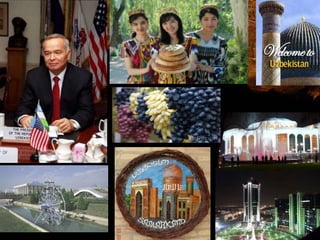
Uzbekistan- The Gem of the East
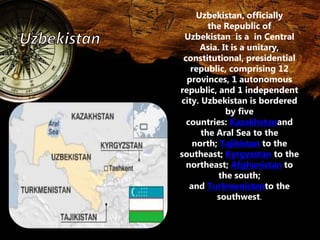
Uzbekistan, officially 
the Republic of 
Uzbekistan is a in Central 
Asia. It is a unitary, 
constitutional, presidential 
republic, comprising 12 
provinces, 1 autonomous 
republic, and 1 independent 
city. Uzbekistan is bordered 
by five 
countries: Kazakhstanand 
the Aral Sea to the 
north; Tajikistan to the 
southeast; Kyrgyzstan to the 
northeast; Afghanistan to 
the south; 
and Turkmenistanto the 
southwest.
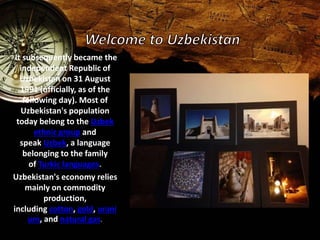
It subsequently became the 
independent Republic of 
Uzbekistan on 31 August 
1991 (officially, as of the 
following day). Most of 
Uzbekistan's population 
today belong to the Uzbek 
ethnic group and 
speak Uzbek, a language 
belonging to the family 
of Turkic languages. 
Uzbekistan's economy relies 
mainly on commodity 
production, 
including cotton, gold, urani 
um, and natural gas.
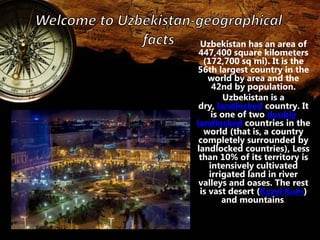
Uzbekistan has an area of 
447,400 square kilometers 
(172,700 sq mi). It is the 
56th largest country in the 
world by area and the 
42nd by population. 
Uzbekistan is a 
dry, landlocked country. It 
is one of two doubly 
landlocked countries in the 
world (that is, a country 
completely surrounded by 
landlocked countries), Less 
than 10% of its territory is 
intensively cultivated 
irrigated land in river 
valleys and oases. The rest 
is vast desert (Kyzyl Kum) 
and mountains.
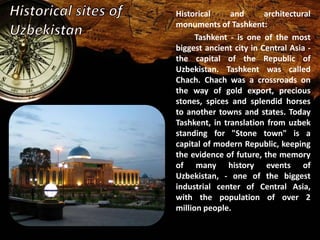
Historical and architectural 
monuments of Tashkent: 
Tashkent - is one of the most 
biggest ancient city in Central Asia - 
the capital of the Republic of 
Uzbekistan. Tashkent was called 
Chach. Chach was a crossroads on 
the way of gold export, precious 
stones, spices and splendid horses 
to another towns and states. Today 
Tashkent, in translation from uzbek 
standing for "Stone town" is a 
capital of modern Republic, keeping 
the evidence of future, the memory 
of many history events of 
Uzbekistan, - one of the biggest 
industrial center of Central Asia, 
with the population of over 2 
million people.
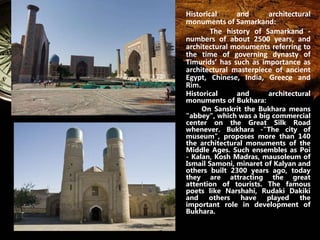
Historical and architectural 
monuments of Samarkand: 
The history of Samarkand - 
numbers of about 2500 years, and 
architectural monuments referring to 
the time of governing dynasty of 
Timurids’ has such as importance as 
architectural masterpiece of ancient 
Egypt, Chinese, India, Greece and 
Rim. 
Historical and architectural 
monuments of Bukhara: 
On Sanskrit the Bukhara means 
"abbey", which was a big commercial 
center on the Great Silk Road 
whenever. Bukhara -"The city of 
museum", proposes more than 140 
the architectural monuments of the 
Middle Ages. Such ensembles as Poi 
- Kalan, Kosh Madras, mausoleum of 
Ismail Samoni, minaret of Kalyan and 
others built 2300 years ago, today 
they are attracting the great 
attention of tourists. The famous 
poets like Narshahi, Rudaki Dakiki 
and others have played the 
important role in development of 
Bukhara.
Historical and architectural 
monuments of Khiva: 
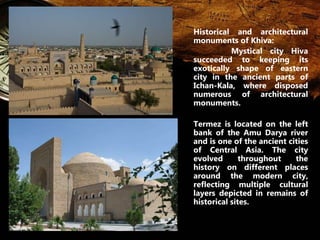
Mystical city Hiva 
succeeded to keeping its 
exotically shape of eastern 
city in the ancient parts of 
Ichan-Kala, where disposed 
numerous of architectural 
monuments. 
Termez is located on the left 
bank of the Amu Darya river 
and is one of the ancient cities 
of Central Asia. The city 
evolved throughout the 
history on different places 
around the modern city, 
reflecting multiple cultural 
layers depicted in remains of 
historical sites.
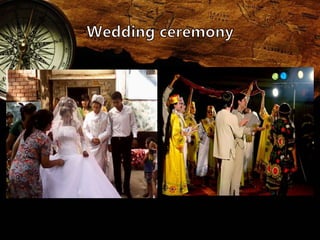
Wedding ceremony traditionally plays essential role Uzbeks life, and 
celebrates as an important event. In the presence of common features 
this ceremony has its own characteristics different areas. The highlight of 
weeding cycle is the transition of the bride from her parents' house to the 
groom’s house. On the day of the wedding in the house of the bride 
arranged wedding pilaf, which is prepared in the house of the groom and 
then sent to the bride. The same palov ceremony serving in the house of 
the groom. On the wedding day the imam of the mosque reads "Hutbai 
Nikoh" (prayer for marriage), after which the young are declared husband 
and wife before God. Imam explains the rights and duties of husband and 
wife. Usually after the nikoh the young go to the registry office for 
registration of their civil marriage. On the day of the wedding at the 
bride's groom wear sarpo (clothes and shoes, a gift for the wedding), after 
which the groom goes to the bride's parents for the welcome. After the 
return of the groom, the bride arrives.
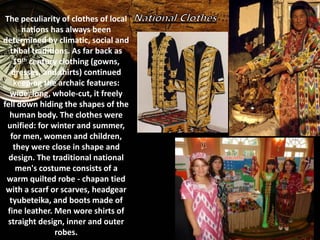
The peculiarity of clothes of local 
nations has always been 
determined by climatic, social and 
tribal traditions. As far back as 
19th century clothing (gowns, 
dresses, and shirts) continued 
keeping the archaic features: 
wide, long, whole-cut, it freely 
fell down hiding the shapes of the 
human body. The clothes were 
unified: for winter and summer, 
for men, women and children, 
they were close in shape and 
design. The traditional national 
men's costume consists of a 
warm quilted robe - chapan tied 
with a scarf or scarves, headgear 
tyubeteika, and boots made of 
fine leather. Men wore shirts of 
straight design, inner and outer 
robes.
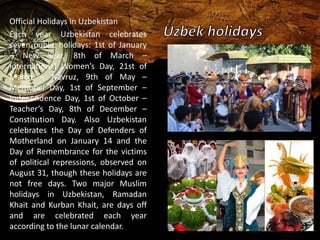
Official Holidays in Uzbekistan 
Each year Uzbekistan celebrates 
seven public holidays: 1st of January 
– New Year, 8th of March – 
International Women’s Day, 21st of 
March – Navruz, 9th of May – 
Memorial Day, 1st of September – 
Independence Day, 1st of October – 
Teacher’s Day, 8th of December – 
Constitution Day. Also Uzbekistan 
celebrates the Day of Defenders of 
Motherland on January 14 and the 
Day of Remembrance for the victims 
of political repressions, observed on 
August 31, though these holidays are 
not free days. Two major Muslim 
holidays in Uzbekistan, Ramadan 
Khait and Kurban Khait, are days off 
and are celebrated each year 
according to the lunar calendar.
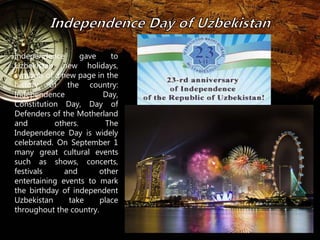
Independence gave to 
Uzbekistan new holidays, 
symbols of a new page in the 
history of the country: 
Independence Day, 
Constitution Day, Day of 
Defenders of the Motherland 
and others. The 
Independence Day is widely 
celebrated. On September 1 
many great cultural events 
such as shows, concerts, 
festivals and other 
entertaining events to mark 
the birthday of independent 
Uzbekistan take place 
throughout the country.
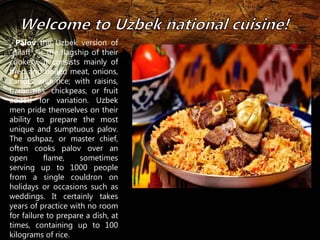
, Palov the Uzbek version of 
"pilaff", is the flagship of their 
cookery. It consists mainly of 
fried and boiled meat, onions, 
carrots and rice; with raisins, 
barberries, chickpeas, or fruit 
added for variation. Uzbek 
men pride themselves on their 
ability to prepare the most 
unique and sumptuous palov. 
The oshpaz, or master chief, 
often cooks palov over an 
open flame, sometimes 
serving up to 1000 people 
from a single couldron on 
holidays or occasions such as 
weddings. It certainly takes 
years of practice with no room 
for failure to prepare a dish, at 
times, containing up to 100 
kilograms of rice.
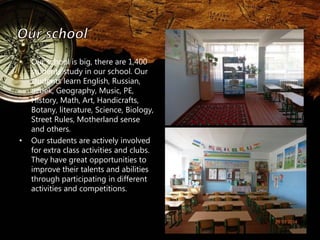
• Our school is big, there are 1,400 
students study in our school. Our 
students learn English, Russian, 
uzbek, Geography, Music, PE, 
History, Math, Art, Handicrafts, 
Botany, literature, Science, Biology, 
Street Rules, Motherland sense 
and others. 
• Our students are actively involved 
for extra class activities and clubs. 
They have great opportunities to 
improve their talents and abilities 
through participating in different 
activities and competitions.
• Ask any Uzbek people, whether old or 
young, about the dearest and most 
favorite holiday. And as often as not 
you will get the answer “Navruz”. What 
kind of holiday is it? And why it is so 
favorite by everyone, either residents or 
guests of the country. 
• First of all, perhaps, for the wisdom that 
came to us from midst of time. Because 
the history of this holiday goes back to 
the Zoroastrianism epoch, to the period 
of good god Zarathustra and the sun 
cult. And this holiday appeared not 
without the reason, but exclusively on 
the call of nature. Exactly on March 21, 
when day and night are equal, a new 
solar cycle, new astronomical year, and 
consequently the law of renewal again 
come into their power. 
• And today, as well as thousand years ago, 
the holiday Navruz is full of original rituals 
and colorful ceremonies. Though, they are 
not devoted to the cult of the Sun-god: 
many things were introduced by Islamic 
religion, but they became not less 
interesting and exciting at that. 
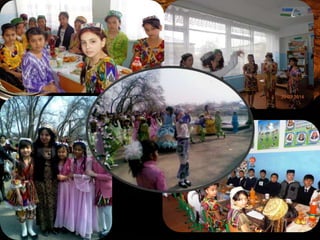
• The main mystery happens on the night 
of March 21. It is time for preparation of 
the main ceremonial meal from 
germinated wheat: sumalak. The whole 
mahalla, mostly women, gather near the 
huge pot: sit in a circle, sing songs, have 
fun, each of them waits for their turn to 
stir the sumalak. In the morning still 
warm sumalak is handed out to 
neighbors, relatives and friends. Tasting 
the sumalak it is necessary to make a 
wish, which, the locals say, will come 
true.
Uzbekistan
Uzbekistan

Uzbekistan

  • 1.
  • 2.
    Uzbekistan, officially theRepublic of Uzbekistan is a in Central Asia. It is a unitary, constitutional, presidential republic, comprising 12 provinces, 1 autonomous republic, and 1 independent city. Uzbekistan is bordered by five countries: Kazakhstanand the Aral Sea to the north; Tajikistan to the southeast; Kyrgyzstan to the northeast; Afghanistan to the south; and Turkmenistanto the southwest.
  • 3.
    It subsequently becamethe independent Republic of Uzbekistan on 31 August 1991 (officially, as of the following day). Most of Uzbekistan's population today belong to the Uzbek ethnic group and speak Uzbek, a language belonging to the family of Turkic languages. Uzbekistan's economy relies mainly on commodity production, including cotton, gold, urani um, and natural gas.
  • 5.
    Uzbekistan has anarea of 447,400 square kilometers (172,700 sq mi). It is the 56th largest country in the world by area and the 42nd by population. Uzbekistan is a dry, landlocked country. It is one of two doubly landlocked countries in the world (that is, a country completely surrounded by landlocked countries), Less than 10% of its territory is intensively cultivated irrigated land in river valleys and oases. The rest is vast desert (Kyzyl Kum) and mountains.
  • 6.
    Historical and architectural monuments of Tashkent: Tashkent - is one of the most biggest ancient city in Central Asia - the capital of the Republic of Uzbekistan. Tashkent was called Chach. Chach was a crossroads on the way of gold export, precious stones, spices and splendid horses to another towns and states. Today Tashkent, in translation from uzbek standing for "Stone town" is a capital of modern Republic, keeping the evidence of future, the memory of many history events of Uzbekistan, - one of the biggest industrial center of Central Asia, with the population of over 2 million people.
  • 7.
    Historical and architectural monuments of Samarkand: The history of Samarkand - numbers of about 2500 years, and architectural monuments referring to the time of governing dynasty of Timurids’ has such as importance as architectural masterpiece of ancient Egypt, Chinese, India, Greece and Rim. Historical and architectural monuments of Bukhara: On Sanskrit the Bukhara means "abbey", which was a big commercial center on the Great Silk Road whenever. Bukhara -"The city of museum", proposes more than 140 the architectural monuments of the Middle Ages. Such ensembles as Poi - Kalan, Kosh Madras, mausoleum of Ismail Samoni, minaret of Kalyan and others built 2300 years ago, today they are attracting the great attention of tourists. The famous poets like Narshahi, Rudaki Dakiki and others have played the important role in development of Bukhara.
  • 8.
    Historical and architectural monuments of Khiva: Mystical city Hiva succeeded to keeping its exotically shape of eastern city in the ancient parts of Ichan-Kala, where disposed numerous of architectural monuments. Termez is located on the left bank of the Amu Darya river and is one of the ancient cities of Central Asia. The city evolved throughout the history on different places around the modern city, reflecting multiple cultural layers depicted in remains of historical sites.
  • 9.
    Wedding ceremony traditionallyplays essential role Uzbeks life, and celebrates as an important event. In the presence of common features this ceremony has its own characteristics different areas. The highlight of weeding cycle is the transition of the bride from her parents' house to the groom’s house. On the day of the wedding in the house of the bride arranged wedding pilaf, which is prepared in the house of the groom and then sent to the bride. The same palov ceremony serving in the house of the groom. On the wedding day the imam of the mosque reads "Hutbai Nikoh" (prayer for marriage), after which the young are declared husband and wife before God. Imam explains the rights and duties of husband and wife. Usually after the nikoh the young go to the registry office for registration of their civil marriage. On the day of the wedding at the bride's groom wear sarpo (clothes and shoes, a gift for the wedding), after which the groom goes to the bride's parents for the welcome. After the return of the groom, the bride arrives.
  • 11.
    The peculiarity ofclothes of local nations has always been determined by climatic, social and tribal traditions. As far back as 19th century clothing (gowns, dresses, and shirts) continued keeping the archaic features: wide, long, whole-cut, it freely fell down hiding the shapes of the human body. The clothes were unified: for winter and summer, for men, women and children, they were close in shape and design. The traditional national men's costume consists of a warm quilted robe - chapan tied with a scarf or scarves, headgear tyubeteika, and boots made of fine leather. Men wore shirts of straight design, inner and outer robes.
  • 12.
    Official Holidays inUzbekistan Each year Uzbekistan celebrates seven public holidays: 1st of January – New Year, 8th of March – International Women’s Day, 21st of March – Navruz, 9th of May – Memorial Day, 1st of September – Independence Day, 1st of October – Teacher’s Day, 8th of December – Constitution Day. Also Uzbekistan celebrates the Day of Defenders of Motherland on January 14 and the Day of Remembrance for the victims of political repressions, observed on August 31, though these holidays are not free days. Two major Muslim holidays in Uzbekistan, Ramadan Khait and Kurban Khait, are days off and are celebrated each year according to the lunar calendar.
  • 13.
    Independence gave to Uzbekistan new holidays, symbols of a new page in the history of the country: Independence Day, Constitution Day, Day of Defenders of the Motherland and others. The Independence Day is widely celebrated. On September 1 many great cultural events such as shows, concerts, festivals and other entertaining events to mark the birthday of independent Uzbekistan take place throughout the country.
  • 14.
    , Palov theUzbek version of "pilaff", is the flagship of their cookery. It consists mainly of fried and boiled meat, onions, carrots and rice; with raisins, barberries, chickpeas, or fruit added for variation. Uzbek men pride themselves on their ability to prepare the most unique and sumptuous palov. The oshpaz, or master chief, often cooks palov over an open flame, sometimes serving up to 1000 people from a single couldron on holidays or occasions such as weddings. It certainly takes years of practice with no room for failure to prepare a dish, at times, containing up to 100 kilograms of rice.
  • 17.
    • Our schoolis big, there are 1,400 students study in our school. Our students learn English, Russian, uzbek, Geography, Music, PE, History, Math, Art, Handicrafts, Botany, literature, Science, Biology, Street Rules, Motherland sense and others. • Our students are actively involved for extra class activities and clubs. They have great opportunities to improve their talents and abilities through participating in different activities and competitions.
  • 18.
    • Ask anyUzbek people, whether old or young, about the dearest and most favorite holiday. And as often as not you will get the answer “Navruz”. What kind of holiday is it? And why it is so favorite by everyone, either residents or guests of the country. • First of all, perhaps, for the wisdom that came to us from midst of time. Because the history of this holiday goes back to the Zoroastrianism epoch, to the period of good god Zarathustra and the sun cult. And this holiday appeared not without the reason, but exclusively on the call of nature. Exactly on March 21, when day and night are equal, a new solar cycle, new astronomical year, and consequently the law of renewal again come into their power. • And today, as well as thousand years ago, the holiday Navruz is full of original rituals and colorful ceremonies. Though, they are not devoted to the cult of the Sun-god: many things were introduced by Islamic religion, but they became not less interesting and exciting at that. • The main mystery happens on the night of March 21. It is time for preparation of the main ceremonial meal from germinated wheat: sumalak. The whole mahalla, mostly women, gather near the huge pot: sit in a circle, sing songs, have fun, each of them waits for their turn to stir the sumalak. In the morning still warm sumalak is handed out to neighbors, relatives and friends. Tasting the sumalak it is necessary to make a wish, which, the locals say, will come true.