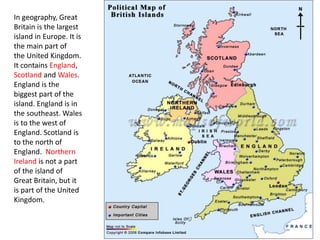
In geography, Great 
Britain is the largest 
island in Europe. It is 
the main part of 
the United Kingdom. 
It contains England, 
Scotland and Wales. 
England is the 
biggest part of the 
island. England is in 
the southeast. Wales 
is to the west of 
England. Scotland is 
to the north of 
England. Northern 
Ireland is not a part 
of the island of 
Great Britain, but it 
is part of the United 
Kingdom.
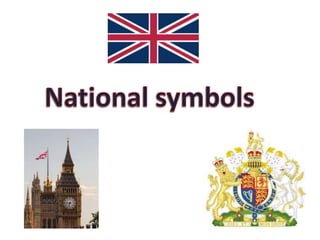
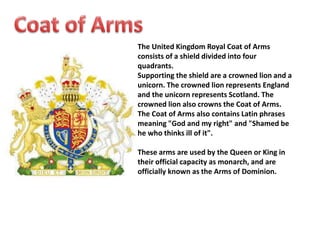
The United Kingdom Royal Coat of Arms 
consists of a shield divided into four 
quadrants. 
Supporting the shield are a crowned lion and a 
unicorn. The crowned lion represents England 
and the unicorn represents Scotland. The 
crowned lion also crowns the Coat of Arms. 
The Coat of Arms also contains Latin phrases 
meaning "God and my right" and "Shamed be 
he who thinks ill of it". 
These arms are used by the Queen or King in 
their official capacity as monarch, and are 
officially known as the Arms of Dominion.
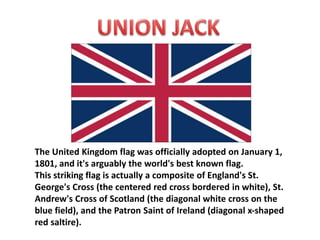
The United Kingdom flag was officially adopted on January 1, 
1801, and it's arguably the world's best known flag. 
This striking flag is actually a composite of England's St. 
George's Cross (the centered red cross bordered in white), St. 
Andrew's Cross of Scotland (the diagonal white cross on the 
blue field), and the Patron Saint of Ireland (diagonal x-shaped 
red saltire).
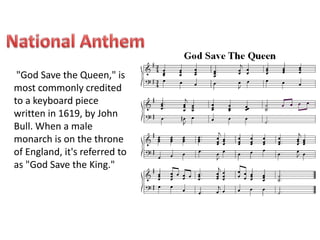
"God Save the Queen," is 
most commonly credited 
to a keyboard piece 
written in 1619, by John 
Bull. When a male 
monarch is on the throne 
of England, it's referred to 
as "God Save the King."
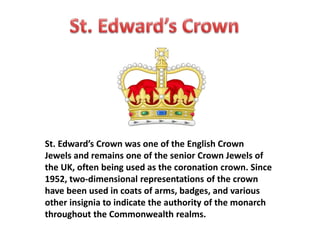
St. Edward’s Crown was one of the English Crown 
Jewels and remains one of the senior Crown Jewels of 
the UK, often being used as the coronation crown. Since 
1952, two-dimensional representations of the crown 
have been used in coats of arms, badges, and various 
other insignia to indicate the authority of the monarch 
throughout the Commonwealth realms.
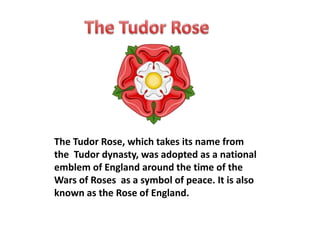
The Tudor Rose, which takes its name from 
the Tudor dynasty, was adopted as a national 
emblem of England around the time of the 
Wars of Roses as a symbol of peace. It is also 
known as the Rose of England.
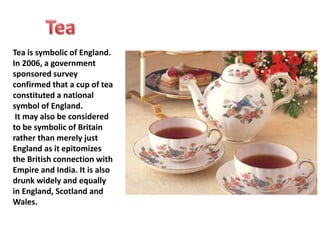
Tea is symbolic of England. 
In 2006, a government 
sponsored survey 
confirmed that a cup of tea 
constituted a national 
symbol of England. 
It may also be considered 
to be symbolic of Britain 
rather than merely just 
England as it epitomizes 
the British connection with 
Empire and India. It is also 
drunk widely and equally 
in England, Scotland and 
Wales.
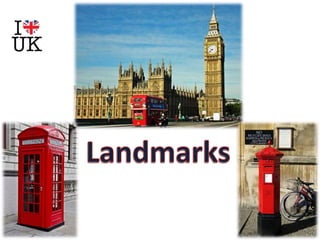
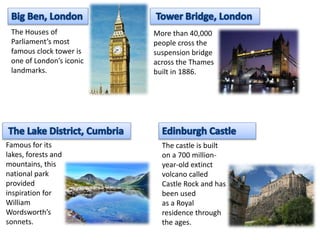
The Houses of 
Parliament’s most 
famous clock tower is 
one of London’s iconic 
landmarks. 
More than 40,000 
people cross the 
suspension bridge 
across the Thames 
built in 1886. 
Famous for its 
lakes, forests and 
mountains, this 
national park 
provided 
inspiration for 
William 
Wordsworth’s 
sonnets. 
The castle is built 
on a 700 million-year- 
old extinct 
volcano called 
Castle Rock and has 
been used 
as a Royal 
residence through 
the ages.
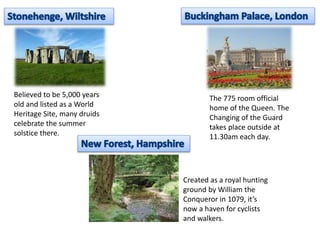
Believed to be 5,000 years 
old and listed as a World 
Heritage Site, many druids 
celebrate the summer 
solstice there. 
The 775 room official 
home of the Queen. The 
Changing of the Guard 
takes place outside at 
11.30am each day. 
Created as a royal hunting 
ground by William the 
Conqueror in 1079, it’s 
now a haven for cyclists 
and walkers.
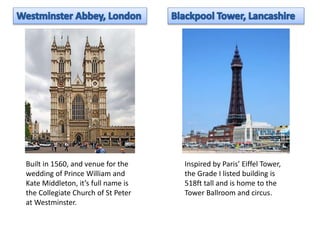
Built in 1560, and venue for the 
wedding of Prince William and 
Kate Middleton, it’s full name is 
the Collegiate Church of St Peter 
at Westminster. 
Inspired by Paris’ Eiffel Tower, 
the Grade I listed building is 
518ft tall and is home to the 
Tower Ballroom and circus.
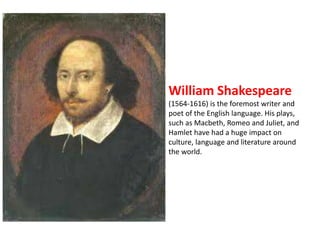
William Shakespeare 
(1564-1616) is the foremost writer and 
poet of the English language. His plays, 
such as Macbeth, Romeo and Juliet, and 
Hamlet have had a huge impact on 
culture, language and literature around 
the world.
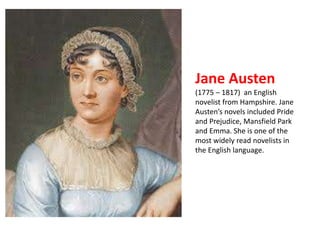
Jane Austen 
(1775 – 1817) an English 
novelist from Hampshire. Jane 
Austen’s novels included Pride 
and Prejudice, Mansfield Park 
and Emma. She is one of the 
most widely read novelists in 
the English language.
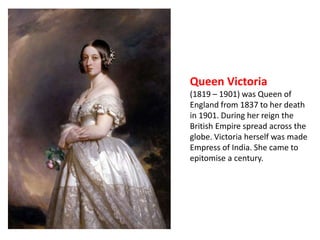
Queen Victoria 
(1819 – 1901) was Queen of 
England from 1837 to her death 
in 1901. During her reign the 
British Empire spread across the 
globe. Victoria herself was made 
Empress of India. She came to 
epitomise a century.
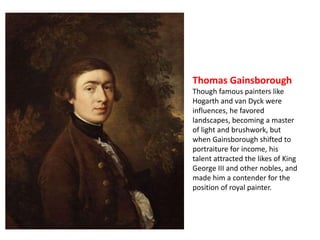
Thomas Gainsborough 
Though famous painters like 
Hogarth and van Dyck were 
influences, he favored 
landscapes, becoming a master 
of light and brushwork, but 
when Gainsborough shifted to 
portraiture for income, his 
talent attracted the likes of King 
George III and other nobles, and 
made him a contender for the 
position of royal painter.
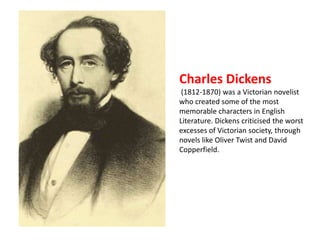
Charles Dickens 
(1812-1870) was a Victorian novelist 
who created some of the most 
memorable characters in English 
Literature. Dickens criticised the worst 
excesses of Victorian society, through 
novels like Oliver Twist and David 
Copperfield.
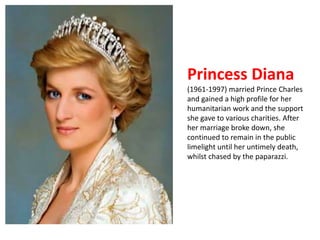
Princess Diana 
(1961-1997) married Prince Charles 
and gained a high profile for her 
humanitarian work and the support 
she gave to various charities. After 
her marriage broke down, she 
continued to remain in the public 
limelight until her untimely death, 
whilst chased by the paparazzi.
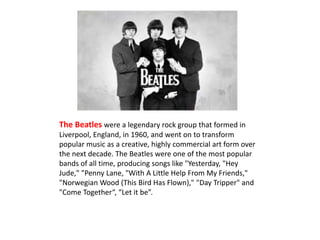
The Beatles were a legendary rock group that formed in 
Liverpool, England, in 1960, and went on to transform 
popular music as a creative, highly commercial art form over 
the next decade. The Beatles were one of the most popular 
bands of all time, producing songs like "Yesterday, "Hey 
Jude," "Penny Lane, "With A Little Help From My Friends," 
"Norwegian Wood (This Bird Has Flown)," "Day Tripper" and 
"Come Together“, “Let it be”.
Presentation  Great Britain

Presentation Great Britain

  • 3.
    In geography, Great Britain is the largest island in Europe. It is the main part of the United Kingdom. It contains England, Scotland and Wales. England is the biggest part of the island. England is in the southeast. Wales is to the west of England. Scotland is to the north of England. Northern Ireland is not a part of the island of Great Britain, but it is part of the United Kingdom.
  • 5.
    The United KingdomRoyal Coat of Arms consists of a shield divided into four quadrants. Supporting the shield are a crowned lion and a unicorn. The crowned lion represents England and the unicorn represents Scotland. The crowned lion also crowns the Coat of Arms. The Coat of Arms also contains Latin phrases meaning "God and my right" and "Shamed be he who thinks ill of it". These arms are used by the Queen or King in their official capacity as monarch, and are officially known as the Arms of Dominion.
  • 6.
    The United Kingdomflag was officially adopted on January 1, 1801, and it's arguably the world's best known flag. This striking flag is actually a composite of England's St. George's Cross (the centered red cross bordered in white), St. Andrew's Cross of Scotland (the diagonal white cross on the blue field), and the Patron Saint of Ireland (diagonal x-shaped red saltire).
  • 7.
    "God Save theQueen," is most commonly credited to a keyboard piece written in 1619, by John Bull. When a male monarch is on the throne of England, it's referred to as "God Save the King."
  • 8.
    St. Edward’s Crownwas one of the English Crown Jewels and remains one of the senior Crown Jewels of the UK, often being used as the coronation crown. Since 1952, two-dimensional representations of the crown have been used in coats of arms, badges, and various other insignia to indicate the authority of the monarch throughout the Commonwealth realms.
  • 9.
    The Tudor Rose,which takes its name from the Tudor dynasty, was adopted as a national emblem of England around the time of the Wars of Roses as a symbol of peace. It is also known as the Rose of England.
  • 10.
    Tea is symbolicof England. In 2006, a government sponsored survey confirmed that a cup of tea constituted a national symbol of England. It may also be considered to be symbolic of Britain rather than merely just England as it epitomizes the British connection with Empire and India. It is also drunk widely and equally in England, Scotland and Wales.
  • 12.
    The Houses of Parliament’s most famous clock tower is one of London’s iconic landmarks. More than 40,000 people cross the suspension bridge across the Thames built in 1886. Famous for its lakes, forests and mountains, this national park provided inspiration for William Wordsworth’s sonnets. The castle is built on a 700 million-year- old extinct volcano called Castle Rock and has been used as a Royal residence through the ages.
  • 13.
    Believed to be5,000 years old and listed as a World Heritage Site, many druids celebrate the summer solstice there. The 775 room official home of the Queen. The Changing of the Guard takes place outside at 11.30am each day. Created as a royal hunting ground by William the Conqueror in 1079, it’s now a haven for cyclists and walkers.
  • 14.
    Built in 1560,and venue for the wedding of Prince William and Kate Middleton, it’s full name is the Collegiate Church of St Peter at Westminster. Inspired by Paris’ Eiffel Tower, the Grade I listed building is 518ft tall and is home to the Tower Ballroom and circus.
  • 16.
    William Shakespeare (1564-1616)is the foremost writer and poet of the English language. His plays, such as Macbeth, Romeo and Juliet, and Hamlet have had a huge impact on culture, language and literature around the world.
  • 17.
    Jane Austen (1775– 1817) an English novelist from Hampshire. Jane Austen’s novels included Pride and Prejudice, Mansfield Park and Emma. She is one of the most widely read novelists in the English language.
  • 18.
    Queen Victoria (1819– 1901) was Queen of England from 1837 to her death in 1901. During her reign the British Empire spread across the globe. Victoria herself was made Empress of India. She came to epitomise a century.
  • 19.
    Thomas Gainsborough Thoughfamous painters like Hogarth and van Dyck were influences, he favored landscapes, becoming a master of light and brushwork, but when Gainsborough shifted to portraiture for income, his talent attracted the likes of King George III and other nobles, and made him a contender for the position of royal painter.
  • 20.
    Charles Dickens (1812-1870)was a Victorian novelist who created some of the most memorable characters in English Literature. Dickens criticised the worst excesses of Victorian society, through novels like Oliver Twist and David Copperfield.
  • 21.
    Princess Diana (1961-1997)married Prince Charles and gained a high profile for her humanitarian work and the support she gave to various charities. After her marriage broke down, she continued to remain in the public limelight until her untimely death, whilst chased by the paparazzi.
  • 22.
    The Beatles werea legendary rock group that formed in Liverpool, England, in 1960, and went on to transform popular music as a creative, highly commercial art form over the next decade. The Beatles were one of the most popular bands of all time, producing songs like "Yesterday, "Hey Jude," "Penny Lane, "With A Little Help From My Friends," "Norwegian Wood (This Bird Has Flown)," "Day Tripper" and "Come Together“, “Let it be”.